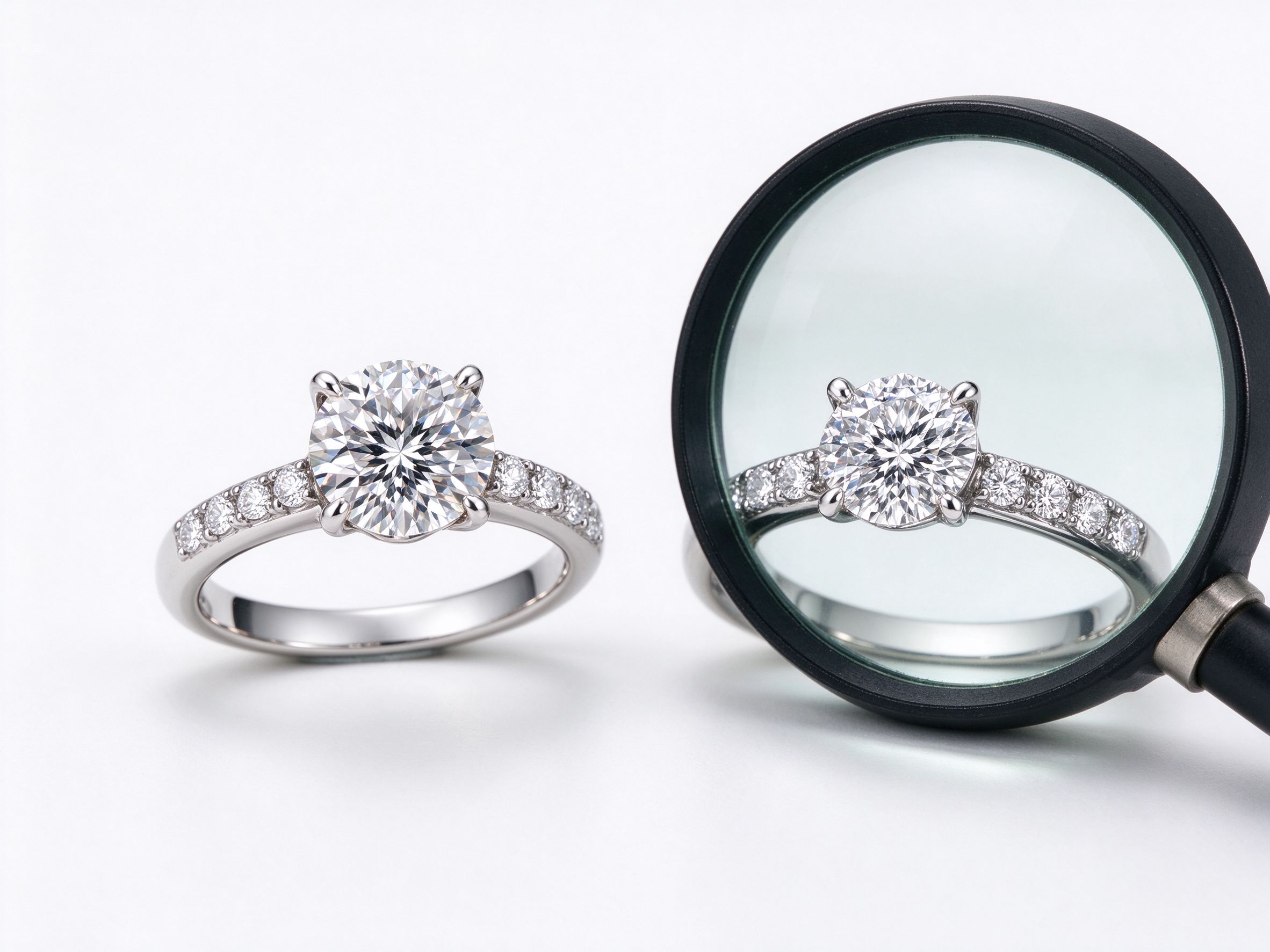
Moissanite Grading: How Color, Clarity and Cut Set Wholesale Prices
Grading determines what a moissanite is worth. But moissanite grading is not diamond grading, and the price premiums attach to different qualities. This guide explains how our factory grades colour, clarity and cut, which grades carry real premiums, and how wholesale buyers should choose grades for their market.
Color Grading: The Near-Colourless Premium
Moissanite can show subtle grey or green undertones depending on growth conditions. Near-colourless stones with no visible tint command a premium because achieving that whiteness requires tighter control of the growth process. Stones with a faint tint are perfectly bright in jewellery lighting but cost less. Our colour grades are read under controlled daylight-balanced light, not under warm shop bulbs that flatter everything. For engagement lines where customers compare the stone next to a diamond, the whiter grade earns its price; for fashion pieces, a slightly warmer grade saves cost without a visible compromise.
Fire and brilliance are measurable. Our cutting bench tests each stone for light return and dispersion, and the grades we quote correspond to how the stone actually performs under spotlights, not just how it looks under a desk lamp. This matters because moissanite signature rainbow fire is exactly what differentiates it at the counter, and a poorly cut stone cannot show it.
Substitution risk is real. The market contains heavily treated and imported stones sold as premium moissanite at premium prices. Working with a factory that shows its cutting floor, its grading logs and its plating records protects you from that gap between what you paid for and what arrives on your shelf.
We encourage buyers to request sample stones before committing to volume, because a sample under spotlight is worth more than a grade sheet. When a buyer sees the fire and compares it directly, the value of the right cut grade becomes obvious. Sampling de-risks the wholesale decision and builds confidence in the grade you are buying.
The moissanite market rewards buyers who understand the stone, not those who treat it as a generic cheap diamond. A retailer who can explain fire, dispersion and cut grade positions the product as a considered choice rather than a bargain. That knowledge commands better prices and attracts customers who value the explanation, not just the discount.
Long-term buyers benefit from price stability on stone grades. Once we establish a buyer's preferred grade and volume, we can lock preferential pricing and reserve stones, insulating them from spot fluctuations. This predictability lets retailers plan margins and promotions without worrying about sudden stone cost changes.
Every stone we ship is traceable to a cutting lot, so if a buyer ever questions a grade, we can show the measurements behind it. That traceability is a safeguard against the inflated labels common in the market. Buyers who source from a transparent factory do not have to take quality on faith; it is documented.
Clarity: Why It Matters Less in Moissanite
Natural diamond clarity varies wildly because of the way it forms in the earth. Lab-grown moissanite is remarkably clean by comparison, with very few inclusions in most commercial grades. This means clarity is rarely the price driver in moissanite, and buyers should not overpay for a top clarity grade that looks no different from the next one down. The real value levers are colour and cut. We are transparent about this: on our grade sheets, clarity is usually a non-issue, and the meaningful differences are where the stone sits on the colour and cut scales. Buyers new to moissanite often overpay for clarity out of diamond habit; we steer them toward colour and cut instead.
The value case for moissanite is strongest when the product is positioned honestly: a brilliant, durable, ethically produced stone at a fraction of diamond's cost. Retailers who overclaim or underprice sell themselves short. The middle path - honest comparison, fair margin, good display - is where moissanite brands build lasting customer trust.
The price of a moissanite is set mostly by the cut, not the rough. Laboratory-grown rough is comparatively affordable, but turning it into a round brilliant that returns light as fire requires experienced cutters, precision faceting and repeated measuring. Two stones of the same carat can differ in price by several multiples purely because of how precisely the facets align.
Colour grade is the next lever. Near-colourless stones command a premium because the chemical growth process must be carefully controlled to suppress the grey or green undertone moissanite can show. Buyers choosing for high-end engagement lines pay for the whiter grade; buyers for fashion lines can save substantially on a grade that still looks white in jewellery lighting.
Clarity in moissanite is rarely a sales issue. Lab-grown stones are remarkably clean compared with mined diamond, so most price movement comes from cut and colour rather than internal inclusions. This is a structural advantage for wholesale buyers: the premium you pay buys visible light performance, not invisible clarity paperwork.
Cutting cost scales with carat. A one-carat stone is faceted in minutes on modern equipment, but larger stones demand more orientation decisions, more wasted rough, and closer supervision. That is why per-carat price does not fall linearly as size rises; big, well-cut stones carry a disproportionate craftsmanship premium that factories document in their quotes.
Factory-direct pricing removes the layered middle. A mined diamond travels through miner, cutter, broker, wholesaler and retailer before it reaches a shop; moissanite from a manufacturer moves from growth, through our cutting and setting bench, straight to your storefront. That shorter chain is the structural reason the same visual size sells for a fraction of a diamond price.
Cut: The Grade Customers Actually See
Of the three, cut is the grade customers see immediately. A well-cut moissanite flashes with rainbow fire; a poorly cut one looks dull even if it is colourless and flawless. Our cut grading measures proportions, angles and light return, and it is the grade we most emphasise to bridal buyers. When a customer compares two moissanite rings side by side, the cut difference is obvious within seconds, while the colour difference is subtle. We recommend buyers invest in cut first, then colour, and treat clarity as a given. This priority ordering is the opposite of the diamond habit, but it is correct for moissanite.
Grading reports add cost and trust. We can include an internal grading card or a trusted third-party report with selected grades, and the choice changes the landed price. For a retailer building trust at the counter, a certified stone justifies a higher ticket; for a high-volume fashion line, the internal grade sheet is enough margin.
Landed cost includes more than the stone. Buyers should compare duty, freight, plating and setting when weighing quotes, not just the per-carat figure. Two factories with identical stone prices can deliver very different total cost once silver, finish and shipping are included, which is why we quote a fully built piece rather than a loose-stone placeholder.
Bulk pricing tiers reward planning. The more units committed in a single production run, the more the fixed costs of setup, tooling and plating baths are spread across each piece. Buyers who consolidate orders into fewer, larger runs consistently land a lower per-unit cost than buyers who place many small urgent orders.
Fire and brilliance are measurable. Our cutting bench tests each stone for light return and dispersion, and the grades we quote correspond to how the stone actually performs under spotlights, not just how it looks under a desk lamp. This matters because moissanite signature rainbow fire is exactly what differentiates it at the counter, and a poorly cut stone cannot show it.
Substitution risk is real. The market contains heavily treated and imported stones sold as premium moissanite at premium prices. Working with a factory that shows its cutting floor, its grading logs and its plating records protects you from that gap between what you paid for and what arrives on your shelf.
We encourage buyers to request sample stones before committing to volume, because a sample under spotlight is worth more than a grade sheet. When a buyer sees the fire and compares it directly, the value of the right cut grade becomes obvious. Sampling de-risks the wholesale decision and builds confidence in the grade you are buying.
How Grading Translates to Price Tiers
Our price tiers combine these grades deliberately. Entry-tier stones are good cut, near-colourless enough, and priced for volume fashion lines. Mid-tier stones add tighter colour and better cut for everyday bridal. Premium-tier stones are top cut, the whitest grade, and individually tested for light return. Each tier is a bundle, not a single attribute, so a buyer chooses a position rather than negotiating each grade. The tier structure makes ordering simple: tell us the price point, and we supply the matching grade bundle. Wholesale margins are built on buying the right tier for the market rather than the top grade everywhere.
The moissanite market rewards buyers who understand the stone, not those who treat it as a generic cheap diamond. A retailer who can explain fire, dispersion and cut grade positions the product as a considered choice rather than a bargain. That knowledge commands better prices and attracts customers who value the explanation, not just the discount.
Long-term buyers benefit from price stability on stone grades. Once we establish a buyer's preferred grade and volume, we can lock preferential pricing and reserve stones, insulating them from spot fluctuations. This predictability lets retailers plan margins and promotions without worrying about sudden stone cost changes.
Every stone we ship is traceable to a cutting lot, so if a buyer ever questions a grade, we can show the measurements behind it. That traceability is a safeguard against the inflated labels common in the market. Buyers who source from a transparent factory do not have to take quality on faith; it is documented.
The value case for moissanite is strongest when the product is positioned honestly: a brilliant, durable, ethically produced stone at a fraction of diamond's cost. Retailers who overclaim or underprice sell themselves short. The middle path - honest comparison, fair margin, good display - is where moissanite brands build lasting customer trust.
The price of a moissanite is set mostly by the cut, not the rough. Laboratory-grown rough is comparatively affordable, but turning it into a round brilliant that returns light as fire requires experienced cutters, precision faceting and repeated measuring. Two stones of the same carat can differ in price by several multiples purely because of how precisely the facets align.
Colour grade is the next lever. Near-colourless stones command a premium because the chemical growth process must be carefully controlled to suppress the grey or green undertone moissanite can show. Buyers choosing for high-end engagement lines pay for the whiter grade; buyers for fashion lines can save substantially on a grade that still looks white in jewellery lighting.
Grading Reports: Internal vs Third-Party
We supply internal grading cards as standard, and third-party certified grading on selected premium stones. The internal card states colour, cut and carat with a light-return note. Third-party certification adds trust at a higher price and is worth it for high-ticket bridal sales where the customer expects documentation. For fashion volume, internal grading is sufficient and keeps cost down. We help buyers decide which SKUs need certification and which do not, based on price point. Not every stone needs a paper trail; the ones that anchor trust at the counter do.
Clarity in moissanite is rarely a sales issue. Lab-grown stones are remarkably clean compared with mined diamond, so most price movement comes from cut and colour rather than internal inclusions. This is a structural advantage for wholesale buyers: the premium you pay buys visible light performance, not invisible clarity paperwork.
Cutting cost scales with carat. A one-carat stone is faceted in minutes on modern equipment, but larger stones demand more orientation decisions, more wasted rough, and closer supervision. That is why per-carat price does not fall linearly as size rises; big, well-cut stones carry a disproportionate craftsmanship premium that factories document in their quotes.
Factory-direct pricing removes the layered middle. A mined diamond travels through miner, cutter, broker, wholesaler and retailer before it reaches a shop; moissanite from a manufacturer moves from growth, through our cutting and setting bench, straight to your storefront. That shorter chain is the structural reason the same visual size sells for a fraction of a diamond price.
Grading reports add cost and trust. We can include an internal grading card or a trusted third-party report with selected grades, and the choice changes the landed price. For a retailer building trust at the counter, a certified stone justifies a higher ticket; for a high-volume fashion line, the internal grade sheet is enough margin.
Landed cost includes more than the stone. Buyers should compare duty, freight, plating and setting when weighing quotes, not just the per-carat figure. Two factories with identical stone prices can deliver very different total cost once silver, finish and shipping are included, which is why we quote a fully built piece rather than a loose-stone placeholder.
Bulk pricing tiers reward planning. The more units committed in a single production run, the more the fixed costs of setup, tooling and plating baths are spread across each piece. Buyers who consolidate orders into fewer, larger runs consistently land a lower per-unit cost than buyers who place many small urgent orders.
Avoiding Grade Inflation When Comparing Suppliers
The market has a problem with grade inflation: a supplier may label a stone premium when it is merely average, because moissanite grading is less standardised than diamond. The protection is a factory that shows its testing, its light-return data and its cut proportions, not just a label. We encourage buyers to compare actual stones under the same light rather than comparing grade names on paper. A grade is only as honest as the labelling behind it, and working with a transparent factory removes the guesswork. Buyers who source from us can see the bench, which is the surest grade guarantee.
Fire and brilliance are measurable. Our cutting bench tests each stone for light return and dispersion, and the grades we quote correspond to how the stone actually performs under spotlights, not just how it looks under a desk lamp. This matters because moissanite signature rainbow fire is exactly what differentiates it at the counter, and a poorly cut stone cannot show it.
Substitution risk is real. The market contains heavily treated and imported stones sold as premium moissanite at premium prices. Working with a factory that shows its cutting floor, its grading logs and its plating records protects you from that gap between what you paid for and what arrives on your shelf.
We encourage buyers to request sample stones before committing to volume, because a sample under spotlight is worth more than a grade sheet. When a buyer sees the fire and compares it directly, the value of the right cut grade becomes obvious. Sampling de-risks the wholesale decision and builds confidence in the grade you are buying.
The moissanite market rewards buyers who understand the stone, not those who treat it as a generic cheap diamond. A retailer who can explain fire, dispersion and cut grade positions the product as a considered choice rather than a bargain. That knowledge commands better prices and attracts customers who value the explanation, not just the discount.
Long-term buyers benefit from price stability on stone grades. Once we establish a buyer's preferred grade and volume, we can lock preferential pricing and reserve stones, insulating them from spot fluctuations. This predictability lets retailers plan margins and promotions without worrying about sudden stone cost changes.
Every stone we ship is traceable to a cutting lot, so if a buyer ever questions a grade, we can show the measurements behind it. That traceability is a safeguard against the inflated labels common in the market. Buyers who source from a transparent factory do not have to take quality on faith; it is documented.
Frequently Asked Questions
Which moissanite grade costs the most?
The premium comes from near-colourless white and excellent cut. Clarity is rarely a price driver in lab-grown moissanite because the stones are naturally clean.
Should I pay for top clarity moissanite?
Usually no. Moissanite is naturally clean, so top clarity looks the same as the next grade. Spend the premium on cut and colour instead.
What grade should bridal lines stock?
Premium cut grade with near-colourless white, ideally with a grading card or certification. Cut is the grade customers see and compare directly.
Do you include grading reports?
Internal grading cards are standard; third-party certification is available for premium stones. We advise which SKUs justify certification based on price point.
How do I avoid inflated grade labels?
Compare actual stones under the same light, and work with a factory that shows cut proportions and light-return data rather than just a label.
Conclusion
Moissanite grading rewards cut and colour, not the clarity overspend buyers bring from diamond habits. Choose the tier that matches your price point, invest in cut where it shows, and demand transparent data rather than a label. The right grade mix keeps margins healthy and the counter competitive.