Why Is Moissanite Cheaper Than Diamond - HOLYCOME
A moissanite engagement ring that looks identical to a diamond one costs a tenth as much, and people want to know why. Is the diamond trade lying? Is moissanite fake? Is there a catch? As a factory that grows, cuts, and sets moissanite at scale, we can give you the real answer, and it has nothing to do with quality and everything to do with supply and manufacturing. Diamonds are expensive because they are rare, because a mined supply chain is long and expensive, and because a century of marketing has built a price. Moissanite is cheap because it is grown in a factory, in days, at scale, with no mining, no sorting pipeline, and no marketing premium. This guide walks through the actual economics, from the crystal growth to the retail shelf, so you can see exactly where the price difference comes from. There is no trick. The price gap is honest, and it is why moissanite is such a smart buy.
The short answer is this: a diamond's price is set by scarcity and a controlled supply chain, while a moissanite's price is set by the cost of growing a crystal and cutting it. We can make as many moissanite stones as the market demands, at a known and falling cost, so the price stays low. We cannot make diamonds, because they come from mines, and the supply is limited. That single difference—factory-made versus mined—explains the entire price gap. The stone in your ring is beautiful either way, but one is a manufactured commodity and the other is a scarce natural resource. This guide explains how that plays out, step by step, on the factory floor and beyond.
We cover the related question of what moissanite resells for, which is the flip side of this story. We also cover lab-grown diamond versus moissanite, which is a different comparison between two manufactured stones. This article is specifically about moissanite versus natural diamond, and why the price gap is so large. Read on, and the economics will stop being mysterious.
Scarcity: Why Diamonds Cost What They Cost
A natural diamond is formed deep in the earth over billions of years, and only a tiny fraction of mined diamonds are gem quality. The supply is finite, and bringing one to the surface requires mining operations that move tons of earth for a single carat. The cost of mining, sorting, and grading that diamond is enormous, and the scarcity on top of that sets the price. De Beers and other producers have, for decades, controlled the supply to keep prices stable and high, which is part of why a one-carat diamond costs thousands. The stone is rare, the supply chain is long, and the marketing tells you it is a forever symbol. All three add up to the price you pay.
Moissanite has none of this. It is not rare, because we grow it. It does not require mining, because it is synthesized in a furnace. It does not have a marketing campaign telling you it is a once-in-a-lifetime symbol, because it is a manufactured product. So there is no scarcity premium, no mining cost, and no marketing markup. The price is just the cost of making it. This is the first and biggest reason moissanite is cheaper: the supply is not constrained by geology, it is constrained only by how many crystals we choose to grow. That is a completely different economic model, and it shows up directly in the price.
This is not to say diamonds are a scam. A natural diamond is a real, rare, beautiful stone, and for people who want a natural gem, the price reflects that rarity. But the price is not set by the cost of cutting and polishing; it is set by the scarcity and the brand. Moissanite, by contrast, is priced almost entirely on the cost of cutting and polishing, because there is no scarcity to add a premium. When you compare the two, you are comparing a scarce natural resource with a manufactured commodity, and the price difference is the price of scarcity. That is the honest explanation, and it is the one we give every customer who asks.
The Crystal: Factory Growth Versus Mine Extraction
On our side, moissanite starts as a pile of silicon and carbon, which we feed into a high-temperature furnace. Over a few days, the materials crystallize into a boule of silicon carbide, which is the raw moissanite crystal. The furnace runs at about 2,500 degrees Celsius, and the process is energy-intensive, but it is controlled, repeatable, and scalable. We can run ten furnaces or a hundred, and each produces a known amount of crystal. There is no exploration, no mining crew, no geological luck. The input is raw material and electricity, and the output is crystal, every time.
A diamond mine, by contrast, is a massive earth-moving operation. Companies dig open pits, move tons of ore, process it, and recover a fraction of a carat per ton. The capital cost is billions, the environmental cost is large, and the recovery is uncertain. Some mines are rich, some are thin, and the price of a diamond has to cover all of that risk across the whole operation. When you buy a diamond, you are paying for the tons of earth that were moved for your stone, plus the profit margin across a long chain of miners, sorters, cutters, and dealers. When you buy moissanite, you are paying for a few days of furnace time and the labor of cutting the crystal. The supply chain is twenty steps shorter, and that cost difference is enormous.
We cover the regional angle in our guide on why the Wuzhou manufacturing cluster has a price advantage, which is about the cutting side. The crystal growth side is separate, but the principle is the same: a centralized, factory-based supply chain is cheaper than a dispersed, mining-based one. We grow the crystal, we cut it, and we set it, all in the same region, which keeps the cost low. A diamond travels from a mine in Africa or Canada, to a sorter in Antwerp, to a cutter in India, to a dealer in New York, to a retailer, to you. Each step adds margin. Moissanite goes from our furnace to our cutter to your door, with far fewer middlemen. That supply chain shortening is a huge part of the price gap.
Cutting and Yield: Where the Moissanite Cost Goes
Moissanite is not free to produce, and the cost is not zero. We spend money on the crystal growth, the diamond-tool cutting, the polishing, the grading, and the certification. But these costs are low compared to a diamond, because the material is uniform and the process is repeatable. When we cut a moissanite crystal, we know exactly what we will get, because the material is consistent. When a diamond cutter cuts a rough stone, the yield is a gamble: a rough diamond might yield a beautiful one-carat, or it might yield a smaller stone with poor clarity, and the cutter has to plan around that uncertainty. That risk is priced into every diamond.
We cover the cutting-yield side in our guide on fancy shapes and cutting yield, and the principle is that a hard, uniform material like moissanite gives a predictable yield, which keeps the cost down. A diamond's yield is variable, so the cutter has to charge more to cover the risk of a bad cut. A moissanite's yield is predictable, so the cutter can price it tightly. This is another layer of the cost difference: diamond cutting carries risk, and moissanite cutting does not. The predictable yield is why moissanite can be produced at a known, stable price, while diamond prices fluctuate with the rough market.
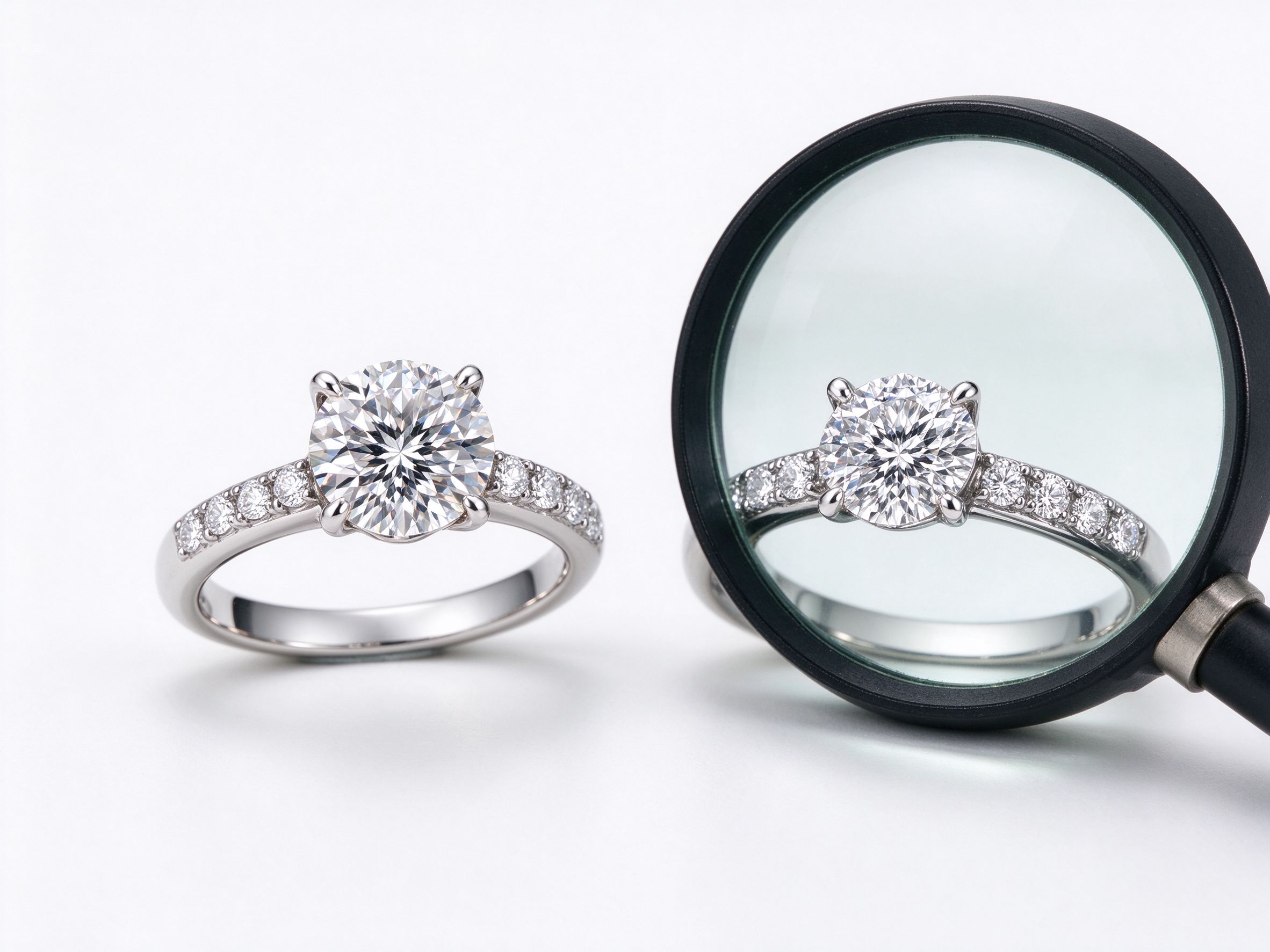
The cutting quality on moissanite is actually very good, because modern faceting machines are precise. We cut moissanite to ideal angles to maximize its already high refractive index, and the result is a stone that out-sparkles many diamonds. The low price is not because the cut is bad; it is because the material is cheap to grow and the cutting is automated. This surprises people, because they assume a cheap stone must be poorly made, but in fact we cut moissanite to a very high standard, because the material rewards it. The price is low because the input is cheap, not because the output is low.

Precision-cut moissanite. The low price comes from factory crystal growth and scalable cutting, not from poor quality.
The Marketing Premium: What You Are Actually Paying For
The largest single component of a diamond's price, beyond the raw material and the cutting, is the marketing. For a century, the diamond industry has told consumers that a diamond is the only acceptable engagement ring, that it is rare, that it is forever, and that it costs two months' salary. That marketing is embedded in the retail price, because someone has to pay for the advertising, the showroom, and the sales staff who deliver that message. By the time a diamond reaches a consumer, a large part of the price is not the stone itself, but the story attached to it. Moissanite has no such marketing budget, because it is a value product, and so that markup is absent.
This is not an accusation; it is an observation. The diamond marketing works, and it has created a market where consumers will pay thousands for a stone that, physically, is not worth that much more than a moissanite. The value is in the meaning and the rarity story, and people pay for that. But if you do not want to pay for the story—if you just want a beautiful, hard, brilliant stone on your hand—then moissanite gives you the physical product at a fraction of the price. You are not paying for the century of advertising, the showroom lighting, or the sales pitch. You are paying for the stone and the setting, which is why the price is so much lower.
We think this is the right trade for many people. An engagement ring is a personal choice, and if the meaning of a natural diamond matters to you, that is a valid reason to buy one. But if the meaning is in the commitment, not the rock, then moissanite delivers the same look, the same durability, and the same everyday joy at a tenth of the cost. The money you save can go to a house, a wedding, a trip, or savings, which is a better use for most people than a markup on a mined stone. We build moissanite for those people, and we are open about why it is cheap.
The Setting: Where the Real Cost Lives
Here is a point that surprises many buyers: in a moissanite ring, the stone is the cheap part, and the setting is where the cost actually goes. A one-carat moissanite stone costs us a small amount, but a solid 14k gold setting with hand-finished prongs costs more, because it is labor-intensive gold work. This is why a moissanite ring is not as cheap as you might expect: the stone is cheap, but the metal and the setting labor are real costs, just as they would be for a diamond ring. The price difference between moissanite and diamond is almost entirely in the stone, not in the setting.
We cover this in our guide on setting cost versus stone value, and the point is that a moissanite ring in a cheap silver setting is very cheap, while the same ring in a hand-finished platinum setting costs more, because the setting is the expensive part. This is good news for buyers: you can put the money you saved on the stone into a better setting, which means a more durable, more comfortable, better-finished ring. A two-thousand-dollar diamond ring has maybe twelve hundred dollars in stone and eight hundred in setting. A two-thousand-dollar moissanite ring has maybe two hundred dollars in stone and eighteen hundred in setting. The moissanite ring, at the same budget, has a far nicer band and setting, which is what you feel on your hand every day.
This is a key insight. People think moissanite is a cheap ring, but actually it is a ring where the budget goes into the part you wear—the metal and the finish—rather than into the stone you look at. For daily wear, the setting matters more than the stone, because a poorly set stone will fall out, and a cheap band will bend. So a moissanite ring at a given price point is often better built than a diamond ring at the same price, because more of the budget went into the construction. This is the hidden value of choosing moissanite: you are not just getting a cheaper stone, you are getting a better-built ring for the same money.
Why the Price Is Not Dropping to Zero
If moissanite is factory-made and scalable, why does it still cost anything? Because the crystal growth is energy-intensive, the cutting requires diamond tools, the grading takes skilled labor, and the setting is hand work. These real costs do not disappear, no matter how much we scale. The price of moissanite has fallen over the years as the process has improved, and it will keep falling, but it will never be free, because the furnace, the tools, and the labor are real. What we have done is drive the cost down to where a one-carat moissanite stone costs a fraction of a lab-grown diamond, which is the point of the exercise.
We also invest in quality control. Every stone we produce is checked for color, clarity, and cut, and the ones that do not pass are rejected. This QC costs money, but it is why our moissanite is consistent. A no-name moissanite from a cheap supplier might have gray tints or uneven facets, and it costs less because the QC is skipped. We do not cut corners on QC, because our wholesale partners rely on a consistent product. So the price you pay for moissanite from us includes the cost of quality, which is part of why it is not the absolute cheapest on the market. You are paying for a stone that is graded, consistent, and certified, not a random crystal from a tray.
For wholesale buyers, this means the price has a floor, and that floor is honest. We cannot sell a one-carat moissanite ring for fifty dollars, because the gold setting and the QC cost more than that. We can sell it for a fraction of a diamond ring, because the stone is cheap, but the rest of the ring costs what it costs. This is why we are transparent about the bill of materials: the stone is X, the gold is Y, the setting labor is Z, and the margin is W. Buyers can see the cost structure, which is the opposite of the diamond industry, where the price is opaque and inflated. We think transparency is part of the value, and it is why brands work with us.
The Long View: Why This Price Gap Will Persist
Moissanite will probably never become as expensive as diamond, because it is a manufactured material with scalable supply. It might become even cheaper, as the furnace technology improves and the cutting becomes more automated. But it will always be a value product, because the supply is not constrained by geology. Natural diamonds, for their part, will remain expensive, because the supply is finite and the mining cost is high. The gap between the two will persist, because it is rooted in two fundamentally different supply models: one from a mine, one from a furnace. This is good news for buyers, because it means moissanite will stay affordable, and you can plan on that.
We cover the investment angle in our guide on whether moissanite is an investment, and the answer is no, which is the flip side of this story. Because moissanite is cheap to produce and scalable, it will not appreciate, and it will not hold resale value. But that is fine, because you are not buying it as an investment; you are buying it as a beautiful, durable, affordable ring. The low price is the feature, not a bug. You get a diamond-like ring at a factory price, you wear it every day, and you never worry about it. That is the value proposition, and it is a strong one, without pretending it is something it is not.
For wholesale brands, this means moissanite is a stable, scalable product line. We can supply more next year than this year, at a similar or lower cost, because the supply chain is factory-based. You do not have to worry about a mine closing or a rough price spike, because the crystal growth is ours to plan. This predictability is a big reason brands choose moissanite: the cost is known, the supply is reliable, and the price stays accessible to customers. We have been producing moissanite for years, and we will keep producing it, at scale, at a fair price. That is the promise we make to our partners.
Frequently Asked Questions
Is moissanite cheaper than diamond because it is lower quality?
No. Moissanite is cheaper because it is manufactured in a factory with scalable supply, not because it is lower quality. It is nearly as hard as diamond, it sparkles more, and it lasts for decades. The price gap comes from supply and manufacturing, not from a difference in beauty or durability.
Why is a diamond so much more expensive than a moissanite of the same size?
Because diamonds are rare and mined, with a long, expensive supply chain and a century of marketing built into the price. Moissanite is grown in a furnace in days, cut at scale, and sold without a scarcity premium. The stone itself looks nearly identical, but the economic models are completely different.
Will moissanite get even cheaper over time?
Probably yes, gradually, as furnace technology improves and cutting becomes more automated. But it will never be free, because the crystal growth, cutting, grading, and setting have real costs. The price will stay low and accessible, which is good news for buyers and brands.
If the stone is cheap, why is the ring not cheaper?
Because the setting is where the cost lives. A moissanite stone is inexpensive, but a solid gold setting with hand-finished prongs costs real money. This is good news: at a given budget, a moissanite ring puts more money into the band and setting, which means a better-built ring for the same price.
See the Real Moissanite Price for Yourself
We are a factory, so our prices are factory prices, without the retail markup, the showroom, or the marketing premium. We cut the stones, set the rings, and ship them to wholesale brands and direct customers. If you want to see what a moissanite ring actually costs when you cut out the middlemen, contact us at service@holycome.com with your design idea, and we will send you a transparent quote: stone, metal, setting, and margin, all broken out. No secrets, no story, just the honest manufacturing price. That is why moissanite is cheaper than diamond, and that is why we think it is the smart choice for a ring you will wear every day.