01Why returns start after the sale, not before
Most return conversations I sit in on start with a stone or a clasp. But when I pull the actual complaint, it is usually a piece that arrived fine and then fell apart in the customer's hands three weeks later — a lost earring back, a chain that kinked, a silver ring that went black in a bathroom drawer. That is not a manufacturing defect. That is a missing care loop.
For other jewelry wholesale buyers, the profit math is simple: every returned unit costs you the shipping, the inspection time, and often the resale value. A care sheet costs a few cents. A repair bench agreement costs nothing until you use it. I have watched buyers cut their return rate in half just by adding those two things to the packing slip.
This is article eleven in our factory series, so I am not going to repeat the choosing-a-supplier talk. This one is about what happens after the carton leaves Shenzhen.
02The three points where jewelry actually fails
Over twelve years on the floor, failures cluster in three spots. Knowing them tells you what to write on the care card and what to inspect on arrival.
- Stone setting: prongs catch on knitwear and bend, then the stone loosens. Common on halo and pavé styles.
- Chain and clasp: spring rings fatigue, lobster claws open under load, box chains kink at the jump ring.
- Surface finish: rhodium plate wears at the high points, silver tarnishes in humid storage, and plated brass discolors at the edges.
None of these are hidden defects. They are wear patterns. If your customer knows them, they clean and check instead of filing a claim.
Over twelve years on the floor, failures cluster in three spots. Knowing them tells you what to write on the care card and what to inspect on arrival.
03What goes on the care card we ship with bulk orders
We print a two-sided insert for buyers who ask. It is not marketing copy; it is six instructions and one phone number. Keep it plain, because customers actually read plain.
- Put jewelry on last, after perfume, lotion and hairspray. Alcohol and oils dull moissanite and strip rhodium.
- Take it off before swimming, showering, dishes and the gym. Chlorine attacks silver alloys and plated layers.
- Store each piece in its own pouch. Two chains in one box is how you get scratches and knots.
- Wipe with a dry soft cloth after wear. A silver polishing cloth once a month on sterling items only.
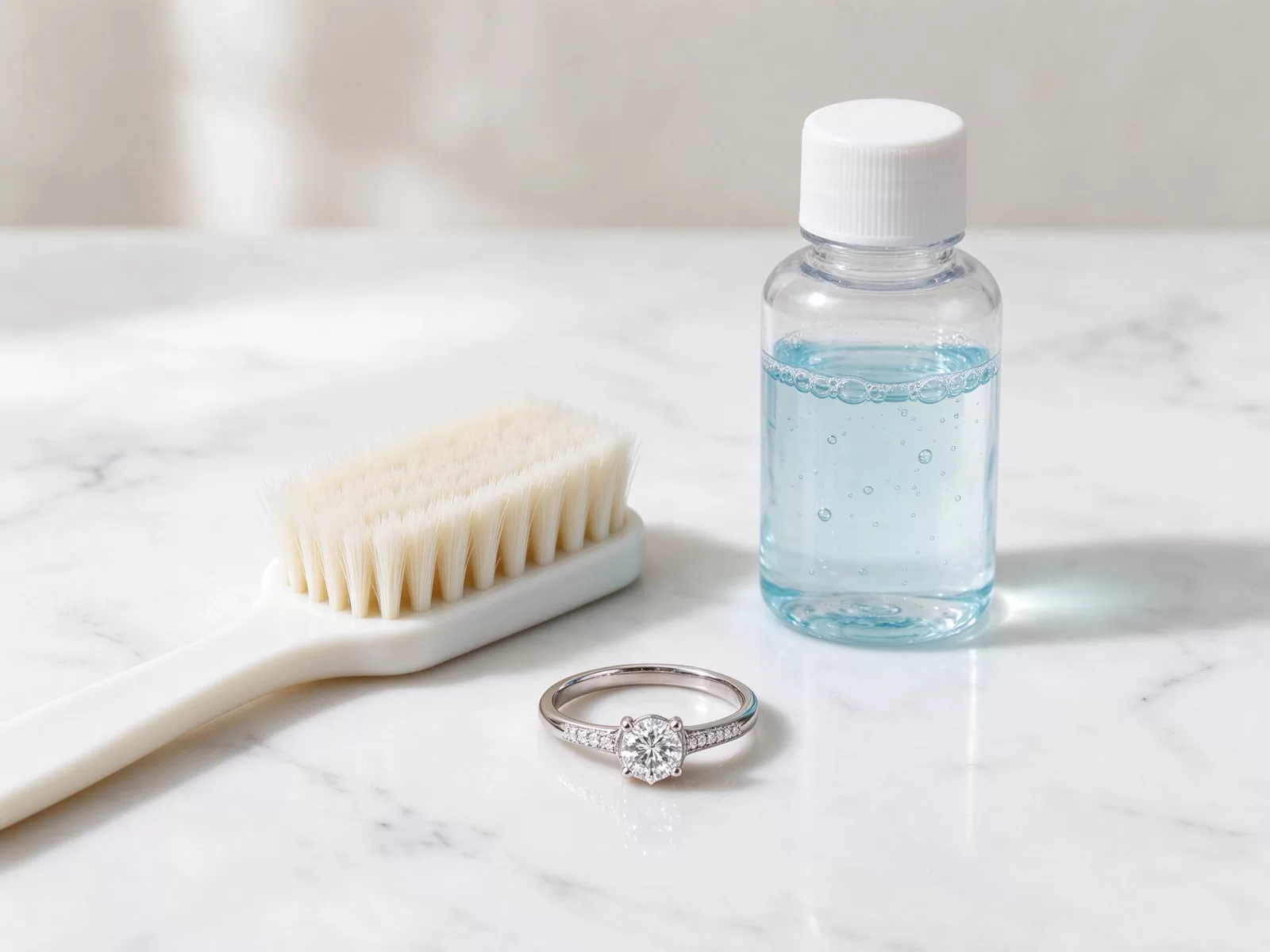
- Clean moissanite and lab-grown diamond with warm water, a drop of dish soap and a soft brush. Rinse and dry fully.
- Check prongs and clasps every few months with a fingernail. If a prong moves, stop wearing it and take it to a bench.
That list alone removes a large share of angry emails, because most complaints are really misuse the customer did not know was misuse.
04Cleaning routines by material, so staff do not guess
Your customer service team will get cleaning questions. Give them a one-page table and they stop improvising. Here is the version we hand to new QC staff, and it works just as well for a retail counter.
| Material | Safe method | Avoid | Check frequency |
|---|---|---|---|
| Moissanite and lab-grown diamond | Warm water, mild soap, soft brush, air dry | Ultrasonic on glued or tension settings | Monthly |
| 925 sterling silver | Polishing cloth, then dry pouch storage | Chlorine, bleach, rubber bands | Every wear |
| Rhodium-plated silver | Damp cloth only, dry immediately | Abrasive pads, repeated polishing | Weekly |
| Plated brass | Dry cloth, keep away from skin oils | Water soaking, perfume contact | Every wear |
Notice the table has no magic products. Ultrasonic cleaners are fine for solid metal and tight settings, but they will shake loose a glued pearl or a poorly seated stone. When in doubt, hand-clean.
05Setting up a repair loop without owning a bench
You do not need a jeweler on staff. You need one bench you trust and a written price list. Most buyers we ship to partner with a local repair shop for chain soldering, prong retipping and re-plating, and send anything structural back to us if it is inside the warranty window.
Three things make that loop work. First, a decision rule: what the buyer fixes locally versus what gets replaced. Second, a shipping method for returns under a certain value, so a twenty-dollar repair does not eat forty dollars of freight. Third, a log. Track the style number, the failure point and the month. After two seasons you will see which SKUs keep coming back and can drop them.
In our own pre-ship data, roughly seven of ten claimed defects turn out to be wear or handling, not production faults. The log tells you which is which before you argue with a supplier.
That log is also leverage. When you reorder, you can show us a pattern and we adjust the setting or the clasp spec on the next run. We do that at no charge when the volume justifies it.
06Where our factory sits in that loop
Our job is to make the loop short. We hold stock of common styles at MOQ 1 piece, and custom work starts at 30 pieces per design. Production runs 12 to 18 days depending on stone setting complexity and plating steps. Every order goes through three QC stages: incoming stone check on color, cut and carat weight; in-process inspection at setting and polishing; and a pre-ship AQL sample pull against the approved spec sheet.
Moissanite and lab-grown diamond ship with GRA and IGI certificates where the order calls for them. Payment is T/T with 30% deposit, balance before shipment, and PayPal for sample orders. Delivery is DDP, typically 5 to 8 days to US and EU addresses once the carton is released.
On cost and speed we run about 20% better than typical trading companies, and the reason is boring: we cut and set in the same building, so there is no second party marking up the stone and no week lost to a middleman's inspection. Fewer hands, fewer transfers, fewer damaged pieces.
If a batch does have a real defect, we replace it. What we ask in return is the failure detail — photos, style number, and where it broke — because that is what keeps the next run clean.
07Frequently Asked Questions
What is the minimum order for other jewelry wholesale?
Stock styles ship from 1 piece, so you can test a care-and-repair program on a small batch. Custom designs start at 30 pieces per style, and price is quoted per piece based on metal, stone grade and plating.
How long does production and delivery take?
Production is 12 to 18 days after deposit and spec approval. DDP delivery then takes about 5 to 8 days to US and EU addresses, so plan roughly three to four weeks door to door.
Do you supply certificates and what is the price basis?
Yes, GRA and IGI certificates are available for moissanite and lab-grown diamond orders. Pricing is per piece, quoted on stone grade, metal weight and finish, with T/T 30% deposit and PayPal accepted for samples.
Send us your style list and target landed cost, and we will quote per piece with certificates, packing and the care insert included. Ask for a sample box first — WhatsApp +86 133 7744 7107 or service@holycome.com, and we will get it moving the same week.