
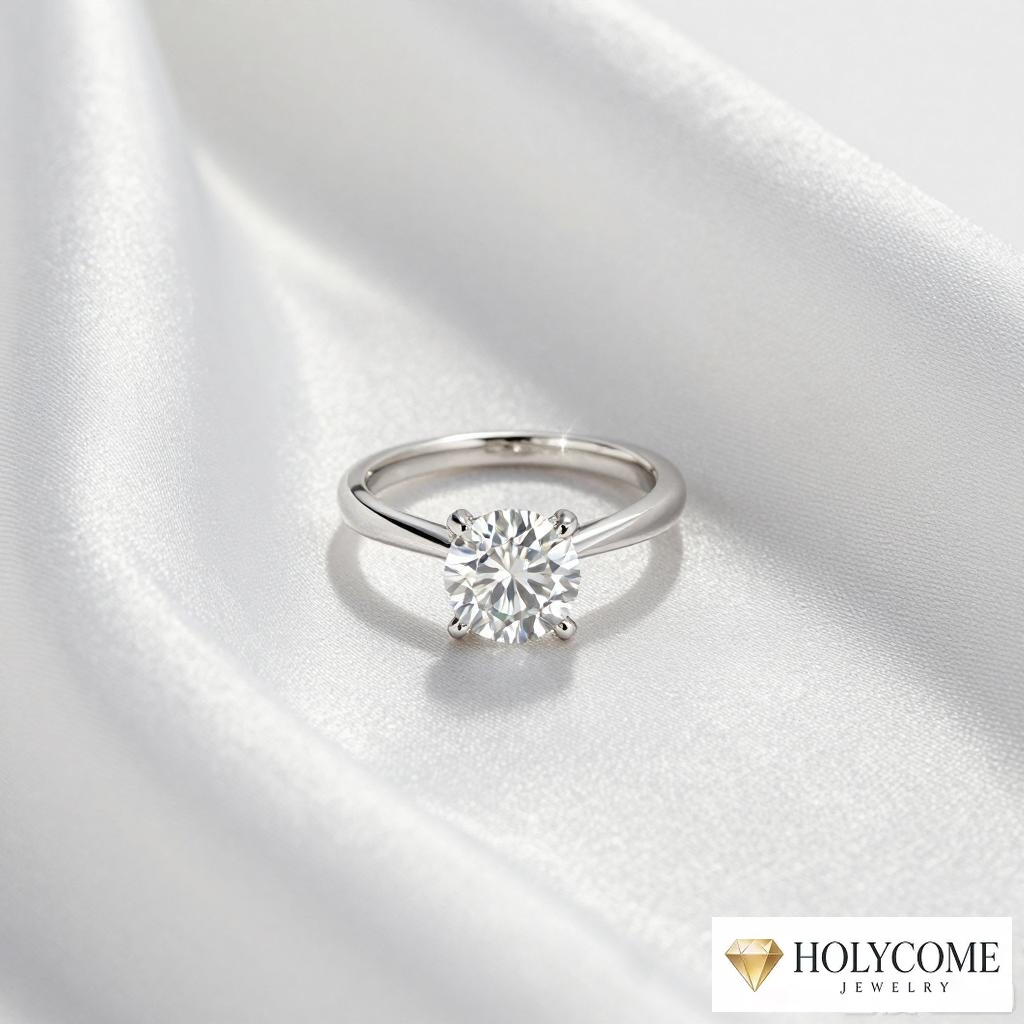
The solitaire is the original, enduring silhouette of the engagement ring, and moissanite solitaire rings carry forward that classic design with a material built for the way couples buy bridal jewelry today. A single center stone held high in clean prongs, with no accent stones or elaborate metalwork to compete for attention, puts the gem itself at the center of the design. For moissanite, that unobstructed view is exactly what the material needs to show its signature fire and brilliance, and the solitaire setting has become the top-selling moissanite ring style across every major market we supply.
HOLYCOME manufactures moissanite solitaire rings for over 280 jewelry brands worldwide, producing finished settings in sterling silver, 10k/14k/18k gold, and platinum, as well as loose calibrated moissanite for brands that set in-house. Our production data across 14 years shows solitaires account for 42% of all moissanite bridal rings we ship—more than halos, three-stone rings, and vintage designs combined. This guide covers everything brands and designers need to know when building a moissanite solitaire ring line, from design choices and metal selection to production standards and pricing.
01Why the Solitaire Works So Well for Moissanite
The solitaire setting exposes the center stone's pavilion to light from every angle, which maximizes both brilliance and fire. Moissanite's 0.104 dispersion—2.36 times higher than diamond—shows most dramatically when light can enter through the bottom and sides of the stone without obstruction from bezels, halos, or heavy metalwork. In a solitaire head held high by a thin band, light bounces through every facet and produces the rainbow sparkle moissanite is known for. In a bezel or halo setting, some of that light gets blocked, and the stone shows less fire.
Beyond optical performance, the solitaire silhouette carries powerful cultural weight. It is the ring style customers have seen in movies, on family members' hands, and in advertising for decades. That familiarity means customers who choose a moissanite solitaire get a ring that reads as "classic engagement ring" to everyone who sees it, but with the added sparkle and value that moissanite delivers. For couples who want a traditional-looking ring without the diamond price tag, the solitaire is the natural starting point.
| Design Factor | Recommendation for Moissanite Solitaires | Why It Matters |
|---|---|---|
| Prong count | 4-prong for rounds under 8mm; 6-prong for 8mm+ (2ct+) | 4-prong shows more stone; 6-prong adds security and a classic Tiffany-like look for larger stones |
| Head style | Open basket head; avoid solid closed heads | Open baskets let light enter through the pavilion for maximum sparkle |
| Band width | 1.8mm–2.5mm (tapered to 1.6mm at head for dainty look) | Thin bands make center stones look larger; too thin causes bending under daily wear |
| Prong profile | Rounded tip prongs covering 0.3mm+ girdle | Protects girdle edge from chipping; sharp flat prongs can chip during setting |
| Head height | Medium to high (4.5–6mm clearance under girdle) | High heads maximize light entry; low profiles are less likely to catch but reduce sparkle |
The Gemological Institute of America notes that solitaire settings have been the dominant engagement ring style since the 1880s, when Tiffany & Co. introduced the raised six-prong solitaire that still bears the company name. That design legacy carries weight with customers across generations, and the silhouette translates seamlessly to moissanite without modification. GIA's research on jewelry design history documents how setting styles evolved alongside diamond cutting, and the solitaire emerged as the style that best shows off a well-cut round brilliant—a benefit that applies equally to moissanite.
02Designing a Moissanite Solitaire Collection
A strong solitaire collection covers a range of aesthetics without overwhelming customers with redundant designs. The most successful solitaire lines we supply balance a few classic core silhouettes with selective trend-forward pieces.
Prong Count and Head Style Options
4-prong heads are the most popular moissanite solitaire style, accounting for roughly 60% of our solitaire production. Four rounded prongs leave more stone visible between the tips, creating a more open look that shows off moissanite's sparkle. 6-prong heads account for another 30% of orders—the extra two prongs distribute pressure more evenly around the stone, reduce girdle exposure, and create a distinct "Tiffany-style" appearance that many customers specifically request for larger center stones. We also produce compass-point (north-south-east-west) 4-prong settings and double-prong heads for brands seeking a more distinctive look.
For the head itself, open basket heads are the standard choice and deliver the best light performance. Cathedral shanks (where the band rises up to meet the head with arching shoulders) add a traditional, elegant look and reinforce the head for large stones. Low-profile "beauty" heads sit closer to the finger for customers who prefer a ring that does not catch on clothing, though they sacrifice some sparkle from reduced light entry through the pavilion.
Band Profile and Metal Choice
Band width and profile dramatically change how a solitaire looks on the hand. Thin bands (1.6–2.0mm) create the popular "dainty" aesthetic and make center stones look larger by contrast, but anything thinner than 1.6mm in 14k gold risks bending under heavy daily wear. Standard 2.5mm bands offer the best balance of durability and classic proportion for most customers. Comfort-fit bands (rounded on the interior) cost slightly more to produce but reduce friction on the finger and feel noticeably better for customers wearing the ring every day—they are worth the small premium for bridal pieces.
Metal selection for moissanite solitaires breaks down roughly as follows across our production orders:
- 14k white gold (with rhodium plating): 48% of solitaire orders; classic, bright, pairs perfectly with D-F colorless moissanite
- 14k yellow gold: 22% of orders; fastest growing metal; warm reflection masks faint yellow body color, allowing G-H stones to look fully colorless
- 14k rose gold: 18% of orders; popular for vintage-inspired and modern minimalist collections
- Sterling silver (rhodium/gold plated): 8% of orders; entry price point fashion and affordable bridal lines
- Platinum 950 and 18k gold: 4% of orders; high-end premium bridal
Center Stone Size and Shape Options
Round brilliants dominate solitaire orders because they deliver the maximum sparkle, but fancy shape solitaires are a fast-growing segment—particularly oval and cushion cuts. Offer at least four center stone sizes in your core solitaire SKU: 5mm (0.5ct equivalent), 6.5mm (1ct), 8mm (2ct), and 9mm (3ct). Many customers who choose moissanite specifically go for the 2ct and 3ct sizes, because those sizes would cost $15,000–$40,000 in natural diamond but land at $1,000–$3,000 retail in moissanite. A collection that only goes up to 1ct misses the core moissanite value proposition.
A strong solitaire collection covers a range of aesthetics without overwhelming customers with redundant designs. The most successful solitaire lines we supply balance a few classic core silhouettes with selective trend-forward pieces.
03Production Standards and Specifications
Solitaire settings may look simple, but they demand tight production tolerances because the single stone is completely exposed—any crooked stone, off-center prong, or rough finish is immediately visible. HOLYCOME produces all moissanite solitaire settings to consistent manufacturing standards.
Setting Construction
- Shank construction: Solid cast or hand-forged shanks (no hollow or semi-hollow bands), with consistent wall thickness of 1.2mm minimum across the bottom for durability
- Head attachment: Heads are laser-welded to the shank (not soldered only) for maximum strength; weld points are hand-finished to be invisible after polishing
- Prong seating: Seats are cut with precision burrs matched to the stone's girdle contour; every prong is pressed, burnished, and checked with a 0.02mm feeler gauge to ensure the stone is fully seated with no movement
- Finishing: All pieces go through three polishing stages (rough, fine, mirror) plus ultrasonic cleaning and steam cleaning before quality inspection
- Rhodium plating: White gold pieces receive a 0.5–1.0 micron thickness rhodium plate over a nickel barrier plate; plating passes 48-hour salt spray testing for adhesion and tarnish resistance
Stone Specification Defaults
Our standard default moissanite for solitaire rings is D color, VVS1 clarity, Excellent cut, with H&A (hearts and arrows) precision cut available as an upgrade. For yellow and rose gold pieces, we offer G-H color as a cost-saving option that looks colorless in warm metal. All center stones are calibrated to ±0.05mm diameter to ensure proper seating in pre-manufactured heads.
MOQ, Lead Times, and Pricing (Wholesale)
- Sample orders: 1 piece per SKU available at sample pricing for new account evaluation
- In-stock solitaire designs: 5 pieces per SKU MOQ; 10–15 day lead time for sterling silver, 15–20 days for 14k/18k gold
- Custom solitaire designs: 30 pieces per SKU MOQ; 30–45 days from CAD approval to bulk production; $200–$500 one-time tooling fee depending on complexity
- Stone-only orders for in-house setting: 10 pieces per size MOQ; 7–10 day lead time for in-stock rounds
- Wholesale pricing (finished 14k white gold solitaire with 1ct/6.5mm D-VVS1 moissanite): $180–$240 per piece in quantity, depending on band width and head style
- Quality pass rate: 99.4% of finished solitaires pass final QC; defect rate for loose stones set in-house is under 0.1%
04Quality Control for Solitaire Rings
Every finished moissanite solitaire passes through four QC checkpoints before shipment:
- Post-casting inspection: Check shank porosity, head alignment, and casting integrity before any setting work begins
- Post-setting inspection: Verify stone is fully seated, prongs are evenly spaced and burnished, no tool marks on stone surface from setting, table is level with ring plane
- Post-polish inspection: Check for uniform polish across all surfaces, no file marks or rough edges, smooth interior comfort fit
- Final visual inspection: Overall quality review including stone sparkle under multiple lighting conditions, engraving verification, ring size confirmation, and stamping (metal quality stamp and brand hallmark inside shank)
After QC, every ring is individually wrapped in anti-tarnish tissue and sealed in a plastic pouch with silica gel packet before packing into branded packaging. We also perform weekly pull tests on prongs from random production samples to verify prong strength and stone security.
05Merchandising Strategies That Sell Solitaires
Our highest-performing retail partners share a few approaches that consistently move solitaire inventory:
- Size comparison visuals: Show the same solitaire setting with 0.5ct, 1ct, 1.5ct, 2ct, and 3ct center stones side-by-side in product photography. Customers coming from diamond shopping are used to seeing size comparisons, and the dramatic difference in visual presence per dollar with moissanite is a powerful conversion driver.
- Metal sample swatches: Offering free metal color swatches on request reduces return rates by 20–30% for online brands—customers who can see white, yellow, and rose gold next to their skin tone order the right metal first.
- Lifestyle video content: Video of the ring catching light outdoors in sunlight is the single most effective content for converting browsers to buyers, because moissanite's fire only shows fully in motion and in real light.
- Lifetime warranty front and center: Solitaires are forever purchases for customers; a visible lifetime warranty covering manufacturing defects and stone security reduces purchase anxiety dramatically.
06FAQ: Moissanite Solitaire Rings
How many prongs are best for a moissanite solitaire?
Four prongs show more of the stone and are the most popular choice overall, especially for 1ct and smaller. Six prongs add security and create a more traditional, timeless look that many customers prefer for 2ct+ stones. Four prongs do not make the stone less secure when prongs are properly constructed and checked annually—both configurations are completely safe for daily wear if the ring is well made.
Can you set a moissanite solitaire in a pre-existing diamond setting?
Usually yes, with caveats. Moissanite has almost the same optical and physical dimensions as diamond for equivalent carat weights, so a 6.5mm moissanite will seat in a 6.5mm diamond head. The main risk is that diamond prongs may be cut with sharp seats designed for diamond's hardness, which can chip softer girdle material if not adjusted. We recommend having a jeweler check the prong seats and re-burnish them after setting moissanite.
How thick should the band be for a 2ct moissanite solitaire?
For a 2ct (8mm) center stone in a solitaire, we recommend a 2.0–2.5mm band width in 14k gold. Thinner than 2.0mm and the band risks bending over time under the weight of a larger head and stone, especially on ring sizes 7 and above. Platinum pieces can go slightly thinner (1.8mm) because platinum is denser and more rigid than gold.
Do moissanite solitaires look like diamond solitaires in person?
From three feet away in indoor lighting, a well-cut moissanite solitaire looks like a beautiful white gemstone ring, and most people will assume it is diamond. Up close in direct sunlight, the extra fire becomes visible, but this is not a negative for most moissanite buyers—they specifically choose moissanite for that extra sparkle. Customers who want the most diamond-subtle look should specify an H&A cut and avoid very high heads.
Can you add a wedding band to sit flush with a moissanite solitaire?
Yes, but head style matters. Solitaires with a high head and straight shank allow a standard wedding band to sit flush underneath the head with no gap. Cathedral settings and heads that sit low on the shank often leave a gap between engagement ring and band. We offer contour wedding bands specifically matched to each solitaire design for customers who want a perfectly stacked no-gap fit.
07Building Your Solitaire Collection With HOLYCOME
For brands launching a moissanite solitaire line for the first time, we recommend starting with four core solitaire SKUs: a 4-prong classic solitaire in two widths, a 6-prong Tiffany-style solitaire, and a cathedral solitaire. Offer each in white, yellow, and rose gold (or plated silver), with three to four center stone sizes per design. That gives customers a meaningful range without spreading your initial inventory too thin.
You can browse our full moissanite rings catalog to view in-stock solitaire designs, or contact us through the custom jewelry manufacturing page to develop your own proprietary solitaire designs. We also offer loose calibrated moissanite through our loose stone catalog for brands setting in-house, as well as matching stud earrings and pendants to build coordinated collections.
The moissanite solitaire is the backbone of every successful moissanite bridal line. It is the design customers know, it shows off moissanite's signature fire better than any other setting, and it hits an accessible price point that brings bridal jewelry within reach for a growing segment of buyers who would never consider a diamond solitaire at five to ten times the price. When sourced from a manufacturer that controls stone quality and setting construction to tight tolerances, a moissanite solitaire delivers decades of wear with zero clouding, minimal risk of chipping, and a sparkle that turns heads in every lighting.
08Frequently Asked Questions
Is moissanite a viable diamond alternative for retail?
Yes for price-sensitive buyers who want brilliance and hardness. It ranks 9.25 on the Mohs scale and costs a fraction of a natural diamond of the same size, so it turns fast in bridal and fashion lines.
What is the minimum order?
MOQ starts at 50 pieces per design for stock items; custom cuts and private-label settings start at 100 to 300 pieces.
Are certificates included?
Yes. Every parcel ships with GRA or IGI documentation listing carat weight, color grade and cut.
What are the lead times?
Samples 3 to 5 days. Bulk 15 to 20 days under 500 pieces, 25 to 30 days for custom work.