
01Three-Stone Moissanite Rings: Past, Present, Future Bridal
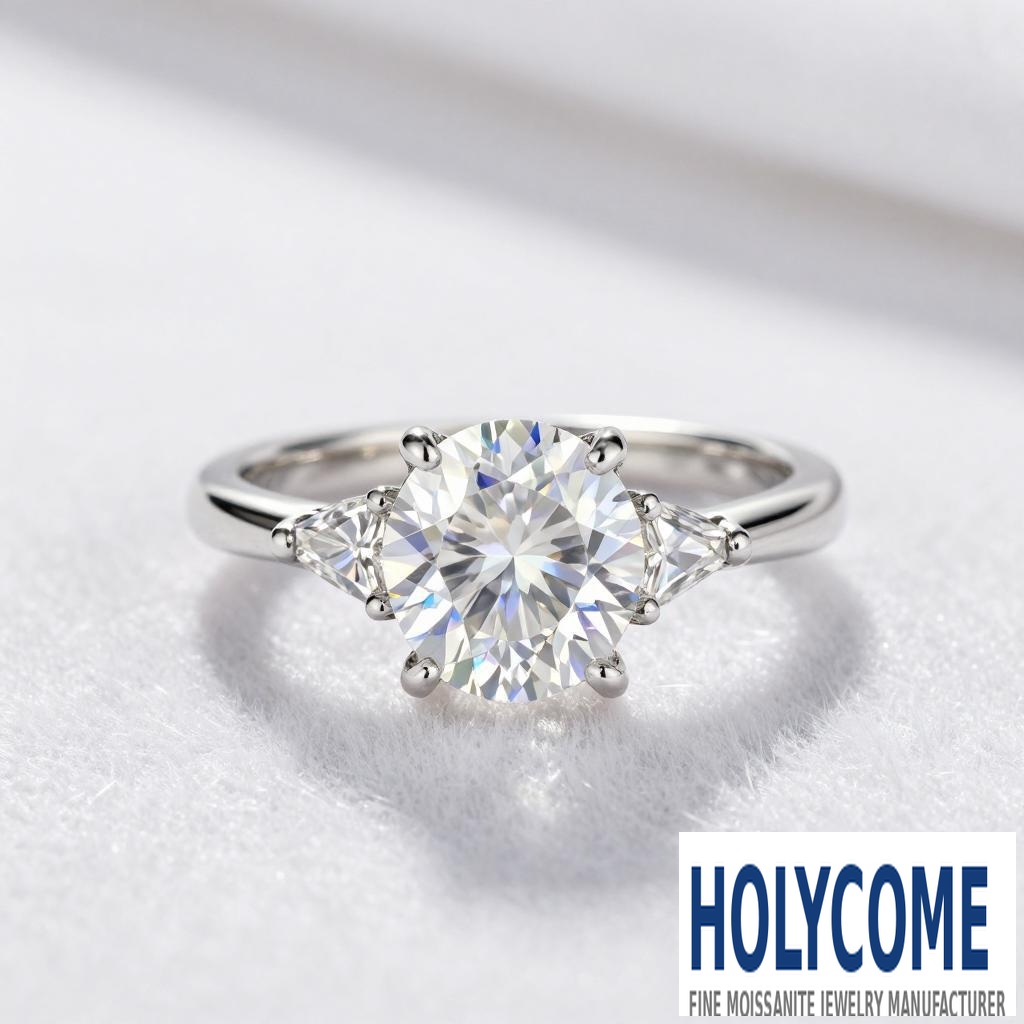
If the solitaire is the timeless default and the halo is the statement-maker, the three-stone moissanite ring is a storytelling piece of moissanite bridal jewelry. Three stones, classically symbolizing a couple's past, present, and future, have been a bridal staple for decades — but the style surged back into mainstream demand following high-profile celebrity three-stone engagement rings in the 2010s and 2020s. In moissanite, the three-stone format delivers exceptional value: a large center stone flanked by two smaller side stones creates a wider, more substantial look on the finger than a solitaire at the same price point, and the design flexibility (side stones can be round, tapered baguette, pear, trillion, cushion, or oval) makes the category highly brandable. This guide covers three-stone design parameters, side-stone proportions, popular configurations, pricing, MOQ, and QC for B2B buyers.
02Three-Stone Symbolism and Market Demand
The classic three-stone "past, present, future" meaning is not marketing fluff — it has driven the style's endurance since the 1980s, when De Beers popularized trilogy rings as anniversary and engagement pieces. In contemporary bridal, three-stone moissanite rings represent approximately 13% of our engagement ring shipment volume, making them the 4th best-selling engagement ring style behind solitaire, halo, and vintage. Three-stone moissanite ring volume grew 34% YoY in 2025, outpacing the overall ring category.
Three reasons three-stone moissanite rings work so well for B2B jewelry brands:
- Built-in emotional narrative: The past-present-future story gives sales copy something concrete to work with and creates emotional connection with buyers. This translates to higher conversion rates in DTC and in-store retail.
- Perceived size: Two side stones add visual spread, making the ring look wider than a solitaire of the same total carat weight. A 1ct with two 0.25ct sides reads like 1.5ct+.
- Design variety: Side stone shapes (baguette, pear, trillion, oval) create dramatically different aesthetics, letting brands differentiate within the category.
The classic three-stone "past, present, future" meaning is not marketing fluff — it has driven the style's endurance since the 1980s, when De Beers popularized trilogy rings as anniversary and engagement pieces. In contemporary bridal, three-stone moissanite rings represent approximately 13% of our engagement ring shipment volume, making them the 4th best-selling engagement ring style behind solitaire, halo, and vintage. Three-stone moissanite ring volume grew 34% YoY in 2025, outpacing the overall ring category.
03Center-to-Side Stone Ratios
Proportion is everything with three-stone rings. If the side stones are too small, they disappear and the ring reads like an underwhelming solitaire. If they're too large, they compete with the center and the ring loses hierarchy. The standard proportions:
| Ratio Style | Center : Side Ratio | Example (1ct center) | Aesthetic | Market Share |
|---|---|---|---|---|
| Classic (balanced) | 1 : 0.25-0.35 | 6.5mm center + two 3.5mm sides | Center clearly dominates; sides are elegant accents | 55% (best-selling, safe) |
| Bold sides | 1 : 0.4-0.5 | 6.5mm center + two 4.3-4.5mm sides | More substantial, "three equal stones" look; higher total carat weight | 25% |
| Delicate accent | 1 : 0.15-0.20 | 6.5mm center + two 2.8-3.0mm sides | Very subtle sides; looks almost like a solitaire with small sparkle accents | 12% |
| Equal trilogy | 1 : 0.7-1.0 | 5.5mm center + two 5.0-5.5mm sides | Three nearly equal stones; bold, vintage-inspired, statement look | 8% (niche, high-end) |
Our default stocking ratio for three-stone moissanite ring designs is 1 : 0.30 (center stone is approximately 3x the diameter of each side stone), which produces the classic balanced look with broadest appeal. We recommend OEM brands start with the 0.30 ratio and offer one bold-side (0.45) SKU as a premium upsell.
04Side Stone Shape Options
The side stone shape defines the look of a three-stone ring more than the center shape does. Popular side stone configurations:
- Round brilliant sides: The most universal option (35% of three-stone volume). Round sides work with any center shape (round, oval, cushion, princess), are forgiving to set, and deliver maximum sparkle. Safe, classic, easy to stock.
- Tapered baguette sides: 22% of volume and growing rapidly due to Meghan Markle association. Long, tapered baguette-cut moissanite on either side create a clean, geometric, elegant Art Deco-adjacent look. Tapered baguettes are set horizontally (length-wise along the shank) to channel outward from the center, creating a tapered, slimming effect on the finger.
- Pear sides ("toi et moi" adjacent): 15% of volume. Pear-shaped side stones with their points facing outward (away from center) create a soft, romantic silhouette; points facing inward create a tight cluster effect. Pear sides look particularly striking with oval and cushion centers.
- Trillion sides: 12% of volume. Triangular trillion-cut sides with points outward create a bold, geometric, contemporary look that photographs well on social media. Works best with round and princess centers.
- Cushion sides: 8% of volume. Cushion-shaped sides with a cushion center create a matched, cohesive, softer look (the "three cushions" style); romantic and vintage-feeling.
- Oval sides: 5% of volume. Oval sides with oval center create a strong elongating effect; more unusual and harder to execute (fitting two ovals to point outward requires careful head design).
- Mixed shapes: 3% of volume (special order). e.g., round center with marquise sides, emerald center with trapezoid sides — these are typically OEM custom designs.
Trapezoid and half-moon sides are also used in premium designs with emerald and Asscher centers; both require custom CAD because angles must fit the center girdle.
05Setting Styles for Three-Stone
Three-stone rings require a different head design than solitaire or halo — the head must hold three stones at appropriate angles, with proper spacing and alignment:
| Setting Style | Description | Best For |
|---|---|---|
| Three-prong head per stone (classic prong) | Each stone held by its own set of prongs (typically 4 for center, 2-3 for sides); classic look, maximum light entry, lowest production cost | Round, oval, cushion centers; high-volume stock SKUs |
| Shared-prong / common-prong head | Adjacent stones share one prong between them (the prong between center and side stone holds both stones); cleaner lines, fewer prongs, modern look | Premium stock; looks sleek but requires tighter stone matching |
| Bezel three-stone | Each stone held in a bezel; very secure, smooth profile, less sparkle; industrial/modern feel | Men's three-stone; active-wear bridal |
| Bar-set | Stones separated by vertical metal bars instead of prongs; clean channel-like look; popular with baguette sides | Baguette and emerald-cut sides; Art Deco and vintage aesthetics |
| Cathedral shank three-stone | Shank arches up to meet the center stone at the gallery, lifting the center and creating architectural lines; classic and regal | Classic bridal; premium positioning |
GIA's guidance on diamond setting types and their structural considerations applies analogously to moissanite, particularly regarding shared-prong heads — common prongs must be precisely positioned to hold both stones securely, as a bent or worn shared prong compromises both stones (GIA setting types reference).
06Matching Wedding Bands for Three-Stone Rings
Three-stone engagement rings are more complex to pair with wedding bands than solitaires, because the side stones extend the ring's head further along the finger and a straight band will not sit flush without leaving a gap. Three common solutions:
- Curved nesting band: The standard solution; a wedding band shaped with a gentle notch that curves around the center head and fits between the side stones. 45% of three-stone bridal sets use a curved band. We recommend producing a matched curved band as part of any three-stone SKU program.
- Notched/chevron band: A V-shaped band that fits under the center stone and points toward it; works with higher three-stone heads where a gentle curve isn't enough.
- Gap as design feature: Some brands design for the gap intentionally, selling three-stone rings with straight bands and styling the gap as a deliberate aesthetic (the "floating" look). This is less common but works for modern, minimalist brands.
For matched sets, producing both rings from the same gold batch ensures identical color (especially white gold, where rhodium thickness varies between batches). We guarantee color match for sets produced together.
07Pricing: 14K White Gold Three-Stone Moissanite Rings (EXW Factory, DEF VVS1 Excellent Cut, classic 1:0.30 ratio)
Current 2026 wholesale pricing for standard three-stone configurations:
| Configuration | Center | Side Stones | 50-199 pcs | 200+ pcs | Typical DTC Retail |
|---|---|---|---|---|---|
| Round center, round sides (classic) | 1.0ct (6.5mm) | 2x 0.25ct (4.0mm) | $82 | $68 | $599-$1,099 |
| Round center, tapered baguette sides | 1.0ct (6.5mm) | 2x tapered baguette (4x2mm) | $90 | $75 | $649-$1,199 |
| Round center, round sides (large) | 1.5ct (7.5mm) | 2x 0.40ct (4.8mm) | $108 | $90 | $799-$1,499 |
| Round center, round sides (statement) | 2.0ct (8.0mm) | 2x 0.50ct (5.0mm) | $132 | $112 | $999-$1,799 |
| Oval center, pear sides | 1.5ct (9x6.5mm oval) | 2x pear (5x3mm) | $118 | $98 | $899-$1,599 |
| Equal trilogy (3 equal rounds) | 3x 1.0ct (6.5mm) | 2x 1.0ct (6.5mm) | $165 | $140 | $1,299-$2,299 |
Three-stone moissanite rings cost 25-35% more than equivalent solitaire rings because of the additional stones, more complex head fabrication, and the additional alignment work required to set three stones precisely. Tapered baguette sides carry a $5-8 premium over round sides because baguette cutting has lower yield (more breakage at the sharp corners of the tapered end). FTC guidelines require that any representations about stone composition (including distinguishing natural diamond from moissanite) be accurate in marketing and product documentation (FTC Jewelry Guides).
08Quality Control Specific to Three-Stone Rings
Three-stone rings have QC concerns that solitaire and halo do not:
- Three-point alignment: All three stones must align perfectly along a single axis. A side stone tilted 2 degrees relative to the center is immediately visible and must be reset. Our QC check involves laying the ring on a flat surface and sighting along the table of all three stones under D65 lighting.
- Equal side stones: The two side stones must be matched in color, clarity, cut, and dimensions within 0.05mm and one color grade. Mismatched side stones (one warmer, one larger, one with higher crown) are one of the most common defects in three-stone production; we match side stones from the same melee batch to minimize variation.
- Shared-prong security: On common-prong heads, the shared prongs must seat firmly on both stones. A shared prong that grips one stone well but leaves a gap on the other is a stone-loss risk. All shared prongs are inspected at 10x for secure contact on both girdles.
- Gap between stones: In tight three-stone designs, stones must not touch (metal-to-stone contact between two stones causes chipping with wear). A tiny gap of 0.15-0.3mm between adjacent stones is ideal; contact requires re-spacing.
- Symmetry of side heights: Both side stones must be set to the same table height relative to the center. If one side sits higher than the other, the ring looks lopsided.
Our outgoing defect rate on three-stone moissanite rings is 2.8% for all moissanite three-stone production — the highest of any ring category because of the multiple alignment and matching checks, and approximately 1% higher than solitaire rings. Side-stone mismatch (1.1% of pieces) and alignment (0.7% of pieces) are the two most common rejects. Field stone loss on three-stone rings runs 0.5% over 12 months, slightly higher than solitaire (0.3%) because the side stones experience more girdle contact and impact exposure.
09MOQ and Lead Times
- Stock three-stone moissanite rings (round center, round sides, 1ct): MOQ 50 per size/metal; 15-20 days for gold.
- Stock three-stone with tapered baguette sides: MOQ 50 per size/metal; 18-24 days (baguette cutting adds 2-3 days).
- Matched three-stone + curved nesting band set: MOQ 50 sets; 20-25 days.
- Equal trilogy (3 equal stones): MOQ 50 per size; 20-25 days.
- Custom three-stone (non-stock side shapes, custom CAD): MOQ 100 per size; 28-35 days; NRE $250-$500.
- Sterling silver three-stone: MOQ 50 per size; 8-12 days; entry pricing $22-35 EXW.
10FAQ
What side stone shape should I stock for my first three-stone SKU?
Start with round sides — they're the best-selling (35% of volume), the most forgiving to produce (lower defect rate), and they work with every center shape. Add tapered baguette sides as your second SKU (they carry a celebrity association that drives strong conversion and have distinct visual identity). Hold off on trillion, pear, and oval sides until your core three-stone SKU has proven traction.
Do customers buy three-stone rings only for engagements, or also as anniversary rings?
Both. Three-stone rings are popular as engagement rings (62% of our three-stone volume) because of the past-present-future narrative, but they are also our #1 anniversary ring style (38% of volume), where the three stones can represent past years, present commitment, and future together — or three children, or a 10-year milestone. The symbolic flexibility of three stones is one reason the style has such lasting appeal.
What center-to-side ratio is most photogenic?
The classic 1:0.30 ratio photographs best for product catalog use because the center dominates cleanly without the sides competing. Bold-side ratios (0.45) photograph well for social media and influencer marketing because the ring reads larger in thumbnails and close-ups, but the visual balance is less traditional.
Can I offer three-stone rings with diamond side stones and moissanite center?
Yes — several of our clients offer three-stone rings with moissanite center and diamond side stones for customers who want the price benefit of moissanite in the center but "real diamond" accents. We can supply natural diamond melee (G-H SI, $20-40 premium per ring depending on side stone size) or lab-grown diamond melee ($8-15 premium). DEF-color VVS1 moissanite sides are the default and are indistinguishable from diamond sides to the naked eye in most lighting.
Do three-stone rings require a special wedding band?
Most three-stone designs require a curved nesting band to sit flush, because the side stones extend the head wider than a solitaire. A straight band will leave a 1-2mm gap. We recommend producing a matched curved band for every three-stone engagement ring SKU — selling the set increases average order value by approximately 35% compared to selling the engagement ring alone.
What size center stone is the best seller in three-stone?
1.5ct (7.5mm) center with two 0.40ct sides is the best-selling three-stone size in our 2025 data — it balances substantial appearance and price. 1.0ct center is the entry price-point SKU; 2.0ct is the premium/statement SKU. We recommend stocking 1.0ct and 1.5ct for launch, adding 2.0ct once sales validate the style.
11Adding Three-Stone to Your Moissanite Ring Line
Three-stone moissanite rings are the natural third SKU of moissanite rings for most brands after solitaire and halo — they occupy a distinct positioning (romantic, symbolic, story-driven) that complements the solitaire's minimalism and the halo's glamour. For a launch assortment, we recommend two SKUs: a 1.5ct round with round sides (classic, 1:0.30 ratio, 14K white gold) and a 1.5ct round with tapered baguette sides (celebrity-inspired, slightly premium) — with a matched curved nesting band available for both.
For context on the other engagement ring styles, see our solitaire guide, halo guide, vintage rings, oval rings, and wedding bands. Moissanite's optical properties and the reason it rivals diamond for sparkle in side stones are rooted in its refractive index of 2.65, documented in gemological references (moissanite reference). Stock three-stone orders of 50+ pieces ship within 20 business days; matched bridal sets ship within 25 days. Contact our B2B desk for samples or custom ratio quotes.