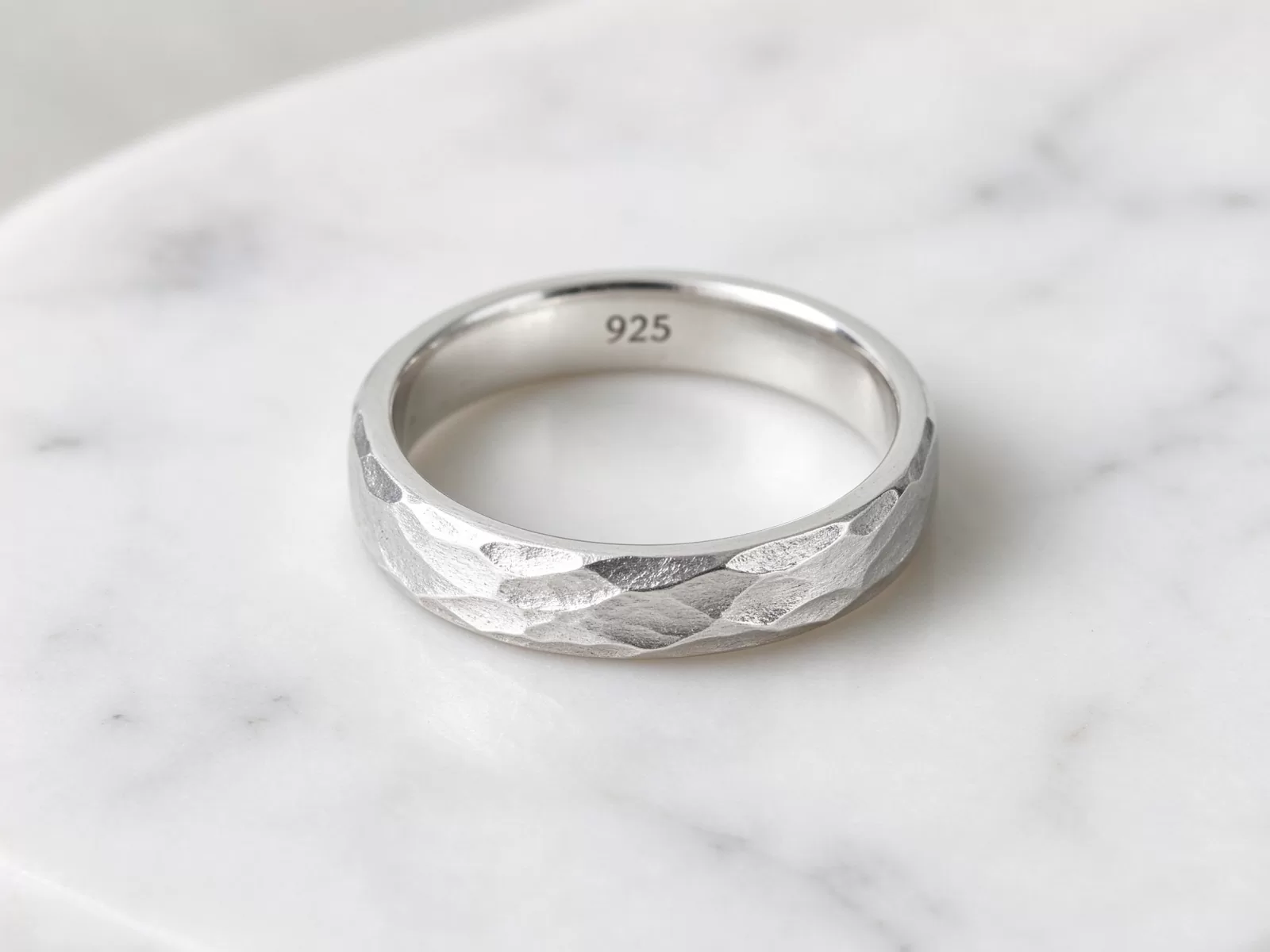
01Why the plating spec decides your return rate, not the 925 stamp
Every week a buyer sends me a photo of a ring gone pink at the shoulder and asks whether the silver was fake. Usually it is not. The stamp says 925, the assay is fine, and the piece still failed because the plating layer was 0.03 microns when it needed 0.1. On a wholesale order of 5,000 units, that difference is the whole margin.
I have run incoming inspection, in-process checks and pre-ship AQL on this floor for twelve years. What follows is how I actually think about metal and plating when a trade buyer asks me to quote 925 sterling silver wholesale, and where I tell them to spend the extra cents.
02The base alloy: copper is not the only option
Sterling is 92.5% silver and 7.5% something else. Most factories use copper because it is cheap and casts beautifully. It also tarnishes fast and, in thin sections, work-hardens until a claw snaps.
We run three base mixes depending on the product. Standard copper alloy for high-volume pendants and studs. A copper-germanium mix for pieces that will sit against skin and sweat. And a palladium-bearing mix for anything with a prong setting or a hinge, where you cannot afford creep over a two-year wear cycle.
What changes on the bench
- Copper alloy: cheapest, best cast detail, tarnishes in 3-6 weeks in humid retail display.
- Copper-germanium: roughly 8-12% higher metal cost, visibly slower fire-scale, better for ear wires and chains.
- Palladium-bearing: 20-25% higher metal cost, holds spring tension in clasps, my default for bracelets.
- Deoxidised silver: reduces porosity after repeated annealing; worth it on castings over 8 g.
None of this is visible on a spec sheet the buyer receives. Ask for the alloy name in writing, not just "925 sterling silver wholesale" on the invoice header.
Sterling is 92.5% silver and 7.5% something else. Most factories use copper because it is cheap and casts beautifully. It also tarnishes fast and, in thin sections, work-hardens until a claw snaps.
03Plating options ranked by real wear life
Plating is where most wholesale disputes start, because "rhodium plated" covers everything from a 0.02 micron flash to a 0.25 micron functional layer. Here is how the four common finishes behave on a wear test we run on a tumbler with abrasive media, simulating roughly six months of daily use.
| Finish | Typical thickness | Wear life in test | Best use | Cost index |
|---|---|---|---|---|
| Rhodium | 0.05-0.20 micron | 5-9 months | White-look rings, earrings | 100 |
| Platinum group flash | 0.03-0.08 micron | 3-6 months | Low-price pendants | 60 |
| 18K gold tone (ion) | 0.10-0.30 micron | 6-12 months | Yellow-tone fashion lines | 140 |
| E-coat over rhodium | 0.05 micron + lacquer | 8-14 months | High-touch bracelets | 170 |
E-coat is the one buyers undervalue. A clear electrophoretic layer over rhodium adds maybe six cents a piece at volume and pushes tarnish resistance well past a bare rhodium finish. If your channel is e-commerce with a 90-day complaint window, that six cents is the cheapest insurance you will buy.
Thickness beats brand name every time. I have seen 0.15 micron from a small plating shop outlast 0.05 micron from a big name, because the buyer never asked for the number.
04Where plating fails first, and how to spec around it
Failure is not random. On rings it starts at the palm side of the shank. On chains it starts at the clasp and the two links either side. On earrings it starts at the post thread. Those are the three zones to name in your purchase order.
Ask for plating thickness in microns per zone, not per piece. A supplier who cannot answer that has not measured it. We keep a coulometric thickness tester at the pre-ship station and log five pieces per lot, and that log travels with the shipment.
Three specs that prevent most claims
- Minimum 0.10 micron rhodium on shank and prong tips, 0.05 elsewhere.
- Nickel-free barrier layer under gold tone, with a written declaration for EU REACH.
- Clasp and post assemblies plated after assembly, not before, so edges are sealed.
- Tumble test of 200 cycles on a sample lot before bulk plating is approved.
05How we hold the numbers down without cutting the layer
Our cost, speed and yield run about 20% better than a typical trading company, and the reason is boring. We own the casting, the polishing line and the plating bath under one roof, so a lot does not travel between three vendors who each add margin and a week of queue time.
That shows up as a 12-18 day production window on custom work, MOQ of 1 piece on stock and 30 pieces per design on custom runs. Samples go out by PayPal, bulk runs on T/T with 30% deposit, and DDP delivery lands in 5-8 days to most US and EU addresses. Stones arrive with GRA and IGI certificates, checked at the incoming gate before they touch a bench.
06The QC sequence that catches plating problems
Three stages, no shortcuts. Incoming: stone count, color match and certificate verification, plus a metal assay on each alloy heat. In-process: dimensional check after casting and a plating thickness pull after the bath. Pre-ship: AQL sampling at 2.5 major and 4.0 minor, with a wear-spot photo set on every lot.
The pre-ship stage is where I reject most often, and it is almost always the same finding: a gold-tone lot where the barrel plated unevenly and the inside of a jump ring reads a shade darker. You will not see it in a hero photo. You will see it in reviews three months later.
07What to put in your RFQ
Send the design, the target retail price, the finish you want and the zones that take the most abrasion. I will come back with an alloy recommendation and a plating thickness that fits the price, plus the honest trade-off if you push the layer thinner than I would.
Reach the floor directly at WhatsApp +86 133 7744 7107 or service@holycome.com. Samples of any stock design ship inside a week, and custom plating specs can be quoted same day once we see the drawing.
08Frequently Asked Questions
What is the MOQ for a plated 925 sterling silver wholesale order?
One piece for anything in stock, 30 pieces per design for custom casting and plating. Below 30 the plating bath setup cost per lot stops making sense, so we would quote stock designs instead.
How long does production take once plating is approved?
Twelve to eighteen days for custom runs, counted from deposit and plating sign-off. Stock items ship in about a week, and DDP transit is 5-8 days to most US and EU destinations.
How is price calculated on a plated piece?
Price is silver weight at the day's fix, plus stone cost, plus a plating charge scaled to thickness and surface area, plus labor. Thicker rhodium or an e-coat top layer moves the unit price by cents, not dollars, at volume.
If you are comparing suppliers on 925 sterling silver wholesale, send us your worst-performing SKU with the failure photos and your target landed cost. We will quote it with a named alloy, a micron spec per wear zone and a sample you can tumble-test yourself before you commit to a PO.