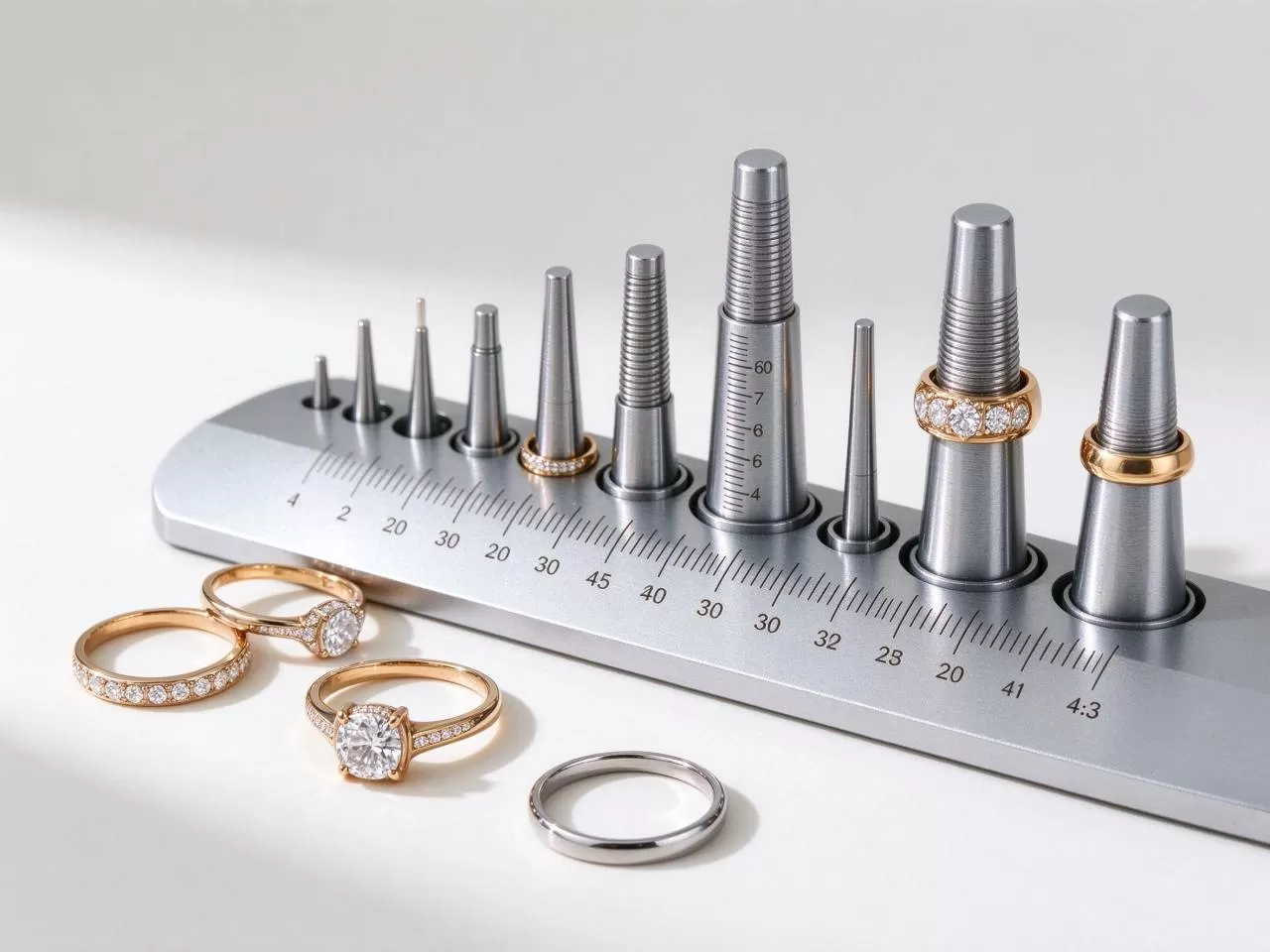
01Why size and fit decide your reorder, not your price list
Most buyers come to me with a price per carat in mind. After twelve years checking stones at the bench, I can tell you the price is rarely what kills a program. What kills it is a size curve that does not match the fingers and settings your customers actually own. You can buy the cheapest synthetic stones wholesale on the market and still sit on 40 percent of them if the millimeter spread is wrong.
This piece is not a beginner's guide to picking a stone type. It is a working note on coverage: which sizes and proportions move, which ones gather dust in the tray, and how to build a buy that keeps your best sellers in stock without freezing cash in shapes nobody asks for twice.
One number to frame the whole conversation: our cost, speed and yield run roughly 20 percent better than a typical trading company. That is not marketing. We cut and set on the same floor, so there is no middleman margin stacked onto every carat and no week lost relaying specs back and forth.
02The mm ranges that keep turning
In moissanite and lab-grown diamond, buyers think in carats but jewelers think in millimeters. The two do not map cleanly across shapes, and that mismatch is where inventory goes wrong. Here is what I see move steadily through wholesale trays, based on what we cut and ship week to week.
- Round brilliant: 1.0 mm to 3.0 mm melee moves constantly for pavé and halo work; 4.0 mm to 6.5 mm is the volume core for studs and solitaires; 7.0 mm and up is a slower, higher-ticket sell.
- Oval: 5x3 mm through 8x6 mm is the sweet spot; the 1.5 ratio outsells the longer 1.6 and 1.7 cuts in most US and EU programs.
- Emerald and radiant: 6x4 mm to 9x7 mm sells; anything past 10x8 mm needs a confirmed order before we cut stock.
- Pear and marquise: strong in 5x3 mm to 7x5 mm; long, thin ratios over 8 mm sit because setting them is fussy for small benches.
- Princess and cushion: 4.0 mm to 6.0 mm square moves; oversized cushions stall unless the buyer has a bridal line with wide shanks.
The pattern is simple. Sizes that fit standard stock settings turn fast. Sizes that require a custom mounting turn slowly, because your customer has to commit before the jeweler commits.
In moissanite and lab-grown diamond, buyers think in carats but jewelers think in millimeters. The two do not map cleanly across shapes, and that mismatch is where inventory goes wrong. Here is what I see move steadily through wholesale trays, based on what we cut and ship week to week.
03The sizes that sit and why
Every factory has a dead tray. Ours used to be full of 2.5 mm and 2.75 mm melee in colors that looked good under our lights and wrong on a jeweler's bench. The lesson: odd fractional sizes between the standard steps rarely earn their shelf space. If a setting house already stocks 2.0 mm, 2.25 mm and 3.0 mm seats, a 2.75 mm stone is a special order in disguise.
Oversized fancy shapes are the second trap. A 12x10 mm emerald cut in a colored moissanite looks impressive in a photo and then waits months for the right buyer. Unless you have a repeat client asking for statement pieces, keep the big fancies to sample quantities and let the order pull the stock.
Third trap: matching pairs and calibrated lots. A single 6.5 mm stone is easy to sell. A matched pair within 0.05 mm in size and color is a different product, and buyers who do not specify tolerance end up rejecting good stones because the pair reads uneven to the eye. Our incoming stone check catches size drift before it becomes a return.
04Fit means two things: finger and setting
Fit is not only about what looks right on a hand. It is also about what drops into a mounting without a jeweler spending an hour on the seat. A 6.4 mm round in a 6.5 mm setting is a reaming job. A 6.5 mm in a 6.5 mm seat is a two-minute set. That difference decides whether your trade customer reorders.
So when you spec synthetic stones wholesale, give us the setting seat, not just the carat weight. We will match to the seat tolerance and flag anything that will not drop in clean. This is also where the 20 percent advantage shows up in practice: our in-process QC checks diameter against the order sheet at the cutting stage, not after polishing, so a drifting lot gets corrected while it is still cheap to correct.
05Building a size curve that survives a season
A practical starting curve for a trade buyer testing a new line: 60 percent of budget in round melee 1.0 to 2.5 mm, 25 percent in the 4.0 to 6.5 mm round core, 10 percent in oval and emerald mid sizes, and 5 percent in samples of the larger fancies. Adjust after your first sell-through, not before.
Keep the curve narrow at the start. Ten well-chosen sizes in depth beat forty sizes bought shallow, because shallow depth means you cannot fill a repeat order and your customer learns to buy elsewhere. Depth also earns better unit pricing on the next run.
| Stone group | Working size range | Typical MOQ | Notes |
|---|---|---|---|
| Round melee, white | 1.0 to 3.0 mm | 1 pc from stock | Depth matters more than breadth |
| Round core, white | 4.0 to 6.5 mm | 1 pc stock / 30 pcs custom | Main volume driver |
| Oval and emerald | 5x3 to 9x7 mm | 30 pcs custom | Confirm ratio before cutting |
| Fancy large | 10 mm and above | Sample first | Order-pull only |
06How we hold size tolerance on the floor
Three QC stages do the work. Incoming stone check verifies diameter, color grade and clarity against the order sheet before anything enters production. In-process inspection watches the cutting and polishing steps for size drift and symmetry. Pre-ship AQL sampling pulls finished lots against the same sheet, so what leaves the building matches what you approved.
Certificates follow the goods: GRA for moissanite, IGI where lab-grown diamond documentation is needed. Lead time is 12 to 18 days for production, with stock items moving faster. Terms are T/T with 30 percent deposit, PayPal accepted for samples, and DDP delivery at 5 to 8 days to most US and EU addresses.
Buyers who send us the setting seat and the tolerance get fewer rejections than buyers who send a carat weight and hope.
07Frequently Asked Questions
What is the minimum order for a size test?
Stock sizes ship from 1 pc, so you can test a curve before committing. Custom cuts and calibrated lots start at 30 pcs per size and shape.
How long does a custom size run take?
Production runs 12 to 18 days after deposit and spec sign-off, plus 5 to 8 days DDP transit. Certificate turnaround is built into that window.
How is price quoted for synthetic stones wholesale?
We quote per carat or per piece depending on the shape, with size, color grade and certificate scope stated on the sheet. Depth and repeat volume move the unit price, so tell us the curve you plan.
Send your size list, setting seats and target quantities to service@holycome.com or WhatsApp +86 133 7744 7107, and we will come back with a quote and sample availability. If you are unsure which sizes to test first, ask for our current stock list and we will mark the ranges that turn fastest for your market.