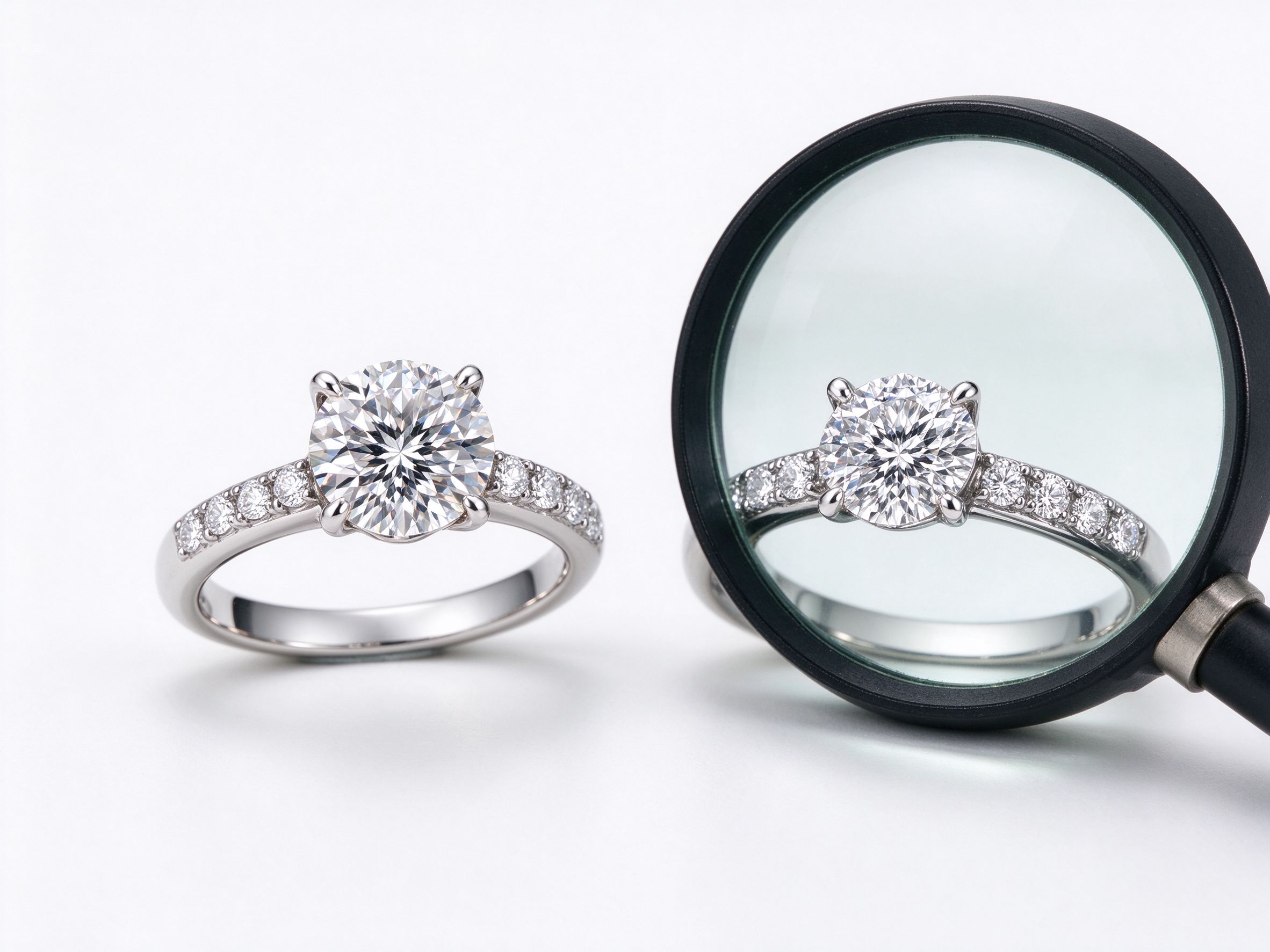
Moissanite Value for Money - HOLYCOME
"Value for money" is the phrase shoppers type when they want a beautiful stone without the diamond price, but they also do not want a piece that looks cheap in six months. Moissanite sits in the middle of that question. It costs far less than diamond and lasts far longer than cubic zirconia, but whether it is actually good value depends on what you are buying, how you will wear it, and which stone you would otherwise choose. After cutting and setting moissanite in our Shenzhen workshop for over a decade, we have a clear view of where the value is real and where the marketing oversells it. This guide walks through the total value equation, not just the sticker price.
What Value for Money Actually Means for a Gemstone
Value for money is not the same as cheap. A cheap stone that breaks, clouds, or tarnishes within a year is bad value even if it cost ten dollars. A more expensive stone that you wear every day for ten years is good value even if it cost several hundred. The right way to think about a gemstone is the total experience: how it looks on day one, how it looks after five years, how much it costs to maintain, and how much stress you feel wearing it. On every one of those dimensions, moissanite has a different story than either diamond or cubic zirconia.
Diamond is the benchmark. It is the hardest known gem, it holds a recognizable brand in the customer's mind, and it has a thin secondary market. But it also carries a retail markup of two to three times the wholesale price, and for a pendant or earrings worn at conversational distance, the visual difference from a well-cut moissanite is almost invisible. CZ is the opposite end: cheap, pretty on day one, and visibly worn within a year. Moissanite occupies the gap between them, and that gap is where the value question lives.
The honest answer is that moissanite is excellent value for money for about 80 percent of buyers, and mediocre value for the other 20 percent. The 20 percent for whom it is a poor choice are people who specifically want the diamond name, the certificate, or the resale story. For everyone else, a moissanite piece delivers the look, the durability, and the peace of mind at a fraction of the diamond price. We break this down across the sections below.
What You Actually Get Per Dollar
Let us compare a real purchase. A 1 carat equivalent moissanite solitaire ring in sterling silver with rhodium plating retails for roughly $80 to $150. A comparable 0.9 carat lab-grown diamond ring in 14k gold retails for $1,200 to $2,500. A comparable mined diamond ring retails for $3,000 and up. A CZ version retails for $15 to $30. The price gap between moissanite and CZ is about five to ten times, while the price gap between moissanite and diamond is ten to twenty times.
| Stone (1ct equiv, solitaire) | Typical retail | Looks new for | Hardness (Mohs) |
|---|---|---|---|
| Cubic zirconia | $15-$30 | 6-12 months | 8-8.5 |
| Moissanite | $80-$150 | 20+ years | 9.25 |
| Lab-grown diamond | $1,200-$2,500 | Forever | 10 |
| Mined diamond | $3,000+ | Forever | 10 |
When you divide the retail price by the years the stone will actually look new, moissanite comes out ahead of every other option. A $120 moissanite ring worn for 20 years costs $6 a year. A $2,000 lab-grown diamond ring worn for 20 years costs $100 a year, before insurance. A $25 CZ ring worn for one year costs $25 a year, and then it has to be replaced. This is the core value argument for moissanite, and it is the reason the category has grown so fast.
The catch is that the value math only works if the moissanite is well cut and well set. A $40 moissanite ring from a marketplace seller may use a cloudy, poorly cut stone and a flimsy setting, and it will feel cheap despite the material advantage. A $120 moissanite ring from a factory-direct brand uses a graded, well-cut stone and a solid silver setting, and it will genuinely outperform the price. The stone is only half the product; the setting and the cut are the other half. We discuss why moissanite is affordable in why is moissanite cheaper than diamond.
The Look: Fire, Brilliance, and How It Reads
One of the most common objections is that moissanite "looks different" from diamond. It does, in one specific and measurable way: it has more fire. Fire is the colored light dispersion, the rainbow flashes you see when a stone catches a light. Moissanite has about 2.5 times the fire of diamond. Under bright daylight or restaurant lighting, a moissanite stone throws more colored flashes than a diamond of the same size. Some people love this; some purists find it too much.
Brilliance, the white light return, is close between the two. A well-cut modern moissanite returns light to the eye almost as well as a well-cut modern diamond. At conversational distance, on a hand across a dinner table, the two stones look equally bright. The main visual giveaway to an expert is the double refraction visible under a loupe, which is invisible to the naked eye. To a stranger at a restaurant, a moissanite solitaire reads as a diamond.
The comparison with CZ is more lopsided. CZ is actually brighter than both when new, because it is a high-index glass designed for maximum sparkle. The problem is that CZ scratches, clouds, and abrades within months. Moissanite holds its edge. We cover the optical differences in moissanite vs cubic zirconia value. If you have ever owned a CZ ring that turned milky after a summer, you already understand the long-term value argument.
Durability and Daily Wear
Moissanite scores 9.25 on the Mohs hardness scale, which puts it just under diamond at 10 and well above CZ at 8.25. In practical terms, this means a moissanite ring resists scratching from keys, soap dispensers, purse clasps, and the hundred small knocks a hand takes in a day. Dust, which routinely contains quartz at Mohs 7, will not scratch a moissanite. It will slowly abrade a CZ. After ten years of daily wear, a moissanite stone still has sharp facet edges; a CZ stone of the same age looks frosted.
Moissanite is also chemically stable. It is unaffected by perfume, hand sanitizer, sunscreen, sweat, or chlorine. You can shower with it, wash dishes with it, and sleep in it without damaging the stone. The setting around it is another matter. Sterling silver with rhodium plating will eventually wear, and the prongs can loosen. But the stone itself is essentially permanent. This is why we recommend moissanite for people who do not want to baby their jewelry. We cover daily wear in moissanite durability guide.
The one thing that can damage moissanite is a hard knock at the right angle. Despite its hardness, moissanite is slightly more brittle than diamond, and a sharp blow on a corner can chip it. This matters more for rings than for pendants or earrings, which take far less impact. A bezel setting that wraps the edge of the stone eliminates almost all chipping risk. For rings, a six-prong solitaire protects the corners but lets the stone take direct knocks. Choose the setting with your lifestyle in mind.
Resale and Insurance: The Honest Limits
No honest value discussion can skip resale. Moissanite has essentially no secondary market. If you try to resell a moissanite ring, you will get a small fraction of what you paid, usually the silver scrap value of the band. This is not a flaw unique to moissanite; diamond jewelry also resells for a fraction of retail. A $5,000 diamond ring might resell for $1,500 to $2,500, which is better than zero but still a large loss. A moissanite ring bought for $120 resells for $10 to $20. We lay this out in does moissanite have resale value.
The way to think about this is that jewelry is a consumable, not an investment. You buy it to wear, enjoy, and keep. The resale question matters if you expect to get your money back, and almost no jewelry delivers that. Moissanite is honest about it: it is priced as a wearable luxury, not a financial asset. If resale is important, a diamond is still the better choice, but even then, budget for a 50 to 70 percent loss on resale. The value argument for moissanite is that you never took that loss in the first place.
Insurance is the flip side. A $5,000 diamond ring needs a rider on your homeowner's or renter's insurance, costing $50 to $150 a year. A $120 moissanite ring does not need insurance at all; if it is lost, you replace it for $120. Over ten years, the insurance premium on the diamond can equal the entire purchase price of the moissanite. This is a hidden value that almost no one prices in, and it matters a lot for people who live active lives. We discuss the investment question directly in is moissanite an investment.
Cost Per Wear: The Real Value Metric
Cost per wear is the most honest way to compare jewelry. Take the purchase price, divide by the number of days you actually wear the piece, and you get a per-day cost. A $3,000 diamond ring worn 365 days a year for 10 years costs $0.82 a day. A $120 moissanite ring worn the same way costs $0.03 a day. A $25 CZ ring worn for 6 months costs $0.14 a day, then it has to be replaced. We walk through the formula in moissanite cost per wear value.
Most people are surprised at how low the per-day cost of moissanite is. A $150 moissanite pendant worn every day for five years costs less than 10 cents a day. That is cheaper than a cup of coffee, and you get to wear it on your neck. The reason the math works is that moissanite never needs replacing, never needs insurance, and never needs servicing. The purchase price is the total cost. There is no ongoing drain.
This metric is also why moissanite is such a good gift choice. Buying a $150 moissanite necklace for a birthday is not a compromise; it is a piece the recipient will wear daily for years, at a per-day cost that is trivial. Buying a $3,000 diamond necklace for the same birthday puts the recipient in the position of worrying about losing it, which is not how a gift should feel. The value for money is not just the stone; it is the freedom to wear it.
Ethics and Sourcing: The Quiet Value
Modern buyers care where their jewelry comes from. Mined diamonds carry the legacy of mining communities, labor questions, and the historical conflict diamond trade. Lab-grown diamonds solve most of these issues but carry an energy footprint and a higher price. Moissanite is grown in controlled factories, has no mining supply chain, and can be sourced directly from the manufacturing cluster where the labor conditions are transparent. This ethical transparency is part of the value, even if it is not on the price tag.
For a brand selling moissanite, the ethical story is honest: the stone is manufactured, not mined, and the customer is not funding a global diamond supply chain. This resonates with millennial and Gen Z buyers who want beautiful jewelry without the moral baggage. It also resonates with buyers in markets where diamond resale is not a priority. The Wuzhou manufacturing cluster, where most of the world's moissanite is cut, is discussed in Wuzhou cluster price advantage.
The environmental angle is quieter than the marketing suggests. Lab-grown stones use energy, and that energy footprint depends on the local grid. But compared with mining, the land disruption, water use, and tailings are dramatically smaller. For a buyer choosing between a mined diamond and a moissanite, the environmental difference is real if not dramatic. The value here is not a reason alone to buy moissanite, but it is a reason that tilts the decision when other factors are close.
Where Moissanite Is Not Good Value
Honesty matters. There are situations where moissanite is not the best value. The first is an engagement ring where one partner specifically wants a mined diamond. The emotional weight of the diamond tradition is real, and substituting moissanite to save money can feel like a compromise to the person who expected the diamond. If the conversation is open and both partners prefer the moissanite value, great. If one partner is being told what they should prefer, that is not a value decision, it is a negotiation.
The second situation is high-visibility investment jewelry. If you are buying a piece specifically to pass down as an heirloom, a diamond or a precious metal has a more recognized intergenerational value. A moissanite ring will physically outlast a diamond ring, but the next generation may not recognize it as a keepsake. Heirloom value is about recognition as much as durability, and moissanite has not yet earned that recognition.
The third situation is the bargain-basement moissanite. A $30 "moissanite" ring from an unbranded marketplace seller is often either CZ, a very low-grade moissanite, or a stone with no cut quality. It will look fine in photos and cloudy on a finger. The value equation only works when the moissanite is genuinely graded, well cut, and well set. We discuss the factory pricing gap in factory direct pricing vs retail markups.
Moissanite vs Lab-Grown Diamond: The Real Choice
Lab-grown diamonds have pulled a lot of buyers away from both mined diamonds and moissanite. They are real diamonds, grown in weeks rather than mined, and they cost 30 to 50 percent less than mined stones. For many buyers, they look like the obvious middle ground. But the value question is more nuanced. A lab-grown diamond still costs ten times what a comparable moissanite costs, and the secondary market for lab-grown diamonds has softened in recent years as prices have fallen. We compare the two in lab diamond vs moissanite value.
The case for lab-grown diamond is that it is chemically and optically identical to a mined diamond. If you want the diamond experience without the mined cost, it is the most direct route. The case for moissanite is that it delivers the same visible look at one-tenth the price, with slightly more fire. For a buyer choosing between a $1,500 lab-grown diamond and a $150 moissanite, the $1,350 difference is a real amount of money. If that difference buys you the diamond name and the certificate, it is justified. If it buys you nothing you can see, moissanite wins on value.
Lab-grown diamond prices have fallen roughly 50 percent over the last five years, which means the gap is narrowing. But moissanite prices have also fallen, and the relative gap remains. As of 2026, a 1 carat equivalent moissanite solitaire still costs less than 10 percent of a comparable lab-grown diamond. That gap is large enough that the value question is not going away. We recommend a side-by-side viewing before deciding; many shoppers are surprised at how little they prefer the diamond once the price tag is hidden.
How to Buy Moissanite for the Best Value
If you have decided moissanite is the right value for you, the buying strategy matters. Buy from a factory-direct brand or a certified wholesaler, not from a luxury mall store. The same stone that retails for $400 in a mall can be had for $120 factory direct. The stone is identical; the markup is the rent and the sales commission. We discuss this in real cost of 1ct, 2ct, 3ct moissanite.
Specify the cut grade and color grade. A VVS, colorless moissanite is visibly cleaner than a VS, near-colorless one, and the price difference is modest. For a ring, a well-cut round brilliant will out-sparkle a poorly cut fancy shape even if the fancy shape is larger. Prioritize cut over carat. A 6.5mm well-cut stone looks larger and brighter than an 8mm poorly cut one.
Buy the setting in solid 925 sterling silver with rhodium plating, not brass with a silver flash. The silver setting will outlast the brass one by years, and the plating protects the silver from tarnishing. Buy a slightly heavier chain or band than you think you need; the marginal cost is small, and the durability difference is large. And buy from a brand that stands behind the piece with a warranty on the stone and a return window. That warranty is part of the value, because it means the factory expects the piece to last.
Factory Q&A on Moissanite Value
Is moissanite worth buying in 2026?
Yes, for everyday jewelry, fashion pieces, and engagement rings where both partners want the value. The cut quality has improved dramatically in the last five years, and the price has dropped. It is no longer a compromise; it is a deliberate choice.
Will moissanite go out of style?
The stone is neutral and modern. It does not carry a decade-specific trend the way halo settings or rose gold have. A simple solitaire moissanite will look fine in 20 years. Trends change the setting, not the stone.
Can I upgrade later?
Yes, and this is one of the quiet value benefits. Start with a moissanite solitaire for daily wear, and if your circumstances change, add a diamond anniversary band or upgrade the center stone. The moissanite piece keeps working as a daily ring. There is no pressure to buy the diamond on day one.
Does moissanite scratch easily?
No. At 9.25 on the Mohs scale, it resists household scratching. Dust, soap, and lotion will not mark it. It can chip under a sharp impact, but daily wear does not scratch it.
How long does a moissanite piece actually last?
The stone itself is permanent. The rhodium plating on the setting wears off in one to three years and needs re-plating, which costs $20 to $40 at a local jeweler. The prongs should be checked annually. With that basic maintenance, the piece lasts for decades.
If you want a quote on moissanite pieces for yourself or for your brand, email service@holycome.com with the piece you are considering and your budget. We will send back a recommendation based on your lifestyle, not on a commission tier. Our workshop in Shenzhen ships worldwide, and every piece is QC-checked before export.