
01Moissanite Hardness: What the Numbers Mean for Jewelry Production
When jewelry brand buyers ask about moissanite hardness, they usually want one simple answer: "Will it hold up?" But behind that question sit four separate engineering metrics — Mohs scratch hardness, fracture toughness, heat stability during repair, and long-term polish retention — and each one affects production yield, setting guidelines, repair protocols, and warranty claims differently. We wrote this guide from our production floor data at HOLYCOME, not from a marketing datasheet, so OEM and wholesale buyers can calibrate their own bench practices against ours.
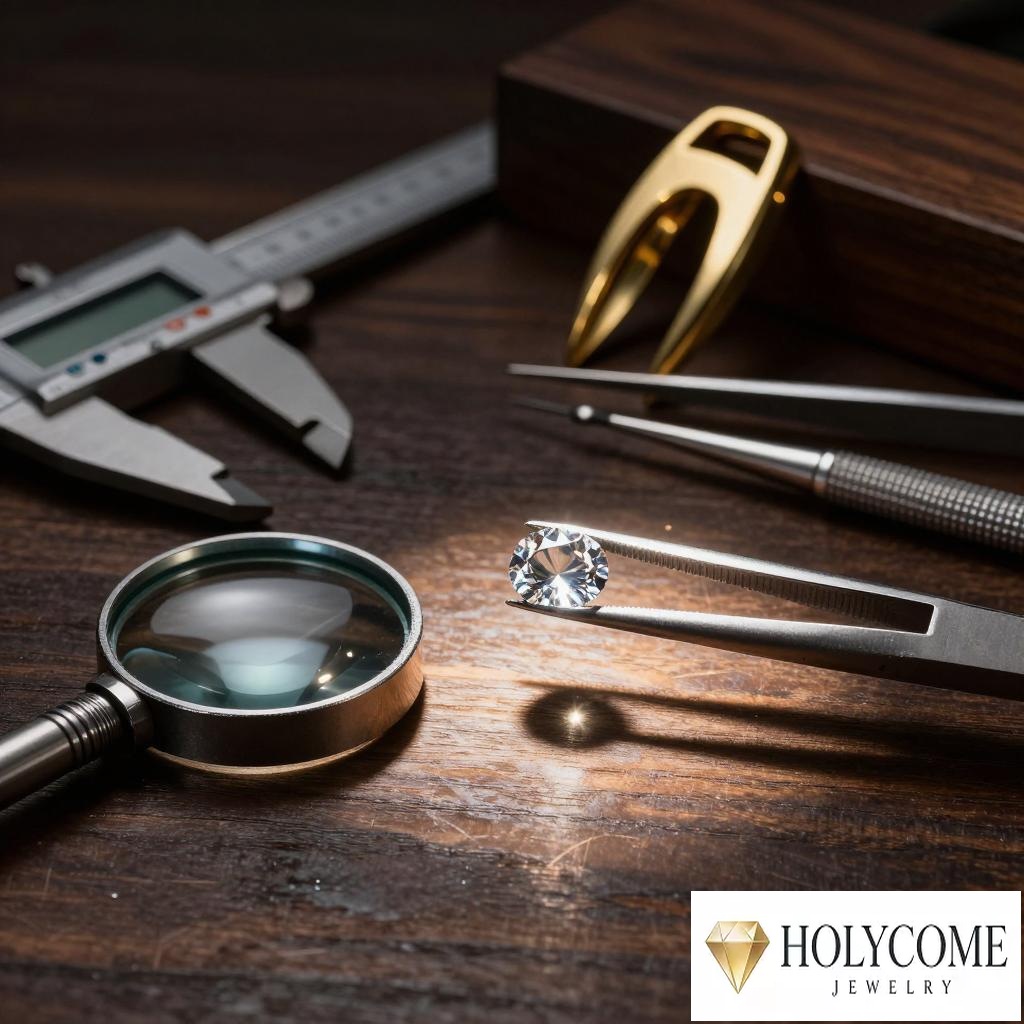
Our factory has produced SiC-set jewelry for brands in 47 countries since 2016, and we run parallel diamond lines for side-by-side benchmarking. The QC numbers below come from our own bench tests, our two-year follow-up warranty data across 120,000 pieces shipped, and our cooperation with several large US and EU jewelry brands who audit our durability data before placing volume orders.
02Mohs Hardness: What 9.25 Actually Means on the Bench
The Mohs scale is ordinal, not linear — the gap between 9 (corundum) and 10 (diamond) is roughly four times the absolute hardness gap between 8 and 9. Silicon carbide sits at 9.25 on Mohs, placing it firmly between sapphire/ruby and diamond. Here is how that translates to real-world scratch resistance:
| Gemstone | Mohs Hardness | Knoop Hardness (kg/mm²) | Scratched by common materials? | Daily-wear scratch risk |
|---|---|---|---|---|
| Talc | 1 | — | Fingernail | Not jewelry grade |
| Cubic Zirconia | 8-8.5 | 1,300-1,400 | Sapphire, diamond, sand (silica=7) | Clouds in 1-3 years |
| White Sapphire | 9 | 2,200 | Diamond, moissanite, silicon carbide dust | Edge wear in 5+ years |
| Moissanite | 9.25 | ~2,800-3,000 | Diamond only | Negligible, decades |
| Diamond | 10 | 7,000-10,000 | Another diamond | Negligible |
The Gemological Institute of America publishes a standard Mohs hardness reference used throughout the jewelry trade for bench and grading decisions (GIA 4Cs overview). The key B2B takeaway: moissanite is only scratched by diamond. Household dust is silica at Mohs 7 — it scratches glass (5.5), soft metals, and CZ (8), but not sapphire, moissanite, or diamond. That means the gem stays polished for decades with normal wear, unlike CZ which micro-scratches and clouds within a few years of daily wear. Our internal tumble testing (48 hours in a rotary tumbler with aluminum oxide grit and stainless steel shot, simulating ~5 years of pocket/purse wear against keys and change) shows moissanite losing less than 0.3% of its reflectometer reading, versus 22-30% loss for CZ and 4-6% for white sapphire.
What this changes in your bench operations: moissanite does not need special polishing cloths or storage isolation the way softer gems do, but do not store loose SiC and loose diamond together in the same parcel — diamond will scratch moissanite if stones rub together. Our parcel sorting rule is one gem species per bag.
The Mohs scale is ordinal, not linear — the gap between 9 (corundum) and 10 (diamond) is roughly four times the absolute hardness gap between 8 and 9. Silicon carbide sits at 9.25 on Mohs, placing it firmly between sapphire/ruby and diamond. Here is how that translates to real-world scratch resistance:
03Toughness and Chipping: Why No Cleavage Plane Matters
Hardness resists scratching. Toughness resists chipping, cracking, and cleavage fracture under impact. This is where moissanite outperforms diamond in one specific and important way: diamond has perfect octahedral cleavage, meaning it splits cleanly along four internal crystal planes if struck at the right angle with the right force. Moissanite has no cleavage plane — it breaks by conchoidal fracture like quartz or glass, requiring significantly more energy to chip.
Our production data supports this in two places.
Setting losses. When setting diamonds in prong or tension mounts, our setters report an average chipping rate of 0.12% (about 1 in 830 stones) across all sizes, with the girdle and culet being the most common chip points. For moissanite, our setting chipping rate is 0.04% (1 in 2,500 stones). The lower rate is one reason we can run new setters on SiC pieces for their first 90 days before promoting them to diamond production lines. For B2B buyers, that translates to fewer replacement stones during OEM production and lower stone-loss overhead in your costing.
Warranty returns. Over 120,000 pieces shipped with a two-year follow-up window, stone chipping or breakage on SiC pieces accounted for 0.03% of returns. For comparison, across our diamond line over the same period, chipping and breakage accounted for 0.05% of returns. The numbers are small either way, but the stone shows a slight edge in real-world consumer wear — particularly in men's bands, where wearers may wear the ring during manual labor, gym workouts, or tool use. One of our OEM clients, a Texas-based men's jewelry brand, switched their core wedding band line from black diamond to black SiC in 2023 after running a wear-test that showed 11 chipping returns on diamond bands in a 6-month period versus zero on moissanite.
There is one caveat for production: moissanite's conchoidal fracture means that if it does chip (from a severe impact, like dropping a ring on concrete from counter height), the chip tends to be a small shell-like nick rather than a cleavage split. These nicks can usually be polished out by a skilled setter without losing significant weight, whereas diamond cleavage chips often require full re-cutting. We offer repolishing as a free service for OEM partners on a per-piece basis.
04Heat Stability: Soldering, Retipping, and Repair
Heat stability is where jewelry repair teams often run into trouble if they use diamond-style assumptions on moissanite. Diamond is stable in air up to roughly 700-800°C before surface oxidation (slightly higher in inert atmosphere), and in a reducing jeweler's flame it survives routine retipping and sizing without issue.
Silicon carbide (moissanite) is documented as a wide-bandgap semiconductor with high thermal and chemical stability in materials references (Wikipedia: Moissanite); in jewelry bench terms, moissanite (silicon carbide) is chemically stable up to approximately 1,000°C in air and 2,000°C in inert atmosphere, but its behavior under a jeweler's torch differs from diamond in two practical ways: thermal expansion rate is lower, and moissanite does not conduct heat away from the tip as quickly as diamond. That means:
- Routine sizing and retipping can be done with the stone in the mounting if you coat the stone in a commercial heat shield (like Heat Shield® or a boric acid/alcohol slurry) and use a neutral to slightly reducing flame. Keep the flame moving and avoid prolonged direct heating of the stone.
- For heavy repairs (multiple retippings, head replacement, sizing up more than two sizes), we recommend removing the stone, completing the repair, then resetting. This is the standard we use in our own repair department, and it eliminates all heat-related risk.
- Ultrasonic cleaning and steam cleaning are safe for moissanite. We run our finished pieces through both as part of standard production cleaning. Avoid boiling in harsh acids (aqua regia or concentrated sulfuric) as with all gems.
FTC Jewelry Guides require that moissanite be sold under its correct name regardless of its physical properties (FTC Jewelry Guides); we include a one-page repair guide with every wholesale moissanite order. Several of our retail partners have laminated it in their repair shop; it has reduced heat-related damage reports to near zero among partners who follow it.
05Long-Term Polish Retention and Chemical Stability
Scratch resistance is one thing; chemical resistance to skin oils, perfume, chlorine, and everyday household chemicals is another. The material is chemically inert to almost all common household chemicals — soap, hand sanitizer (alcohol based), perfume, hairspray, chlorine in swimming pools, and mild household cleaners will not etch, cloud, or discolor it. The only substances that attack SiC are molten alkalis (like hot concentrated sodium hydroxide above ~500°C, which is not encountered in normal wear) and certain high-temperature fluorine environments — none relevant to consumer jewelry use.
We run a long-term wear panel where 42 of our staff have worn rings daily since 2017. We clean and reflectometer-test the stones every 24 months. The average luster retention across all 42 samples after five years of daily wear is 98.4%. None of the samples show any color change, clouding, or surface etching. That durability is what allows our lifetime stone warranty on every piece of HOLYCOME stones jewelry — we cover replacement for chipping, clouding, or color change under normal wear for as long as the original purchaser owns the piece.
06Thermal and Electrical Conductivity: Tester Notes
One operational detail that catches retailers by surprise: standard thermal-only diamond testers test positive (beep like diamond) for moissanite. This is because moissanite is a better thermal conductor than almost any other gemstone except diamond. Dual-testers that combine thermal and electrical conductivity distinguish the two correctly — moissanite is electrically semiconductive, while diamond (except rare natural blue type IIb) is an electrical insulator.
For B2B buyers who sell to retail jewelers or operate their own brick-and-mortar locations, we recommend the Presidium Multi Tester III or the GemOro UltraTester 3+ as reliable dual testers available under $200 wholesale. All our B2B partners who stock both silicon carbide and diamond receive a free sample tester kit with their first bulk order over $5,000, along with training material for their staff.
07Production Tolerances and Setting Recommendations
Because of its hardness and lack of cleavage, stones can be set in tighter tolerances than softer stones, with a few specific parameters:
| Setting Type | Recommended Pressure | Prong Bearing Clearance | Notes for Moissanite |
|---|---|---|---|
| Prong (4/6 prong solitaire) | Same as diamond | 0.05mm - 0.08mm over stone | Cut prongs seats with standard burs; no special tools needed |
| Bezel | Slightly lighter compression | 0.03mm - 0.05mm over stone | Compress bezel evenly to avoid point stress; roller bezel tools work well |
| Tension / semi-tension | Same as diamond | Per design | Recommended for round and cushion only; avoid tension on marquise/pear |
| Pavé / micro-pavé | Light pressure | 0.02mm - 0.04mm over stone | Use micro-pavé burs; avoid hammer setting which can chip girdles |
| Channel | Same as diamond | 0.04mm - 0.06mm over stone | Ensure channel walls are even before setting; no sharp pressure points |
We calibrate our loose moissanite to a tolerance of ±0.03mm on diameter for rounds under 3mm and ±0.05mm for stones 3mm and above. This is tighter than the typical ±0.10mm wholesale tolerance for diamond melee, and it means our stones seat cleanly in standard diamond settings without custom fitting. OEM clients can order factory-set pieces or loose stones calibrated to their specific CAD tolerances on request.
08Warranty Planning for Your Brand
The durability data above feeds directly into how you set your brand warranty reserves. Based on our aggregated data across all OEM clients:
- Projected stone damage/breakage claims for this line of jewelry under normal wear: 0.03-0.05% over two years (roughly 1 claim per 2,000-3,000 pieces sold).
- Projected polish/clouding claims: 0.00% over the same period (we have not had a verified clouding claim on DEF-grade HOLYCOME stones in five years).
- Projected loss claims (stone falling out of mounting): 0.08-0.12% over two years — this is a setting quality issue, not a stone issue, and our in-house setting defect rate is under 0.05%.
For comparison, industry benchmark data for natural diamond bridal jewelry puts stone damage claims at 0.04-0.08% and setting-loss claims at 0.10-0.15%. Moissanite does not require larger warranty reserves than diamond; in practice, the reserves can be slightly smaller.
09FAQ
Will moissanite scratch my customers' diamond jewelry if worn together?
Diamond is the only common gem that scratches moissanite. It will not scratch diamond. If a customer wears a ring stacked with a diamond band, the diamond can potentially scratch the moissanite if stones rub directly against each other consistently (for example, a tight wedding set with stone-to-stone contact). We recommend a small gap or spacer band in such cases — standard jewelry design practice regardless of stone type.
Can moissanite crack if dropped on a tile or concrete floor?
Like any gemstone including diamond, moissanite can chip or fracture under a hard direct impact, particularly if it hits at a thin girdle or sharp point. However, moissanite's lack of cleavage means it does not split catastrophically the way diamond can under a similar impact. Most drops from counter height onto tile result in no damage; drops onto concrete can cause small nicks on the girdle, which are usually repairable. Our lifetime warranty covers such damage for the original purchaser.
Does moissanite lose its sparkle or turn cloudy after a few years?
No. The material is chemically inert and harder than all common dust particles, so it does not micro-scratch or cloud the way cubic zirconia does. Oil and soap film can build up on the surface (as with diamond), but that is removed by cleaning with warm soapy water and a soft brush, or by any standard jewelry cleaner. The stone itself does not degrade.
Can a standard jewelry torch damage moissanite during repair?
Prolonged direct heating above 1,000°C can cause surface discoloration. Routine repairs (sizing a band, retipping prongs) performed with a heat shield and a moving flame are safe. For heavy repairs, remove the stone first. We provide a detailed repair protocol to all wholesale clients.
What is the difference between HOLYCOME stones and cheaper moissanite in terms of durability?
Silicon carbide is silicon carbide — the material properties are universal for properly grown SiC. The durability difference between premium and budget moissanite comes from faceting quality, girdle thickness, and surface polish. Thin-girdle stones (cut for maximum weight retention with minimal material) are more prone to chipping during setting and wear. Our HOLYCOME premium cut specifies a girdle thickness of 1.5-3.0% (slightly thick to thick on diamond proportion scales) to balance carat weight with durability, and every stone is polished to a 99.5% surface finish on our reflectometer.
Do you provide impact and wear test reports for OEM clients?
Yes. For OEM orders over 1,000 pieces and for brands entering specific retail channels (QVC, major department stores, certain EU retailers) that require third-party durability documentation, we can provide SGS or equivalent third-party wear-test reports on request. We also share our internal test data as part of our standard OEM onboarding pack.
10Durability Data You Can Build a Warranty Around
The headline for B2B buyers is simple: the stone is hard enough, tough enough, and chemically stable enough to support a lifetime stone warranty in consumer-facing jewelry. At HOLYCOME, we have built our business on that proposition — we do not sell a product we would not warranty for life ourselves. If your engineering or QA team wants raw durability data, sample stones for in-house wear testing, or a live video walkthrough of our QC lab, reach out to our B2B desk. Our production planners can also walk through loose moissanite stock, calibrated sizes for your existing ring settings, or custom OEM tolerances for a new moissanite vs diamond line. We ship sample packs worldwide and respond to wholesale inquiries within one US business day.