01Why returns on rings wholesale start after the parcel lands
Most return arguments I sit through are not about a bad stone. They are about a ring that went cloudy in three weeks, a band that lost a prong on a kitchen counter, or a size that never fit and nobody offered to fix. The buyer blames the factory, the end customer blames the buyer, and the ring comes back through the post twice.
After twelve years on the QC floor, I can tell you the fix is not a better polishing wheel. It is a care, cleaning and repair loop that rides along with every order you place. If your supplier hands you rings and nothing else, you are buying returns in advance.
This piece is about that loop, not about picking a stone. We already covered selection elsewhere in this series. Here I want to talk about the boring after-sales plumbing that decides whether your return rate sits at two percent or eight.
02What actually comes back, and why
Pull six months of your own return reasons and sort them honestly. On moissanite and lab-grown diamond rings sold through wholesale channels, the pattern is remarkably stable across US and EU accounts.
- Cloudy or dull appearance after contact with lotion, chlorine or dish soap. Roughly half of these are cleaning problems, not stone problems.
- Loose stones, usually from a prong bent during daily wear or a setting that was never tightened at the bench.
- Size mismatch, especially on wider bands where customers order their usual size and forget that a 6mm band fits tighter than a 2mm one.
- Plating wear on 925 silver pieces, which is a care instruction failure more than a manufacturing one.
- Surface scratches on the shank from keys, gym equipment and stacked rings rubbing together.
Notice that almost none of these are stone quality failures. They are lifecycle failures. That is good news for a wholesale buyer, because lifecycle failures can be engineered out with paperwork and a small repair budget.
Pull six months of your own return reasons and sort them honestly. On moissanite and lab-grown diamond rings sold through wholesale channels, the pattern is remarkably stable across US and EU accounts.
03The three-stage QC gate that stops half of it before shipping
Our line runs a three-stage check on every ring order: incoming stone verification, in-process inspection at setting and polishing, and a pre-ship AQL sampling pass. The third gate is where most future returns get caught, because it is the first time the finished ring is looked at as a wearable object rather than a component.
At pre-ship we check prong tension by hand, spin the stone under a loupe for wobble, run a finger around the inside of the shank for burrs, and verify the stamped size against the packing list. We also photograph each SKU under consistent lighting so you have a baseline image of what normal looks like. When a customer later claims the ring arrived scratched, you can compare.
Our cost, speed and yield run about 20 percent better than typical trading companies on this kind of order, and the reason is simple: we cut and set in the same building. There is no handoff to a second workshop, no re-inspection gap, and no argument about who scratched what. One floor, one QC signature.
04Build the care card before you build the listing
The cheapest return prevention tool you will ever buy is a printed care card in the box. Not a folded pamphlet with legal text, but a short, plain sheet the customer will actually keep next to the jewelry tray.
Write it in the customer's language, not in factory terms. Four lines do most of the work: remove before swimming, showering or cleaning with chemicals; wipe with a dry soft cloth after wearing; store separately so stones do not rub; bring it back to us for a free tighten and polish once a year.
That last line matters commercially. A yearly check invitation converts a one-time sale into a service relationship, and it catches loose prongs before they become lost stones. We supply care cards in bulk with wholesale orders at no extra charge when you confirm artwork at the sample stage.
If a customer never learns how to clean a ring, they will eventually decide the ring is defective. Education is cheaper than a refund.
05Cleaning instructions that survive real bathrooms
Most cleaning advice online is written for people who already know how to handle jewelry. Write yours for someone standing at a sink with a toothbrush and no patience.
What to tell the end customer
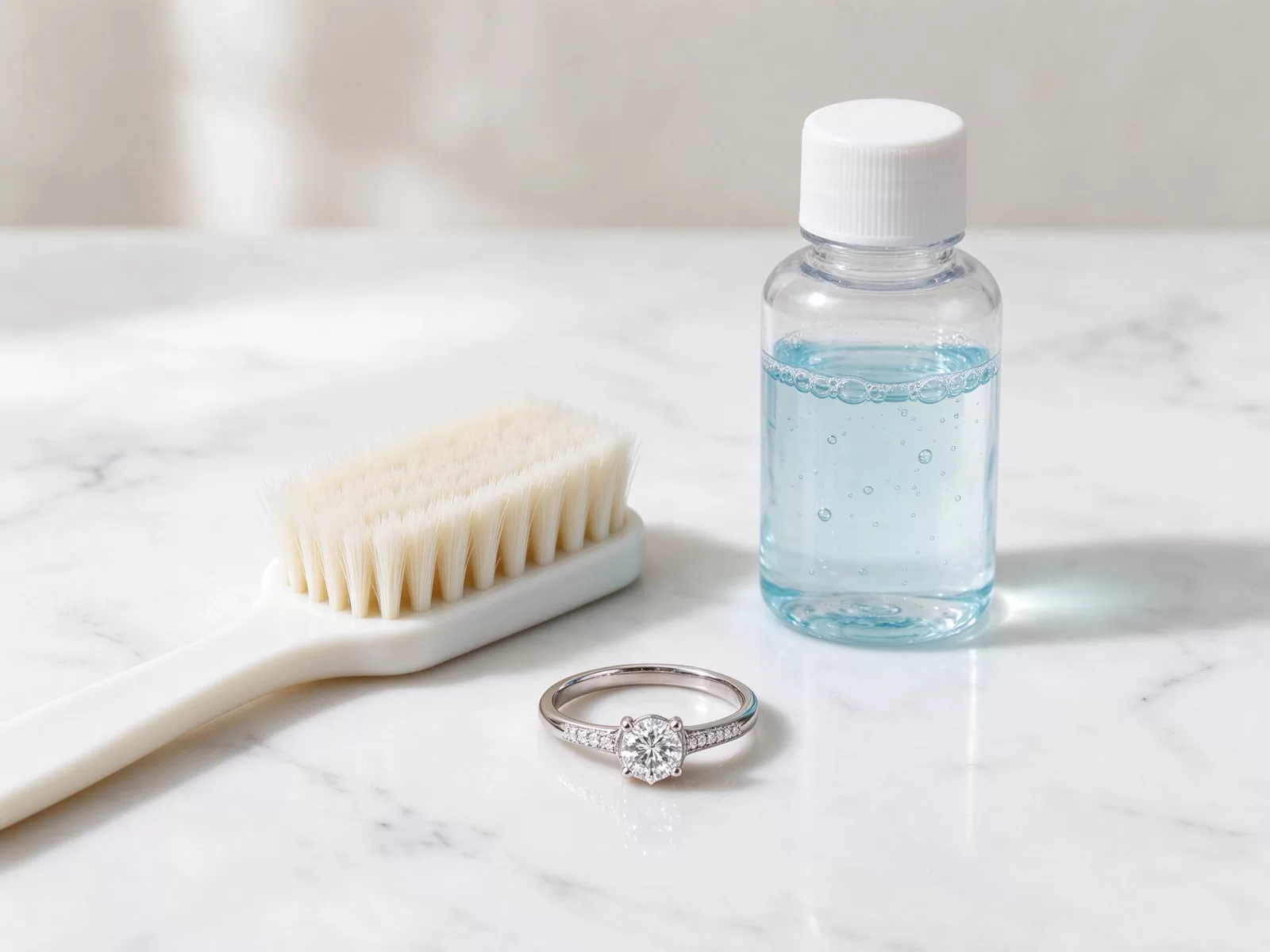
- Warm water, a drop of mild dish soap, and a soft brush. Thirty seconds, not five minutes.
- Rinse over a closed drain or in a small bowl, because a loose stone plus an open drain is a lost sale.
- Pat dry with a lint-free cloth and let it air for ten minutes before wearing.
- Skip ultrasonic cleaners on silver with plated finishes, and skip steam on any ring with a glued or tension setting.
- No toothpaste, no baking soda paste, no jewelry dips on moissanite. They leave a film that reads as dullness.
Moissanite and lab-grown diamond both hold up well to this routine. The failure mode is almost always residue, not abrasion. A ring that looks cloudy after a month is usually wearing a thin coat of hand cream.
06Repair loop: what you fix, what you replace, what you refuse
Set a written repair policy before your first wholesale shipment, because the moment a customer asks, you want an answer that does not involve a meeting. Here is the split we recommend to buyers, and the one we support on our side.
| Issue | Typical cause | Action | Who pays |
|---|---|---|---|
| Loose or missing stone | Prong wear or impact | Retip and reset | Split or free within 12 months |
| Surface scratches | Normal wear | Polish and rhodium refresh | Customer, low flat fee |
| Size change within one size | Ordering error | Resize at bench | Buyer absorbs, quoted upfront |
| Plating wear on silver | Chemical contact | Replate | Customer, with care advice |
| Cracked or chipped stone | Impact damage | Replace stone | Customer, quoted per stone |
Publish this table on your site and in your wholesale line sheet. Buyers who know the rules stop arguing, and customers who know the rules stop expecting free replacements for damage they caused.
On our side, we hold spare stones for every SKU we produce for twelve months after the order, so a replacement stone matches the original batch. We also keep the CAD file, which means a resize or a re-tip uses the original geometry instead of a bench guess.
07Certificates and paperwork that reduce disputes
Every order ships with GRA certificates for moissanite and IGI certificates where lab-grown diamond is specified. Certificate numbers are logged against the packing list, so a customer query about a specific stone can be traced to the exact parcel and inspection sheet.
That trail is what shortens arguments. When someone claims a stone is not what they ordered, you do not need to debate. You pull the certificate, pull the pre-ship photo, and compare. In my experience, nine out of ten disputes end at that point.
08Order mechanics for a care-first program
Practical numbers, so you can plan the loop into your buy rather than bolt it on later. Stock rings carry an MOQ of 1 piece, which is how most buyers test a care program on a small run first. Custom designs start at 30 pieces per style. Production runs 12 to 18 days depending on setting complexity and stone sourcing.
Payment is T/T with 30 percent deposit and balance before shipment, or PayPal for samples. We ship DDP, typically 5 to 8 days to US and EU addresses, with duties handled on our side. For anything about a specific SKU, spare stone availability or a repair policy draft, message WhatsApp +86 133 7744 7107 or email service@holycome.com.
09Frequently Asked Questions
What is the minimum order if I want to test a care and repair program?
Stock rings start at 1 piece, so you can order a handful of SKUs, print care cards and measure your return rate before committing. Custom designs require 30 pieces per style. Sample orders can be paid by PayPal.
How long does production and delivery take for a wholesale ring order?
Production runs 12 to 18 days after artwork and deposit confirmation, depending on setting type and stone availability. DDP delivery adds roughly 5 to 8 days to US and EU addresses, with duties covered.
How is pricing set, and what does a repair program cost?
Pricing is quoted per style based on metal, stone grade and setting labor, with T/T 30 percent deposit as standard. Repair work such as retipping or resizing is quoted per piece at the time of request, so you can pass a clear figure to your customer.
If you want to see how this loop looks on paper, ask us for a quote and a sample set. Send your top three ring styles, your target retail price band and the return reasons you see most often, and we will come back with a costed care and repair plan alongside the wholesale price. Samples ship first so you can check the prong work yourself before you commit to a season.