01Why size coverage beats design count
Most buyers who come to us for moissanite wholesale start with a design sheet. That is backwards. After twelve years on the floor, I can tell you the returns and the dead stock almost never come from a bad setting. They come from a ring that was made in the wrong size, or a center stone that looked right in a photo and wrong on a hand.
Our own shipping data backs this up. When a buyer orders a balanced size curve, reorder rates run about 20% better than a buyer who orders the same total piece count spread across too many shapes. The reason is simple: we cast and set in-house, so we cut waste at the stone-check bench instead of paying a trading company margin to sort it out later.
This piece is not another how-to-choose guide. It is a coverage map: what moves, what sits, and how to write a buy sheet you can defend to your own customers.
02The size bands that actually turn
For loose moissanite and for center stones, demand clusters hard. Roughly 70% of wholesale volume sits in four bands. If you are building a first or a repeat order, weight your dollars here before you touch the exotics.
- 0.50 to 0.75 ct equivalent: band and stacking stones. High unit count, low ticket, steady reorder.
- 1.00 to 1.50 ct equivalent: the volume core for solitaires and three-stone. This is where most of your margin lives.
- 2.00 ct equivalent: strong seller in the US, growing in the EU. Order deep on round and oval only.
- 3.00 ct and up: low velocity, high ticket. Keep two or three pieces as halo stock, not as a full size run.
Emerald and radiant cuts at 2.00 ct and above sit longer than round or oval in the same weight. That is a shape issue, not a size issue, and it shows up fastest in your 60-day sell-through.
For loose moissanite and for center stones, demand clusters hard. Roughly 70% of wholesale volume sits in four bands. If you are building a first or a repeat order, weight your dollars here before you touch the exotics.
03Ring size coverage: the quiet profit killer
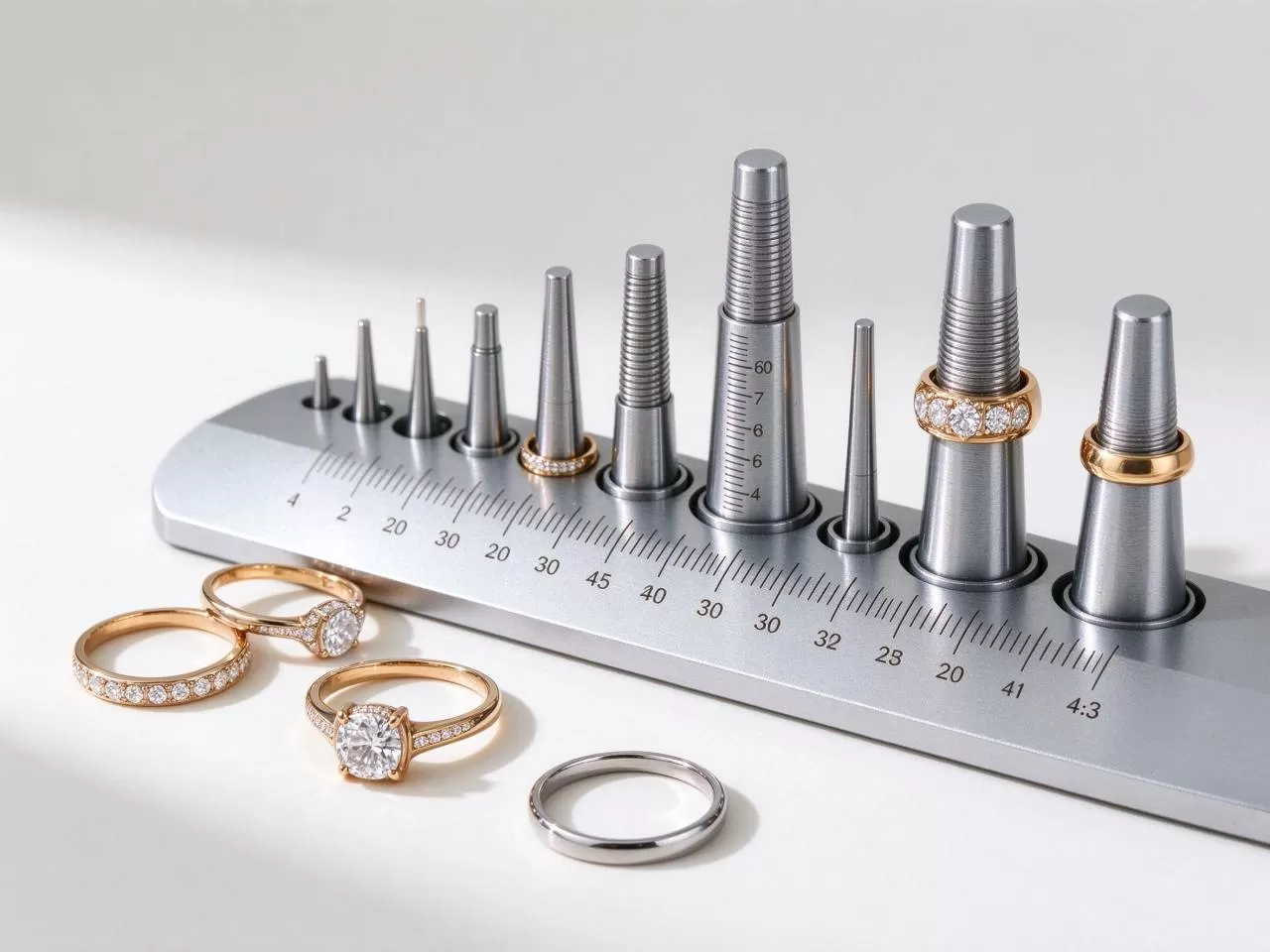
Ring size is where wholesale buyers lose money without noticing. A style that sells beautifully in US 6 and 7 can sit for a year in 4 and 9. We see this on every pre-ship AQL pull.
Here is the working curve we recommend for a first stock order of any bridal style. Adjust for your market, but do not flatten it.
| US size | Share of order | Notes |
|---|---|---|
| 4 to 5 | 15% | Keep light; mostly special order |
| 5.5 to 6.5 | 35% | Core stock, reorder often |
| 7 to 8 | 35% | Core stock, equal to above |
| 8.5 to 10 | 15% | Size up on men's and wide bands |
Wide bands and eternity styles shift the whole curve up half a size. A 4mm comfort band in US 6 fits tighter than a 2mm solitaire in the same marked size, and customers blame the ring, not the width. Note it on your listing.
04What sits, and why
Dead stock is rarely random. In our experience it clusters into four buckets, and three of them are avoidable at the order stage.
- Oversized fancy shapes: 3 ct plus pear, marquise and heart. Beautiful in a case, slow on a reorder.
- Full size runs on unproven designs. Ten sizes of a new style is ten chances to sit.
- Half sizes outside 5 to 8.5 on stock items. Offer them as custom, not shelf stock.
- Yellow and rose gold plated silver in large sizes. Plating wear shows up fast and drives returns.
One more: matched pairs sold as singles. Earring stones need to be sold in matched pairs by color and measurement, and unmatched pairs are the single most common complaint we hear from buyers reselling loose stone.
05How we hold the size and fit line in production
Coverage only works if the piece that ships matches the spec sheet. Our line runs a three-stage check: incoming stone check on every parcel (color, measurement, inclusion under 10x), in-process check at setting and polishing, and a pre-ship AQL pull against your approved sample.
Certificates follow the goods. Every stone above 0.30 ct ships with GRA, and we arrange IGI on request for center stones where your customer needs a lab report. Metal is 925 silver, and we stamp and measure the band width at the QC bench, not at packing.
Half-size errors and mismatched pairs cause more returns than any stone grade issue we see. Fix the fit, and the return rate follows.
06MOQ, lead time and how to order a size curve
Stock items carry an MOQ of 1 pc, so you can test a size curve without committing to a full run. Custom styles start at 30 pcs per design, and that is where size coverage gets planned properly rather than guessed.
Production runs 12-18 days on custom after sample approval. Stock ships faster. Payment is T/T with 30% deposit, or PayPal for samples. We ship DDP, typically 5-8 days to US and EU addresses, so your landed cost is known before you commit.
If you want to talk through a buy sheet, message the floor directly on WhatsApp at +86 133 7744 7107 or email service@holycome.com. Send your current size mix and we will tell you honestly which lines will sit.
07Frequently Asked Questions
What is the minimum order for a moissanite wholesale size run?
Stock items start at 1 pc per size, so you can build a curve gradually. Custom designs require 30 pcs per style, and we can split that across sizes to your curve.
How long does production take once sizes are confirmed?
Custom orders run 12-18 days after sample approval, followed by DDP delivery of 5-8 days. Stock sizes usually ship within a few working days.
How is price quoted for different sizes?
Price is quoted per piece, based on stone weight, metal and setting, with volume breaks at the 30 pc custom tier. Certificates are included on qualifying stones at no extra line item.
08Get a size-and-fit quote
Send us your target market, your current best-selling size mix, and the styles you are considering. We will come back with a quoted buy sheet, sample availability, and a straight answer on which sizes to hold and which to offer as special order.