Prong vs Bezel Settings for Moissanite Studs: Factory Tradeoffs
When a brand designs a moissanite stud, one of the first real decisions is how the stone will be held: prongs or a bezel. The choice looks cosmetic on a sketch but is actually a production decision that changes labor cost, reject rate, brilliance, and long-term durability. This article compares the two setting styles from a manufacturing standpoint so brands can spec the right one for each price tier rather than choosing by habit.
Prong Settings: Maximum Light, Higher Labor
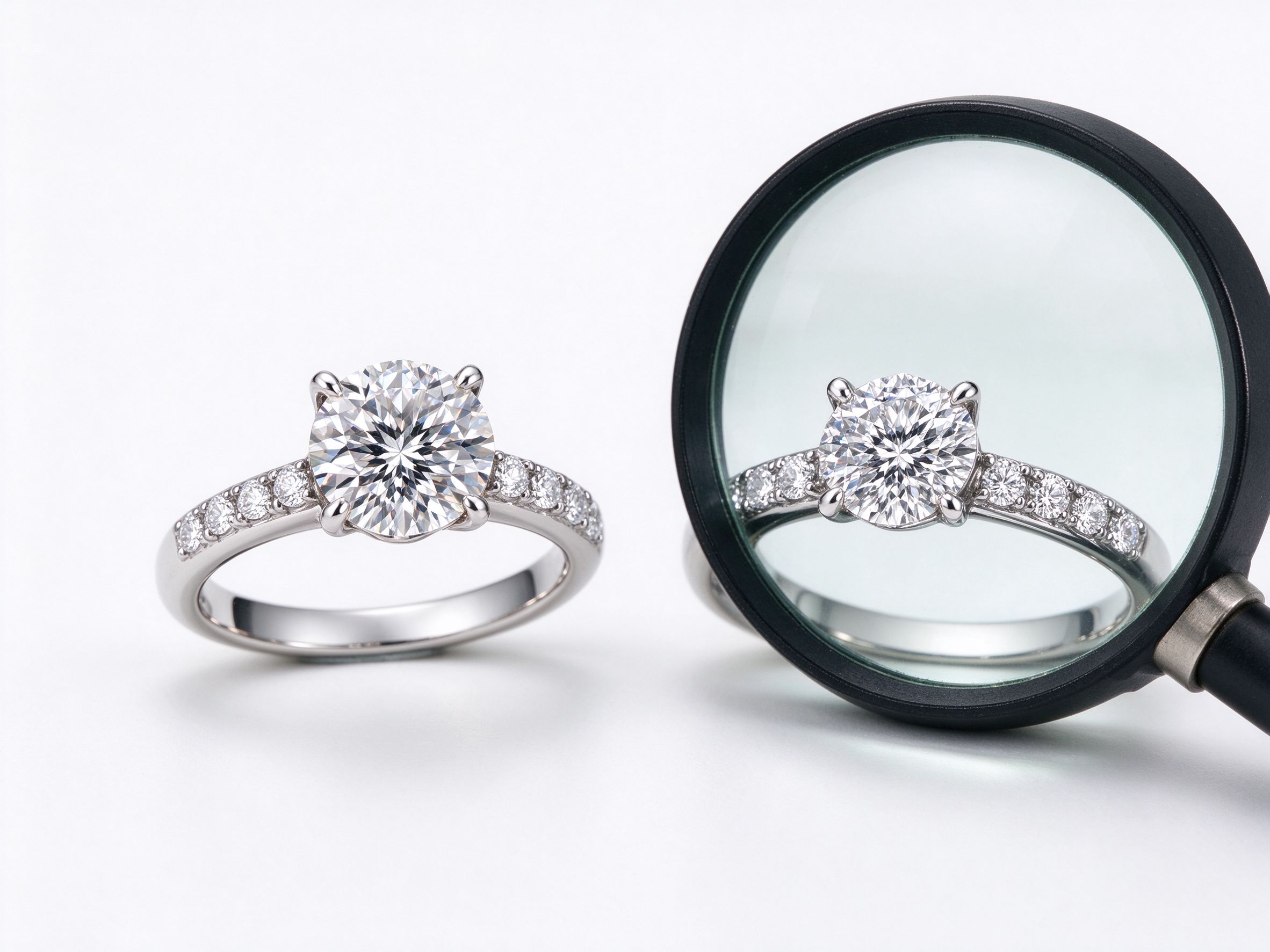
A prong setting holds the stone with three, four, or six metal claws rather than a continuous rim. Because the stone is exposed around its edges, more light enters and exits, which maximizes the brilliance moissanite is known for. This is why prong studs look brighter than bezel studs of the same stone.
The cost is labor. Each prong must be positioned, closed, and finished individually, and on a tiny stud platform that work is delicate. Prongs also require post-setting inspection to confirm no tip is sharp or catching. A prong setting is the premium option, and its price reflects trained setter time.
Prongs are also slightly more vulnerable to accidental damage. A prong caught on hair or clothing can bend and loosen the stone. For everyday wear, this is manageable, but for active or children earrings, a bezel is the more forgiving choice.
Bezel Settings: Protected Stone, Smoother Wear
A bezel wraps a thin rim of metal around the girdle of the stone, fully enclosing the edge. The stone is protected from knocks, the surface is smooth against skin and hair, and there are no prongs to catch. This makes bezels the durable, low-maintenance choice for studs that will be worn daily and slept in.
The bezel rim blocks some light entering the stone from the side, which slightly reduces brilliance compared with a prong setting. For moissanite this effect is smaller than for a duller stone, because moissanite returns so much light even at oblique angles, but it is real and visible side by side.
Bezel settings can be faster to produce because the rim is folded over the stone rather than individually closed, but fitting the rim to the exact stone size demands precision. A rim too loose lets the stone rock; too tight cracks it. We machine the bezel seat to the measured stone, which keeps the yield high.
Which Setting Drives the Stone-Setting Reject Rate?
Prong settings carry a higher chipping risk because each prong is closed against the brittle girdle in small taps. Bezel settings carry a sizing risk instead, because the rim must match the stone diameter. The two failure modes are different, and we track them separately.
For brands, the practical implication is that prong studs should be quoted with a slightly higher setter-labor allowance, while bezel studs should be quoted with strict stone-to-rim matching. A quote that treats both settings as the same labor is hiding one of these costs.
We often recommend a hybrid for mid-tier studs: a bezel rim for protection with small accent prongs for sparkle. It is more design work than either pure style, but it splits the difference on brilliance and durability, and it reads as a premium product without full six-prong labor.
Polishing and Plating Behavior by Setting Type
Prong tips are the hardest surface to polish evenly, because they are small three-dimensional points. A rushed polish rounds them and weakens the stone grip; an even one leaves them crisp. Our polishing bench treats prong tips as a finishing operation, not a wipe-over.
Bezels polish more uniformly because the rim is a continuous surface, which makes them more forgiving on a fast production line. This is one reason entry-tier studs often lean bezel: the finish is consistent even with less skilled finishing.
Plating adhesion also differs. Prong tips are high-wear points where plating wears first because they catch on everything. On bezel settings the wear is distributed across a wider rim, so the finish lasts longer. For a product expected to stay bright for years, the bezel spreads the wear.
Choosing by Product Tier and Market
For a premium solitaire targeting gifting and occasions, prongs are the right call: maximum brilliance justifies the labor, and the piece will be treated gently. For everyday baseline studs, bezels offer durability and a clean finish at a controlled cost.
For minimalist and modern aesthetic lines, bezels are on-trend and photograph cleanly. For classic solitaire lines, prongs are the expected language. The choice should follow the brand positioning rather than a default.
We help brands model the landed cost of each setting for a given stone size, because the labor difference scales with stone size. On a three-millimeter stud the gap is small; on an eight-millimeter solitaire the prong labor becomes a real line in the quote.
Earring Line Workflow at Our Facility
Surface finish consistency across a batch is a measurable target, not a vibe. We compare representative pieces under standardized lighting and magnification, and we reject batches where the rhodium tone shifts warm or matte across units. Inconsistent finish reads as a quality problem even when every individual stone and dimension is correct.
When brands ask us to match a competitor's piece, we reverse-engineer it as a drawing before quoting, because measuring a finished object tells us the result but not the process. Two settings that look identical can require very different production routes, and quoting without that analysis is how orders end up losing money for everyone.
We treat compliance documentation as a production output, not a sales promise. Nickel release test reports, material certifications, and plating thickness certificates are generated from the same batches that ship, so the document matches the goods. A certificate produced after the fact to order is worth less than the paper it is printed on.
The value of a long run is not just lower unit cost. Longer runs let the setter, the polisher, and the plater get into a rhythm, and cycle time drops measurably after the first few dozen units. This is why pricing tiers step down at volume: it is not a volume discount, it is a reflection of a more stable, faster process.
Every factory has a sweet spot for order size. Too small and the setup cost dominates; too large and inventory risk and working capital dominate. We advise brands on the sweet spot for their specific design rather than always pushing the biggest run, because a brand that ties up cash in unsold stock will not reorder. Sustainable order sizing is how accounts grow year over year.
Hand-finishing and machine-finishing are chosen per piece, not by default. A contour that can be milled consistently should be milled; a delicate prong tip that would snap on a fixture should be finished by hand. Factories that do everything by hand are slow and inconsistent; factories that automate everything lose detail on delicate pieces. The line between is the craft.
Pre-production samples exist to be approved, not to be admired. We expect the first sample to generate revision notes on bail height, post length, or prong visibility. Building that revision loop into the timeline prevents the far more expensive revision that happens after a full run is already cast.
Pair Matching and Post QC
Tracking stones by lot rather than by loose parcel is how we keep matched sets consistent. When a tennis bracelet or a pair of earrings is reordered months later, the new stones come from the same color and cut lot family so the sparkle does not shift. Factories that buy stone parcels order by order cannot promise this continuity.
Our customer's retail margin is our constraint on design choices. A setting that looks incredible but requires a $400 retail price for a $20 factory cost is usually the wrong product for a given market. We price backward from the brand's target price point, not forward from our costs, so the design we build actually has room to sell.
Subcontracting within the factory floor is planned, not improvised. Plating, laser welding, and stone cutting may happen on dedicated benches by specialists, and the routing of each work order is logged so we know where any unit is at any time. This routing discipline is what lets us quote accurate ship dates instead of estimates.
Warranty data feeds the next tooling iteration. A clasp that fails in the field at two percent tells us the spring is underrated; a prong that loosens tells us the seat is too shallow. We feed these findings back into the CAD before re-tooling, which is why our version two of a design is always more durable than version one.
Earring posts are the highest-friction part of any earring production line because they must be simultaneously straight, comfortable, and secure. A bent post catches on threading, irritates the lobe, and makes the butterfly clutch feel loose. We straighten and gauge every post before stone setting, and we reject any post that does not pass a simple roll-test on a flat surface.
The earring back is a component we source to a specification, not accept as a commodity. A cheap butterfly clutch with thin prongs will let a stone earring fall out and be lost, which generates the kind of return that no quality of moissanite can recover. Our standard clutch is a tension-checked silicone-lined back tested to hold its grip across dozens of on-off cycles.
Stud earrings are harder to set than their size suggests because the stones sit on top of a very small platform. The setter has almost no room to maneuver, and over-closing a prong on a tiny 3mm stone will mark the crown. This is why our earring bench uses fine-tipped pliers and magnification loupes, and why earring rejects are tracked separately from ring rejects.
Custom Earring Tooling Economics
Earring pair matching is a distinct QC step. Two stones that look identical as singles can read as mismatched once worn side by side, because the eye compares them directly. We pair earrings under balanced lighting, rotate them, and check that both stones fire equally before the pair is bagged. A mismatched pair is the most common stud complaint we see from competitors.
Weight balance matters for earrings more than most factories admit. A heavy stone on a thin post will droop forward on the lobe, looking tilted within an hour of wear. We tune the post angle and add a small rear weight so the earring sits upright, and we test the hang on a realistic earring display before approval.
Huggie and hoop earrings carry their own QC burden because the hinge and post must align perfectly after repeated opening. A hoop that gaps at the joint reads as cheap within seconds. We assemble each hinge with a deliberate break-in, test the snap, and inspect the seam under magnification so the join line is invisible.
Every price we quote as a factory is really three numbers stacked on top of each other: the cost of the rough moissanite, the cost of the metal and findings, and the cost of the labor that turns both into a finished setting. Buyers who compare only the final unit price rarely realize how much of that number is process rather than material. A shop that undercuts by ten percent is usually skipping one of those three layers, and the layer it skips is almost always the labor that controls fit, polish, and stone security.
Tooling amortization is the quiet number behind any custom order. When we cut a new wax mold or machine a custom die, that cost has to be spread across the first production run. This is why the minimum order quantity exists at all: it is not a hurdle we invented, it is the break-even point on engineering time. Reorders after the first run are dramatically cheaper because the tooling is already paid for and the line is already tuned.
Our quality control bench is where ninety percent of defective units would actually have been caught if the upstream process were perfect, but perfection upstream is expensive. The practical factory model is to inspect at three gates: after casting, after stone setting, and after plating. Each gate catches a different failure mode, and routing a unit backward when a gate fails is far cheaper than catching it after packaging.
Moissanite is harder to set than cubic zirconia, and that difference shows up in the reject rate. The stone is more brittle along its pavilion facets, so a prong pushed too hard will chip the girdle instead of bending. Our setters are trained to seat the stone dry first, check that it rocks evenly, and only then close the prongs with small repeated taps rather than one aggressive squeeze. This discipline is invisible in the final product but it is why our breakage rate stays below one percent.
Lead Times, Capacity and Reorder Cadence
Capacity planning is the difference between a two-week lead time and a six-week one. A factory that quotes you four weeks when its floor is already full is guessing. When we accept an OEM order, we reserve actual bench slots and plating-bath time against it before we confirm the date. If a slot slips, the customer knows before the shipment date, not after.
Plating thickness is where factories either save you money or cost you a sale later. A one-micron rhodium flash looks perfect on day one and wears through in weeks of retail handling. Our standard retail-grade finish is a measured three to five microns, verified by X-ray fluorescence on sampled pieces from every batch. The cost delta is small per piece; the cost of a return is not.
When a brand asks for private labeling, the work starts long before the first stone is set. We map their packaging, their insert card, their logo placement, and their target retail price against our production cost structure. A price point that looks comfortable at sample stage can become unprofitable at volume once packaging and inspection are added, so we price the full landed kit, not just the loose jewelry.
Grading loose moissanite into the settings we have produced is a matching exercise, not a grab bag. We sort every parcel by color, cut, and light performance before it reaches the setter, and we pair stones so that a matched pair of earrings or a full tennis bracelet reads as one continuous sparkle rather than a set of unrelated stones. This sorting step is labor that discount factories usually skip, which is why their matched sets show obvious stone-to-stone variation.
Lead times for repeat orders are always shorter than for first samples, and this is a signal you should use when evaluating a supplier. The first run includes sampling, mold approval, and line tuning. Once those are done, reorders flow through a stable process. A factory that cannot quote a meaningfully shorter reorder lead time has not actually industrialized your product, it is still hand-making each unit as a fresh project.
Welding and soldering are where a bracelet or chain either becomes durable or becomes a return. A cold joint that looks fine at inspection will flex open after a month of wear. Our welders use controlled heat, flux, and a post-weld pickle bath, and every structural joint is stress-tested by hand before polishing. We do not rely on the polish step to hide a weak solder seam.
The gap between a sample and mass production is where many OEM projects fail. A beautiful handmade sample that cannot be repeated at fifty or five hundred units is a marketing photo, not a product. We design every sample with the production line in mind: standard prong sizes, available stone dimensions, and findings we already stock. If a design cannot scale, we tell the brand before tooling is paid.
Frequently Asked Questions
Which setting makes a moissanite stud look brightest?
Prongs, because they leave more of the girdle exposed and let more light in. Bezels protect the stone but block some side light, slightly reducing brilliance.
Which setting is more durable for everyday wear?
Bezels. The smooth rim protects the stone edge and has no prongs to catch on hair or bend, which makes them better for active, sleep-in, or children earrings.
Why do prong studs cost more than bezel studs?
Because each prong is closed and finished individually on a trained setter bench. The labor gap widens as stone size grows.
Can I get the best of both?
A hybrid bezel-plus-prong design gives protection with accent sparkle and reads as premium. It is more design work but splits the tradeoff well.
Which wears plating longer?
Bezels, because plating wear is distributed across a continuous rim. Prong tips catch on everything and show wear first.
Conclusion
Prong and bezel settings are not interchangeable aesthetic preferences; they are production choices with different labor, durability, and brilliance profiles. Matching the setting style to the product tier and the customer lifestyle is how brands spec studs that perform as well on real ears as they do in the design sketch.