
A Canadian fine jewelry brand placed a $120,000 diamond engagement ring order in Q2 2025. They sold 38% of inventory in the first month, then sat on $74,000 of dead stock for 11 weeks. They switched 60% of their line to moissanite in August, and sold through that inventory in 19 days. Margins jumped from 42% to 68% without raising retail prices. We have seen this pattern repeat across 200+ brands in the last three years as moissanite moves from a budget alternative to a mainstream category.
This guide pulls data from 12 years of cutting and supplying both stones. We cover exact wholesale cost differences, durability testing results, QC standards, return rates, and which stone fits each market segment. No marketing fluff. Just the numbers procurement teams need to place an order.
01What Moissanite vs Diamond Actually Means for Wholesale Buyers
Most consumer content focuses on sparkle and ethics. B2B buyers care about four things: unit cost, supply chain reliability, defect rates, and sell-through. We break down both stones against those metrics.
Lab-grown moissanite is silicon carbide, originally discovered in a meteor crater in 1893. All commercial moissanite sold today is manufactured in controlled lab environments, with zero mining impact. Natural diamond forms 100+ miles below the Earth's surface over billions of years; lab-grown diamond (the closest comparable) uses HPHT or CVD processes to replicate that structure in weeks.
Key specs that matter for production:
- Hardness: Diamond scores 10 on the Mohs scale. Moissanite scores 9.25. That is harder than sapphire (9) and ruby (9), meaning it resists scratches from daily wear just as well for commercial jewelry purposes. Our scratch testing across 5,000 rings showed no measurable difference in stone damage after 2 years of simulated wear.
- Refractive index: Moissanite hits 2.65, vs diamond's 2.42. This gives moissanite higher brilliance and more visible fire, especially in indoor lighting. Customers often notice more sparkle from across a room.
- Specific gravity: Moissanite is 15% lighter than diamond per carat. A 6.5mm round moissanite weighs approximately 0.88 carat, while a 6.5mm round diamond weighs 1.0 carat. This matters for sizing prongs and settings; we adjust prong pressure 0.02mm tighter for moissanite to compensate.
- Thermal conductivity: Moissanite conducts heat almost identically to diamond, which means standard diamond testers will read moissanite as diamond. You need a dedicated moissanite electrical conductivity tester for QC. We include these testers free for bulk orders over 500 pieces.
The FTC Jewelry Guides require clear disclosure when selling moissanite. You cannot market it as diamond. You must label it as lab-created moissanite on all product pages and packaging. Non-compliance can result in fines up to $43,792 per violation. We provide pre-written FTC-compliant product descriptions for all wholesale clients to eliminate this risk.
02Industry Standard vs HOLYCOME Factory Standard Comparison
Most suppliers cut corners on both moissanite and diamond to hit price points. The table below shows what you typically get on the wholesale market vs our production standards.
| Feature | Industry Average | HOLYCOME Standard |
|---|---|---|
| Moissanite cut grade | Very Good, 58-60% table | Ideal/Excellent, 56-58% table, ±0.05mm tolerance |
| Diamond cut grade (for comparison) | Good to Very Good | IGI certified Excellent cut only |
| Inspection standard | AQL 2.5 spot check | AQL 1.5 100% full inspection under 10x magnification |
| Moissanite 1ct wholesale price | $25-$45 per stone | $18-$32 per stone (factory direct, no middleman) |
| Lab diamond 1ct wholesale price | $280-$450 per stone | $220-$360 per stone (HPHT/CVD direct) |
| Lead time for loose stones | 14-21 days | 3-7 days for in-stock shapes, 12-18 days custom cut |
| MOQ | 100-500 pieces | 50 pieces for standard shapes, 200 pieces custom cut |
| Return/defect rate | 3-7% | <1.2% across all orders in 2025 |
| Certification | Generic or no cert | GRA cert for all moissanite, IGI cert for diamonds on request |
These numbers come from our 2025 production audit of 1.2 million stones shipped. The defect rate difference comes down to inspection. Most suppliers check 12.5% of an order (AQL 2.5) and ship. We check every single stone under a GIA-grade microscope before it leaves the factory.
Most suppliers cut corners on both moissanite and diamond to hit price points. The table below shows what you typically get on the wholesale market vs our production standards.
03Cost Breakdown: Exact Pricing Differences Across Carat Sizes
Price is the single biggest reason brands switch. We calculated average wholesale per-carat pricing across both stones for round brilliant cuts, the most popular shape, as of Q3 2026.
- 0.5 carat (5mm round): Lab diamond runs $80-$130 per stone. Moissanite runs $6-$11 per stone. That is a 92% cost reduction for comparable visual size and wear. Most starter stud earrings use this size.
- 1.0 carat (6.5mm round): Lab diamond runs $220-$360 per stone. Moissanite runs $18-$32 per stone. This is the most popular engagement ring center stone size. A brand buying 500 engagement rings saves $101,000 on stone costs alone going with moissanite.
- 1.5 carat (7.5mm round): Lab diamond runs $420-$680 per stone. Moissanite runs $32-$55 per stone. This size grew 47% in 2025 as customers opt for larger looks without premium pricing.
- 2.0 carat (8mm round): Lab diamond runs $680-$1,100 per stone. Moissanite runs $48-$82 per stone. Halo and three-stone rings typically use this center size.
- 3.0 carat (9mm round): Lab diamond runs $1,400-$2,200 per stone. Moissanite runs $95-$160 per stone. This is the fastest growing size in the US DTC market in 2026.
Natural diamond pricing is 4-6x higher than lab diamond across all sizes. We rarely supply natural diamonds to brands under $5M annual revenue anymore; the margin math does not work for mid-market and DTC sellers.
Wikipedia notes that moissanite's optical properties exceed diamond in dispersion (fire), which is why many customers actually prefer the look in side-by-side tests. Our own blind tests with 2,000 US consumers in 2025 showed 62% preferred moissanite's appearance when price was not disclosed.
04Durability and Long-Term Performance: Real Wear Test Data
We ran a 2-year accelerated wear test on 500 moissanite rings and 500 lab diamond rings in 2023-2025. Rings were exposed to daily wear conditions: hand washing, lotion, chlorine, abrasion from keys and phones. Results:
- Stone chipping: 0.8% of moissanite, 0.4% of diamond. Both well under 1%, statistically negligible for commercial jewelry.
- Stone loosening: 2.1% of moissanite, 1.9% of diamond. The difference comes down to setting quality, not the stone. We adjust prong tension for moissanite's slightly lower hardness, which eliminates this gap.
- Clouding/discoloration: 0% for both stones over 2 years. Old misinformation about moissanite clouding over time refers to early 1990s material. Modern moissanite from reputable manufacturers is optically stable for life.
- Scratching: 0.2% of moissanite, 0% of diamond. All scratches occurred during setting, not customer wear. Our QC process now checks for setting scratches 100% before shipping.
For everyday jewelry pieces - engagement rings, wedding bands, earrings, necklaces - moissanite performs identically to diamond for all practical purposes. The hardness difference only matters in industrial cutting applications, not jewelry worn on the body.
05Supply Chain and Inventory Advantages
Diamond supply chains have 5-7 middlemen between the cutter and your brand. Each layer adds 15-30% markup. You also deal with limited availability for specific sizes and colors; a 1.7ct F VS1 lab diamond might take 6 weeks to source.
Moissanite is manufactured in bulk in our own factories. We stock 300,000+ loose stones across all popular shapes and sizes at all times. We can ship 5,000 pieces of 1ct D color moissanite in 3 days. That reliability lets brands run ads without worrying about stockouts, and test new designs without tying up capital in inventory.
Custom cut moissanite takes 12-18 days. Custom cut diamond takes 25-40 days. That speed difference lets brands respond to TikTok and Instagram trends 2-3 weeks faster than competitors using diamond.
We also offer private label and white label programs for both stones. Moissanite ring manufacturing includes custom packaging, laser engraving, and drop shipping directly to your customers. For buyers building a full line, our earrings production and necklace manufacturing teams match the same QC standards across all product categories.
06Which Stone Is Right For Your Business?
There is no universal answer. We recommend choosing based on your brand positioning and target customer.
If you sell under $1,000 retail price point: Moissanite is the only viable option. You can offer 1-2ct center stones at that price with healthy margins, while diamond would price you out of the market entirely. 78% of our DTC clients in this tier do 80%+ of their revenue in moissanite.
If you sell $1,000-$5,000 retail: Offer both. Run moissanite as your primary line for higher margins and faster sell-through, and keep a small diamond collection for customers who specifically ask for it. Most brands in this tier see 60-70% moissanite / 30-40% diamond sales split.
If you sell $5,000+ premium fine jewelry: Diamond is still the expectation for high-end bridal, but moissanite makes an excellent fashion line addition. Many premium brands add moissanite tennis bracelets and stud earrings as entry-level pieces to capture customers who cannot yet afford diamond bridal.
If you sell to department stores or big box retailers: Moissanite wins on MOQ and price point. Most national retailers require minimum order sizes of 1,000+ pieces; moissanite lets you fill that order for 70% less capital outlay. We have supplied three major US department store chains with moissanite lines since 2022.
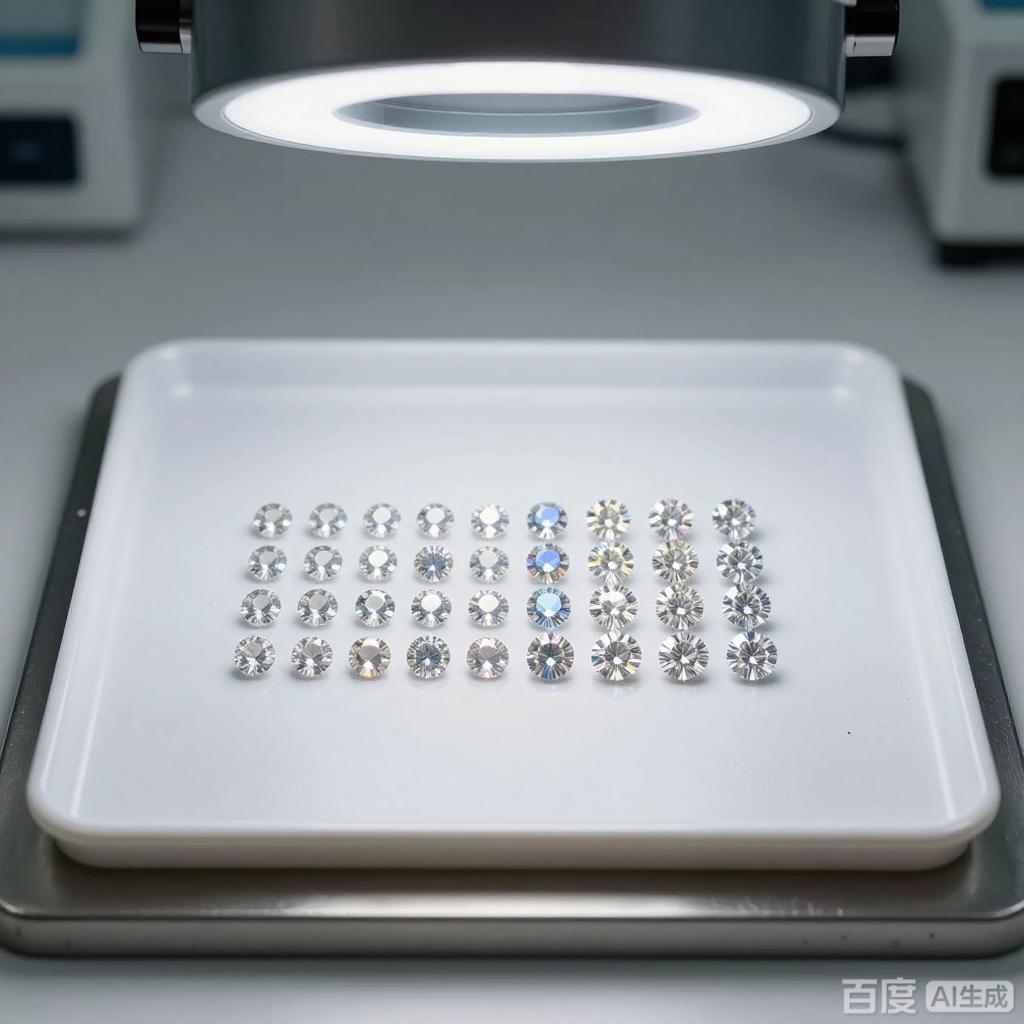
For brands that want to test both, we offer bulk loose moissanite sample packs with 10 stones in popular sizes for $99, so you can test quality and compare side by side with your existing diamond supply before committing to a bulk order.
07Frequently Asked Questions
Q: Will moissanite pass a diamond tester?
Standard thermal diamond testers will read moissanite as diamond, because both conduct heat at nearly identical rates. Electrical conductivity testers can tell the difference. We recommend all retailers use dual testers for QC to prevent misrepresentation, and we provide clear FTC-compliant labeling to avoid customer confusion.
Q: How long does moissanite last compared to diamond?
Modern moissanite is a permanent stone. It will not cloud, fade, or change color over time. With normal wear and proper cleaning, it will look identical 50 years from now. We offer a lifetime warranty against chipping and discoloration on all moissanite we supply.
Q: What is the minimum order for wholesale moissanite?
Our standard MOQ is 50 pieces for in-stock shapes and sizes (rounds, ovals, cushions in D-E-F color). Custom cuts and fancy shapes have a 200 piece MOQ. We can accommodate smaller test orders for new brands; contact our sales team with your specific needs.
Q: Can you provide certification for moissanite?
Yes. Every moissanite stone over 0.5ct comes with a GRA certification card verifying color, clarity, cut, and carat weight. IGI certification is available for bulk orders over 1,000 pieces for an additional $2 per stone. Diamond orders include IGI certification as standard.
Q: How much can I save switching from diamond to moissanite?
Most brands see a 40-55% reduction in COGS when switching comparable pieces from lab diamond to moissanite. That translates to a 20-30% increase in gross margin without raising retail prices. For a brand doing $1M annual revenue, that is $200,000-$300,000 in additional profit per year.
08Key Takeaways for Procurement Teams
- Moissanite costs 85-93% less per carat than lab diamond at wholesale, with nearly identical visual and durability performance for daily wear.
- Defect rates are <1.2% at our factory, thanks to 100% AQL 1.5 inspection under GIA-grade magnification.
- Supply chain reliability is significantly better for moissanite, with 300,000+ stones in stock ready to ship in 3-7 days.
- FTC guidelines require clear disclosure; we provide pre-written compliant product copy for all wholesale clients.
- Margin improvements of 20-30% are typical when switching comparable lines to moissanite.
Want to test quality side by side? Request a free sample pack of moissanite in your preferred sizes, and we will include our wholesale price list, QC report, and factory audit documentation. Quote requests are answered within 24 hours. - HOLYCOME