01Why returns start on the polishing bench, not the design table
Twelve years on the floor taught me one thing about other jewelry wholesale: your return rate is decided before the parcel ever reaches your customer. A pendant that arrives with a hazy pave setting or a prong that snags a sweater will come back, no matter how good the photo looked. Buyers blame the design. I blame the finish and the care instructions that never got printed.
This piece is not about picking a supplier. It is about the loop that sits after the order: how you specify finish, how you tell the end buyer to clean the piece, and how you handle the small repair that would otherwise become a refund. Run that loop tight and your return window gets quiet.
Our own numbers run about 20 percent better than typical trading companies on cost, speed and yield. The reason is boring: we cut, set, polish and QC under one roof in Guangzhou, so a stone that fails inspection never travels to a second workshop and back before someone notices.
02The three QC gates that decide whether a piece survives a year of wear
Every order, from a one-piece stock pull to a 3,000-piece program, moves through the same three gates. Skipping any of them is how a return gets manufactured.
Gate one: incoming stone check
Stones land in a tray and get checked before they touch metal. We measure color and clarity against the grade on the order, look for bow-tie or window in the fancy cuts, and reject chipped girdles. A chipped girdle is the single most common cause of a stone falling out six months later, because the prong cannot seat on a broken edge.
Gate two: in-process check
This is where setting, soldering and pre-polish get inspected. Prong height gets measured, not eyeballed. We check that every prong tips over the stone by at least the thickness of a business card, that no solder seam sits on a high-wear surface, and that hinge and clasp parts on bracelets move freely before polishing.
Gate three: pre-ship AQL
Finished goods go through an AQL sampling pull before packing. We check finish under a 10x loupe, weigh pieces against the spec sheet, and flex-test clasps. Anything that fails gets pulled to the repair bench, not packed with a note. That is the difference between a return and a rework.
Every order, from a one-piece stock pull to a 3,000-piece program, moves through the same three gates. Skipping any of them is how a return gets manufactured.
03Finish specs you should write into the purchase order
Most care problems start as finish problems. Vague spec language like "high polish" means nothing on the bench. Give your factory numbers and you will get consistency across repeat orders.
- Rhodium thickness: state a minimum in microns for white pieces, and ask whether it is barrel or brush plated.
- Surface roughness: ask for a Ra value on flat faces if you sell at a premium; polished faces should read smooth under a loupe with no drag lines.
- Prong tip diameter: specify a range so a size-6 ring and a size-9 ring do not share the same prong geometry.
- Clasp spring tension: request a pull force range for lobster clasps on bracelets over 8 grams.
- Stone security: ask for a push test result on every pave setting with stones under 2 mm.
Put those five lines on the PO and your complaint rate on fit and finish drops before you spend a dollar on marketing.
04A cleaning routine your customer will actually follow
Care instructions fail when they are too long. I have seen inserts with eleven steps that nobody reads. Write three, print them on the back of the warranty card, and train your support team to say the same three things.
The three-step routine
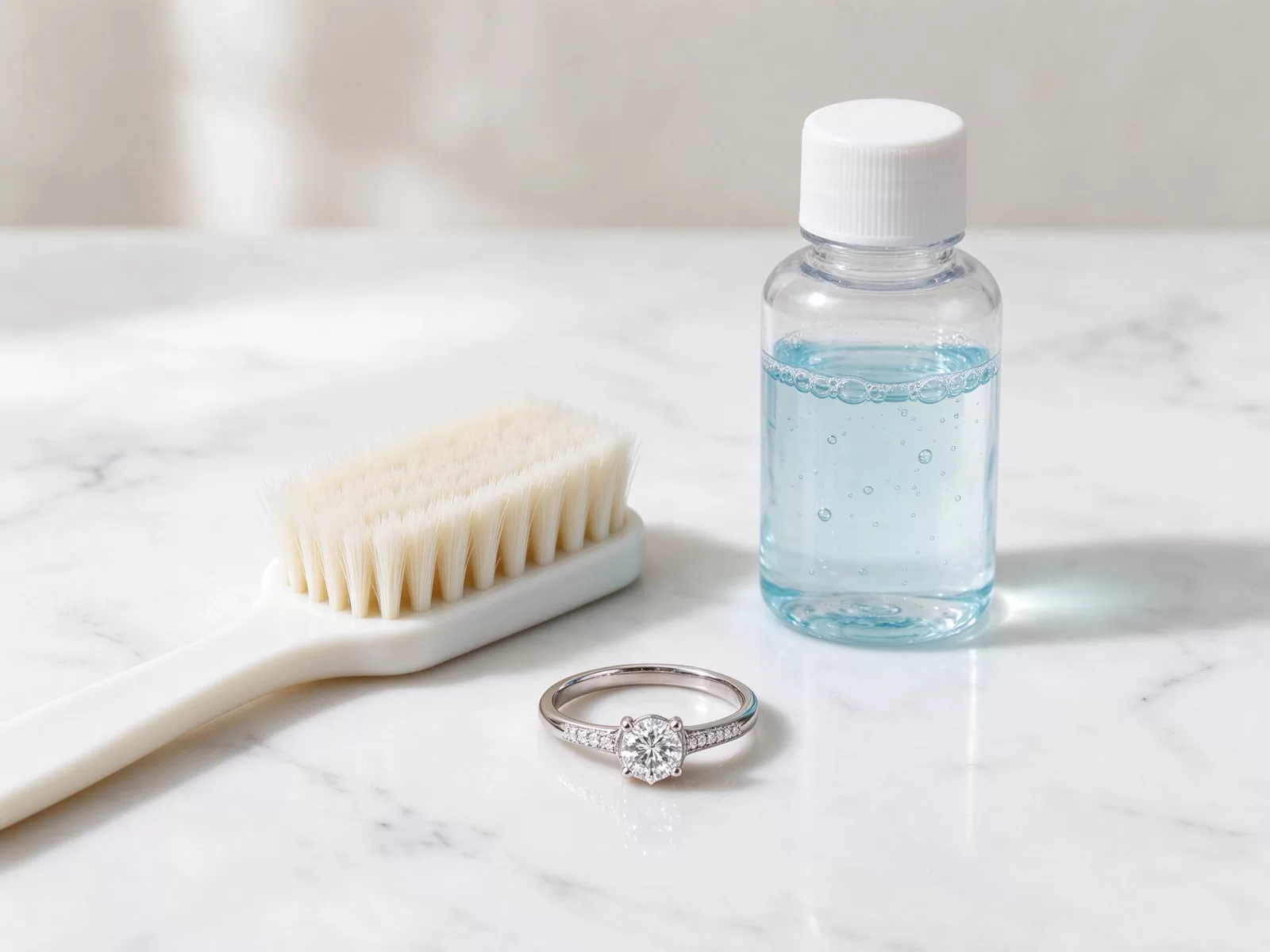
Warm water with a drop of dish soap, a soft brush, thirty seconds of gentle scrubbing behind the stone, then a rinse and a dry with a lint-free cloth. That is it. No ultrasonic for pieces with glued side stones, no steam on anything with a filled or coated surface, no toothpaste because the abrasive dulls rhodium over time.
Storage advice that prevents most scratches
Tell buyers to store pieces separately or in a lined pouch. Silver and moissanite scratch each other when they share a drawer. Most of the surface damage I see on returned pieces never came from wearing; it came from a jewelry box where everything touched everything else.
If your care card has more than fifty words, your customer will not read it, and the return will come back to you instead of the polishing cloth.
05Repair loop: turn a refund into a repeat order
Every wholesale program gets some percentage of repair requests. The question is whether that request becomes a refund or a repair. Set the loop before the season starts.
| Issue | Likely cause | Fix at our bench | Turnaround |
|---|---|---|---|
| Loose stone | Prong not seated on full girdle | Re-tip or re-set, stone re-checked | 3-5 days |
| Dull white finish | Rhodium worn at high-contact points | Strip and re-plate | 4-6 days |
| Clasp failure | Spring fatigue | Replace clasp, re-test tension | 2-4 days |
| Scratched surface | Improper storage | Re-polish and re-finish | 3-5 days |
Offer your buyers a repair path with a stated turnaround and a clear price basis, and most of them will use it instead of filing a return. Repairs keep the customer relationship intact. Refunds end it.
06What to put in the box so the loop closes itself
The cheapest return-prevention tool is a printed card. We can insert a care card in every poly bag at no extra charge on stock orders, and at a small per-unit cost on custom runs. It should carry the three-step cleaning routine, the storage line, and a repair contact that goes to you, not to a dead email address.
Pair that with a warranty statement that is honest about what is covered. Stone loss from a manufacturing defect is on us. A broken prong after a customer drops the ring on tile is not. Say that clearly and you avoid the argument that turns into a chargeback.
07How we handle the loop for trade buyers
We hold stock in moissanite and 925 silver for one-piece pulls, and custom programs start at 30 pieces per style. Production runs 12 to 18 days depending on setting complexity and stone sourcing. GRA and IGI certificates ship with the order where the grade requires them.
Payment is T/T with 30 percent deposit and balance before shipment, or PayPal for samples. DDP delivery lands in 5 to 8 days for US and EU addresses, which keeps your repair and restock cycle short. Send a WhatsApp to +86 133 7744 7107 or email service@holycome.com and we will quote against your spec sheet, not a generic price list.
08Frequently Asked Questions
What is the MOQ for a care-card insert program?
Stock pieces can ship from one piece with a standard care card inserted at no charge. Custom printed cards with your logo need a 30-piece minimum per style, and production takes 12 to 18 days.
How long does a repair take if a customer sends a piece back?
Most stone and finish repairs finish in 3 to 6 days at our bench once the piece arrives. Price is quoted per operation, not per gram, so a re-tip costs the same whether the ring is 2 grams or 6 grams.
Do you supply certificates with repair replacements?
Yes. Replacement stones above the graded threshold ship with GRA or IGI documentation matching the original grade, and the certificate cost is included in the repair quote.
If you want to test the loop before committing to a season, ask for a sample pack with the care cards and a spec sheet you can hand to your support team. Send your finish requirements and target retail price to service@holycome.com or message +86 133 7744 7107 on WhatsApp, and we will come back with a quote and a sample timeline.