
If the solitaire is the backbone of American bridal, the halo engagement ring is the showstopper. First popularized in the Victorian era, then rebooted in the early 2010s as the go-to ring for customers who wanted maximum visual size from a modest center stone budget, the halo is now a permanent fixture in every bridal showcase in the country. From our Wuzhou factory floor, halo engagement rings are the second-highest-volume category of solitaire-style rings we ship — just behind classic four-prong solitaires — and they come with their own set of manufacturing nuances, QC challenges, and pricing dynamics that separate well-made halos from the fragile, accent-stone-spitting cheap versions that give the style a bad reputation. If you are buying halo engagement rings wholesale for your store, here is what you need to know to stock halos that look brilliant in the case and hold up for a decade of daily wear.
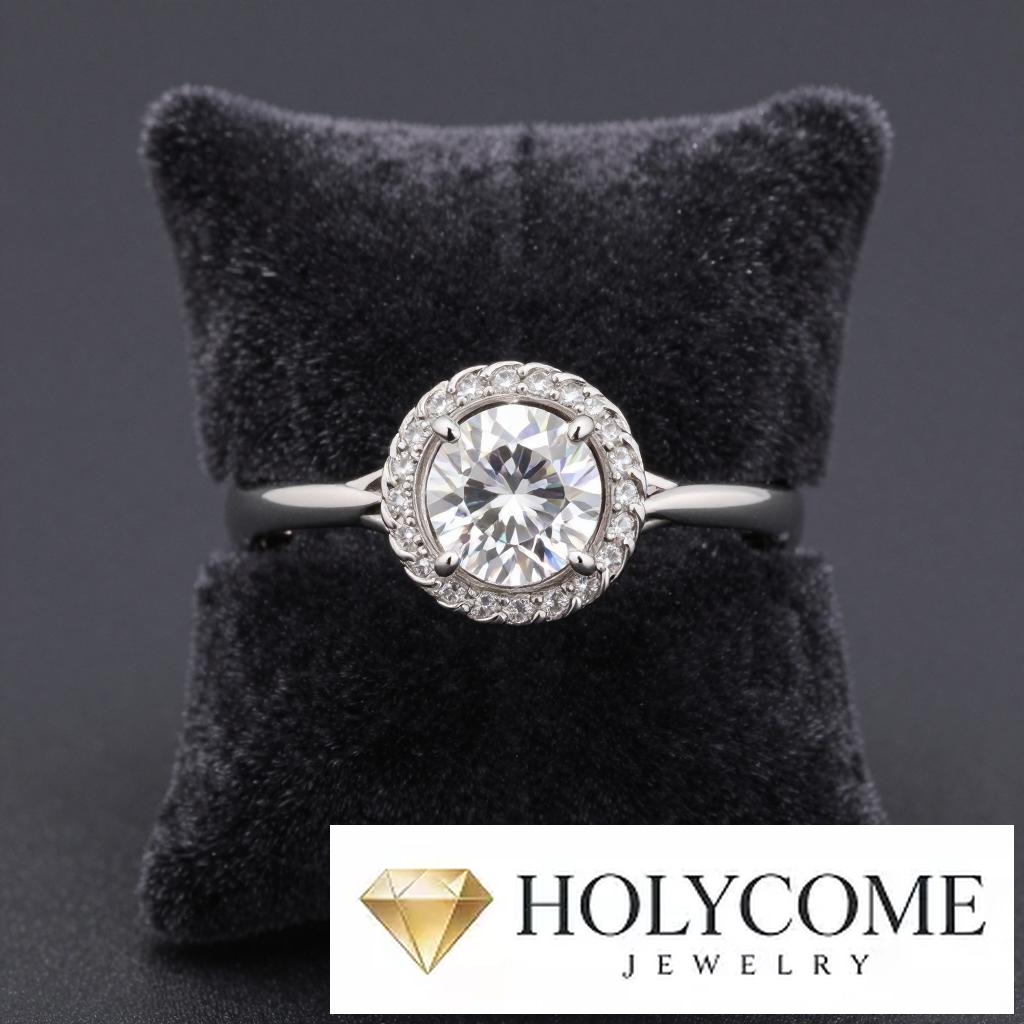
01What a Halo Actually Is, and Why Customers Love It
A halo ring places a circle — or, in double-halo designs, two concentric circles — of small accent stones tightly around the center stone, held in place by tiny individual prongs or shared bezel walls. The visual effect is dramatic: the halo makes the center stone look 20–40 percent larger than its actual carat weight, because the eye perceives the entire spread of the halo-plus-center as a single large stone. A 1.0 ct center with a well-designed halo looks closer to a 1.5 ct face-up, and a 1.5 ct center reads closer to 2.0 ct. For customers working within a budget — and that is almost every customer in 2026 — that visual upgrade is the single strongest selling argument in the entire bridal category.
Beyond size, halos add sparkle. The small accent stones catch light from angles where a solitaire center stone might not, giving the ring a more "alive" look in dim restaurant lighting and low indoor light. Halos also photograph better than solitaires for social media — the extra facet flashes look better on Instagram proposal photos, and that is a meaningful factor for younger buyers who share their proposal moments widely. It is not an accident that halo rings dominated bridal Pinterest boards from 2012 through 2020; the visual payoff on camera is unrivaled by any other ring style at the same price point.
Finally, halos are forgiving. A slightly included center stone, a slightly warmer color grade, even a slightly older hand-me-down diamond reset into a new halo setting all look fresh and bright once surrounded by the extra sparkle. That makes halos the most popular style for resetting family stones and for customers who want a dramatic look without a dramatic diamond budget.
02Halo Construction: The Manufacturing Details That Make or Break the Ring
A halo looks like a small, simple circle of stones. Building one that survives years of daily wear is anything but simple. Every cheap halo on the market fails at the same three points: the accent stones fall out, the head deforms with knocks, and the ring looks cheap because proportions are off. Here are the construction specs we use for our wholesale halos, and the specs you should ask any factory for:
| Component | HOLYCOME Standard Spec | Cheap Halos Cut Corners Here |
|---|---|---|
| Accent stone size | 1.0–1.3 mm diameter (0.005–0.01 ct each) for single halo; 0.8–1.0 mm for double halo inner row | Overly large accents (1.5 mm+) overpower the center and chip easily; overly small accents (0.7 mm) are hard to set consistently and fall out |
| Accent stone spacing | 0.05–0.10 mm gap between girdles of adjacent accents — tight enough to look continuous, loose enough to allow cleaning and avoid chipping | Stones jammed tight against each other chip at the girdle during setting and wear through within 6 months |
| Prong wire gauge | 0.30–0.35 mm precious metal wire per prong for 1.0–1.3 mm accents; micro-prongs cut and burnished smooth | Thinner 0.22–0.25 mm wire saves a tiny amount of gold but bends on contact with door handles, counters, and keys — stones fall out |
| Halo rim thickness | 0.4–0.5 mm solid metal rim under the outer edge of accent stones for structural support | No rim, or paper-thin 0.2 mm rim that deforms on the first hard knock, loosening every stone in the circle |
| Center head height | 0.5–0.8 mm above the halo plane — enough to let light enter the pavilion, low enough to avoid severe snagging | Center set flush with halo (dark center, dead stone) or set 2 mm+ above (snags everything, head bends) |
| Gallery under-halo | Swept filigree or solid tapered gallery supporting the head with cut-out windows for light and easy cleaning | Solid flat under-halo that traps soap, lotion, and dirt; dead and dull stones within months |
The most common complaint jewelers get from cheap halos is stones falling out — and the cause is almost always thin prong wire combined with no structural rim. The accent stones themselves are tiny and cheap, but when one falls out of a customer's engagement ring three months after the proposal, the cost to the customer relationship is enormous relative to the 30-cent stone. At HOLYCOME every halo ring goes through a prong-tugging QC step where every accent stone is tested with a fine tungsten pick under magnification to confirm it cannot be lifted — any stone that moves goes back to the setter for tightening before the ring leaves the factory. Rejects on this step alone add roughly 3–4 percent manufacturing cost versus cheap halos that skip pick-testing, and it is the single most important quality investment we make on halo production.
The engagement ring design tradition dates back centuries, but the modern micro-pavé halo as we know it depends on twentieth-century advances in precision casting and micro-setting tools — specifically the development of stereo microscopes for stone setting in the 1970s and 1980s that made it possible to set hundreds of stones under 1 mm with consistent alignment. A halo ring is not a design that can be thrown together by a bench jeweler in a hurry; micro-setting is a specialized skill that takes 3–5 years of training to master. Our best setters in Wuzhou have 10+ years of halo experience and set an average of 25–30 halo rings per day.
A halo looks like a small, simple circle of stones. Building one that survives years of daily wear is anything but simple. Every cheap halo on the market fails at the same three points: the accent stones fall out, the head deforms with knocks, and the ring looks cheap because proportions are off. Here are the construction specs we use for our wholesale halos, and the specs you should ask any factory for:
03Center Stone and Accent Stone Combinations That Sell
Halo rings are flexible about center stones — almost any size or shape center works with a halo — but some combinations outsell others by a wide margin in US retail. From our wholesale shipping data, the best-selling halo configurations for US independents in 2026 are:
- Round center, round halo (classic single halo): The all-time bestseller. 1.0 ct center with 0.25–0.30 ct total halo weight, 14k white gold. This is the default halo, the style customers picture when they say "halo ring," and makes up roughly 45% of our halo shipments.
- Oval center with round halo: The fastest-growing style for 2025–2026. The elongated oval center creates a flattering finger-lengthening effect, and the round halo softens the oval corners while adding visual size. Popular in 1.5–2.0 ct oval centers in yellow and rose gold.
- Cushion center with cushion halo: Vintage-leaning, very popular with customers who like an Art Deco or antique-inspired feel. Cushion halos have a softer, less severe outline than round halos and pair beautifully with vintage-style milgrain detailing.
- Pear center with pear halo: A fashion-forward choice that has grown with the rise of asymmetrical and "alternative bridal" styling. Pear halos are tricky to manufacture (the point of the pear is a high-risk area for chipping and accent stone loss) but have very strong sell-through in fashion-forward coastal markets.
- Double halo: Two concentric circles of accents for maximum drama. Double halos look particularly strong with smaller centers (0.5–0.8 ct) where the double halo can push the visual spread to 1.5+ ct equivalent. Less popular for larger centers where it can look overdone.
Accent stone identity is another decision point. Premium halos use diamond accents (natural or lab-grown); mid-range halos use moissanite accents; price-point halos use CZ accents. Our rule of thumb for wholesale partners: if the center stone is moissanite at 1 ct or larger, moissanite accents look consistent and durable; if the center is diamond, diamond accents are expected (mismatched optics between diamond center and CZ accents are visible to customers in direct light); CZ accents only on silver price-point pieces. A common mistake we see from new buyers is ordering gold halos with CZ accents to save $40–$60 wholesale — the CZ clouds within 18 months while the gold mounting is still fine, leading to a customer who thinks the whole ring is low quality. Spend the extra for moissanite or diamond accents in gold halos.
04MOQ, Pricing, and Lead Time for Wholesale Halos
Halo rings carry higher labor and accent stone content than solitaires, which shifts the MOQ and pricing structure relative to simpler styles:
MOQ: In-stock finished halo rings (single round halo, 1 ct DEF VVS moissanite center, moissanite accents, 14k white gold, sizes 5–8) — MOQ 8 pieces per size/metal/stone mix for wholesale stock. Made-to-order halos with custom center size, non-round shapes, double halo, or mixed-metal construction — MOQ 5 pieces per SKU. Private label with custom packaging and custom stamp — MOQ 30 pieces across the halo collection.
Pricing: Typical landed wholesale for a 1.0 ct DEF VVS moissanite halo with moissanite accents in 14k white gold: $340–$420 (versus $260–$320 for a solitaire of the same center stone — the accent stones and extra setting labor add roughly $70–$100). A comparable lab-grown diamond halo with 1.0 ct E VS1 IGI center and diamond accents in 14k white gold wholesales for $720–$880. CZ-accent CZ-center halos in 925 silver wholesale for $30–$50.
Lead time: In-stock halos ship within 3 business days. Made-to-order single halos in standard metals ship 10–12 business days from order confirmation. Double halos, fancy-shape centers (pear, marquise, emerald), and mixed-metal designs ship 14–18 business days because of the additional setting time and QC steps. Private label production runs 28–35 days including tooling for custom head design if required.
05Common Quality Issues and How We Prevent Them
After 18 years making halo rings, the failure modes are predictable, and our QC process is built around catching them:
- Accent stone misalignment: Each accent stone should sit level with its neighbors, no high or low stones. Misaligned stones create a wavy circle that looks cheap and catches light unevenly. Every halo is checked under 10x loupe with a direct overhead light for continuity.
- Prong burnish and smoothness: Micro-prongs must be burnished flush with the stone surface with no sharp wire ends that catch on fabric or scratch skin. Rough prongs are reworked by hand before polishing.
- Milgrain consistency (for vintage halos): Milgrain beads should be uniform in size and spacing all the way around the halo; uneven milgrain is the fastest visual giveaway of low-quality vintage-style work.
- Center stone alignment: The center stone must sit perfectly concentric within the halo circle — even 0.2 mm of offset is visible to the naked eye. Our setters use alignment jigs during setting, and final QC checks concentricity with calipers.
- Ring size accuracy: Halo heads are slightly heavier than solitaire heads, which can affect sizing during finishing. Every ring is sized on a ring mandrel and calibrated to within ±0.25 US sizes.
A Los Angeles bridal boutique we work with placed their first halo order with a competing factory because the quote was 22 percent below ours. Within four months they had a 14 percent return rate on halos — mostly accent stones falling out and prongs catching on clothes. They sent us three of the failed rings for inspection, and every one had 0.22 mm prong wire with no support rim. They switched all halo production to our standard spec, and their halo return rate settled to 0.7 percent over the following year, identical to our overall QC defect rate. Saving $60 per ring on the initial quote cost them thousands in returns and reputational damage.
06Frequently Asked Questions
Can I order halo semi-mounts without center stones?
Yes. We ship halo semi-mounts with the halo accents already set and the head sized and ready for your chosen center stone. Semi-mounts allow retailers to show customers the setting and then customize center stone size and grade in-store, which many customers prefer. Semi-mount pricing discounts 15–20 percent versus the fully set ring.
Which metal is best for halo rings?
14k white gold remains the leader for classic halo looks, but yellow gold and rose gold halos have grown substantially since 2023 — rose gold ovals and yellow gold cushions are currently the fastest-moving halo SKUs for many of our partners. Platinum halos are available on request but add roughly $450–$600 to wholesale cost.
Do halo rings snag more than solitaires?
Slightly. The micro-prongs on the halo do catch on knits, gloves, and fine fabrics more than a smooth solitaire, but this is dramatically reduced when prongs are properly burnished smooth and the center stone sits at the standard 0.5–0.8 mm height above the halo. Customers who work with their hands extensively (nurses, teachers, gym staff) often prefer lower-profile halos or six-prong solitaires.
Can you do hidden halos (halo set under the center stone, visible from the side only)?
Yes. Hidden halos (also called "under-halos" or "secret halos") have grown steadily since 2022. They add extra sparkle from the side profile without the larger visual spread of a top halo, making them popular with customers who want sparkle on a budget without a dramatically large face-up look.
How do I clean a halo ring for display and recommend care to customers?
Halo rings trap more soap and lotion than solitaires because of the many small settings. Recommend warm water with mild dish soap, a soft children's toothbrush, and a gentle scrub behind the halo every 2–3 weeks. Professional ultrasonic cleaning at the store every 6 months will keep the accents sparkling. Avoid steam cleaners at home — the high heat can loosen old prongs on worn rings.
Do halos work with all center stone shapes?
Most shapes work, but some pair better than others. Round, oval, cushion, and pear centers with matching-shape halos are our most reliable sellers. Emerald-cut and Asscher-cut centers look best with specially shaped rectangular halos; marquise halos are trickier to manufacture but available. Heart-shaped halos are a niche request and typically require custom tooling.
Halo engagement rings are not passing trend — they are a permanent category because they deliver a simple, powerful value proposition to customers: more visible sparkle, more visual size, more dramatic presence for the same budget. The difference between a halo that stays on a customer's finger for a decade and one that shows up back in your store with a missing accent is the quality of the setting — the prong wire gauge, the support rim, the pick-testing, the alignment, the burnish. At HOLYCOME we build halos to hold up under real daily wear, with tight QC and US-bridal-specific proportions tuned to the aesthetics American customers expect. Browse our wholesale halo engagement ring collection or request a sample parcel to see the construction quality in person before stocking.
", "tags": "halo engagement rings wholesale, wholesale halo rings, moissanite halo rings, bridal rings factory"Related reading: Moissanite Engagement Rings Wholesale: Factory Guide, Moissanite Men's Rings Wholesale Factory Supplier, Solitaire Engagement Rings Wholesale Guide.