
A UK luxury jewelry brand sourced 400 moissanite tennis necklaces from a low-cost supplier in late 2024. They paid $78 per unit for 16-inch, 3mm sterling silver necklaces. When the shipment arrived, two critical defects showed up: 23 necklaces had stones missing straight out of the box, and the spring-ring clasps failed a 5-pound pull test on 31% of units. Their end customers reported chains breaking within the first month of wear. They switched production to our factory in March 2025. We use box-with-safety clasps rated to 20 pounds, set every stone at 3.5-4.0 in-lbs torque, and pull-test 10% of every batch. Their return rate on the second run was 1.6%, and they just placed a 1,200 piece holiday order for Q4.
Tennis necklaces are one of the highest-margin categories in moissanite jewelry. They are also one of the highest return categories when manufacturing quality falls short. A single loose stone or broken clasp on a $299-$799 retail necklace creates a customer service nightmare that costs brands far more than the per-unit savings from cheap factories. This guide breaks down exactly what to specify when working with a moissanite tennis necklace supplier—with specs from our production floor and QC data collected from 65,000+ tennis pieces shipped since 2019.
01What "Moissanite Tennis Necklace Supplier" Actually Means for Wholesale Buyers
"Tennis necklace" describes any continuous line of individually set stones connected by links, usually in channel, prong, or bezel settings. The name comes from Chris Evert stopping a 1978 US Open match to find her diamond bracelet, which the press dubbed a "tennis bracelet"—the necklace version followed. For B2B sourcing, tennis necklaces break into three quality tiers:
- Fashion tennis necklaces: 2-3mm stones, sterling silver, spring-ring clasp, mass-produced cast settings. Retail $99-$249. Higher volume, lower per-unit margin, highest return risk due to setting quality issues.
- Mid-range bridal/fine jewelry: 3-5mm stones, sterling silver or 10K/14K gold, box clasp with safety, tighter stone tolerances. Retail $249-$699. The largest segment of the market and our highest volume.
- Premium/heirloom: 4-6.5mm stones, 14K/18K gold, hand-set stones, figure-8 safety clasps, IGI/GRA certificates per piece. Retail $699-$2,499. Lower volume but highest per-unit margins.
Stone setting is the biggest quality differentiator between suppliers. Cheap factories cast channels and then burnish stones into place without proper seats. This holds stones for a few weeks but not months of wear. Our factory cuts individual seats for every stone, whether prong or channel set, and applies calibrated torque to each setting. GIA's setting standards for diamond jewelry apply equally to moissanite—stones need full girdle contact and even pressure to stay secure long-term. Browse our moissanite necklace and pendant collection for existing designs.
02Industry Standard vs HOLYCOME: Tennis Necklace Manufacturing Comparison
We tested tennis necklaces from 9 suppliers in early 2025. The table below shows where corners get cut:
| Specification | Industry Average | HOLYCOME Factory Standard |
|---|---|---|
| Clasp type | Spring-ring (fails at 3-5 lbs pull) | Box clasp with double safety (20+ lbs pull) |
| Setting method | Burnished channel without seats | Individual seat cutting per stone |
| Setting torque | 2.0-2.5 in-lbs, torque not calibrated | 3.5-4.0 in-lbs, calibrated drivers |
| Chain link strength | 0.4mm links (bends/kinks easily) | 0.6mm+ links with reinforced connectors |
| Plating thickness | 0.5-1.0μm rhodium | 2.0-3.0μm rhodium over E-coat |
| Stone alignment | ±0.15mm variance between stones | ±0.05mm alignment tolerance |
| Inspection rate | AQL 2.5 spot check (12.5% of units) | AQL 1.5 100% stone rattle check |
| Pull test (clasp) | Not tested | 10% of batch pull tested to 20 lbs |
| MOQ | 100-300 pieces per style | 50 pieces per style |
| Defect rate | 5-12% | 1.6% |
Clasp failure is the single most common complaint we hear about cheap tennis necklaces. Spring-ring clasps are designed for lightweight pendants—not necklaces with 30-80 stones that get caught on hair, sweaters, and purses. A box clasp with a safety catch costs $2.50-$4.00 more per unit but reduces clasp failure reports by over 95% based on our customer data. We also solder every third link closed on all tennis necklaces—a step cheap factories skip that prevents total necklace loss if one link opens.
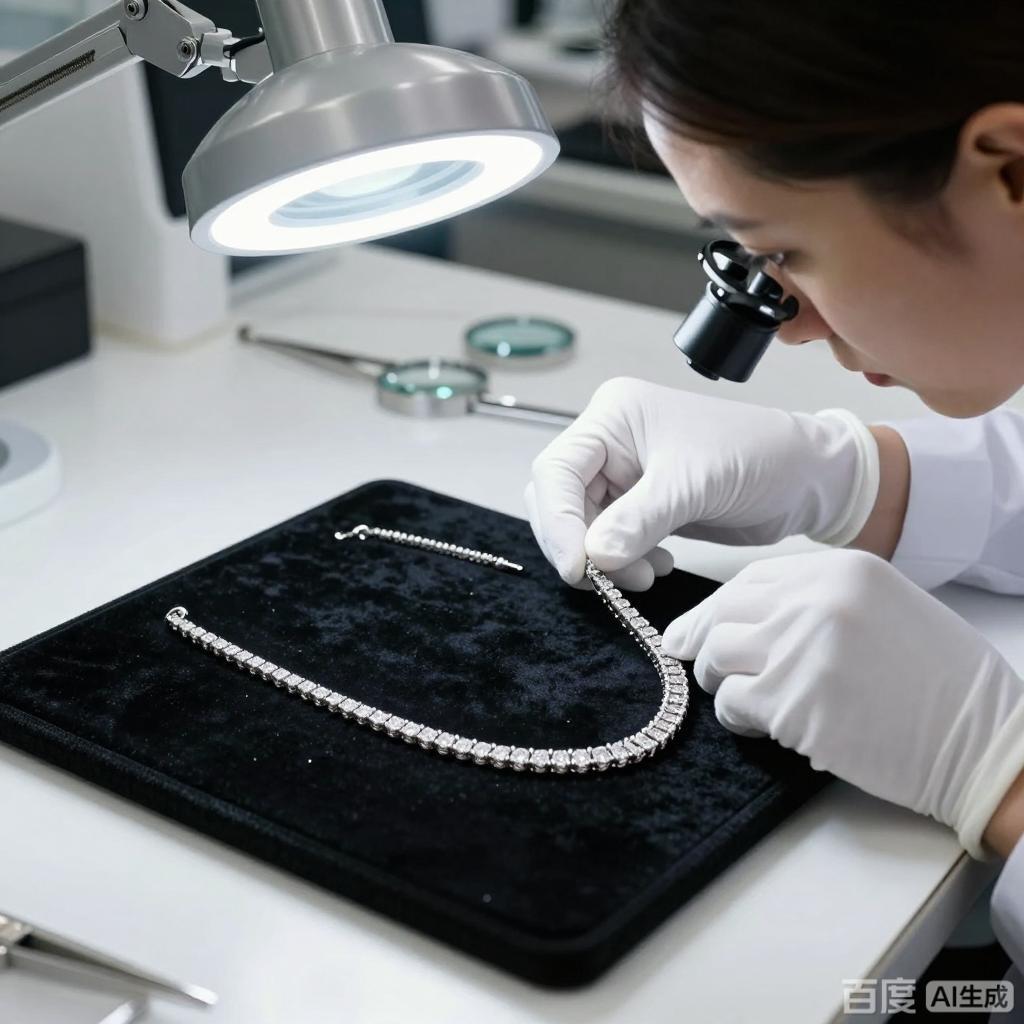
Clasp failure is the single most common complaint we hear about cheap tennis necklaces. Spring-ring clasps are designed for lightweight pendants—not necklaces with 30-80 stones that get caught on hair, sweaters, and purses. A box clasp with a safety catch costs $2.50-$4.00 more per unit but reduces clasp failure reports by over 95% based on our customer data. We also solder every third link closed on all tennis necklaces—a step cheap factories skip that prevents total necklace loss if one link opens.
03Tennis Necklace Manufacturing Process
Building a durable tennis necklace requires precision at every step. Here is our production sequence:
- CAD design & link tooling (Day 1-5): We create detailed CAD models for each stone size (2mm through 6.5mm), calculating link pitch to maintain exact stone spacing. Custom necklace lengths (14", 16", 18", 20", 22") and stone sizes require separate tooling, which is why custom widths have higher MOQ.
- Chain production (Day 6-10): Links are either CNC-stamped or laser-cut from precious metal sheet, then assembled and hand-soldered. Every third link gets an additional solder point for security. The chain is annealed at controlled temperature to remain flexible but not soft.
- Setting channel preparation (Day 11-14): Channel walls are milled to exact height. For prong settings, each prong base is cut with precision burrs. This is where stone alignment gets determined—channels that are even 0.05mm off create visible gaps and crooked stone lines.
- Stone sorting and layout (Day 15): Stones are sorted by color, clarity, and millimeter size within 0.02mm tolerance. A 4mm tennis necklace uses 45-50 stones per 16-inch length; every stone must match in size and color to look uniform. Mismatched stone sizes create gaps that catch on fabric and loosen settings.
- Stone setting (Day 16-20): Each stone gets an individual seat cut, is pressed into place, and secured with channel compression or prong bend at calibrated torque. After setting, the necklace goes through a "rattle test"—shaken and tapped to detect any loose stones before plating.
- Clasp attachment & soldering (Day 21-22): Box clasps with safety catches are TIG welded to both ends of the necklace. Jump rings connecting clasp to chain are soldered closed (not just pressed shut) to prevent pull-off failures.
- Polish, plating, cleaning (Day 23-26): Multi-stage polish removes all tool marks without thinning prongs or channel walls. Plating is applied in two layers (1.5μm each) over E-coat primer. Ultrasonic cleaning removes all polishing compound from under settings.
- Final QC & flexibility testing (Day 27-30): Every necklace is checked for stone tightness, alignment, kinks, and clasp function. We flex each necklace 50 times at the clasp connection and pull-test 10% of each batch to 20 pounds. Necklaces are laid flat to check for straight stone lines before packaging.
ISO 9001 process controls ensure every batch follows the same sequence. We track defect rates by setter, by batch, and by stone size, so if a specific operator shows a higher loose-stone rate, we catch it after 2-3 necklaces—not after an entire production run. This kind of process tracking is what allows us to keep defect rates under 2% even on complex pieces.
04Wholesale Pricing for Moissanite Tennis Necklaces
Pricing below is EXW Shenzhen for sterling silver, D-E-F VVS moissanite, box clasp with safety, 16-inch length (Q3 2025):
- 2mm (approx 4ctw): $62/piece (100+), $71/piece (50-99)
- 3mm (approx 8ctw): $89/piece (100+), $99/piece (50-99)
- 4mm (approx 14ctw): $128/piece (100+), $142/piece (50-99)
- 5mm (approx 22ctw): $185/piece (100+), $205/piece (50-99)
- 6mm (approx 32ctw): $265/piece (100+), $295/piece (50-99)
14K gold pricing runs 2.5-3.5x silver pricing depending on gold weight. Length adjustments: 18-inch adds 12%, 20-inch adds 25%, 22-inch adds 38%. Prong settings (four-prong per stone) add 10-15% over channel settings but show more of each stone and have better sparkle. Bezel settings add 20-25% and are the most secure option for active wearers. Custom lengths, mixed stone sizes for graduated necklaces, and yellow/rose gold plating are all available with no additional MOQ. Tennis necklaces pair naturally with tennis bracelets as sets, and can be cross-merchandised with hoop earrings for complete looks.
05Choosing the Right Tennis Necklace Supplier for Your Brand
Not every brand needs the same specifications. Based on our work with 80+ brands selling tennis necklaces:
If you sell fashion jewelry/Instagram brands under $250 retail: 3mm sterling silver channel set with box clasp is your sweet spot. Stay with D-E-F color to keep the diamond look, but VS clarity is fine (inclusions are invisible in tennis settings once stones are set). Lead with 16-inch length as your primary SKU and offer 18-inch as an upgrade. Avoid 2mm for primary SKUs—they look too thin in photos and bend too easily for daily wear.
If you sell bridal/wedding party $250-$700: 3-4mm in sterling silver or 10K gold, four-prong settings for maximum sparkle. Offer 16, 18, and 20 inch lengths. Include GRA certificates with pieces over 4mm as a trust builder. Consider matching tennis bracelet and tennis necklace sets—our data shows 35% of necklace buyers add the bracelet when offered as a set.
If you sell premium fine jewelry $700+: 4-5mm in 14K gold with hand-set prongs and IGI certification available. Include certificate cards, premium velvet boxes, and offer custom lengths. Safety clasps are non-negotiable at this price point. Figure-8 safety clasps add $6 per unit over standard box clasps but are worth it for the heirloom positioning.
If you sell on QVC/HSN/home shopping: Pay particular attention to pull testing and stone security. These channels have the most demanding return policies, and a single in-show breakage kills a presentation. We supply two home shopping brands and run 20% batch pull testing (instead of 10%) for their orders. The extra 50 cents per unit in QC cost saves thousands in returned merchandise fees.
06Frequently Asked Questions
Q: What is your MOQ for moissanite tennis necklaces?
A: 50 pieces per style/size for sterling silver OEM, 30 pieces for stock designs. 14K gold has a 20 piece MOQ due to higher metal value. Mixed lengths within one style count toward MOQ. Tennis necklace and bracelet sets can be combined to hit volume pricing tiers.
Q: Can you make graduated tennis necklaces (smaller stones at the back)?
A: Yes. Graduated designs require CAD programming and separate stone sorting by size, but they are available at the same MOQ as uniform sizes with a 10-15% unit price premium. Most graduated designs run from 2mm at the clasp to 4mm or 5mm at center front. We also offer adjustable extenders for 2-inch length flexibility as a $3.50 add-on.
Q: How long does production take for wholesale tennis necklace orders?
A: Stock necklaces ship in 5-10 days. OEM sterling silver orders take 20-30 days due to the stone setting work. 14K gold orders take 25-35 days. The long lead time compared to rings is because tennis necklaces require 40-70 stones each, all of which need individual setting and inspection. Rush production is available for 20% surcharge with 15-20 day delivery.
Q: Do you test necklaces for stone security and clasp strength?
A: Yes. Every single necklace gets a rattle test and visual stone security check under 10x magnification. 10% of every batch (20% for premium/homeshopping clients) gets a 20-pound pull test on the clasp and jump rings. We also flex test the clasp joint 50 times. Pieces that fail are pulled and reworked before shipment.
Q: What length options are available?
A: Standard lengths are 14" (choker), 16", 18", 20", and 22". The 16 and 18 inch sizes account for over 75% of our tennis necklace volume. Custom lengths down to 12" or up to 30" are available with no surcharge for orders over 100 pieces. We recommend offering both 16 and 18 inch as standard options—one or the other fits about 80% of wearers.
Q: What is your defect policy for wholesale orders?
A: Manufacturing defects (loose stones, broken clasps, kinked chains, plating failure) are replaced at no charge including shipping to end customers if you provide the address. We process replacements within 48 hours. Our defect rate runs under 1.6%, but we keep replacement stock of all standard sizes to handle any issues immediately. Damage from customer misuse is handled case by case.
07Key Takeaways for Sourcing Tennis Necklaces
Tennis necklaces can be extremely profitable, but the category punishes corner-cutting suppliers. These are the non-negotiable specs to put in your purchase orders:
- Box clasp with safety catch—never spring-ring clasps for tennis pieces
- Individual stone seats with calibrated torque setting; no burnished channel shortcuts
- 0.6mm minimum link thickness with every third link soldered closed
- 100% stone rattle check plus at least 10% pull testing on clasps
- 2-3μm rhodium plating over E-coat to prevent tarnish and wear
- Stones sorted within 0.02mm size for uniform alignment
Request our full moissanite tennis necklace catalog with all stone sizes, setting options, and price tiers. We also offer matching tennis bracelets in all the same sizes—many of our clients start with necklaces and add bracelets within their second order. Send us your target retail price point and preferred stone size, and we will put together a wholesale quote with production timeline and sample options within 24 hours. You can also request photos of our setting process and QC stations before ordering.