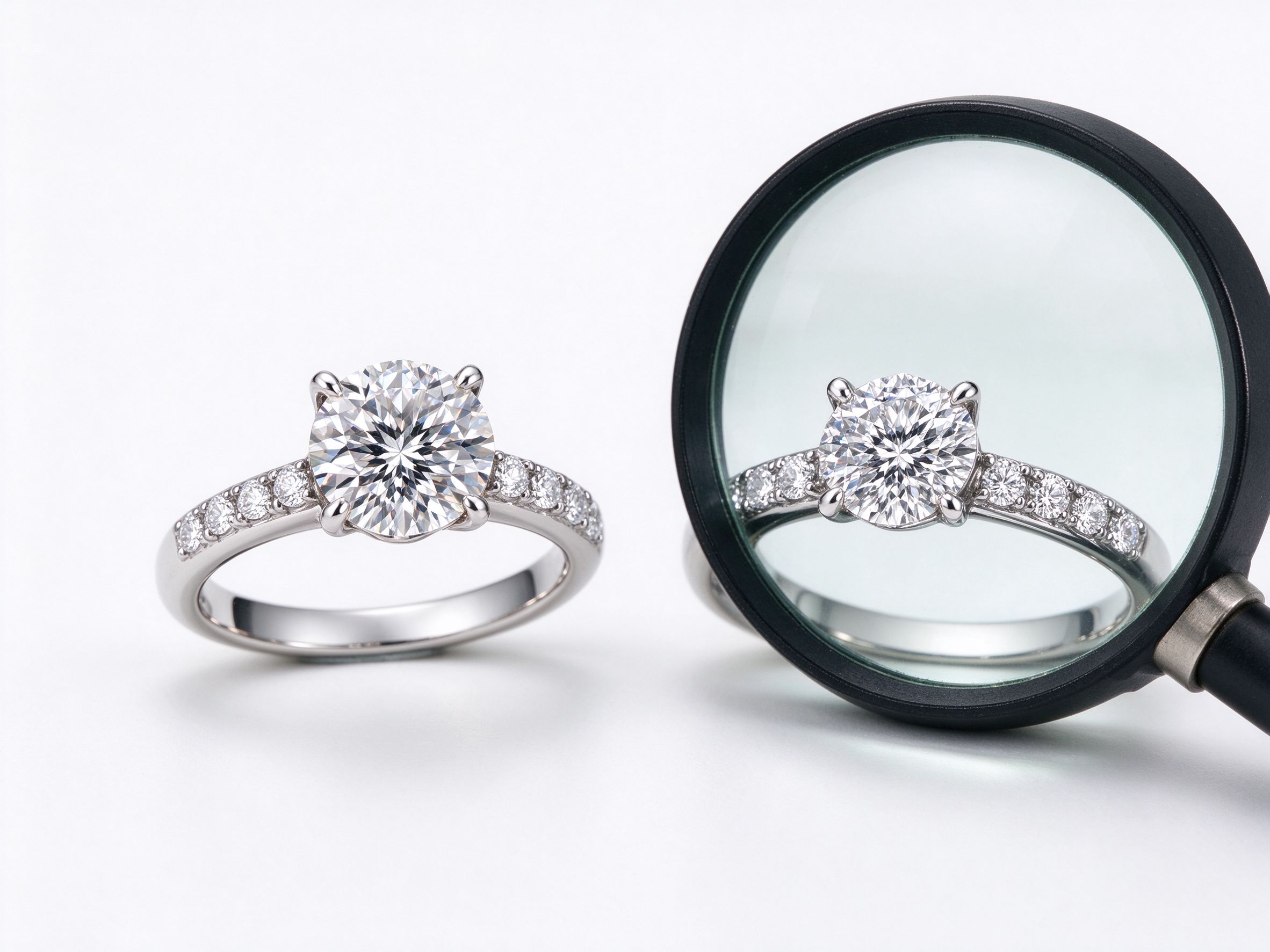
Scratched Moissanite Ring: Metal Scratches Versus Stone Damage
A customer runs a finger over their band and feels a new groove, or holds the ring up to the light and sees a faint line across the stone. The worry is always the same: is the scratch in the moissanite, and is the ring ruined? Almost always, the answer is that the scratch is in the soft silver or gold around the stone, not in the moissanite itself, and the fix is a simple polish. But not every scratch is equal, and some that look like surface scuffs actually signal a bent prong or a chipped seat. After years of inspecting returned rings on our bench, we want to show you how to tell the difference, when a repolish is worth it, and when it is actually a bad idea.
Moissanite ranks at 9.25 on the Mohs scale, which means almost nothing in daily life is hard enough to scratch it. Keys, counters, other jewelry, and even most other gemstones will mark the metal before they mark the moissanite. So when you see a line on your ring, the safe assumption is that it is on the band or the prongs, not on the stone. This guide explains how to confirm that, how a factory repolishes, why repolishing too often is its own problem, and what kind of scratch actually needs urgent attention.
How to Tell if the Scratch Is in the Stone
The fastest test is your fingernail. Run a clean fingernail across the line. If your nail catches on a groove, the mark is in the metal surface. If the nail glides over the line and you can see it but not feel it, it may be in the stone. Moissanite scratches are rare, but they are not impossible, and a true scratch in the stone feels smooth under the nail while still catching the light. The other sign is location. Scratches on the flat top facets of the stone are almost never accidental; they come from contact with another moissanite or a diamond, because nothing else is hard enough.
Look at the pavilion, the back of the stone, as well. Most owners inspect the top and miss the bottom. A scratch on the pavilion happens if the stone was ever loose and rattled against its seat, or if the ring took a serious fall. If you see a pavilion mark combined with a wobbly stone, the real problem is the loose setting, not the scratch. We walk through that scenario in our article on prong security.
If you are still unsure, a jeweler's loupe settles it. Under 10x magnification, a metal scratch looks like a groove in a soft surface, while a stone scratch cuts across facets. Bring the ring in rather than guessing, because the repair path is completely different. A metal scratch polishes out; a stone scratch is a cut or replacement decision, and it should be made by someone looking through the loupe.
Why the Metal Scratches so Much Faster Than the Stone
The contrast is the whole reason this question comes up. Moissanite is nearly as hard as diamond, while the sterling silver or gold holding it is soft enough to mark with a fingernail. The band that looks like a mirror on the day you buy it is actually a very soft, thin layer of polished metal sitting over a slightly harder alloy. Over months of contact with desks, handbags, door handles, and other rings, that layer picks up micro-scratches that accumulate into a matte finish.
This is normal. A ring that has zero scratches after a year of daily wear is a ring that has been sitting in a box. Scratches are evidence that the ring is being lived in, and most owners come to like the soft patina. The question is not whether the band will scratch, but when the scratches bother you enough to justify a repolish. We tell wholesale customers to expect this, and to set expectations with end buyers, because a band that looks matte after a year is not defective.
Plating changes the picture. A rhodium-plated band looks bright and scratch-free at first, but the plating is only a few microns thick. The first micro-scratches break through that bright surface and show the slightly different metal underneath, which is why plated rings seem to scratch more visibly than unplated ones. The scratch count is the same; the contrast is higher. We cover plating wear in our guide to rhodium plating care.

How a Factory Repolishes a Ring
Repolishing is not sanding the band smooth by hand. On our bench, the jeweler first inspects the ring for loose stones or worn prongs, because polishing a ring with a loose stone can shake it out. The stone is protected or removed on very old pieces. Then the jeweler uses a series of fine abrasive compounds on a rotating cloth wheel, starting with a slightly coarser compound to lift the deep grooves and finishing with a fine polish to restore the mirror shine. The whole process takes minutes, and it removes a microscopic layer of metal.
That removed layer is the key trade-off. Each repolish takes off a fraction of a micrometer of metal, which is negligible the first few times. But a thin band that is repolished every six months will eventually thin at the high points, the edges that contact the abrasive wheel most. A band that starts at a comfortable thickness can, after decades of frequent repolishing, become thin enough to bend. This is why we advise polishing only when the scratches actually bother you, not on a fixed schedule.
The inside of the band matters too. We focus polishing on the outside, where people see the scratches, and we leave the inside as-is whenever possible, because the inside already wears thin from contact with your finger. Polishing the inside accelerates thinning where you cannot see it. A good jeweler asks before taking material off the inside, and a factory like ours tracks how many times a ring has been polished so we know when it is approaching its limit.
When to Repolish and When to Leave It
Repolish when the matte finish genuinely distracts you, or when a deep groove catches on fabric and risks a prong. Leave it alone when the scratches are light and you like the lived-in look. Most daily-wear rings benefit from a repolish every two to three years, not every season. A ring worn to an event and then kept safe may never need one at all.
Never repolish a ring with a loose or wobbly stone. Secure the setting first, because the vibration of the polishing wheel can work a loose stone further out. If your ring has engravings, tell the jeweler, because repeated polishing can wear engraving shallow over years. We also avoid polishing very thin vintage-style bands more than necessary, and we explain that limit to the customer rather than over-polishing on request.
If your ring is plated, a repolish is usually paired with a re-plating, because polishing wears off the rhodium anyway. Treat them as one service: the polish smooths the metal, and the fresh rhodium restores the bright white finish. Buying them together costs less than doing them separately, and it leaves the ring uniformly bright rather than polished in spots.
Scratches That Are Not Just Cosmetic
Most scratches are harmless, but a few need attention beyond a polish. A deep groove that cuts into a prong tip can weaken it, and that prong should be retipped rather than polished flat. A scratch on the shank that has opened into a small crack, visible as a dark line, is a fatigue warning, and the ring should be inspected before it breaks. These are rare, but they are exactly the kind of thing a jeweler catches during a routine polish appointment, which is another reason to let a professional handle it.
A dent is different from a scratch. A band that has been bent or dented by a hard impact needs to be reshaped on a mandrel, not just polished. Polishing over a dent leaves the underlying bend, and a bent band sits unevenly on the finger, which stresses the prongs. If you knocked the ring hard and it now sits slightly tilted, have it rounded out before you worry about the surface finish.
If the scratch is truly in the moissanite, do not try to polish it out. Moissanite cannot be refinished at home the way metal can, and an attempt to buff a stone scratch usually damages the facet edges. A stone scratch is a conversation with the maker: sometimes the stone is fine to wear, and sometimes a replacement is the right move. We cut matching stones to seat sizes, and we can advise whether a pavilion mark affects the look enough to justify a replacement.
Why DIY Polishing Kits Usually Make Things Worse
The home jewelry polish aisle is full of creams, cloths, and tumbler kits that promise a factory shine in minutes. Some of them work lightly on tarnish, but almost all of them are too aggressive for fine moissanite settings. Abrasive creams contain fine grit that lifts surface scratches but also rounds over the sharp edges of prongs and pavé beads, softening the setting over time. A customer who polishes at home every month ends up with blunt prongs and a matte-looking setting long before the metal would have worn naturally.
Silver dips are the other home temptation. They dissolve tarnish quickly, but they also attack the copper in sterling silver and can etch the area around the prongs. Used on a plated ring, a dip strips the remaining rhodium and leaves the silver underneath exposed, which is why a dip often makes a ring look brighter for a week and then duller than before. We see this constantly: a customer tried a dip at home, the ring went from bright to patchy, and they brought it in for a proper re-plate. The dip cost them the plating they were trying to preserve.
The safe home tool is the plain polishing cloth, used gently. A dedicated jewelry cloth removes light tarnish and fingerprints without cutting into the metal. Stop using it when it starts to look grey, because a loaded cloth smears rather than cleans. Anything stronger than a cloth, creams, dips, tumblers, toothpaste, or baking soda, should be reserved for a professional bench. The cost of a professional polish is small, and the damage from an aggressive home attempt is permanent.
When to Expect the First Scratches
A new ring develops its first micro-scratches within days, but you will not notice them for weeks. The first visible sign is usually a soft matte sheen on the high points of the band, the edges that contact desks and counters. On a daily-wear ring, that sheen appears around the three-month mark. It is not damage. It is the polished surface settling into the wear pattern of your hand. Most owners adjust to it quickly, because the ring still looks bright overall.
The first deep scratch usually comes from a specific event, a knock against a metal edge, a fall on tile, or contact with another piece of jewelry. People remember these events, and they often bring the ring in after one dramatic scratch. The good news is that a single deep scratch polishes out as easily as a thousand light ones, because the abrasive wheel smooths the whole surface. One bad knock is not a reason to panic; it is a reason to book a polish when the scratch starts to bother you.
Rhodium-plated rings show the first break-through around six to twelve months of daily wear, usually on the bottom of the band where the plating has worn thinnest. That is the scheduled re-plate moment, and it is normal. We tell wholesale customers to expect this so they can offer re-plating as a standing service rather than a surprise. The ring is not failing. The plating is doing exactly what it is designed to do, wearing through so the metal underneath stays protected.
Brushed Versus Polished: Which Hides Wear Better
Not every band is finished to a mirror shine, and the finish you choose changes how scratches show up. A high-polish band looks stunning new, but it shows every micro-scratch as a bright line because the smooth surface reflects light evenly. A brushed or matte band, finished with fine linear strokes, hides scratches almost invisibly, because the existing texture already breaks up the light. For an active owner, a brushed band often stays looking newer for longer, which is why we offer both finishes on request.
Brushed finishes have their own trade-off. A scratch on a brushed band stands out if it cuts across the grain, and a repolish smooths away the brushing, leaving a shiny patch that does not match the rest of the band. Restoring a brushed finish after a polish takes an extra step, which is why we tell customers with brushed rings to expect the finish to need re-brushing alongside any repolish. It is still worth it, because brushed rings hide the everyday wear that drives owners to polish in the first place.
For wholesale brands, this is a useful styling decision. Offering a brushed band option to active or practical customers means fewer "my ring looks scratched" complaints, because the finish is designed to age gracefully. We apply both finishes consistently in production, so a customer choosing brushed gets the same even texture on every unit. The choice is cosmetic, but it changes the care conversation significantly.
Frequently Asked Questions
Can moissanite get scratched by keys or other jewelry? Almost never. Moissanite is harder than keys, silver, gold, and most gemstones. A line on your ring is almost always in the metal band, which polishes out easily.
How many times can a ring be repolished? There is no fixed number, because it depends on band thickness. A thick band can be polished for decades; a thin one needs more care. We inspect thickness before polishing and advise when the band is nearing its limit.
Does polishing ruin the ring's value? A careful, occasional polish improves appearance and does not harm value. Over-polishing, which thins the band or wears engravings, is what reduces value. Reputable jewelers polish conservatively.
Should I use a silver polishing cloth on scratches? A polishing cloth removes light surface tarnish and scuffs, but it will not lift deep grooves, and abrasive cloths used too often slowly thin the metal. Use them gently, and save deep scratches for a professional polish.
We finish rings to a thickness that allows for a lifetime of careful polishing, and we never take more material than needed to remove the scratches. That discipline is what lets a ring come back for a polish year after year without thinning. If you are buying a ring that you intend to wear for decades, ask about band thickness and finish, because those two choices determine how many polishes the ring can survive. A thin, high-polish band looks dramatic on day one but ages faster; a slightly thicker brushed band quietly outlasts it.
When you do bring the ring in, expect the appointment to include a quick prong check and a clean, not just the polish. We take the opportunity to look for loose stones while the ring is on the bench, and most customers leave with a ring that is not only brighter but inspected. That bundled service is why we recommend professional polishing over home kits: the polish is the visible part, but the inspection is the part that protects the stone.
A careful, occasional polish does not cost you anything in value. It is the aggressive home kits and the over-enthusiastic buffing that do. Bring the ring in, let us look at it, and we will tell you the truth about what the scratch really is.The moissanite in your ring is almost certainly untouched by whatever marked the band. That is the quiet reassurance behind every scratch you feel: the expensive, brilliant, hard part of the ring is not the part that wears. The metal is the consumable, and it is cheap to refresh. As long as you let a professional do the refreshing rather than reaching for a cream or a dip at home, your ring will stay sound for decades, gathering honest scratches along the way. Those scratches are not a defect. They are the record of a ring that is being lived in, which is exactly what it was made for. Wear it well, and polish it gently when the time comes.
Scratches Are the Patina, Not the Damage
The next time you feel a new groove on your band, remember what it means. It means the ring is being worn, and the moissanite inside it is almost certainly untouched. Most scratches are cosmetic, they polish out, and they cost very little to fix. The few that matter, bent prongs, dented shanks, and true stone marks, are the exceptions that a quick inspection catches early. Your ring does not need to look brand new to be perfect. It needs to be sound, and a few honest scratches are just evidence that it is living on your hand, where it belongs.
If your band has scratches you are unsure about, or if you are ordering rings built to a thickness that will stand up to years of polishing, talk to us. We are a moissanite manufacturer in Wuzhou, China, and we set and finish rings with conservative, repairable metalwork, so a lifetime of wear and polishing does not wear the band out. Reach our team at service@holycome.com for polish, retipping, or re-plating service. For cleaning between polishes, start with our home cleaning guide, and for plating upkeep, read our rhodium care article. We are glad to look at a scratched ring and tell you honestly whether it needs a polish, a retipping, or nothing at all.