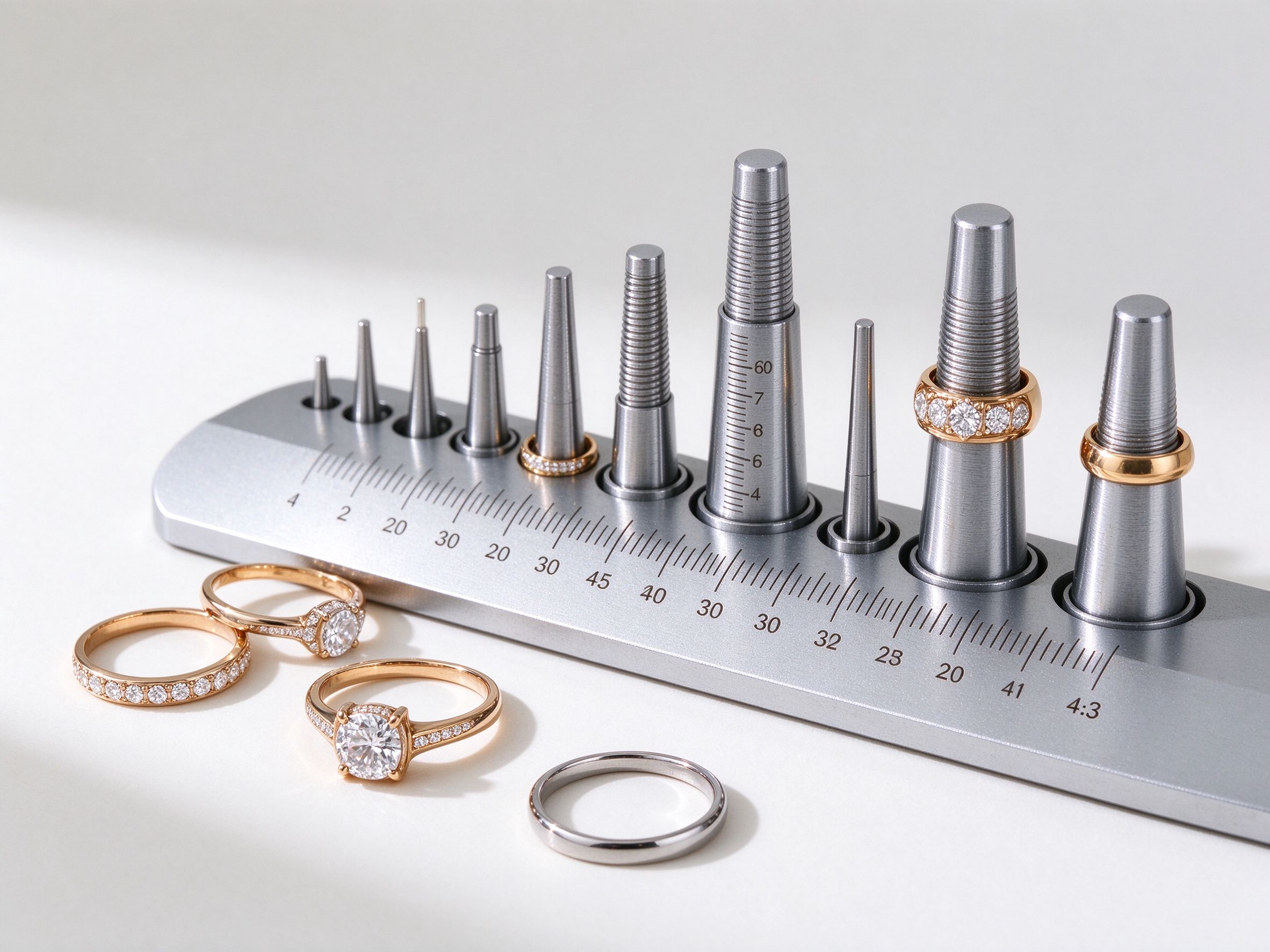
Why Ring Size Changes: Morning, Evening, Heat and Cold
Almost no one's ring size is the same at eight in the morning as it is at eight at night, and almost no one measures their finger under the right conditions. The result is a ring that feels perfect in the jewelry shop and loose by lunchtime, or tight after a hot dinner. As a moissanite manufacturer, we size hundreds of rings a week and see the same confusion over and over: customers convinced their ring was sized wrong, when the finger simply changed between the fitting and the wearing. This guide explains why fingers shrink and swell, how much they actually move, and the single correct time to measure for a ring that will fit in real life, not just on the shop bench.
The short version: your finger size changes by roughly half a ring size across a normal day, and by up to a full size between a cold morning and a hot evening. Measure when the finger is at its average, not its extremes, and choose a fit that slides on over the knuckle but does not spin on the finger. Read on for the detail behind that rule, written from the bench where we watch fingers change every single day.
Why Fingers Shrink in the Cold
Cold is the body's cue to pull blood inward toward the core, and the fingers and toes are the first to feel it. On a cold day, the blood vessels in the hands constrict, the hands cool, and the fingers literally shrink in diameter. A ring that fits comfortably indoors may slide off easily outside in winter. This is why people who wear rings skiing or in cold climates lose them: the finger has shrunk, and the ring, once snug, now spins.
We see this most with customers who get sized in an air-conditioned studio in summer, or a heated room in winter. The finger at the fitting is relaxed and average, but the ring is judged on a finger that may be cooler or warmer than real life. A measurement taken in a cold office underestimates the true size by as much as a half. The ring then feels too tight once the hand warms up, which is the classic "sized wrong" complaint.
The reverse happens in heat. Warm weather dilates the blood vessels, the hands swell, and the fingers grow. A ring that fit perfectly in a spring fitting can feel snug by August. People notice this on vacation, especially in hot countries, when a suddenly tight ring prompts panic about a stuck finger. This is normal physiology, not a medical issue, and it is reversible the moment the hand cools.
Morning Versus Evening Swelling
Fluid pools in the hands overnight. Most people wake with slightly puffy fingers, and the swelling peaks in the first hour or two after rising. By mid-morning, the hand has been moving, the fluid has shifted, and the finger is closer to its average. By evening, after a day of use, salt intake, and heat, many fingers are again slightly fuller. The true average sits somewhere between morning and evening, not at either extreme.
This is why a ring measured first thing in the morning will tend to come up too large. The finger is puffy, the measurement overestimates the steady size, and the ring bought from that measurement spins loosely by midday. Conversely, a finger measured late in a hot, salty dinner will read slightly large, which means the ring bought from that measurement feels snug. Neither extreme is the true size.
The practical rule is simple. Measure mid-morning, after the hand has been up and moving for a couple of hours, and after a normal, not salty, meal. Do not measure right after waking, right after a hot shower, right after a long flight, or right after a heavy salty meal. Those are all moments when the finger is at an extreme, and the measurement will lie to you.
How Much Does a Finger Actually Change?
For most people, the swing across a normal day and a normal temperature range is about half a ring size. A finger that is a comfortable size 6 in the mild mid-morning may feel like a 6.5 after a hot dinner and a 5.5 on a cold winter morning. That half-size swing is the reason sizing exists in half sizes at all. If fingers never changed, whole sizes would be enough. The half-size range exists to absorb the natural variation.
A few people swing more. Those with circulation sensitivities, pregnancy, certain medications, or hot-flush episodes can move a full size or more. For them, the fitting rule matters even more, and a comfort-fit band, which slides on more forgivingly, is worth the small upgrade. We explain comfort fit in our sizing guidance, and it is the single most forgiving band profile for anyone whose finger fluctuates.
What this means for choosing a size is that you are not chasing a single number. You are choosing a size that works across the range. A ring that slides on over the knuckle in the morning and still feels secure, not tight, in the evening swell is the right size. A ring that is snug at the average but tight at the peak is too small. Err on the slightly looser side of average, because a ring that is a touch loose can be worn with a guard, while a ring that is too tight cannot easily be fixed on the finger.
The Dominant-Hand Effect and Other Variables
The hand you use more is often slightly larger, because the muscles and knuckles are more developed. Most people need a half size larger on the dominant hand. We explain this fully in our guidance on dominant hand size differences, but the short version is to measure the hand the ring will actually live on, not the hand it is tried on first. Trying an engagement ring on the left hand when it will be worn on the right is a common and avoidable sizing mistake.
Weight changes also move the finger, and we cover that in detail in our article on weight change and ring size. The point here is that a finger size taken this month is not permanent. Expect to resize at least once if your weight changes significantly, and size for your current hand, not the hand you plan to have.
Pregnancy brings its own swelling, which we cover in our article on pregnancy and jewelry. For sizing during pregnancy, the advice is not to commit to a permanent size mid-trimester, because the swelling is temporary. A temporary band or a necklace chain is the sensible workaround, and the permanent resize waits until the finger settles.
Why a Mandrel Beats a Paper Strip
Paper-strip and string measurements are notorious for inaccuracy, because paper stretches, strings slip, and people pull them at different tensions. We cover this in depth in our article on why paper sizers fail, but the short version is that a proper ring sizer band, the adjustable kind used in jewelry shops, or a visit to a jeweler with a metal mandrel, is worth the small effort. A paper strip measured at home on a puffy evening finger can easily be a full size off.
If you must measure at home, do it multiple times. Measure on three different days, at mid-morning, and average the readings. Use a narrow strip of paper pulled to a consistent, not tight, tension, and mark where it overlaps. Then compare that length to a ring size chart. The average of three calm measurements is far better than one dramatic measurement taken at an extreme. We supply printed ring sizers with wholesale orders, and they are far more reliable than a torn receipt.
The gold standard remains trying an existing ring on a mandrel. If you own a well-fitting ring in the right band width, measure that. The width of the band changes the effective size, a wider band fits more snugly than a narrow one, which is why a wide comfort band may need a quarter to half size up from a thin band. We size for the actual band width we produce, and that width correction is built into our sizing.
When a Loose Ring Becomes a Safety Issue
A ring that spins freely is not just uncomfortable; it is at higher risk of loss. Cold mornings, when the finger shrinks the most, are exactly when rings slip off and are not noticed. A loose ring washed off at the sink, caught on a towel, or slid off during a handshake is the classic lost-ring story, and almost always it happened on a cold day when the finger was at its smallest. If your ring turns freely, especially in the cold, treat that as a sizing problem rather than an annoyance.
The fix is usually a ring guard, a small plastic or metal insert that sits inside the band and takes up the slack. Guards are cheap, reversible, and let you keep the ring on while the finger fluctuates. They are especially useful in winter for a ring that was sized for a warmer finger. We recommend them as a temporary measure rather than resizing down for a seasonal change, because the finger will swell again and a resized-down ring will then be too tight.
A ring that is too loose also knocks against surfaces more, which works the prongs over time. We explain the connection in our article on loose stone emergencies, but the practical point is that a spinning ring is more likely to chip or loosen its setting than a snug one. Sizing correctly, or using a guard, is as much a stone-security measure as a comfort one.
How We Size Rings Consistently in the Factory
In our workshop, every ring is sized on a calibrated steel mandrel, not by guesswork. The mandrel is marked in whole and half sizes, and the band is slid on until it rests at the right mark. We check the size after sizing, after polishing, and after plating, because each process can move the ring a fraction. A ring that was a perfect size 6 before polishing can come back a hair larger after the metal is refined, and we correct that before it ships.
Band width matters as much as the number. A 6mm comfort band reads as snugger than a 2mm band of the same internal diameter, because more metal contacts the finger. When we size a wide band, we add a quarter to half a size to compensate, so it feels the same as the narrow band the customer is used to. This is why sizing an existing thin band is not always a reliable guide for ordering a wide new one; the width correction is real.
For wholesale partners, we produce size charts that match our actual bands, not generic industry charts. A ring sized on our mandrel on our width is the size it will feel on the finger. We also stock half sizes and offer half-size ranges for brands that want to offer a precise fit. The investment in accurate sizing pays back in fewer resizing requests and happier customers, which is why we treat the mandrel check as a non-negotiable QC step before any ring leaves the bench.
Frequently Asked Questions
Is my ring supposed to feel slightly loose in the morning? If the finger is at its cooler, smaller morning state, yes. A ring that turns freely first thing but sits securely by midday is fine. A ring that spins and slips off even at midday is too large.
Why did my ring suddenly feel tight after a flight? Cabin pressure and sitting still let fluid pool in the hands. This is temporary. Elevate the hands, move the fingers, and the swelling eases within hours. Do not panic-size a ring based on a flight-swollen finger.
Should I size for my finger on a hot day or a cold day? Size for the average, mid-morning, mild-temperature finger. A ring fitted for a hot-day maximum will be too loose on cold days; one fitted for a cold-day minimum will be too tight in the heat. Average is the target.
How often do I need to resize? Only when your finger changes meaningfully, weight, pregnancy, aging. A well-sized ring may never need a resize. Seasonal variation is normal and does not require a new size.
The finger on your hand is a living thing, and it moves. It moves with temperature, with time of day, with what you ate, with how much you slept, with the season, and with your weight. A ring that ignored all of that would be a ring that fit perfectly once and never again. Instead, the right approach is to choose a size that works across the natural range, and to accept that a little looseness in the cold is the price of not being tight in the heat. This is not a compromise; it is how rings are meant to fit.
If you remember nothing else, remember the mid-morning rule. Do not measure at the wake-up puff, do not measure after a hot shower, do not measure after a salty dinner, and do not measure after a long flight. Wait until the hand has been up and doing ordinary things for a couple of hours, measure then, and average a few readings. That single habit eliminates most sizing mistakes, because it measures the finger you actually live in, not the one you occasionally wake up as.
For wholesale brands, this is worth teaching on the product page. A short note that says, fingers vary by temperature and time of day, measure mid-morning, prevents a surprising number of "ring feels too loose" and "ring feels too tight" support tickets. Customers who understand that their finger changes stop blaming the ring, and start wearing it well. We supply that guidance with our wholesale packaging, and we recommend it to every brand we work with.
There is no such thing as a perfectly static finger, and there is no point chasing one. The goal is a ring that is comfortable across the normal swing, that slides on over the knuckle without fighting you, and that sits securely enough not to spin off when the hand cools. That target is reachable, and it is reached by measuring calmly, at the right time, and choosing the size that works at the average rather than the extreme. Once you do that, the ring simply lives on your hand, and you stop noticing it, which is exactly what a ring should do.
When in doubt, err on the slightly larger side. A ring that is a touch loose can be tightened with a guard, and it will never pinch your finger. A ring that is too small, fitted for a cold-day minimum, will be genuinely uncomfortable in every warm moment, and cannot be fixed on the finger. The asymmetry favors the looser fit, because the downside of loose is minor and reversible, while the downside of tight is a stuck ring and a panicked evening. Size up a quarter if you are between sizes, and wear a guard in the winter if the cold makes it spin.
The moissanite in the ring does not care about any of this. It sits brilliant in its prongs whether the finger is puffy or slim, hot or cold. What changes is the tube of metal around the finger, and that tube is easy to size right once you know the finger moves. Stop treating ring size as a fixed number. Treat it as a range, choose the size that works across the range, and the ring stops being something you think about and becomes something you simply wear. That is the whole secret, and it works on every hand, every season, and every temperature. Measure calmly, size for the average, and let the ring live on your hand without a second thought. That is the approach we use on our own bench, and it is the approach we recommend to every customer and brand we ship to. The finger moves; the ring should just keep up. Choose well, measure calmly, and the ring will fit through every season of the year and every season of your life. We are here to help you get that size right the first time. Reach out any time, and we will size the ring the way it is meant to be worn, comfortably and securely, for every season.
Size for the Average, Not the Extremes
Fingers are not static, and that is normal, not a defect. They swell in heat, shrink in cold, puff in the morning, and settle by mid-morning. The ring that fits well is the one chosen for that average finger, measured calmly, at the right time of day, on the hand it will actually live on. Measure mid-morning, average a few readings, account for your dominant hand and band width, and accept a slight looseness in the cold as the price of not being tight in the heat. Done right, the ring feels secure across the whole range, and you stop thinking about it.
If you are ordering rings for customers, the sizing guidance you provide sets expectations for life. We are a moissanite manufacturer in Wuzhou, China, and we supply printed sizers, width charts, and comfort-fit bands that absorb natural finger variation. Reach our team at service@holycome.com for wholesale sizing tools, or to discuss comfort-fit production. For dominant-hand differences, start with that article, and for weight-related size changes, read the weight guide. We look forward to hearing from you soon, and to helping you get the perfect, comfortable, secure fit for every ring you wear, for many happy, sparkling, brilliant years to come. Thank you very much indeed for reading this guide carefully today. We are right here whenever you need us.