Ring Size Distribution and Factory Yield: Why Ordering the Right Sizes Saves Money
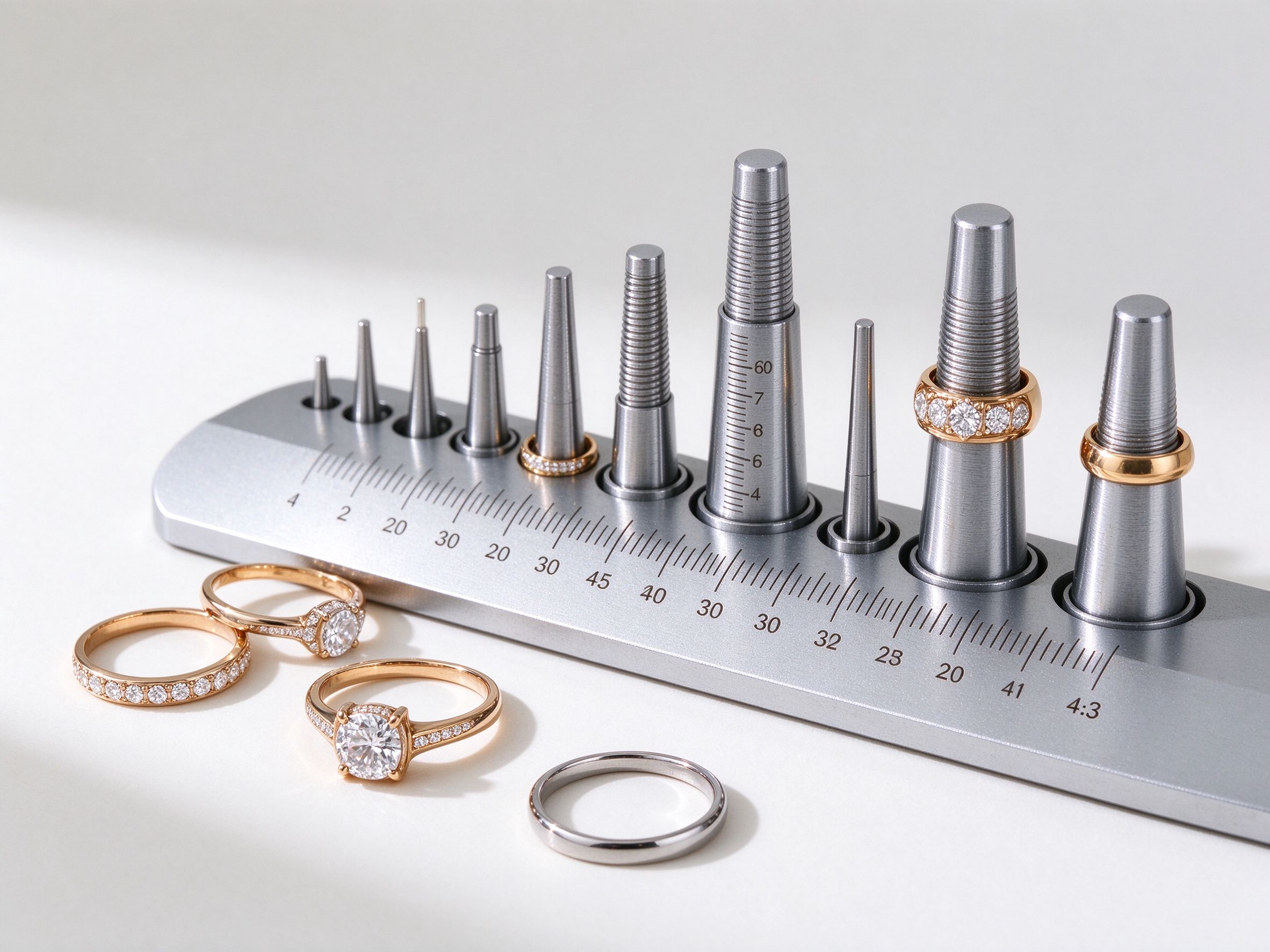
If you have ever ordered a run of rings and been left with a pile of size 4 and size 11 inventory while size 7 sold out in a week, you have felt the cost of getting the size distribution wrong. Ring sizes are not all equal in demand. Most customers wear sizes in a narrow middle range, and the sizes at the extremes sell slowly. Ordering a balanced size run means ordering more of the middle sizes and fewer of the extremes, which reduces dead inventory, improves cash flow, and lowers the effective cost per piece. This article explains how ring size demand is distributed, how we plan production around it, and how a brand can order the right size mix to avoid being stuck with unsellable inventory.
The factory side of this equation is called yield, and it refers to how much of your production run actually sells through. A run with a perfect size distribution has high yield, because every size sells. A run with a skewed distribution has low yield, because the extreme sizes sit on the shelf. The brands that manage size distribution well have higher margins, because they are not discounting slow sizes to clear them. The brands that get it wrong are constantly discounting, and the discounting erodes the price integrity of the whole line.
How Ring Size Demand Is Distributed
Ring size demand follows a bell curve. The middle sizes sell the most, and the sizes at the extremes sell less. For ladies rings in the US market, the peak demand is around size 6 to size 7, with size 7 being the single most common size. Sizes 5 and 8 sell well, but less than 6 and 7. Sizes 4 and 9 sell slowly, and sizes 3 and 10 are niche. For men's rings, the peak is around size 9 to size 10, with size 10 being the most common. Sizes 8 and 11 sell well, and sizes 7 and 12 are niche.
The exact distribution varies by market. Asian markets skew smaller, with ladies sizes peaking around 5 to 6. European markets are similar to the US, but slightly smaller. Middle Eastern markets skew larger, especially for men. We have data on the size distribution for each market we export to, and we will share it with you. The bell curve is the shape, but the peak shifts depending on where your customers live. Ordering the US distribution for an Asian market, or vice versa, is a common mistake that leaves brands with the wrong sizes.
For a brand, the implication is to order more of the peak sizes and fewer of the extremes. A typical ladies size run for the US market might be: size 5 at 10 percent, size 6 at 25 percent, size 7 at 30 percent, size 8 at 20 percent, size 9 at 10 percent, and size 10 at 5 percent. This distribution matches the demand curve, and it means you are not overstocking the slow sizes. If you order equal quantities of every size, you will be left with size 4 and size 10 inventory that never sells, while size 7 keeps going out of stock.
Why the Middle Sizes Sell Out Fast
The middle sizes sell out fast because most customers wear them. Size 7 is the average ladies ring size, and when a customer comes to your store or website, they usually try on a size 7 first. If you are out of size 7, the customer might buy a size 6.5 or 7.5, but they might also just leave. The middle sizes are the engine of the business, and being out of stock on them is the most expensive mistake you can make. We see brands constantly running out of size 7 and then having to reorder, which adds freight and delay, while they have a pile of size 4 that no one wants.
For a brand, the solution is to overstock the middle sizes slightly, and understock the extremes. We recommend ordering 30 percent of your run in size 7 for ladies, and 25 percent in size 10 for men's. This overstock means you will not run out of the size that sells the most, even if demand spikes. The extreme sizes can be ordered on demand, because they sell slowly and you do not want to tie up cash in them. Some brands even offer extreme sizes as a made-to-order option, so they do not have to stock them at all.
The cash flow difference is significant. A brand that orders equal sizes ties up 50 percent of its inventory in slow-moving sizes, and that inventory sits in a warehouse. A brand that orders the bell curve ties up most of its inventory in fast-moving sizes, and the cash comes back quickly. The brands that manage this well have healthier cash flow, and they can reinvest in new designs rather than waiting for old inventory to clear. The size distribution is not a detail; it is a cash flow decision.
How We Plan Production Around Size Distribution
When we produce a run of rings, we plan the size run based on the distribution the customer gives us, or based on our default distribution if they do not specify. We cast more of the middle sizes and fewer of the extremes, because we know that is what will sell. The casting process is flexible, and we can adjust the size mix on the fly as the run progresses. If a brand tells us that size 7 is selling faster than expected, we can increase the proportion of size 7 in the next run, and decrease the proportion of size 4.
The production yield is also affected by the size mix. A run with many small sizes uses less silver per piece, because the torus is smaller. A run with many large sizes uses more silver per piece. We will adjust the silver weight estimate based on the size mix, so you know exactly what the material cost will be. If you order a run that skews large, the average weight per piece goes up, and the cost goes up. If you order a run that skews small, the average weight goes down, and the cost goes down. We will tell you this before you commit, so you are not surprised by the cost.
For a brand, the planning step is where we add value. We will look at your past sales data, if you have it, and recommend a size mix that matches your actual customers. If you are a new brand with no sales data, we will recommend the standard distribution for your market, and we will adjust it after the first run based on what sells. The goal is to get the size mix right, so you are not stuck with inventory that does not move.
What to Do With Slow-Sizing Inventory
No matter how well you plan, you will end up with some slow-sizing inventory. A few size 4 and size 10 pieces will sit on the shelf, because the demand for those sizes is small. The question is what to do with them. The worst option is to discount them heavily, because that erodes the price integrity of the whole line. A better option is to bundle them with fast sizes as a promotion, or to sell them through a different channel that serves customers with non-average sizes.
Some brands handle slow sizes by offering them as a made-to-order option. A customer who needs a size 4 can order it, and we produce it on demand. This way, the brand does not have to stock size 4, but they can still offer it to the customer who needs it. The made-to-order option has a longer lead time, but the customer who needs a non-average size is usually willing to wait. This is the cleanest way to handle slow sizes, because it eliminates the inventory risk entirely.
For a brand, the goal is to minimize the amount of slow inventory you carry, not to eliminate it entirely. A small amount of slow inventory is normal, and it is the cost of doing business. The mistake is carrying a lot of slow inventory, because that ties up cash and reduces your ability to invest in new designs. We will help you set a threshold for how much slow inventory you carry, and we will adjust the size mix to stay below that threshold.
How Regional Differences Change the Size Mix
The size distribution is not the same in every country, and ordering the US distribution for an Asian market is a common and expensive mistake. In East Asia, the average ladies ring size is closer to a US 5 or 5.5, because the average hand is smaller. In Southeast Asia, the average is a US 6. In Northern Europe, the average is a US 6.5. In the US and Canada, the average is a US 7. In the Middle East and parts of Northern Europe, the average is a US 7.5 or 8. These differences sound small, but they mean that a size run that sells perfectly in the US will leave you with size 7 inventory in Japan, where the customer needs a size 5.
For men's rings, the regional differences are even larger. In the US, the average men's ring size is a US 10. In East Asia, the average is closer to a US 8.5 or 9. A men's band run ordered to the US distribution will be too large for most Japanese customers, and too small for most Saudi customers. We have seen brands order a men's run based on the US chart, only to find that 60 percent of the run does not fit their Asian customers. The waste is enormous, and it is avoidable.
For a brand, the implication is to know your market before you order the size mix. If you are selling only in one country, use that country's distribution. If you are selling in multiple countries, use a blended distribution that covers the range, or offer made-to-order for the extreme sizes. We will give you the size chart for any market you are selling into, because we export to most of them. The size distribution is one of the easiest ways to improve yield, and it is also one of the easiest mistakes to make if you do not ask.
How We Track Size Yield Over Time
For brands that order from us repeatedly, we track which sizes sell and which sizes sit, and we adjust the size mix on the next run. If a brand orders 100 pieces of a design, with 30 in size 7 and 5 in size 4, and the size 7 sells out in a month while the size 4 is still there a year later, we will reduce the size 4 proportion on the next run and increase the size 7 proportion. This is how we optimize the yield over time, and it is the kind of data that a brand cannot get from a distributor, because the distributor does not know which size sold.
We keep this size history for every brand we work with, and we share it with you. After the first run, we will tell you which sizes are moving and which are not, and we will recommend a revised mix for the next run. This iterative process gets more accurate over time, because we are learning your specific customer base, not just the general market. The brands that work with us for a few years end up with a size mix that is almost perfectly tuned to their customers, and their yield is very high.
For a new brand with no sales data, we start with the standard market distribution, and then we refine it after the first run. The first run is always a learning experience, and no brand gets the size mix perfect on the first try. The key is to track what sells, and adjust on the next run. We will help you do that, because we want you to order again, and you will only order again if the inventory moves.
How Half Sizes Affect the Equation
Half sizes add complexity to the size run. A whole-size run might have six sizes, from 5 to 10. A half-size run might have twelve sizes, from 5 to 10.5. Each half size adds a SKU, and each SKU is a small amount of inventory. For a brand that is just starting out, offering half sizes means splitting your inventory across twice as many sizes, which means less stock per size and more risk of running out. Most new brands start with whole sizes only, and add half sizes once they have enough volume to justify it.
For thin stackable bands, half sizes are less important, because thin bands are forgiving and a size 6 fits most size 6.5 customers. For solitaire engagement rings, half sizes are more important, because the customer expects a precise fit, and a ring that is slightly loose or tight will be a complaint. We will recommend whether to offer half sizes based on the product type and the brand's volume. For a low-volume brand, whole sizes are fine. For a high-volume brand, half sizes are expected.
The factory cost of half sizes is small, because the torus is the same and only the diameter changes. We can produce any size, whole or half, at the same per-piece cost. The cost of half sizes is in the inventory management, not the production. The more SKUs you have, the more warehouse space you need, and the more likely you are to have some slow SKUs. The decision to offer half sizes is a business decision, not a production decision, and we will help you make it based on your volume and your customer expectations.
Common Questions About Ring Size Distribution
What size should I stock the most of? For ladies in the US, size 7 is the most common, followed by size 6 and size 8. For men, size 10 is the most common, followed by size 9 and size 11. We will give you the exact percentage breakdown for your market.
Should I offer half sizes? For a new brand, start with whole sizes. Once you have volume, add half sizes, especially for engagement rings. Thin stackable bands do not need half sizes, because they are forgiving.
What do I do with size 4 and size 10 inventory? Offer them as made-to-order, or bundle them with fast sizes as a promotion. Do not discount them heavily, because that erodes your price integrity.
Does the size mix change the production cost? Yes. A run skewed to large sizes uses more silver per piece, and a run skewed to small sizes uses less. We will adjust the cost estimate based on the size mix you order.
How do I know my customers' sizes if I am just starting? Start with the market average for your country, and then track what sells. After the first run, you will have data, and you can adjust. We will give you the starting distribution, and we will refine it with you.
Can I order just the middle sizes and skip the extremes? Yes. Many new brands order only sizes 6 through 8 for ladies, and 9 through 11 for men. This covers most customers, and it eliminates the slow extreme sizes. You can add the extremes later if there is demand.
How We Adjust Silver Weight for the Size Mix
When you order a run of rings, we quote a target weight based on the middle size, usually size 7 for ladies. But if your size run skews large, the average weight per piece goes up, and the silver cost goes up with it. We recalculate the average weight based on the size distribution you give us, so you know exactly what the material cost will be. If you order 30 percent size 9 and only 10 percent size 5, the average ring is heavier than if you order 30 percent size 5 and 10 percent size 9. The difference can be 10 percent or more in silver cost, which is why we do the recalculation before we commit to the price.
For a brand, this means that the size mix is not just a sales decision; it is a cost decision. A run that skews small is cheaper to produce, because the average ring uses less silver. A run that skews large is more expensive. If you are trying to hit a target wholesale price, the size mix can move you above or below it. We will show you the weight calculation based on your size mix, so you can adjust the mix if the cost is too high. Sometimes the solution is to order fewer of the large sizes, which brings the average weight down and the cost down with it.
The Bottom Line
Ring size distribution is one of the most important factors in the profitability of a ring line. Ordering the right mix of sizes means you sell through most of your run, you keep cash flowing, and you do not have to discount slow inventory. Ordering the wrong mix means you are stuck with slow sizes, you run out of fast sizes, and you erode your margins. We will help you plan the size run based on your market, your sales data, and your volume, so you get the distribution right. The goal is high yield: every ring you sell, not every ring you produce.
If you are planning a ring run and want to see the recommended size distribution for your market, send us your target countries and we will share the data. Reach our team at service@holycome.com, and for more on how we plan ring production, read our guide to wholesale ring MOQ and minimum order quantities and our breakdown of ring band width and thickness cost.