Weight Loss or Gain? How Your Ring Size Changes (and When to Resize)
You drop twenty pounds, and suddenly your engagement ring spins around your finger like a carousel. Or you put on ten, and the band that slid on easily now leaves a deep groove. Weight changes move ring size, and they move it more than most people expect. As a moissanite cutting and setting factory that resizes rings every week, we have watched thousands of customers go through exactly this: a body that changed, and a band that did not. This guide explains how much weight actually moves a ring size, when to wait before resizing, when resizing is safe and when it is not, and how much metal we add or take off on the bench.
The short answer is that a ten-to-fifteen-pound shift typically changes ring size by about half a size, and a thirty-to-forty-pound shift can move a full size or more. But the real number depends on where you carry weight, how your body distributes fat and water, and whether the change is still happening or has stabilized. Resizing too early, while the finger is still moving, means you pay for a second resize in six months. Waiting too long means the ring either slips off and is lost, or bites into the finger and becomes a circulation problem. Getting the timing right is the whole game.
Why Weight Changes Move Finger Size at All
Finger size is not determined by bone, because bone in the fingers barely changes in adulthood. It is determined by the soft tissue wrapped around those bones: subcutaneous fat, water retention, muscle, and the general plumpness of the pad under the skin. When body weight rises, some of that extra tissue settles in the hands and fingers, and the tube of skin around the finger gets a little wider. When weight falls, that tissue thins, and the finger narrows. The knuckle, which is mostly bone and joint, moves less than the pad does, which is why weight loss often makes the ring slide over the knuckle easily but then spin on the thinner finger below it.
Water retention amplifies this. Even without true fat loss or gain, a salty meal, a flight, a menstrual cycle, or a warm afternoon can add or remove a few millimeters of finger circumference. This is the day-to-day wobble we cover in our guide on why fingers change size from morning to evening and season to season. Weight change is the slow, permanent version of that same phenomenon. The finger does not actually shrink or grow by anatomy; it just carries less or more fluid and fat on any given day.
Muscle matters too. People who take up strength training often find their hands thicken even when their weight stays flat, because grip work builds the muscles between the knuckles. A construction worker, a chef, a rock climber, or a yoga teacher may have fingers that are larger than their weight alone would suggest, and those fingers can stay large as long as they keep training. Conversely, someone who stops using their hands hard may find the muscle softens and the finger narrows. Muscle is a faster change than fat, and it is just as real on the mandrel.
How Much Weight = How Many Sizes
There is no exact conversion, because bodies distribute weight differently, but from the rings we have resized and re-resized, a rough rule emerges. Losing about ten to fifteen pounds usually takes a ring down by roughly half a size. Losing twenty-five to thirty-five pounds often takes it down a full size. Beyond forty pounds, customers typically report moving one and a half to two sizes, sometimes more. On the way back up, the same numbers work in reverse, though people tend to notice the gain later, because a tight ring creeps up slowly and only becomes obvious when it pinches.
The variation is huge. Two people can both lose thirty pounds, and one drops a full size while the other drops only a half, because one carries weight in the hands and face while the other carries it in the hips and thighs. Genetics decide where the fat goes, and the fingers are along for whatever that plan is. If you carry weight in your hands, small shifts in the scale show up quickly on your ring finger. If you do not, the scale can move a lot before the ring notices at all.
Age compounds this. Hands get thinner with age even at stable weight, because skin loses elasticity and fat pads atrophy. A woman in her sixties may find her rings loose not because she dieted, but because her hands aged. The ring itself has not changed, but the finger has flattened over decades. This slow drift is why heirloom rings passed down often need a small sizing adjustment, even when the new owner's weight is close to the original wearer's.
When to Wait Before You Resize
The single most common resize mistake is acting too fast. A customer loses fifteen pounds, the ring spins, they rush it to a jeweler and take it down a half size, and then they lose another twenty pounds three months later and need another resize. Each resize costs money and, on some designs, weakens the band. The smarter move is to wait until the weight has stabilized, usually for at least six to eight weeks, before touching the band. During that waiting window, use a ring guard or a sizing bead to take up the slack temporarily.
If you are actively dieting, especially an aggressive diet, do not resize mid-process. Your finger is still a moving target. Finish the program, maintain the new weight for a couple of months, let the body settle, and then measure. The same applies on the gain side: if you are intentionally gaining weight or recovering from an illness, wait until your weight plateaus before sizing up. A ring resized to a finger that is still swelling will be too small again in a month.
Pregnancy is the classic waiting case. Fingers swell substantially during pregnancy and often stay larger for weeks or months after birth, then shrink back as water leaves the body. Resizing a maternity-swelled finger is almost always a mistake, because the ring will be too big once the swelling goes down. We cover this in depth in our article on ring size during pregnancy and temporary swelling. For now, the rule is: if the change might be temporary, size with a guard, not with a torch.
When a Ring Is Too Loose to Wait
Sometimes waiting is not safe. If the ring slips over the knuckle easily and spins freely, it can fall off and be lost. A moissanite ring that slips off at the sink, the gym, or on vacation is the single most common way these rings are lost, and once a stone is gone down a drain, it is gone. If your ring moves more than a quarter turn on its own, or slides off when your hands are cold and wet, do not wait to stabilize your weight. Put a temporary guard on it immediately.
A ring guard is a cheap, reversible insert that clips or glues inside the band, taking up the gap without altering the metal. It buys you months of safe wear while your weight settles. We recommend guards over tape, because tape collects gunk and irritates skin, and over repeatedly resizing the band up and down, which fatigues the metal. Once your weight has held steady for two months, then bring the ring in for a proper resize to the new, stable size.
If the ring is actually at risk of falling off on a regular basis, stop wearing it during activities where loss is likely, like swimming, washing dishes, or lifting weights. Store it in a small pouch in a safe place until you can size it. Losing a ring because it was a half size too loose is preventable, and a guard costs a few dollars. The ring, set with a moissanite you chose deliberately, is worth far more than the inconvenience of a temporary insert.
When a Ring Is Too Tight
On the other end, a ring that is too tight is not just uncomfortable; it can become a medical issue. If the band leaves a deep indentation, the finger below it swells, or you cannot remove the ring even when your hand is cold, the ring has to come off before it cuts off circulation. Soap and water, elevation, and a cool hand usually get a stuck ring off, but if those fail, a jeweler or a hospital can cut it. Do not panic and yank; you will only injure the finger.
A ring that is gradually tightening over months, as weight goes up, should be sized up before it reaches the stuck stage. Sizing up is generally simpler and safer than sizing down, because it means adding a small piece of matching metal to the band and smoothing the join. We do this on the bench by cutting the band open, inserting a bridge of the same metal, and soldering it closed. The finished band is as strong as the original, provided the design allows it.
Some designs cannot be sized up, and we tell customers this upfront. Rings with full circular pave, eternity bands set all the way around, or bands with inlays of wood or ceramic cannot be stretched or expanded without destroying the setting. If you own an eternity band and your finger grows, the honest answer is that the band may have to be remade or worn on a different finger, not resized. This is why we ask about the design before promising a resize.
What a Resize Actually Does on the Bench
Customers often ask whether we stretch the band like a rubber band. We do not. Stretching is a last-resort trick used on plain, soft gold bands of simple design, and it thins the metal. The proper resize, the one we stand behind, is a cut-and-add or a cut-and-remove. For sizing down, we cut out a small wedge of the band, bring the two ends together, and solder them closed, then refinish the solder seam so it disappears. For sizing up, we add a small strip of matching gold, solder it in, and refinish.
A half-size adjustment removes or adds a sliver of metal only a few millimeters long. A full size removes or adds a slightly longer strip. The band's inner diameter changes by a fraction of a millimeter per size, which is why the operation sounds small but matters so much for comfort. The moissanite in the setting is unaffected, because the stone is held by prongs that do not move when the band is cut at the bottom, opposite the stone.
Platinum and 18k gold resize cleanly. 14k gold also resizes well, though it is firmer. Titanium, tungsten, and stainless steel, the hard alternative metals, generally cannot be resized at all, because the torch and solder do not bond to them the way they do to gold. If your ring is in one of those metals and your weight changes, the honest answer is that you may need a new band, not a resize. We flag this on every order so wholesale customers do not promise resizes they cannot deliver.

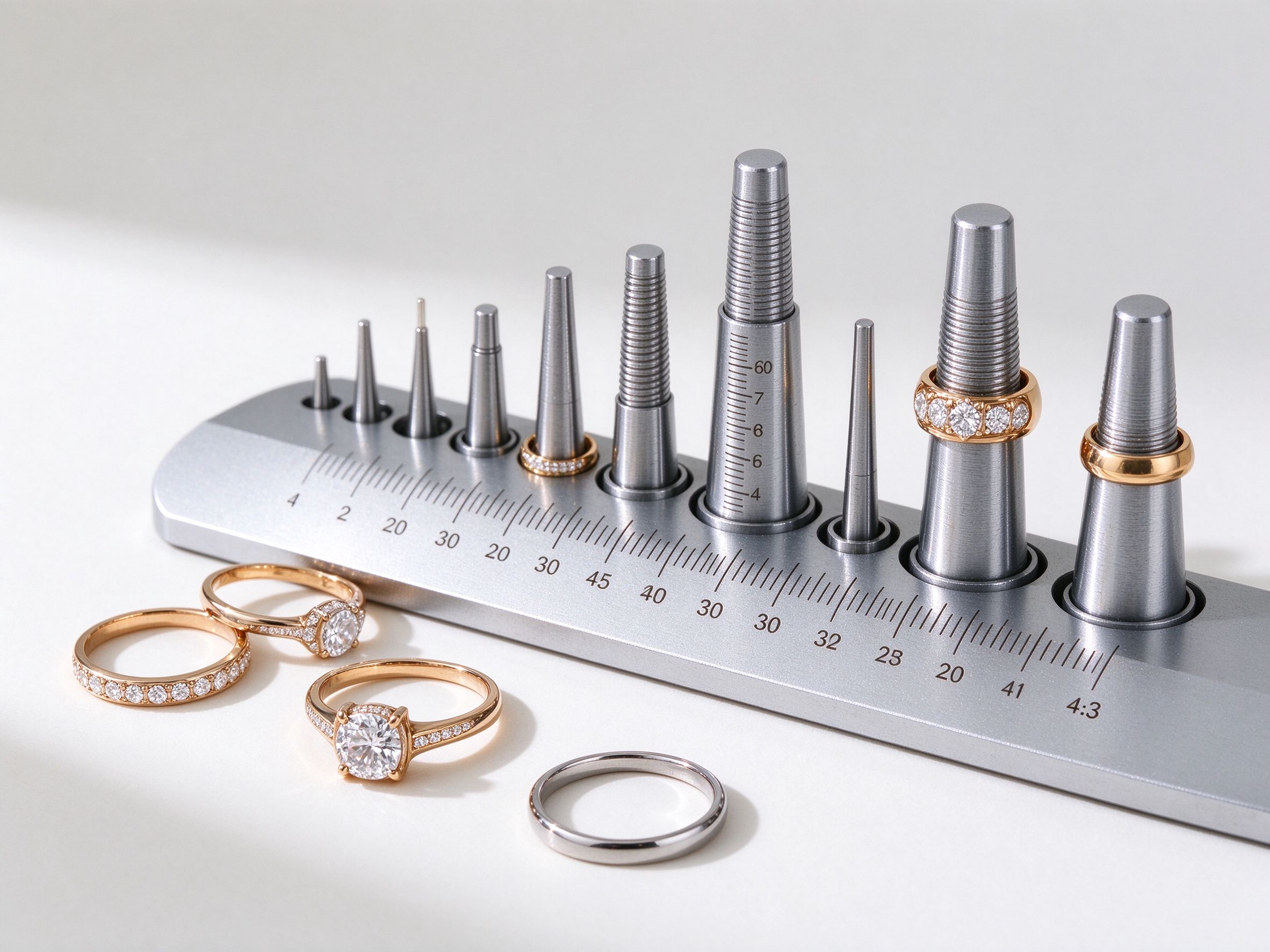
A solitaire moissanite band fitted on a steel mandrel, where we confirm the true inner diameter before and after every resize.
How Weight Gain Changes the Resize Math
Sizing up is not just the reverse of sizing down. When a finger grows, the band does not just need to be a hair larger; it also needs to clear the knuckle, which may have grown as well. We measure both the base of the finger and the knuckle, because the band has to slip over the knuckle and then rest snugly at the base. If the knuckle grew faster than the pad, the ring needs to be sized to the knuckle and then a sizing bead added inside for a snugger fit below, the same technique we describe in our guide on sizing for large knuckles.
On wide bands, sizing up changes the math more. A wide band presses on more of the finger, so a finger that grew by a small amount may feel far more constrained under a wide band than under a narrow one. This is why wide rings are sized slightly looser than narrow rings to begin with, and why a weight gain that barely affects a thin band can make a wide band suddenly uncomfortable. We account for band width in every resize, not just the raw finger number.
The Dominant-Hand Complication
Weight loss rarely affects both hands equally. The dominant hand, which already tends to be half a size larger from muscle use, may change at a different rate as weight goes up or down. Someone losing weight might find their dominant-hand ring finger loosening faster than their non-dominant one, because the fat leaves the non-dominant hand first while the dominant hand holds on to its muscle. This is the asymmetry we cover in our article on why your dominant hand needs a different ring size. When you resize, measure the exact finger you are resizing, not the hand, and do not assume both hands track the same.
We see this in wedding bands all the time. A groom loses weight, his wedding band on his left ring finger loosens, and he resizes it based on a measurement he took on his right hand, because that is the hand he happened to measure. The result is a band that is still a half size off. The fix is simple: measure the finger that wears the ring, at the end of the day, when the hand is warm. Do not borrow a measurement from the other hand, even if they usually match closely.
What Never to Resize
Not every ring should be resized, even when the finger changes. Rings with pavé set along the shoulders, vintage rings with delicate filigree, and rings with multiple stones set into the band itself risk cracking the solder joints around those stones if they are bent on the stretcher or cut. For these, a jeweler will often recommend a sizing bead or a spring insert instead, which adjusts the fit without heating the band near the stones.
Rings that have been resized multiple times already should be treated with caution. Each cycle of heating, cutting, and soldering anneals the metal slightly, and after several resizes the band can become soft or brittle. If a ring has been resized two or three times already because of yo-yo dieting, we recommend letting the weight settle permanently before any further adjustment, or having the band remade in the correct size rather than cycling it again.
Loose stones are another warning. If your moissanite feels wobbly or a prong is bent, get that fixed before you resize, because the bench work for resizing can jostle a loose stone. We cover the emergency side of this in our guide on what to do when a moissanite feels loose. Fix the stone, then resize the band, in that order.

A bench jeweler soldering a sized band; the stone is protected and the heat is kept at the base, away from the moissanite.
Wholesale Sizing Notes for Brand Customers
For the wholesale brands we produce for, weight-change resizing is a predictable part of the after-sales business. We advise brands to stock the common half sizes around the average customer, and to offer a free first resize within a year of purchase, because a meaningful share of customers will need it as their weight settles. Building that one resize into the customer experience prevents returns and builds loyalty. Most customers expect one small adjustment after purchase; brands that provide it easily stand out.
We also produce bands in comfort fit, which slides on more smoothly and tolerates small finger fluctuations better than a flat internal band. For customers whose weight tends to wobble, a comfort-fit band in the next half size up, paired with a sizing bead, often outlasts a tight band that has to be resized every diet cycle. It is a small manufacturing choice that pays off over years of wear.
Frequently Asked Questions
Will I need to resize after major weight loss?
Usually yes, if the loss is more than about fifteen pounds. Wait until the weight has held steady for two months, then measure. Use a guard during the waiting period so the ring does not slip off.
Can I resize a ring up if I gained weight?
Yes, for plain gold or platinum bands. Bands fully set with stones all the way around cannot be resized up and may need to be worn on a different finger or remade.
How many times can a ring be resized?
Two or three times safely. Beyond that, the metal work-hardens and softens with repeated heating, and we recommend remaking the band instead.
Does resizing damage the moissanite?
No, when done correctly. The heat is applied at the base of the band, opposite the stone, and the moissanite and prongs are protected. A reputable shop will never heat near a set stone.
Measure Once, Resize Once
Weight changes are normal, and your ring moving with you is normal too. The mistake people make is either panicking and resizing too early, which means paying twice, or ignoring a too-loose ring until it slips off and is lost. The middle path is simple: when the change is large and still happening, use a guard and wait; when the weight has held steady, resize once, properly, to the finger that actually wears the ring. The moissanite inside the band will be brilliant for decades. The band around it just needs to keep up with the hand you have today.
If you are a brand or wholesaler working with us, we produce bands sized to your customer's exact finger, in comfort or flat fit, with the common half sizes stocked for quick turns. Send us your sizing sheet and your average customer profile, and we will build the size curve that minimizes resize callbacks. A well-sized ring on the first delivery is the cheapest ring to ship, because it never comes back.