
01Moissanite Cuts and Shapes: Building a Catalog That Sells
When a B2B jewelry buyer sits down to plan a moissanite line, the first question after color and cut grade is: "which shapes do I stock, and in what sizes?" The answer drives CAD design, casting volumes, setting time, photography investment, and — most importantly — sell-through. Stock the wrong shapes and your cash sits in slow-moving inventory; miss the trending shapes and you leave margin on the table. This guide breaks down the major moissanite cuts and shapes we produce at HOLYCOME, with real sell-through data from our 2024-2025 OEM shipments, shape-specific production considerations, recommended size ranges, and MOQ guidance.
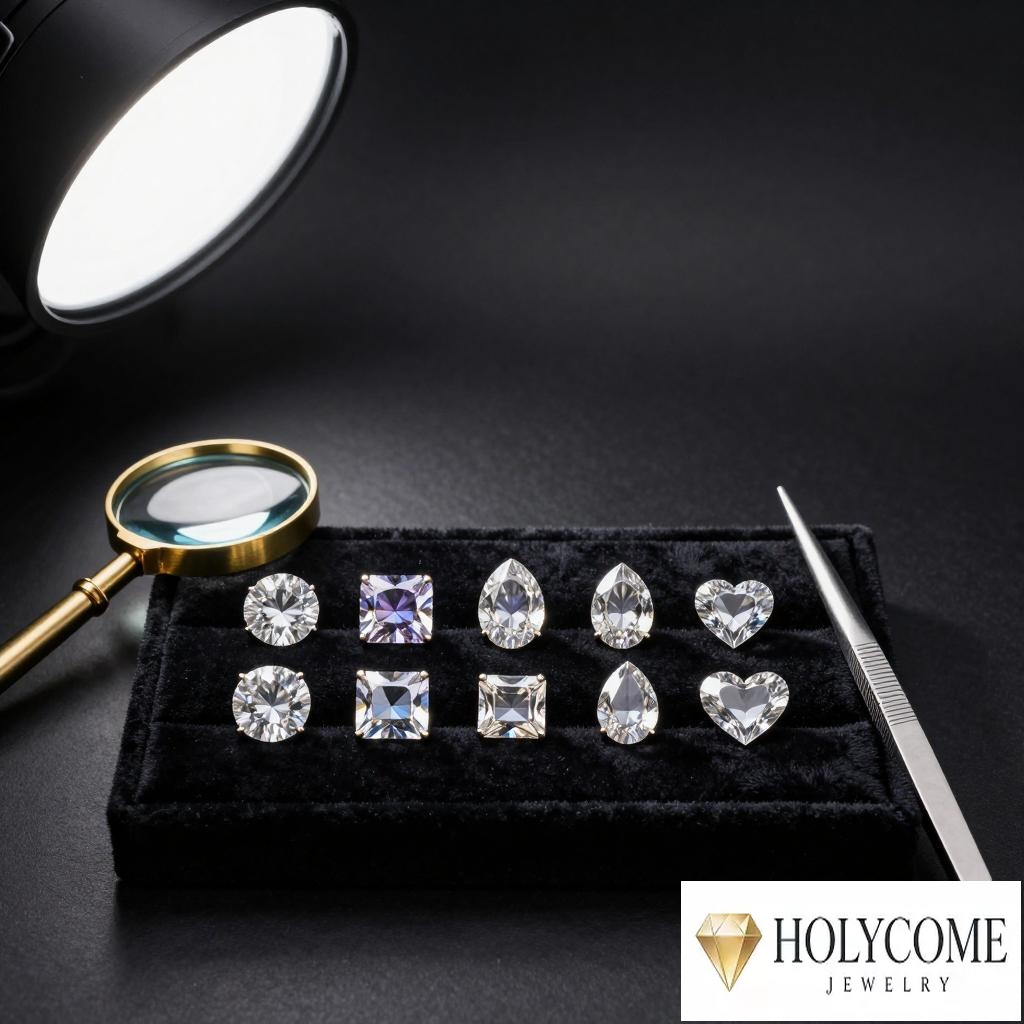
Our faceting floor runs 42 computer-controlled faceting machines across two shifts, producing roughly 240,000 cut moissanite stones per year across 11 primary shapes. The sales data below is aggregated across 180+ active wholesale and OEM accounts spanning DTC brands, independent retail jewelers, department store suppliers, and Amazon/e-commerce sellers. It reflects what actually moves through retail, not what looks compelling in a gem show booth.
02Round Brilliant: The Volume Staple
The Gemological Institute of America documents standard cut grades and facet arrangements across gemstone shapes as a reference for the jewelry trade (GIA Cut Grade). The round brilliant cut accounts for 62% of our total moissanite unit volume and is the default choice for solitaire engagement rings, three-stone rings, halo settings, stud earrings, and pendant centers. It delivers the highest light return of any cut and has the deepest consumer recognition — every jewelry buyer understands what a "round diamond" is, and round moissanite inherits that familiarity.
B2B data snapshot (round brilliant, HOLYCOME premium cut):
- Best-selling sizes: 6.5mm (1ct equivalent), 7.5mm (1.5ct), 8.0mm (2ct), 9.0mm (2.75ct)
- Sell-through index (vs other shapes): 100 (baseline)
- Stock SKUs carried by top-20 OEM partners: 0.8mm to 15mm (0.005ct to 10ct equivalent), 47 calibrated sizes
- MOQ for existing calibrated sizes: 50 pieces per size
- Lead time: in-stock 3-5 days; custom sizes 15-20 days
- Average retail return rate (color/optics): 1.2%, lowest of any shape
For brands launching a first moissanite line, we recommend starting with round brilliant moissanite in 6.5mm and 8.0mm DEF for solitaire SKUs, then adding 1.3-2.0mm DEF melee for halos and side stones. This creates a minimum viable bridal catalog with the highest sell-through per SKU.
The Gemological Institute of America documents standard cut grades and facet arrangements across gemstone shapes as a reference for the jewelry trade (GIA Cut Grade). The round brilliant cut accounts for 62% of our total moissanite unit volume and is the default choice for solitaire engagement rings, three-stone rings, halo settings, stud earrings, and pendant centers. It delivers the highest light return of any cut and has the deepest consumer recognition — every jewelry buyer understands what a "round diamond" is, and round moissanite inherits that familiarity.
03Cushion Cut: Vintage and Halo Favorite
Cushion cut is the second most popular moissanite shape at 11% of our moissanite volume. The modified brilliant cushion (sometimes called "crushed ice cushion" in its high-facet variant) shows exceptional fire and works beautifully in halo settings, vintage-inspired designs, and split-shank rings. Two cushion variants dominate our production:
- Old-mine/antique cushion: Larger facets, chunky flash pattern, vintage feel. Popular in Art Deco and Edwardian reproductions.
- Crushed-ice cushion: More facets (typically 64-73), smaller sparkle pattern, higher scintillation. Best performer on Instagram and TikTok for our partners.
Cushion sell-through is strongest in the US and UK markets; EU buyers tend to prefer more elongated shapes (oval, radiant) for center stones. Recommended ratio for bridal: 1.00-1.10 (square cushion) for classic looks, 1.15-1.25 for slightly elongated cushion halos. MOQ: 50 pieces per size/ratio. Popular sizes: 7mm, 8mm, 9mm.
04Oval: The Elongated Bridal Trend That Stuck
Oval moissanite has been the fastest-growing moissanite shape over the past four years, rising from 4% of our volume in 2021 to 9% in 2025. It shows slightly larger face-up than a round of the same carat weight (typically 10-15% larger apparent size per carat), and its elongated silhouette flatters the finger, making it a favorite for east-west settings and solitaire engagement rings marketed as "modern bridal." Key production considerations for oval:
- Ratio (length-to-width) is the most important spec for buyers. Our best-selling ratio is 1.35-1.45, which balances elongation with a classic oval silhouette. Higher ratios (1.50+) look longer and thinner and appeal to fashion-forward buyers; lower ratios (1.25-1.30) look closer to a rounded round.
- Bow-tie: a dark "bow tie" pattern across the center of the stone is inherent to oval brilliant cuts but varies with cutting quality. Our premium oval cut minimizes bow-tie to below 10% of table area on visual inspection.
- Prong recommendation: 6 prongs for oval moissanite above 8mm to prevent tipping; 4 prongs works for smaller stones.
Oval MOQ matches cushion at 50 pieces per size/ratio. Top DTC partners running oval as their primary engagement shape report sell-through velocity within 15% of round, driven by TikTok and Pinterest bridal trends.
05Radiant: The High-Scintillation Choice
Radiant moissanite is a hybrid cut combining the trimmed corners of an emerald cut with the brilliant faceting of a round. It shows intense sparkle (radiant cuts have up to 70 facets) and is the preferred shape for buyers who want the durability of trimmed corners (no sharp points to chip) with the high fire of brilliant cutting. Radiant accounts for roughly 5% of our volume but has grown 38% year-over-year in 2024-2025, driven by men's jewelry (where the angular shape reads masculine) and by modern bridal brands looking for a distinctive-but-accessible alternative to round.
Recommended ratios: 1.20-1.30 for classic radiant, 1.00-1.10 for "square radiant" (sometimes sold as "princess-radiant hybrid"). MOQ 50 pieces per size/ratio; popular sizes 7-10mm.
06Reference materials on gemstone shapes and cut varieties catalog the major faceting styles used in commercial jewelry (Wikipedia: Diamond cut). Pear (Teardrop): Asymmetry and Statement
Pear moissanite is a brilliant-cut teardrop shape combining the marquise and oval. It accounts for 3% of our volume but has disproportionate influence in fashion and bridal because of its distinctive silhouette. Pear works beautifully in east-west settings, pendants, drop earrings, and as a center stone in modern engagement designs. Production notes:
- Point protection is critical: the pointed tip of a pear is vulnerable to chipping during setting and wear. We recommend V-tip prongs on all pear center stones above 6mm.
- Ratio: 1.45-1.60 is our most balanced bridal range; 1.65+ works for elongated fashion looks but has a less traditional feel.
- Symmetry is everything — a misaligned point or uneven shoulder makes the stone visibly "off" even to untrained eyes. Our symmetry tolerance for pears is 0.5% length differential between shoulders.
Pear MOQ 50 pieces per size/ratio. Return rate runs slightly higher than round (2.1%) due to symmetry expectations, so choose a supplier with tight QC on this shape.
07Princess: The Square Brilliant Classic
Princess-cut moissanite — a square brilliant with sharp corners — was once the second most popular engagement shape but has declined to about 3% of our volume, as cushion and oval have taken share. It remains a staple for stud earrings and for buyers who prefer a geometric, modern look. Production notes:
- Sharp corners are susceptible to chipping; we recommend V-prongs or corner protectors on any princess-cut center stone.
- Ratio: 1.00-1.05 for square princess; ratios above 1.05 start to look like rectangular radiant.
- Best sizes: 5-7mm for studs, 6.5-8mm for solitaire centers.
Princess MOQ 50 pieces per size/ratio. Lead time 10-15 days for non-stock ratios.
08Emerald and Asscher: Step-Cut Sophistication
Emerald-cut moissanite (rectangular step cut) and Asscher (square step cut) are the "quiet luxury" choices. They show larger, mirror-like facets (the "hall of mirrors" effect) rather than the disco flash of brilliants, and they demand high clarity and color because the large open facets act as windows into the stone. We produce emerald and Asscher only in DEF VVS1 for this reason.
Together, emerald and Asscher account for roughly 3% of our volume but carry a 20-25% price premium per carat because of the higher rough loss in cutting and the stricter clarity requirements. Sell-through is strongest in premium bridal lines and among buyers 35+, who appreciate the architectural, understated look. Recommended ratios: emerald 1.35-1.50, Asscher 1.00-1.05. MOQ 50 pieces per size/ratio for DEF VVS1.
09Marquise, Heart, Trillion, and Specialty Cuts
Marquise moissanite (navette), heart-shaped, and trillion-cut moissanite together make up roughly 2% of our production volume and are produced primarily for specific OEM programs rather than general stock.
| Shape | Volume Share | Best Ratio | Setting Notes | MOQ |
|---|---|---|---|---|
| Marquise | ~1.0% | 1.85 - 2.05 | V-tip prongs at both points; bow-tie risk | 100 pcs/size |
| Heart | ~0.6% | 1.00 (symmetric) | Cleft symmetry critical; V-prong at point | 100 pcs/size |
| Trillion | ~0.4% | 1.00 (equilateral) | Three V-prongs for corners; accent stones mostly | 100 pcs/size |
| Baguette (tapered/straight) | (counted as melee) | Various | Step cut; side stone channel setting | 200 pcs/size |
| Custom cuts (hex, shield, kite, etc.) | ~0.2% | Per CAD | Custom faceting; matched to client design | 200 pcs/size/shape |
For specialty moissanite cuts and custom shapes, we work from client CAD files and produce matched sets in volumes starting at 200 pieces per shape. Custom faceting adds 20-30 days to lead time compared with standard shapes.
10Shape Selection Strategy by Channel
Different sales channels reward different shape mixes. Based on our partners' data:
- DTC e-commerce (Shopify, brand sites): Round 40-50%, oval 15-20%, cushion 15%, radiant 10%, emerald/Asscher 5%, pear/princess/other 5-10%. Social media engagement skews to oval, cushion, pear.
- Amazon / marketplaces: Round 60%+, cushion 10%, oval 10%, other shapes 20% or less. Marketplace buyers search "moissanite ring" generically and click round solitaires most often.
- Independent retail jewelers: More balanced mix, with round 45%, oval 15%, cushion 12%, emerald 8%, radiant 8%, others 12%. Retailers serve older demographics and custom orders, so emerald/Asscher and marquise perform better than on Amazon.
- Men's jewelry: Round, cushion, radiant, black moissanite. Softer shapes (pear, heart) and overtly feminine silhouettes underperform. Tension and bezel settings are preferred to prong.
- Bridal / engagement: Round dominant (55-60%) with oval and cushion the primary alternatives. Three-stone designs use cushion or pear side stones; halos use round melee.
- Fashion / statement / earring: Higher shape variety; pear, marquise, heart, and trillion all perform. Fashion buyers seek visual distinctiveness more than carat value.
11Custom Cuts and Exclusive Shapes for OEM
Several of our top OEM partners have developed proprietary cuts with us — proprietary facet patterns, modified ratios, or branded shapes that competitors cannot stock. We offer this as a standard service for OEM clients committing to volumes of 5,000+ stones per year per proprietary shape. The process runs 60-90 days from first CAD review to first production shipment and includes:
- Optical modeling of the cut to confirm light return and fire targets.
- 3D wax print of the cut for physical review before cutting any SiC.
- First article sample (5-10 stones) for partner approval.
- Pilot production run of 200-500 stones for sell-through testing.
- Full production scaling with dedicated tooling.
Branded cuts are an effective way to differentiate from commodity moissanite sellers on Amazon and Alibaba, where round DEF is round DEF and competition is purely price-driven.
12MOQ, Lead Time, and Stocking Guidance
To help wholesale buyers plan initial moissanite inventory, here is our standard stocking recommendation for a new moissanite bridal line launch:
| Shape | Suggested Launch Sizes | Qty per Size | Approx. Stone Cost (USD) | Lead Time |
|---|---|---|---|---|
| Round DEF H&A | 6.5, 7.5, 8.0, 9.0mm | 50 each (200 total) | $3,700 - $4,200 | 3-5 days (in stock) |
| Round melee DEF | 1.0, 1.3, 1.5, 2.0mm | 500 each (2,000 total) | $450 - $600 | 3-5 days |
| Cushion DEF (1.10 ratio) | 7, 8, 9mm | 30 each (90 total) | $1,900 - $2,300 | 10-15 days |
| Oval DEF (1.40 ratio) | 7x9, 8x10mm | 30 each (60 total) | $1,800 - $2,100 | 10-15 days |
| Radiant DEF (1.25 ratio) | 7x9, 8x10mm | 20 each (40 total) | $1,200 - $1,500 | 15-20 days |
| Emerald DEF VVS1 | 7x9, 8x10mm | 20 each (40 total) | $1,600 - $1,900 | 15-20 days |
A full moissanite launch assortment in the range above totals roughly $10,500-$12,600 in stone cost and supports 12-15 SKUs of finished jewelry across rings, earrings, and pendants with matched side stone inventory. We can scale this up or down based on your launch budget; our smallest OEM test programs start at 100 pieces across 5 ring designs ($3,500-$5,000 landed cost).
13FAQ
Which shape gives the best "diamond look" for customers who want moissanite that reads as diamond?
Round brilliant DEF with a hearts-and-arrows premium cut gives the closest diamond-like appearance to the average observer. It has the same silhouette, sparkle pattern, and proportions people associate with diamond engagement rings. Fancy shapes read as their specific shape regardless of material — an oval is an oval, a cushion is a cushion — so the "diamond look" question mostly applies to rounds.
How do I choose between the different cushion variants (crushed ice, old mine, chunky)?
Ask your customer service team and check your social media comments. Crushed-ice cushions (more facets, smaller flashes) photograph best on social media and dominate TikTok/Instagram; we sell roughly 70% crushed ice vs 30% old-mine in the cushion category. Old-mine/antique cushions appeal to vintage buyers and readers of bridal blogs who specifically seek an "heirloom" look. Most of our successful partners carry both at slightly different price points.
Do all shapes have the same color requirements?
No. Step cuts (emerald, Asscher) show color much more readily than brilliants due to their window-like facets — we only sell them in DEF VVS1. Rounds hide color best, so GH works in smaller sizes. Elongated shapes (oval, pear, marquise) show slightly more color in the tips than in the center, so we recommend DEF for center stones over 2ct equivalent in these shapes.
What causes bow-tie in oval, marquise, and pear cuts, and can it be eliminated?
Bow-tie is a dark bow-tie-shaped area across the center of elongated brilliants, caused by light leakage in the belly of the stone. It cannot be fully eliminated (it is geometrically inherent to these shapes), but it can be minimized through careful angle selection and symmetric faceting. Our premium cut targets bow-tie under 10% of table area, where it is effectively invisible under normal retail lighting.
Can I order custom shapes or proprietary cuts for my brand?
Yes, for OEM clients committing to 5,000+ stones per year per shape. We have developed proprietary cuts for a dozen brand partners. The process takes 60-90 days from CAD to first production, and includes optical modeling, wax printing, first-article approval, and pilot production. Custom cuts are a strong brand differentiator because they cannot be directly replicated by commodity Alibaba sellers.
Do calibrated sizes match standard diamond setting diameters?
Yes. We calibrate all our moissanite to standard diamond diameter tolerances: ±0.03mm for stones under 3mm, ±0.05mm for stones 3-5mm, ±0.08mm for stones above 5mm. This means our loose stones drop directly into standard diamond settings without custom fitting, which is a major cost saver for jewelers using existing castings.
14Pick Shapes Based on Sell-Through Data, Not Gem Show Impulse
The FTC requires accurate naming of gemstone materials regardless of cut or shape in US retail sales (FTC Jewelry Guides). The fastest way to burn cash in a moissanite launch program is over-ordering fancy shapes that photograph beautifully at the gem show but sit in inventory. Start with round (60%+ of volume), add cushion and oval for bridal fashion, then expand into radiant, emerald, and pear based on your actual sell-through and channel data. Custom cuts and proprietary shapes come later, once you have 6+ months of sales data to justify the tooling investment.
If you want to plan a launch assortment specific to your channel and price points, our B2B team can walk you through the SKU matrix and produce a recommended buy sheet based on comparable partners in your segment. Browse current loose moissanite stones by shape in stock, see finished ring designs by shape, and review our cut quality specifications for production tolerances. Sample parcels with all six core shapes ship worldwide within 3 business days; reach out to start the conversation.