
Color grade is one of the first specs jewelry brands lock in when sourcing loose moissanite, and it directly impacts both material cost and how the finished piece looks to customers. Moissanite color grades follow a scale similar to the diamond D-to-Z color grading system, but there are material-specific differences every bulk buyer needs to understand before placing a wholesale order. Getting the color spec wrong leads to visible mismatches in multi-stone settings, customer complaints about tinting, and margin erosion from paying for a grade you do not need.
HOLYCOME has graded and sorted over 12 million carats of moissanite since 2012, and our color grading lab uses master comparison stones calibrated against GIA master diamond sets to ensure every parcel matches the stated grade within half a color grade. This guide breaks down each color grade in practical terms, explains what causes color in moissanite, and gives B2B buyers clear guidance on which grade to specify for each product line.
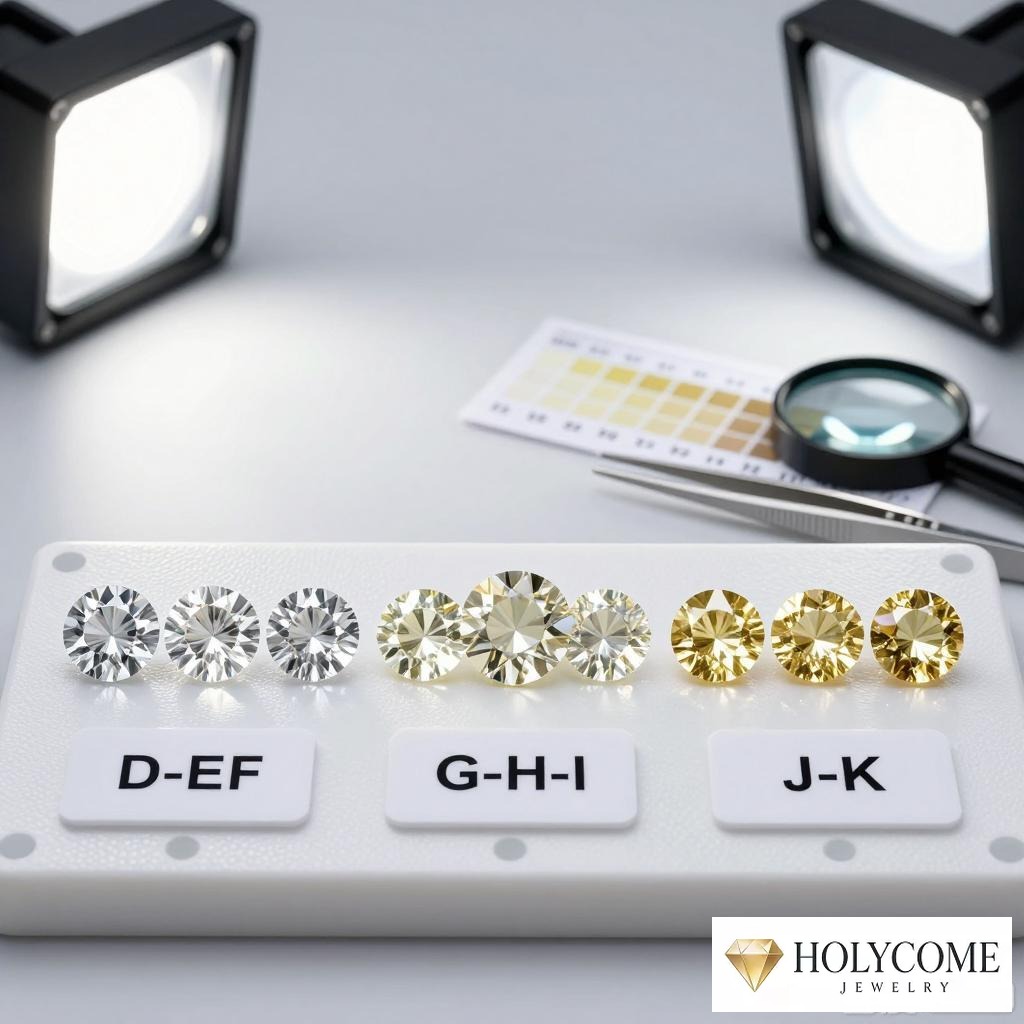
01Understanding the Moissanite Color Scale
Colorless moissanite was not always the norm. Early commercial moissanite (produced in the late 1990s and early 2000s) carried a distinct yellowish or greenish tint that limited its acceptance in fine jewelry. Improvements in crystal growth technology over the past 20 years now allow manufacturers to produce moissanite across the full range from completely colorless (D) to near-colorless (J-K) and even fancy colors. The table below maps the most commonly offered wholesale grades and their visual characteristics.
| Color Grade | Visual Appearance Face-Up | Best Used For | Price Tier (Relative) |
|---|---|---|---|
| D (Colorless) | Absolutely no yellow, gray, or green tint visible face-up even in controlled lighting | High-end bridal, solitaire rings over 1ct, platinum settings | Premium (100%) |
| E-F (Colorless) | No color visible to the untrained eye; only detectable by comparison against a D master stone | Premium bridal collections, white gold engagement rings | High (85–90%) |
| G-H (Near Colorless) | Colorless face-up; extremely faint warm tint visible from the side in controlled lighting against white masters | Mid-range bridal, fashion jewelry, small melee, yellow gold settings | Mid (65–75%) |
| I-J (Near Colorless) | Slight warm yellow tint visible face-up in side-by-side comparison; colorless when set in yellow or rose gold | Affordable fashion lines, yellow/rose gold pieces, accent stones | Value (45–55%) |
| K-L (Faint Tint) | Noticeable warm yellow or faint green tint face-up, similar to K-L diamond | Vintage-style pieces, budget lines, colored metal settings | Budget (30–40%) |
One key difference between moissanite and diamond color grading: moissanite can occasionally show a very faint greenish or grayish secondary tone rather than the pure yellow seen in lower-color diamonds. That green tint comes from trace nitrogen and other impurities incorporated during crystal growth, and it is a well-documented characteristic of silicon carbide. Reputable manufacturers sort out stones with visible green-gray tinting from their higher color grades, but cheap suppliers will sometimes sell tinted stones as G-H grade, which creates visible mismatches.
International gemological standards for diamond color grading are set by the GIA, and most moissanite manufacturers use that same D-to-Z scale for consistency in the trade. Buyers should always confirm which grading standard a supplier uses, as some low-cost producers use in-house scales that inflate grades by one or two full steps. GIA's diamond color grading guide is the industry reference point for understanding how color grades map to face-up appearance.
What Causes Color in Moissanite?
All color in moissanite comes from trace impurities and structural defects in the silicon carbide crystal lattice. Nitrogen atoms substituting for carbon atoms produce yellow body color, while structural defects from fast crystal growth can produce gray or green secondary tones. Completely colorless moissanite requires extremely high-purity starting material, tightly controlled growth conditions, and often post-growth treatment to remove remaining color centers.
HOLYCOME produces our D-E-F colorless moissanite using a proprietary high-purity growth process combined with a high-pressure high-temperature (HPHT) treatment step that neutralizes remaining nitrogen-related color centers. This process is permanent—it does not fade or change over time, unlike coating treatments used by some budget suppliers that can wear off after years of wear and cleaning. Each batch of colorless moissanite undergoes UV-visible spectroscopy testing to verify that color-causing impurities are below detection limits before the stones are released for cutting.
02Choosing the Right Color Grade for Your Product Line
Specifying a higher color grade than you actually need wastes budget; specifying too low leads to customer complaints about yellow stones. The right grade depends on setting metal, stone size, and your target price point.
Bridal and Solitaire Rings (1ct+ center stones)
For solitaire engagement rings and other pieces where the center stone is the visual focus, we strongly recommend D or E-F color. Customers buying bridal pieces compare their stones against diamond expectations, and a clearly tinted center stone in a white gold or platinum solitaire triggers returns and negative reviews. In our experience supplying 280+ jewelry brands, brands that use G-H or lower for center stones over 1 carat in white gold see return rates 3–4x higher than brands that stick with D-E-F for those pieces. D color carries a premium, but the reduction in warranty and return costs more than pays for the difference.
Side Stones, Accents, and Melee
Small stones (under 3mm, or 0.1ct each) show far less visible color than large center stones because less light travels through the stone body. For accent stones and melee in halo rings, pavé bands, and side-stone settings, G-H color is more than sufficient—color is essentially invisible at that size, and the savings compared to D-E-F melee can cut material costs by 25–30%. The one exception: if you are setting D-color center stones in a halo with melee, keep the melee at F color or better. A color mismatch between center and halo is visible in direct comparison, even at melee sizes.
Yellow Gold and Rose Gold Settings
Warm metal colors reflect yellow/pink light back through the stone, which masks yellow body color in the gem. In yellow or rose gold settings, G-H (and even I-J for stones under 6.5mm/1ct) looks completely colorless face-up, because the warm metal reflection cancels the warm stone tint. This is an easy way to reduce material costs without affecting the customer's visual experience. We advise brands building yellow gold lines to specify G-H as their standard grade instead of paying for D-E-F that no one will see in the finished piece.
Colored and Fancy Moissanite
Beyond the standard colorless to near-colorless range, moissanite can be produced in a variety of fancy colors including blue, green, yellow, champagne, gray, and black through controlled doping during growth or post-growth irradiation and heat treatment. Fancy colored moissanite is a growing category for fashion jewelry and alternative bridal pieces, offering the same brilliance and durability as colorless moissanite in bold colors. Standard MOQ for fancy colors is higher than colorless (typically 50 pieces per size/color) because of smaller production batches, and lead time runs 20–25 business days.
Specifying a higher color grade than you actually need wastes budget; specifying too low leads to customer complaints about yellow stones. The right grade depends on setting metal, stone size, and your target price point.
03Factory Color Consistency: What Bulk Buyers Should Expect
Color consistency across bulk orders is the single biggest pain point brands report when switching moissanite suppliers. A batch of 500 "G-H" stones that ranges from E to J creates obvious mismatches when set into finished jewelry, and that inconsistency ends up on a retailer's sales floor where customers can see the difference between two identical rings.
Our Color Grading and Sorting Process
Every moissanite that passes cut and clarity QC moves to our color grading lab, where trained graders compare each stone against a set of GIA-calibrated master comparison stones under standardized 6500K daylight-equivalent lighting. Graders evaluate stones both face-up and face-down, and sort to within half a color grade tolerance. After hand grading, every stone over 4mm goes through an automated colorimetric scanner that measures color coordinates numerically, flagging any stones that fall outside the target grade range. This two-step process keeps our batch color consistency to within one color grade on 99.4% of parcels.
Key wholesale specifications for color-graded moissanite:
- Available grades: D, E-F, G-H, I-J, K-L, plus fancy colors (blue, green, yellow, champagne, gray, black, pink)
- Color consistency tolerance: Within 1 color grade for 99.4% of stones in a parcel (industry average is ~90%)
- Treatments: HPHT color enhancement for D-E-F grades is permanent and disclosed on all paperwork; no surface coatings used
- MOQ: 10 pieces per size/grade for rounds; 50 pieces per size/grade for fancy shapes and fancy colors
- Calibration: ±0.05mm diameter tolerance; sorted to 0.1mm size increments for production setting
- Lead time: 7–10 days for standard D-E-F / G-H rounds in stock sizes; 15–20 days for fancy colors or custom grades
- Quality pass rate: 99.2% across all QC stages; rejected stones are regraded and resorted into the correct grade
Color Matching for Multi-Stone Settings
For halo rings, three-stone rings, and tennis bracelets where multiple stones sit adjacent, we offer precision color matching as an additional service. We sort every stone in the parcel to within 0.5 color grades and match them in their exact size and position, so no two adjacent stones show visible color difference. This service adds 10% to the stone cost but eliminates the need for your setters to hand-sort during production, which saves labor and reduces waste from visible mismatches.
04Common Color-Related Myths and Misconceptions
"Moissanite looks green in sunlight no matter what grade you buy"
This is outdated information based on early moissanite from the 1990s and early 2000s. Modern D-E-F color moissanite from reputable manufacturers shows no green tint in sunlight. Faint greenish secondary tones do appear in some G-H and lower grade stones under certain lighting angles, which is why we sort and separate any stones showing that tint from our pure colorless runs.
"All D-color moissanite is the same across brands"
No. There is no universal third-party grading for moissanite the way GIA grades diamonds, so each manufacturer sets its own standards for what counts as "D." Some suppliers sell what they call D color that looks closer to F or G when compared against a master set. Always request sample stones from a new supplier and compare them against a known master stone before committing to a bulk order. HOLYCOME provides free comparison samples for qualified wholesale accounts so you can verify our color grading against your current supplier before switching.
"Coated colorless moissanite is just as good as HPHT-treated"
Coating treatments apply a thin blue-violet surface film to cancel out yellow body color, similar to how anti-reflective coatings work on camera lenses. These coatings are thin and can scratch or wear off over years of cleaning and wear, revealing the original yellow color underneath. HPHT treatment permanently alters the crystal's color centers throughout the entire stone body, so it cannot wear off or change. We never use surface coating on any of our moissanite grades.
05FAQ: Moissanite Color Grades
Can moissanite color change or fade over years of wear?
Properly produced HPHT-treated colorless moissanite will not change color or fade with normal wear, sunlight exposure, cleaning, or repair work. The only treatment that can cause color change is surface coating, which we do not use. Our lab has tested stones from 10+ year old production runs that still grade D-E-F when re-checked today.
Do I need to buy D color for the best resale value?
For retail brands selling finished jewelry, the color grade affects customer satisfaction and returns far more than any concept of "resale value." D color commands the highest retail price point for bridal pieces, where customers expect the colorless look. For fashion lines where price is the main purchase driver, G-H offers the best balance of appearance and cost.
How does moissanite color compare to lab-grown diamond color?
The D-to-Z scale is applied the same way, so a G-color moissanite and a G-color lab-grown diamond have equivalent face-up body color in comparable sizes and cuts. The difference is in price: D-color moissanite costs roughly one-tenth the price of D-color lab-grown diamond in the same size.
Can I get custom color-matched stones to match an existing piece?
Yes. We offer custom color matching for repair and augmentation projects where you need new stones that exactly match an existing moissanite piece. Send us a sample stone or precise color specifications, and we will grow and cut to match. Custom color matching typically has a 50-piece MOQ and 20–25 day lead time.
What about fluorescence in moissanite?
Unlike some diamonds, moissanite does not exhibit significant fluorescence under UV light. Some very faint blue fluorescence has been reported in certain growth batches, but it is not strong enough to be visible in normal lighting and has no impact on face-up appearance. We do not sort for fluorescence unless specifically requested.
06Ordering Recommendations by Collection Type
As a starting point for new wholesale accounts, we recommend the following grade defaults:
- Premium bridal (platinum/18k white gold solitaires over 1ct): D color, VVS1 clarity, Excellent cut
- Mid-tier bridal (14k white gold, halos, three-stone): E-F color center, F-G color melee, VVS1-VS1 clarity
- Yellow/rose gold bridal: G-H color center, G-H melee, VS1 clarity (color invisible in warm metal)
- Fashion jewelry, stackable bands, everyday earrings: G-H or I-J color, VS1-SI1 clarity
- Tennis bracelets and necklaces: G-H color, matched within 0.5 grade across all stones
You can browse full inventory and request samples through our loose moissanite catalog. For custom color requests or proprietary branded grades, reach out through our OEM custom order page. We also offer pre-set finished jewelry in rings, earrings, and pendants using our standard grade selections.
Moissanite color grades are not just a marketing specification—they have a direct, measurable impact on how your finished jewelry looks to customers and how much material margin you keep on every piece. Working with a manufacturer that uses calibrated master stones, automated color verification, and tight batch consistency means you get exactly what you order on every parcel, with no surprises when stones arrive at your production bench.
07Frequently Asked Questions
Is moissanite a viable diamond alternative for retail?
Yes for price-sensitive buyers who want brilliance and hardness. It ranks 9.25 on the Mohs scale and costs a fraction of a natural diamond of the same size, so it turns fast in bridal and fashion lines.
What is the minimum order?
MOQ starts at 50 pieces per design for stock items; custom cuts and private-label settings start at 100 to 300 pieces.
Are certificates included?
Yes. Every parcel ships with GRA or IGI documentation listing carat weight, color grade and cut.
What are the lead times?
Samples 3 to 5 days. Bulk 15 to 20 days under 500 pieces, 25 to 30 days for custom work.