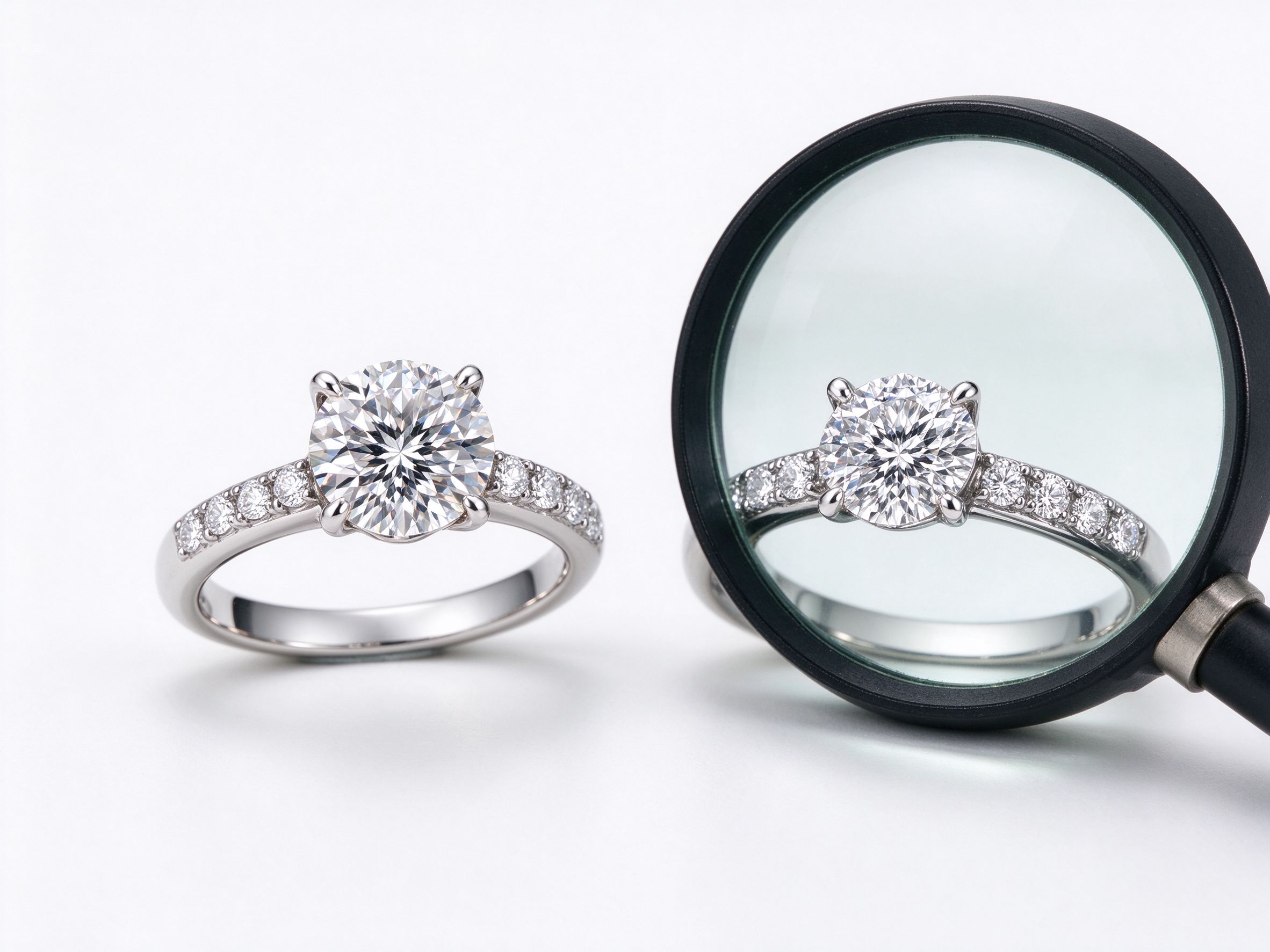
Buyers coming from diamonds often ask whether moissanite has inclusions and what clarity grade to expect. The honest answer is that moissanite is lab-grown and usually very clean, but it is not perfectly flawless, and understanding what you are looking at prevents disappointment.
How moissanite is made
Moissanite is grown in controlled high-temperature furnaces rather than mined. That means it forms under much more predictable conditions than natural diamond. The result is that most commercial moissanite is eye-clean: you cannot see internal flaws without magnification. This is why moissanite looks so clean for the price.
What can appear inside
Under a 10x loupe, you may see thin growth lines, small needles or faint clouding. These are growth features rather than damage. They are almost never visible to the naked eye. Unlike mined diamonds, moissanite rarely has dark crystals or large fractures because the growth environment is controlled.
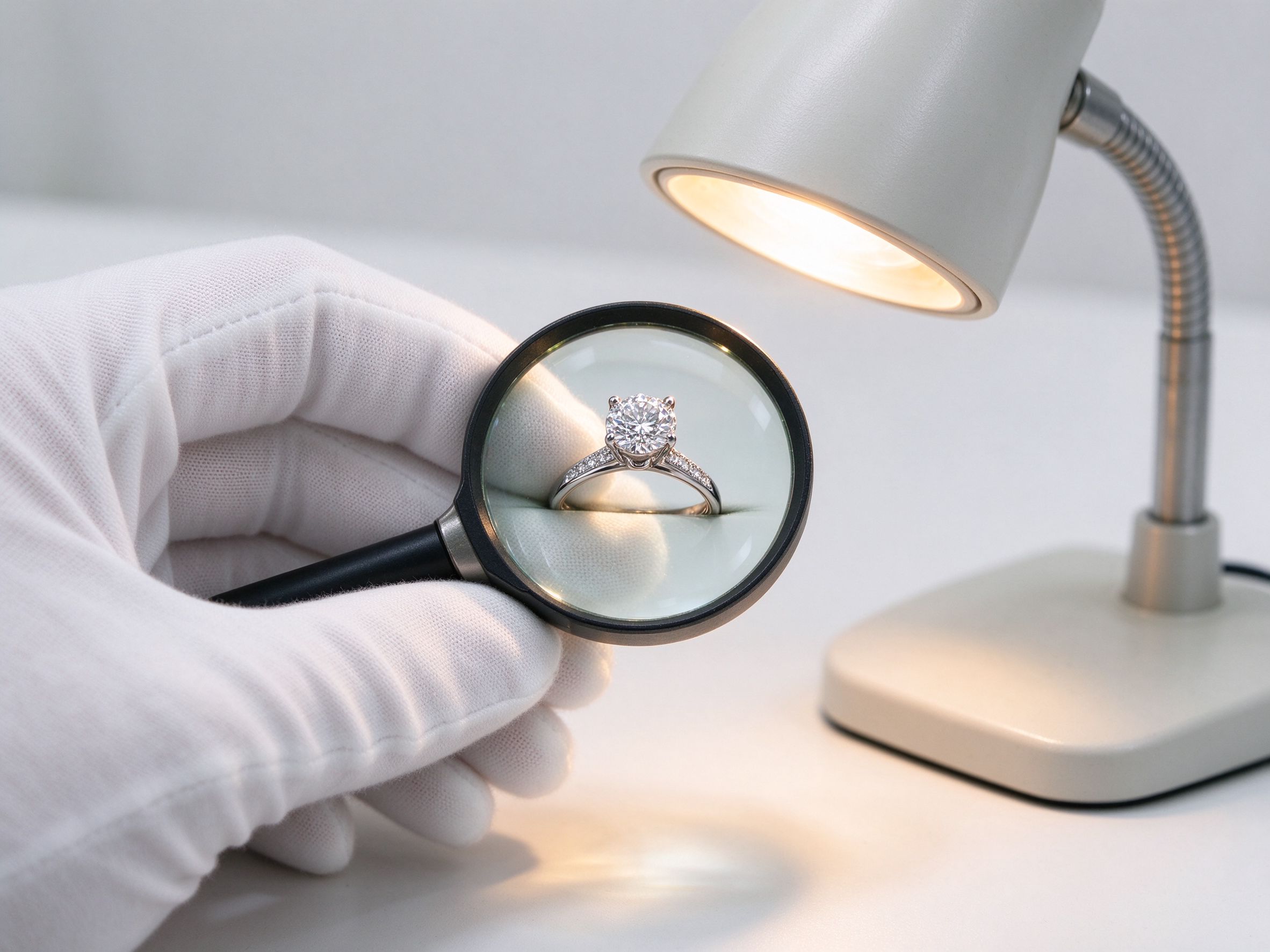
Eye-clean is the standard
For jewelry sold to the public, the meaningful standard is eye-clean: no visible inclusions when the stone is held at arm's length. Almost all moissanite sold as jewelry meets this. You do not need to chase a "flawless" grade, because customers will never see the difference.
What to watch for
The few defects that matter are visible ones: a crack reaching the surface, a large cloud that makes the stone look milky, or chips along the edge. These are quality-control failures, not normal growth features. Reputable factories reject stones with surface-reaching cracks, because they can spread over time.
Clarity and price
Because moissanite is consistently clean, clarity does not drive price the way it does in diamonds. You are not penalized much for slightly lower clarity because there is little lower clarity to begin with. The money you spend is mainly on size, cut quality and color, not on a clarity grade.
FAQ
Is moissanite clearer than diamond?
Typically yes, because lab growth avoids most natural inclusions. A mined diamond with similar eye-clean appearance costs far more.
Can I see moissanite inclusions with a magnifying glass?
Sometimes growth lines, but rarely anything that affects the look of the stone.
Should I ask for a clarity certificate?
Moissanite is usually sold by size and cut rather than a formal clarity report. Ask the factory for a photo of the actual stone instead.
Clarity is only one dimension. Read the full moissanite value series or browse all knowledge.
What a loupe actually shows
Many buyers panic the first time they look at a moissanite under a loupe, because they see lines inside the stone. These growth lines are normal and expected. They are not cracks and they do not weaken the stone. Moissanite grows in layers, and faint parallel lines are the record of that growth. They disappear entirely when the stone is viewed with the naked eye. A jeweler showing you these lines is not pointing out a defect; they are explaining the stone's history.
What you should reject is different. Surface-reaching cracks, chips on the girdle, and large clouds that make the stone look milky are real flaws. These let light escape and can grow over time. Reputable factories sort these out before sale, but it is worth inspecting a close-up photo of your actual stone before accepting a shipment. Ask for a real photo, not a render.
Clarity vs cut: which matters more
For the customer looking at the worn ring, cut quality matters far more than microscopic clarity. A well-cut stone with faint growth lines looks bright and alive. A poorly cut stone that is technically flawless looks dull and dark. When you choose moissanite, spend your attention on the cut and the light return rather than chasing a clarity grade. Eye-clean is the practical standard, and almost all commercial moissanite meets it. Save your money for a better cut and a nicer setting.
Bottom line
Lab-grown moissanite is usually eye-clean, and the faint growth lines you see under a loupe are normal. What matters is rejecting stones with surface cracks or heavy clouding. Clarity barely drives price in moissanite; cut quality does. Ask for a real photo of the actual stone, and accept eye-clean as the practical standard rather than chasing a flawless grade.
A worked example: a loupe panic
A customer borrowed a jeweler's loupe and saw lines inside her new moissanite. She panicked, thinking the stone was cracked. The jeweler explained that these were growth lines, normal in lab-grown stones, and that the stone was perfectly solid. He showed her that the lines were internal, not reaching the surface, and that they were invisible to the naked eye. She relaxed. The lesson is that magnification reveals normal growth features, not damage. Real damage would be a surface-reaching crack, a chip or a cloud. Growth lines are part of how the stone was made, not a flaw.
What to inspect in a real photo
When you buy loose moissanite wholesale, ask for a real photo of the actual stone, not a stock render. Look for three things: a bright, well-centered stone with no dark center, no surface chips along the edges, and no large cloud. Faint internal lines are fine. A photo that looks bright and clean will look bright and clean when mounted. Trust your eyes on the photo more than any grade label.
Quick reference checklist
- Eye-clean is the practical standard; growth lines are normal.
- Reject surface-reaching cracks, chips and heavy clouding.
- Ask for a real photo of the actual stone.
- Spend on cut quality, not on a clarity grade.
- Faint internal lines are not cracks and do not weaken the stone.
Because moissanite is lab-grown, it is consistently clean. The quality judgment is about cut and light return, not about hunting for flaws. Accept eye-clean, inspect the photo, and you will be satisfied. A well-cut, eye-clean moissanite looks bright and solid for years.
Finally, remember that clarity is the least interesting thing about a moissanite. Customers buy it for its sparkle, value and durability. As long as the stone is eye-clean and well cut, they will be happy. Focus your attention on cut, setting and honest photos, and leave the microscope details to the certificate.