Engraving and Ring Size: How Personalization Affects Dimensions and Fit
A personal engraving turns a ring into a keepsake, but it also interacts with the shank, the plating and the sizing process. This guide explains how our factory sequences engraving relative to sizing, why the order matters, and what buyers should know before offering personalization.
Why Sequencing Engraving and Sizing Matters
The order of operations matters. If we engrave first and then resize, stretching the shank distorts the engraved letters. If we resize first and then engrave, the text sits cleanly on a finished, round band. Our production process always sizes and rounds the shank before any engraving, so the personalization stays sharp and straight. For buyers offering custom engraving, this means the size must be finalised before the piece reaches the engraving station - which is why engraved pieces are less resizable afterwards, a point we make clear on the product page.
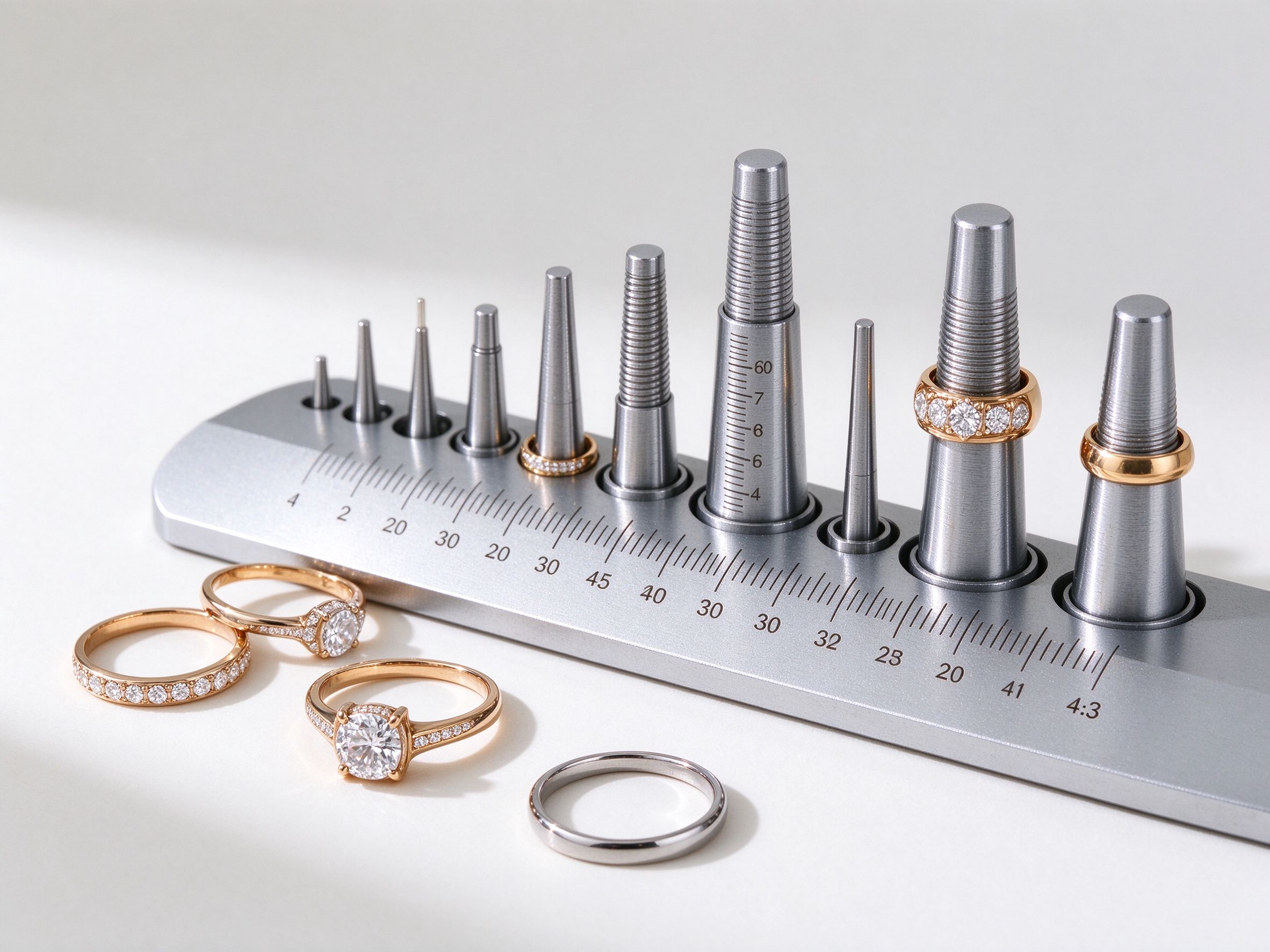
Reusable ring sizers are a wholesale tool, not a gimmick. We ship a plastic circumference gauge and a set of metal mandrels to retail partners so their staff can measure customers accurately rather than guessing from a ring already on a finger. Accurate measurement at the point of sale is the single biggest driver of low ring-size return rates.
Temperature and time of day change finger size. Fingers swell in heat, after exercise, and late in the day, so our guidance to retailers is to measure when the finger is relaxed and at room temperature, and to measure the finger that will actually wear the ring. A good sizer slides on with gentle resistance and comes off over the knuckle without forcing.
Inner finishing matters as much as the size number. A correctly sized band with a rough interior shank will catch on skin and feel smaller than it is, which is why every ring we ship is polished on the inside until the edge is rounded. Size is not just a diameter; it is the whole sensory experience the customer feels sliding the band on.
Bulk size runs are planned around demand data. Retailers tell us which sizes move, and we bias production runs toward those sizes while still covering the long tail. This is why factory-direct wholesale rings are available in the sizes you actually sell, rather than a one-size-fits-all handful that forces every customer to resize later.
We keep master rings for every common size so a production run can be checked against a known reference, not a guessed number. When a buyer questions a measurement, we measure against the master set together, which resolves the dispute in minutes. Reference equipment like this is what turns sizing from an argument into a measurement.
Sizing is one of the few areas where small staff habits cause big returns. A sizer kept on the wrong finger, or used on a cold morning, will mislead even a careful assistant. We give retail teams a short measuring protocol that takes seconds and removes the most common errors. Consistency at the counter prevents the inconsistency that ends in the post.
How Engraving Thins the Shank Locally
Engraving removes a thin layer of silver from the inside of the band. On a normal shank this is negligible, but on a very thin, delicate design it can slightly weaken the engraved area. Our engineering checks the shank thickness before engraving a custom line: if the band is slim, we either deepen the blank slightly before engraving or advise against text that runs too deep. The goal is a crisp engraving that does not compromise the band's strength. A good factory does not just engrave; it confirms the shank can take it.
For rings sold online, a printable size guide and a physical trial-ring sample dramatically reduce size returns. Customers who measure themselves against a real, wide trial ring choose correctly far more often than those who guess. We supply these tools because an accurate measurement at home is the closest thing to being in the shop.
The size stamped inside a ring is a promise we stand behind. If a batch measures outside our tolerance, we replace it rather than argue. Buyers learn quickly that our sizes are reliable, which is why they reorder without re-checking every unit. Trust in the size label is built one verified shipment at a time.
Wide and comfort-fit designs are where sizing tables earn their keep, because the correction is built into production rather than improvised at sale. A customer who orders a wide band in the corrected size gets a ring that fits the first time. That attention to profile detail is what separates a precise factory from a generic wholesaler.
Ring sizing on an industrial line is a tolerance problem, not a guessing problem. Each size is machined to a target inside diameter with a controlled plus-or-minus band, because a ring that measures halfway between labels will feel wrong on the customer and trigger a return. Our gauges are calibrated weekly against master rings traceable to a standard, so every batch measures the same way.
Mass production favours the whole, half and quarter sizes that sell. We stock tooling for the highest-volume sizes and hold them ready, while less common sizes are produced by adjusting the shank during the finishing pass. This is why a factory can offer dozens of sizes at scale without tooling up a new die for every single one.
Comfort fit changes the measured size. A domed, comfort-fit band sits looser on the finger than a flat band of the same number, so our size charts always note the fit profile. A retailer selling comfort-fit rings should measure customers over a similar profile, otherwise the printed size and the on-hand feel will not match and the ring will be returned.
Plating Over Engraving: The Hidden Detail
Engraved recesses hold plating differently than flat surfaces. Rhodium will build up in the recess, which can soften the contrast of the lettering. Our plating process controls the current and duration on engraved pieces so the recesses stay defined and legible rather than filling in. We also recommend slightly heavier plating on engraved bands because the recessed text is the first place plating wears thin. This is a small production adjustment that keeps an engraving looking crisp for years instead of fading within months.
Wide bands need a half-size up. A band wider than about six millimetres grips more of the finger and feels tighter than a narrow band of the same diameter, so our sizing tables add a half size for wide designs. Building this correction into production means the size stamped on the inside matches the way the ring actually feels, not just the diameter.
Custom resizing on factory work is governed by the setting. A plain band can be opened and closed reliably, but a pav or channel-set eternity ring cannot be resized because stretching the shank shifts every stone seat. Our quoting process flags which designs are resizable before the order is confirmed, so retailers never promise a customer a resize the construction will not allow.
Measurement standards differ by country. The US uses numerical sizes, the EU uses a circumference in millimetres, the UK uses letters, and Asia uses yet another set of internal diameters. Our factory produces to whichever standard the buyer specifies and stamps the shank accordingly, and we supply a conversion chart so retail staff never have to approximate between systems.
Reusable ring sizers are a wholesale tool, not a gimmick. We ship a plastic circumference gauge and a set of metal mandrels to retail partners so their staff can measure customers accurately rather than guessing from a ring already on a finger. Accurate measurement at the point of sale is the single biggest driver of low ring-size return rates.
Temperature and time of day change finger size. Fingers swell in heat, after exercise, and late in the day, so our guidance to retailers is to measure when the finger is relaxed and at room temperature, and to measure the finger that will actually wear the ring. A good sizer slides on with gentle resistance and comes off over the knuckle without forcing.
Inner finishing matters as much as the size number. A correctly sized band with a rough interior shank will catch on skin and feel smaller than it is, which is why every ring we ship is polished on the inside until the edge is rounded. Size is not just a diameter; it is the whole sensory experience the customer feels sliding the band on.
Resizing an Engraved Ring Later
Once a ring is engraved, resizing becomes problematic. Cutting and stretching the shank to change size would warp or remove the text. An engraved piece is therefore effectively locked to its production size. This is why we advise customers to be certain of their size before ordering an engraved ring, and why we recommend a professional measure for engraved engagement pieces. For wholesale buyers, it means engraved designs should carry a clear 'confirm your size' note, because the usual later-resize safety net does not apply.
Bulk size runs are planned around demand data. Retailers tell us which sizes move, and we bias production runs toward those sizes while still covering the long tail. This is why factory-direct wholesale rings are available in the sizes you actually sell, rather than a one-size-fits-all handful that forces every customer to resize later.
We keep master rings for every common size so a production run can be checked against a known reference, not a guessed number. When a buyer questions a measurement, we measure against the master set together, which resolves the dispute in minutes. Reference equipment like this is what turns sizing from an argument into a measurement.
Sizing is one of the few areas where small staff habits cause big returns. A sizer kept on the wrong finger, or used on a cold morning, will mislead even a careful assistant. We give retail teams a short measuring protocol that takes seconds and removes the most common errors. Consistency at the counter prevents the inconsistency that ends in the post.
For rings sold online, a printable size guide and a physical trial-ring sample dramatically reduce size returns. Customers who measure themselves against a real, wide trial ring choose correctly far more often than those who guess. We supply these tools because an accurate measurement at home is the closest thing to being in the shop.
The size stamped inside a ring is a promise we stand behind. If a batch measures outside our tolerance, we replace it rather than argue. Buyers learn quickly that our sizes are reliable, which is why they reorder without re-checking every unit. Trust in the size label is built one verified shipment at a time.
Wide and comfort-fit designs are where sizing tables earn their keep, because the correction is built into production rather than improvised at sale. A customer who orders a wide band in the corrected size gets a ring that fits the first time. That attention to profile detail is what separates a precise factory from a generic wholesaler.
Designing Engraving Layout for Production
Not every engraving request is practical at scale. Very long text, elaborate scripts or tiny characters can become illegible once curved around a narrow shank. Our art team works with buyers to set the text length, font size and placement so the engraving reads well on the actual band width. We produce a digital proof before production so the customer sees exactly how the text will curve around the ring. This proof step prevents the most common engraving disappointment: text that looks great on screen but crowds the shank in real life.
Ring sizing on an industrial line is a tolerance problem, not a guessing problem. Each size is machined to a target inside diameter with a controlled plus-or-minus band, because a ring that measures halfway between labels will feel wrong on the customer and trigger a return. Our gauges are calibrated weekly against master rings traceable to a standard, so every batch measures the same way.
Mass production favours the whole, half and quarter sizes that sell. We stock tooling for the highest-volume sizes and hold them ready, while less common sizes are produced by adjusting the shank during the finishing pass. This is why a factory can offer dozens of sizes at scale without tooling up a new die for every single one.
Comfort fit changes the measured size. A domed, comfort-fit band sits looser on the finger than a flat band of the same number, so our size charts always note the fit profile. A retailer selling comfort-fit rings should measure customers over a similar profile, otherwise the printed size and the on-hand feel will not match and the ring will be returned.
Wide bands need a half-size up. A band wider than about six millimetres grips more of the finger and feels tighter than a narrow band of the same diameter, so our sizing tables add a half size for wide designs. Building this correction into production means the size stamped on the inside matches the way the ring actually feels, not just the diameter.
Custom resizing on factory work is governed by the setting. A plain band can be opened and closed reliably, but a pav or channel-set eternity ring cannot be resized because stretching the shank shifts every stone seat. Our quoting process flags which designs are resizable before the order is confirmed, so retailers never promise a customer a resize the construction will not allow.
Measurement standards differ by country. The US uses numerical sizes, the EU uses a circumference in millimetres, the UK uses letters, and Asia uses yet another set of internal diameters. Our factory produces to whichever standard the buyer specifies and stamps the shank accordingly, and we supply a conversion chart so retail staff never have to approximate between systems.
Offering Personalization as a Wholesale Upgrade
Engraving is one of the highest-margin upgrades a jeweller can offer. It costs the factory a short station time but commands a meaningful premium and deepens the emotional value of the piece. We set up OEM engraving on existing tooling, so a private-label brand can offer custom names and dates without new moulds. The combination of moissanite brilliance, 925 quality and personal engraving is a strong gift-market offer. We help buyers price and package the engraving upgrade so it adds margin without complicating the size process.
Reusable ring sizers are a wholesale tool, not a gimmick. We ship a plastic circumference gauge and a set of metal mandrels to retail partners so their staff can measure customers accurately rather than guessing from a ring already on a finger. Accurate measurement at the point of sale is the single biggest driver of low ring-size return rates.
Temperature and time of day change finger size. Fingers swell in heat, after exercise, and late in the day, so our guidance to retailers is to measure when the finger is relaxed and at room temperature, and to measure the finger that will actually wear the ring. A good sizer slides on with gentle resistance and comes off over the knuckle without forcing.
Inner finishing matters as much as the size number. A correctly sized band with a rough interior shank will catch on skin and feel smaller than it is, which is why every ring we ship is polished on the inside until the edge is rounded. Size is not just a diameter; it is the whole sensory experience the customer feels sliding the band on.
Bulk size runs are planned around demand data. Retailers tell us which sizes move, and we bias production runs toward those sizes while still covering the long tail. This is why factory-direct wholesale rings are available in the sizes you actually sell, rather than a one-size-fits-all handful that forces every customer to resize later.
We keep master rings for every common size so a production run can be checked against a known reference, not a guessed number. When a buyer questions a measurement, we measure against the master set together, which resolves the dispute in minutes. Reference equipment like this is what turns sizing from an argument into a measurement.
Sizing is one of the few areas where small staff habits cause big returns. A sizer kept on the wrong finger, or used on a cold morning, will mislead even a careful assistant. We give retail teams a short measuring protocol that takes seconds and removes the most common errors. Consistency at the counter prevents the inconsistency that ends in the post.
Frequently Asked Questions
Does engraving affect ring size?
Not directly, but we size and round the shank before engraving so the text stays straight. An engraved ring is then effectively locked to its size, because resizing would distort the lettering.
Does engraving weaken the ring?
Slightly, on very thin shanks. We check shank thickness before engraving and adjust the blank depth so the text is crisp without compromising strength.
Does plating cover the engraving?
We control plating current on engraved pieces so recesses stay legible, and recommend slightly heavier plating because engraved areas wear thin first.
Can an engraved ring be resized later?
Not practically. Cutting the shank would warp the text. Confirm the size precisely - a professional measure is ideal - before ordering an engraved ring.
Can I offer engraving as a wholesale upgrade?
Yes. We engrave on existing OEM tooling, so private-label brands can offer names and dates at premium margin without new moulds.
Conclusion
Engraving and sizing are sequenced deliberately: size first, then engrave, so the text stays sharp and the shank stays strong. Buyers who confirm the size up front, control the plating over the recesses, and offer a visual proof turn personalization into a high-margin, high-loyalty upgrade.