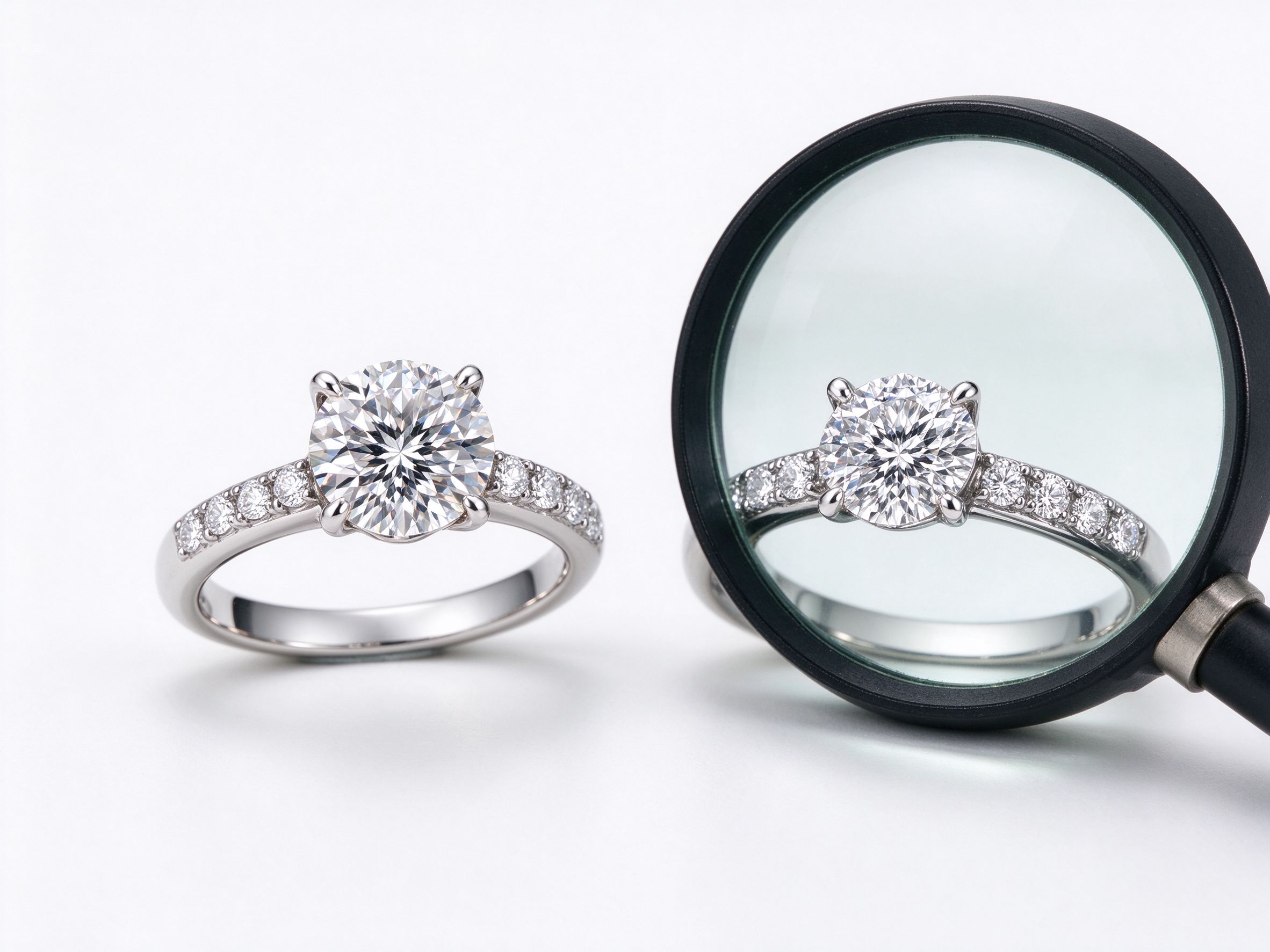
Moissanite Necklace Cost Breakdown - HOLYCOME
When a buyer asks us why one moissanite pendant costs twelve dollars and another costs forty, the answer is not marketing or mystery. It is arithmetic, and we are going to show you every line of it. As a moissanite cutting and jewelry factory in Wuzhou, China, we price necklaces the same way we price everything else: we add up the stone, the metal, the setting labor, the plating, the packaging, and a small margin, then we quote that number. Nothing is hidden in a markup that no one can explain, and nothing is built on a cost structure a buyer cannot verify.
This article breaks down what actually goes into the factory price of a moissanite necklace so you can compare quotes like an insider. You will see why the center stone is only part of the cost, why the chain often matters more than the pendant, why two pendants that look identical on a photo can differ by a wide margin on the invoice, and where the honest savings live versus the corners that will come back as returns. If you buy necklaces wholesale, this is the sheet we use internally when we cost a new sample.
The Five Cost Blocks of Any Necklace
Before we get into numbers, understand the structure. Every moissanite necklace leaves our workshop assembled from five separate cost blocks, and a factory quote is simply those five blocks added together. The blocks are the center moissanite stone, the pendant casting or stamping, the chain, the setting and polishing labor, and the plating plus finishing. A sixth block, packaging and inspection, is small but real. Once you can look at a necklace and mentally split it into these pieces, every quote on the market stops looking arbitrary.
The trap for new buyers is assuming the stone dominates. In a small pendant of 6.5 millimeters or under, the stone is often less than a third of the factory cost. The metal, the chain, and the labor of setting and finishing are where the money actually goes. This is why a necklace with a slightly smaller but well-cut stone can be a smarter buy than one with a larger stone set in a flimsy, thin, under-finished mounting. We cover the stone side separately in our guide on moissanite pendants for every neckline, and the chain side in chain types explained.
Block One: The Moissanite Center Stone
The stone is the part customers see, so it is also the part buyers obsess over. In our factory, loose moissanite is priced by diameter and cut grade, not by a fantasy carat number, because moissanite is not weighed the way diamond is. A 6.5 millimeter round brilliant is our most common pendant stone, and its cost moves with color grade, clarity grade, and the precision of the cut. A colorless VVS stone cut to a tight ideal spread costs more than a near-colorless stone cut to a looser tolerance, and the difference is visible to a trained eye but invisible to a customer wearing it under a shirt.
What buyers often miss is the stone waste built into a pendant order. When we cut a stone for a solitaire pendant, we are not guaranteed a perfect result from every rough piece. A certain percentage of stones come off the cutting line with a slightly off table, a chipped girdle, or a clarity grade below what the order specified, and those stones are downgraded into smaller jewelry or sold to a different channel. That rejected cost has to be absorbed into the stones that pass. The more demanding the grade, the higher the rejection rate, and the higher the per-passing-stone cost. This is the real reason a VVS pendant costs more than an SI pendant, and it is the same economics you see in moissanite cutting styles.
How Shape Changes Stone Cost
Round brilliants are the cheapest moissanite shape to cut because the industry has standardized them over decades. Ovals, cushions, pears, and hearts demand more custom work, more rough waste, and more hand polishing, so the same millimeter size in an oval can cost meaningfully more than a round. For a wholesale necklace line, this is why solitaire round pendants are the volume backbone and fancy shapes are the premium tier. If your margin model depends on a low entry price, rounds are where you start.
Block Two: The Pendant Mounting
The mounting is the metal cage that holds the stone and the loop the chain slides through. It is either cast in 925 sterling silver or stamped from sheet, and the choice changes both the cost and the character of the piece. Cast mountings carry more detail, more depth, and more metal weight, but they cost more because casting involves wax patterns, investment, burnout, casting, and cleanup. Stamped mountings are thinner, lighter, faster, and cheaper, and they are the workhorse of budget pendant lines.
The mounting cost scales with weight. A heavy, solid pendant back uses more silver, and silver is priced by the gram plus a small fabrication premium. A hollow, lightweight back uses less silver but flexes more and can bend in a customer's hand. The honest middle ground we recommend for most wholesale buyers is a medium-weight back: enough metal to feel solid and survive a year of daily wear, not so much metal that the necklace pulls at the customer's neck. Weight is a value dial, not a quality dial, and we help buyers set it deliberately rather than by accident.
Block Three: The Chain, the Quiet Cost Driver
Here is where most new buyers get surprised. A sterling silver chain is not a free accessory thrown in with a pendant. It is a precision-made piece of jewelry in its own right, and on many of our necklaces the chain costs as much as the pendant mounting. Cables, box chains, and rope chains are drawn and formed wire, soldered link by link or machine-woven, then cut to length, fitted with a lobster clasp, and finished. The thinner and finer the chain, the more delicate the work and the higher the labor per centimeter.
Chain choice is also where perceived value is won or lost. A thin, flimsy chain that kinks on the first wearing makes the whole necklace feel cheap, even if the pendant stone is excellent. We push our buyers to spec a chain that feels right in the hand rather than the cheapest chain that closes. For a detailed breakdown of the options, our chain types guide walks through cable, box, rope, and snake constructions and which ones sell in which markets. The cost difference between a good chain and a bad one is small in factory terms, but the return-rate difference is not.
Block Four: Setting, Polishing, and Labor
Stone setting is skilled handwork. A setter places the moissanite in the mounting, seats it on the seat, and raises and burnishes each prong by hand so the stone sits level and cannot wobble. For a four-prong solitaire, a trained setter moves quickly, but for a pave halo pendant with dozens of tiny stones, setting time multiplies. Labor is the reason halo pendants cost more than solitaire pendants even when the total carat weight of stone is similar: the micro-pave stones are tiny, but each one has to be placed, pricked, and seated by hand.
Polishing follows setting. A pendant goes through rough polishing to remove casting marks, medium polishing to smooth the metal, and high polishing to bring up the shine before plating. Each stage is another labor step, and skipping stages is how a cheap pendant gets that flat, lifeless finish that looks cloudy within weeks. We price polishing as its own line because it is its own skill, and buyers who compare only stone and metal weights usually underpay for the finish that makes a necklace sell.
Block Five: Plating and Finishing
Almost every sterling silver moissanite necklace leaves our shop rhodium plated. Rhodium gives silver that bright white diamond-like look and seals the surface against tarnish. The plating is applied in an electroplating bath, and its thickness is a spec, not a guess. A thin flash plating looks great on day one but wears off in weeks of skin contact, turning the pendant grey at the high points. A proper plating thickness costs a little more in bath time and electricity but stays white for months. We discuss this tradeoff in depth in our article on rhodium plating finish consistency.
Finishing also includes the hallmark. Every export piece gets an S925 stamp, and for many markets that stamp is not optional. We include hallmarking in the finishing cost because skipping it creates customs and compliance problems far more expensive than the few cents the stamp costs. Buyers who ask us to leave the stamp off to save money almost always regret it at the border.
Packaging, Inspection, and the Small Print
The last block is the one buyers rarely itemize: packaging and quality control. Each pendant gets a velvet pouch or a small box, a polishing cloth, and a tag with the stone spec. Each piece is inspected under magnification before it packs, and a small percentage are rejected again for plating spots, loose prongs, or chain defects. That rejection cost is spread across the good pieces. We build it into the quote because we would rather reject a piece in our building than have a customer reject it in theirs.
For wholesale buyers, packaging is also a value lever. A necklace that arrives in a plain plastic bag sells for a different price than the same necklace on a branded card. We offer kitting, custom cards, and branded boxes as an add-on, and the marginal factory cost is small compared with the retail uplift a buyer gets from presentation. More on that in necklace display and packaging.
Putting the Numbers Together: A Sample Pendant
To make this concrete, picture a popular entry pendant: a 6.5 millimeter colorless VVS round moissanite in a four-prong 925 solitaire mounting, on a 45 centimeter cable chain, rhodium plated, with a velvet pouch. The stone accounts for the largest single line, but the mounting, chain, setting labor, polishing, plating, and packaging together make up the majority of the factory price. When a buyer asks us to cut the price, we do not shave the stone grade silently, because that creates returns. Instead we look at chain weight, plating thickness, and packaging tier, where the cost can move without touching what the customer actually sees and feels.
This is also why first-order tooling matters. When we cut a new pendant design, the mold and the setting jigs are a fixed cost amortized across the first batch. Reorders at the same tooling cost less per piece because the fixed work is already paid. That is the economics behind necklace MOQ and tooling, and it is why repeat buyers pay less than first-time buyers for the same piece.
Where Buyers Usually Overpay or Underpay
After years of quoting necklaces, we see the same patterns. Buyers overpay when they chase a brand certificate on a stone that does not need one for a price-point line, or when they spec an oval or fancy shape for an entry pendant where a round would sell identically. Buyers underpay when they choose a chain so thin that it breaks, or a plating so thin that the tarnish complaints start in month two, or a mounting so light that it bends. The right move is to pay honestly for the parts customers touch and live with every day, and to be conservative on the parts they cannot see.
The single highest-value negotiation a buyer can make is not on unit price. It is on total landed quality: agreeing on the stone grade, the chain gauge, the plating thickness, and the packaging up front, in writing, so the first sample matches the tenth thousandth piece. A factory that quotes low and then quietly substitutes a thinner chain is not cheaper; it is a deferred return.
Volume Tiers: Why the Thousandth Piece Costs Less
The cost build-up above is per piece at a given order size, but order size itself changes the math. A first batch of fifty pendants carries the full weight of tooling, sample approval, setup time, and small-lot plating runs, all spread across fifty units. A reorder of two thousand pendants spreads those same fixed costs across forty times as many pieces, and the per-piece price drops even though the stone, the metal, and the labor per unit have not changed at all. This is the single most important economics lesson for a necklace buyer: unit price is not a property of the design, it is a property of the design multiplied by the order quantity.
We quote in tiers because the factory line behaves in tiers. Setting up a casting tree, prepping a plating rack, and organizing a stone sort all take a floor of fixed time that does not shrink when the order is small. At small quantities, that fixed time dominates. At large quantities, the line runs continuously, setters work the same design all day, polishing runs batch after batch without changeover, and the marginal cost per piece approaches the raw cost of stone, metal, and minutes of skilled labor. Buyers who understand this plan their orders to hit the next tier rather than bleeding money on repeated small runs.
| Cost Block | Typical Share of Factory Price | Where Buyers Usually Negotiate |
|---|---|---|
| Moissanite stone | 25-35% | Color and clarity grade; round vs fancy shape |
| Pendant mounting (925 silver) | 15-25% | Casting vs stamping; back weight |
| Chain with clasp | 15-25% | Chain type, gauge, length |
| Setting and polishing labor | 10-20% | Solitaire vs pave; finish grade |
| Rhodium plating and hallmark | 5-10% | Plating thickness |
| Packaging and QC rejection | 3-8% | Box, card, pouch tier |
Read the table as a range, not a fixed truth, because the shares shift with the design. A large stone pendant leans heavily on the stone block. A multi-stone halo pendant leans on the labor block. A cheap fashion pendant on a thin chain leans on the chain and packaging blocks. When a quote looks too good to be true, work backward through the table: the savings are hiding in one of these six lines, and usually it is the line the customer feels every single day.
How Silver Spot Price Flows Into Your Quote
One block moves independently of everything else, and that is the silver itself. Sterling silver is a traded commodity, and its spot price drifts up and down on the open market every week. Our quotes are valid for a fixed window, typically thirty days, because locking the silver weight beyond that window is a bet we cannot afford to lose. When silver rises, every silver-heavy pendant costs more, and when silver eases, the saving flows through. Buyers who want stable budgeting often ask us to hold the silver component separately, quoting the fabrication and stone at a fixed price and adding the silver weight at the daily spot on the invoice. We explain this hedging dynamic in detail in how silver spot price moves your factory quote.
The practical takeaway is that the metal block is not where a factory earns its margin. It is a pass-through cost with a small fabrication charge on top. Negotiating the silver weight downward is legitimate design work, but trying to negotiate below spot on the silver itself only pushes a supplier to use thinner metal or lower purity, and both come back as quality problems. The honest way to control the metal cost is to control the design: lighter backs, optimized chain gauges, and shared components across a collection.
Frequently Asked Questions
Why does the chain cost as much as the pendant? Because a chain is precision-drawn wire with a clasp, not a string. Fine chains in particular require slow work, and the clasp alone is a small manufactured component. Comparing pendant-only prices without a chain is misleading; always ask for the necklace as worn.
Can I save money by buying the stone and mounting separately? In theory yes, in practice rarely. Setting, polishing, and plating have to happen on the assembled piece, and splitting sourcing adds shipping, mismatch risk, and a second margin. A factory that cuts and sets in house usually costs less than two suppliers combined.
What is the cheapest necklace that still feels valuable? A round 6.5 millimeter colorless moissanite in a medium-weight four-prong 925 mounting, on a decent box or cable chain, properly rhodium plated. It avoids fancy-shape premium, avoids pave labor, and spends the money where the customer feels it.
How much should I budget for plating redoing later? Good plating on a silver necklace lasts twelve to twenty-four months of daily wear before it needs refresh. Budget that as a long-term service cost, not a defect; it is normal wear on any rhodium piece.
Why is my second quote higher than my first? Usually one of three reasons: silver spot moved, the first quote was a small-lot setup price and the reorder spec changed, or the first quote omitted a block like plating or hallmark that the factory absorbed to win the sample. Ask for the line-by-line build-up on the second quote and compare it block by block.
Does a bigger stone always mean a better-value necklace? No. Above a certain size, the marginal brilliance the customer sees stops growing, but the stone cost climbs fast. For everyday pendants, a 6.5 to 8 millimeter stone hits the visual sweet spot, and spending the difference on a better chain and plating raises the perceived value far more than jumping to a 10 millimeter stone.
Work With a Factory That Costs in the Open
The point of this breakdown is not to expose some industry secret. It is to show that a fair necklace price is a built-up number, and a buyer who understands the build-up can negotiate intelligently instead of guessing. Whether you are sourcing a first trial order or reordering a proven seller, the question worth asking your supplier is not only what the unit costs, but how that number is made: stone grade, mounting weight, chain gauge, plating thickness, and packaging. When those five numbers are on the table, the price takes care of itself.
We cut and set moissanite jewelry in Wuzhou, China, and we cost every pendant line this way, line by line, before we quote it. If you are comparing necklace suppliers or want a transparent cost build-up for your next design, reach our team at service@holycome.com. For more on the manufacturing side, see our guides on wholesale necklaces and pendants and custom necklace OEM workflow, and we will walk you through samples, tooling, and pricing for your brand.