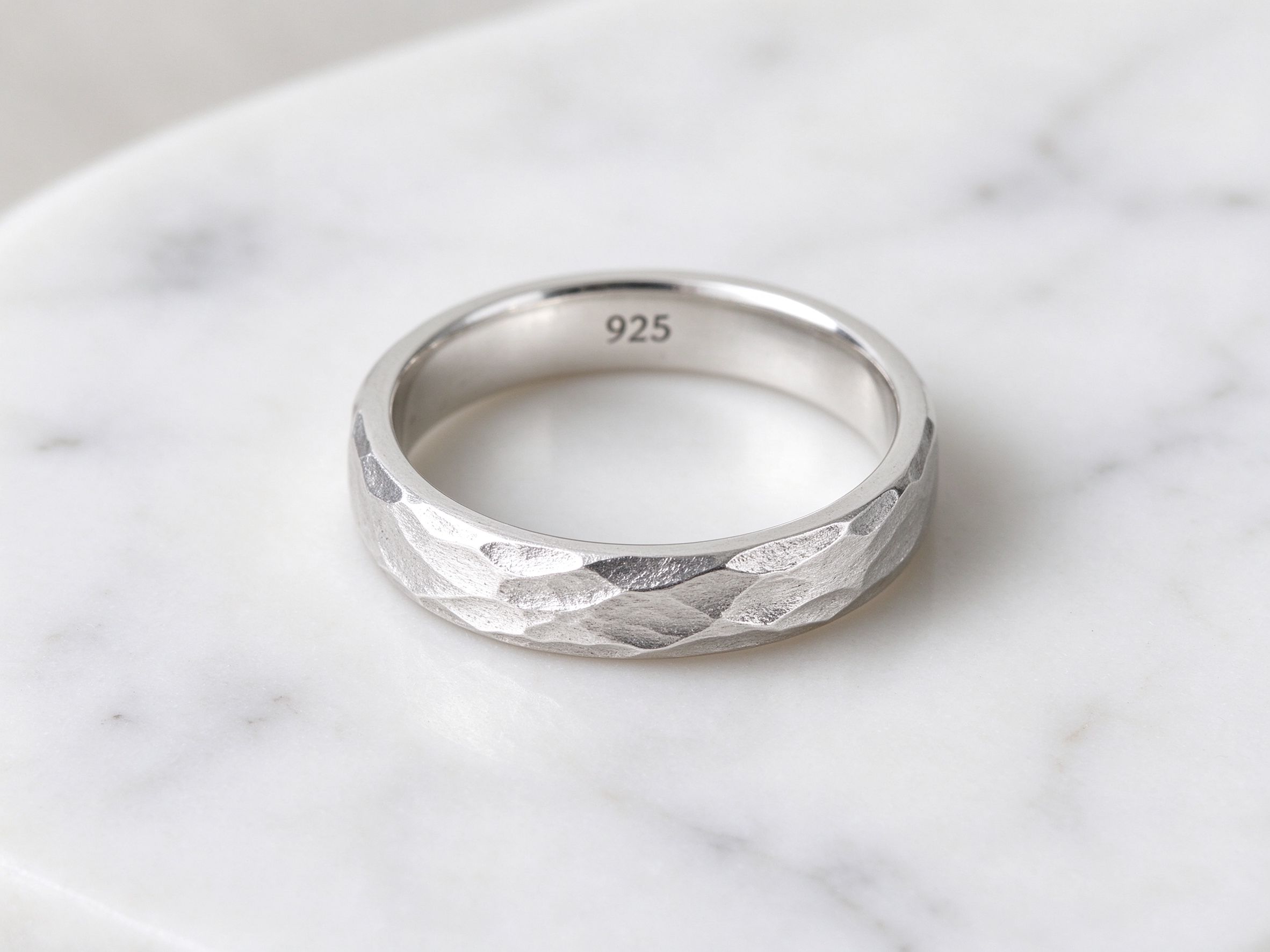
Men's Silver Rings: Why Weight and Width Matter More Than Design
When a man buys a silver ring, he is usually not buying it for the design. He is buying it for the feel. A men's ring that feels light and thin in the hand will be returned, because it feels like a woman's ring. A men's ring that feels solid, wide, and weighty will be kept, because it feels like a men's ring. The design details on a men's ring are almost secondary; what matters is the mass, the width, and the presence. This article explains why weight and width drive men's ring value more than any other factor, how we design men's bands in the factory, and why a brand that skimps on silver for men's rings will lose customers.
The market for men's silver rings has grown steadily in the last few years, as men become more comfortable wearing jewelry. But the customer for a men's ring is different from the customer for a ladies ring. He does not want dainty, he does not want stones, and he does not want trends. He wants a band that looks like it belongs on a man's hand, which means it has to be wide, heavy, and simple. A brand that tries to sell men's rings with the same thin design they use for ladies will be disappointed, because the customer will reject the piece as too small.
Why Weight Is the Primary Signal
Weight is the first thing a customer judges when they pick up a men's ring. A ring that weighs 3 grams feels thin and flimsy in a man's hand, because his hand is larger and the ring disappears on it. A ring that weighs 8 grams feels substantial, because it has presence. The customer does not know the exact gram weight, but he knows whether the ring feels right when he holds it. This is why men's bands are almost always heavier than ladies bands, even when they are the same material. The weight is the signal that the ring is for a man.
The cost of weight is the cost of silver. An 8-gram silver band uses more than twice as much silver as a 3-gram band, which means the material cost is more than twice as high. A brand that tries to make a men's ring cheap by using a thin 3-gram band will save silver cost, but they will lose the sale, because the customer will feel the ring is too light. The brands that sell men's rings well are the ones that accept the weight requirement, and price the ring accordingly. A men's band that retails for 80 to 150 dollars is priced for the weight, and the customer is willing to pay it, because he knows a light ring would feel wrong.
For a brand, the implication is that you cannot make a cheap men's ring that feels right. The silver weight is a requirement, not a choice. If you try to skimp on weight, the customer will tell you by returning the ring. We will always recommend a minimum weight for men's bands, usually 6 grams for a 6-millimeter band, because below that the ring feels flimsy. A 6-gram band is the minimum that feels like a men's ring, and it is the weight that most of our brands use for their men's line.
Why Width Matters Almost as Much as Weight
Width is the second signal. A man's finger is larger than a woman's, and a 3-millimeter band looks lost on it. A 6-millimeter band looks proportional, because it covers a meaningful portion of the finger. An 8-millimeter band looks bold, which is what some men want. The width sets the visual presence of the ring, and a narrow band on a man's hand looks like a ladies ring that was borrowed. This is why men's bands are almost always 5 to 8 millimeters wide, while ladies bands are 2 to 4 millimeters.
The cost of width is the cost of silver, because a wider band uses more silver. A 6-millimeter band uses twice as much silver as a 3-millimeter band, all else being equal. A brand that wants to sell a wide men's band has to accept the silver cost, because the width is the requirement. The brands that sell narrow "men's" bands at a low price are usually not selling well, because the customer can tell the band is too narrow for his hand. The width is not optional; it is part of what makes the ring a men's ring.
For a brand, the width choice is about the look you want. A 5-millimeter band is subtle and works for everyday wear. A 6-millimeter band is the most common men's width, because it is visible without being bulky. An 8-millimeter band is bold and works for customers who want a statement. We will recommend the width based on your target customer, because the wrong width makes the ring feel like it belongs on a different gender.
How Men's Rings Are Sized Differently
Men's rings are sized differently from ladies rings, because men's fingers are larger. The average men's ring size is a US 10, compared to a US 7 for ladies. The size run for men's bands usually covers US 8 through US 12, with the peak at US 9.5 to 10. A brand that orders a men's run with the ladies size distribution will be left with size 8 inventory that no one wants, while size 10 sells out. We will give you the men's size distribution for your market, because it is different from the ladies distribution, and getting it wrong is an expensive mistake.
The size distribution for men is also wider than for ladies, because men's fingers vary more in size. A men's size run might need to go from US 8 to US 13, while a ladies run might go from US 5 to US 9. The wider range means more SKUs, and more inventory to manage. We recommend that new brands start with a narrow size range for men, US 9 through US 11, which covers most customers, and then add the extremes as demand appears. This keeps the inventory manageable, and it avoids the slow size problem.
For a brand, the size planning for men is as important as the design. A men's band that is available only in size 10 will miss the customer who wears size 12, who is often willing to pay more for a band that fits. But a men's band stocked in every size from 7 to 13 will have slow inventory in the extremes. The balance is to stock the peak sizes heavily and offer the extremes as made-to-order, which is the approach that most of our brands use.
How Plating and Finish Change the Men's Ring Feel
The finish on a men's ring changes how it feels and how it ages. A polished men's band looks bright and new, but it shows scratches easily, because the polished surface reflects every mark. A brushed men's band looks matte and masculine, and it hides scratches, because the brushed texture absorbs the light. Most men's bands use a brushed or matte finish, because it is more practical for daily wear, and it does not show the wear as obviously. A polished men's band looks great when new, but it will look worn in a few months if the customer works with his hands.
Rhodium plating on a men's silver band is less common than on a ladies band, because the plating adds a bright white look that some men do not want. A natural silver band, with a patina that develops over time, is more masculine in appearance, because it shows the wear and history of the piece. Some brands offer a rhodium-plated men's band for customers who want the bright look, but the natural silver band is the more traditional choice for men. We will recommend the finish based on your market, because the finish changes the perceived gender of the piece.
For a brand, the finish is part of the product positioning. A polished rhodium-plated men's band feels modern and clean. A natural silver brushed band feels traditional and masculine. The customer will choose the finish that matches his style, and the brand should offer both options if the market supports it. The finish costs the same to apply, but it changes the product significantly, which is why we treat finish as a design choice, not just a production step.
Solid vs Hollow Men's Bands
For wide men's bands, the choice between solid and hollow is a real one. A solid wide band, 8 millimeters wide and 2 millimeters thick, might weigh 10 grams. A hollow wide band, the same width but a thin shell, might weigh 4 grams. The hollow band looks the same from the outside, but it feels much lighter, and it does not have the solid feel that a man expects. Some customers like the lightness of a hollow band, because it is comfortable for daily wear. Other customers reject it, because it feels cheap.
We offer both solid and hollow men's bands, and we will tell you which one we recommend for your market. Solid bands are better for brands that position themselves as fine jewelry, because the weight signals quality. Hollow bands are better for brands that want to hit a lower price point, because the silver cost is much lower. The trade-off is that a hollow band is less durable, and it can dent if hit hard, while a solid band will survive almost anything. We will never push a hollow band on you if we think your customer expects solid, because the wrong choice leads to returns.
For a brand, the solid vs hollow choice is a positioning decision. A solid men's band that retails for 120 dollars is selling weight and durability. A hollow men's band that retails for 50 dollars is selling the look of width at a lower price. Both have their place, and both can be successful if the brand is clear about which one it is selling. The mistake is selling a hollow band at a solid price, because the customer will feel the lightness and feel cheated. The price has to match the construction, and we will help you set it.
How Design Details on Men's Rings Work
While weight and width are the main signals, design details on men's rings do matter, but they have to be subtle. A men's band might have a brushed finish instead of polished, which gives it a more masculine look. It might have a slight groove down the center, which adds visual interest without being decorative. It might have a small stone, like a black onyx or a thin moissanite, set low in the band. But the details have to be restrained, because a man does not want a ring that looks like it has too much going on.
The most popular men's band designs are the simplest: a flat polished band, a brushed band, or a band with a single thin groove. These designs have been around for decades, and they will not go out of style. The trendy men's designs, like wide engraved bands or stone-encrusted rings, sell in the season they are released, but they do not last. The brands that build a men's line around simple designs have steady sellers, while the brands that chase trendy men's designs have to reinvent the line every year.
For a brand, the design implication is to keep the men's line simple. A few basic bands, in polished, brushed, and grooved finishes, are enough to start. Add more details later, once you know what your customer wants. The customer who buys a men's ring usually wants something that will last for years, not something that will look dated next season. The simple designs are the ones that build loyalty, because the customer can wear them every day without worrying about fashion.
How We Produce Men's Bands
Producing men's bands efficiently is about the same process as ladies bands, but with wider and heavier castings. We cast the torus in a wider mold, the band comes out thicker, and we polish it on a wider buffing wheel. The process is the same, but the equipment is sized for the wider piece. The per-piece cost is higher, because more silver is used, and the polishing takes slightly longer, because the wider band has more surface area. But the efficiency is the same, because the process is repetitive.
For solid men's bands, we use a thicker casting, because the band has to hold its shape. A thin casting on a wide band will flex, and a flexing men's band feels cheap. We cast men's bands at a minimum of 1.5 millimeters thick, because below that the band is not rigid enough. For hollow bands, we use a thin shell, and we form it on a mandrel, which is faster than casting. The hollow process is cheaper, but it is limited to simple band shapes, because a hollow band cannot have complex details.
For a brand, the production choice is between casting and forming, depending on the design. Simple solid bands are cast, simple hollow bands are formed, and detailed bands are cast. We will recommend the process based on the design and the price point, because each process has a different cost structure. The goal is to get the right feel at the right price, and we have the equipment to do both.
How to Price Men's Rings for the Right Customer
Pricing a men's ring correctly means matching the price to the weight and width. A solid 6-millimeter men's band that weighs 7 grams should retail for 80 to 120 dollars, because the customer expects a solid piece at that price. A hollow 6-millimeter band that weighs 4 grams should retail for 40 to 60 dollars, because the customer should not pay solid prices for a hollow piece. The price tells the customer what to expect, and if the price and the construction do not match, the customer will feel cheated when they pick up the ring.
The margin on men's bands is healthy, because the customer is less price-sensitive than the ladies customer. A man who is buying a wedding band or an everyday ring is not browsing for the cheapest option; he wants something that will last. He will pay for the weight and the width, because he knows that a light ring will feel wrong. This is why men's bands can be priced higher than ladies bands of the same design, even though the production process is similar. The customer is buying the feel, not the design, and he will pay for it.
For a brand, the pricing implication is to invest in the weight and price the ring accordingly. A men's band that feels solid and wide will sell for a good price, and the customer will be happy. A men's band that feels light and narrow will not sell, no matter how low the price, because the customer will reject it as a ladies ring. The mistake is trying to make a cheap men's band, because there is no such thing. The men's customer wants weight, and weight costs silver money. The brands that accept this and price for it are the ones that succeed in the men's market.
Common Questions About Men's Silver Rings
What is the best width for a men's ring? A 6-millimeter band is the most versatile, because it is visible without being bulky. A 5-millimeter band is subtle, and an 8-millimeter band is bold. Most brands start with a 6-millimeter band and add other widths later.
How heavy should a men's band be? A solid 6-millimeter band should weigh at least 6 grams. Below that, it feels flimsy. An 8-millimeter solid band might weigh 10 grams. The weight is the signal of quality, and we do not recommend skimping on it.
Are hollow men's bands good value? They are good value if the price matches the construction. A hollow band at a hollow price is fine. A hollow band at a solid price is a bad deal. We will tell you which construction we are quoting, so you can price it correctly.
Do men like stones on their rings? Some do, but most prefer a plain band. A small black onyx or a thin moissanite set low is acceptable, but a ring covered in stones is usually not a men's style. Keep the stones minimal.
Why Engraving Matters on Men's Bands
Engraving on men's bands is more common than on ladies bands, because men's bands are often wedding rings or promise rings, and the customer wants a date or initials on the inside. A men's wedding band with a date engraved on the inside is the standard product, and most brands that sell men's bands offer engraving as a standard option. The wider band also gives more room for the engraving, because a 6-millimeter band has more space inside than a 2-millimeter band. The engraving on a men's band is usually a wedding date, initials, or a short phrase, and it is done by laser just like on ladies bands.
For a brand, offering engraving on men's bands is almost expected, because the wedding market is a large part of the men's ring business. A customer buying a men's wedding band will almost always want the date engraved, and a brand that does not offer engraving will lose the wedding sale to a competitor that does. The cost of the engraving is small, and the margin on the wedding band is healthy, so it is worth offering. We set up the engraving for men's bands just like for ladies bands, and we will help you promote it as part of the wedding band service.
The Bottom Line
Men's silver rings are bought for feel, not for design. The customer wants a band that is wide, heavy, and simple, because that is what looks right on a man's hand. The weight and width are non-negotiable, and a brand that skimps on them will lose the sale. The design details matter, but they have to be restrained, because the customer wants a ring that will last, not a fashion piece. The brands that sell men's rings well are the ones that understand this, and they price the ring for the weight, not for the design.
If you are planning a men's ring line and want to see which widths and weights are selling best, send us your target market and we will share the data. Reach our team at service@holycome.com, and for more on how we produce bands, read our guide to ring band width and thickness cost and our breakdown of ring weight and material cost balance.