Ring Size When Pregnant - HOLYCOME
Pregnancy changes a lot of things, and finger size is one of them. By the second and third trimesters, water retention, increased blood volume, and heat combine to make fingers noticeably thicker, and a ring that fit before pregnancy can suddenly feel tight. This sends expecting mothers into a familiar panic: should I size up now, will the ring stay on, am I doing damage by wearing it? As a factory that produces rings for wholesale brands and has fielded thousands of sizing questions, we have a clear answer. Pregnancy swelling is temporary, and the ring strategy should match that. This guide explains how much fingers actually grow during pregnancy, what size to buy if you need a ring now, when to size up versus when to wait, and how we build rings that can be resized after. We also cover the factory side: why resizing a gold or silver band is cheaper than you think, and why we recommend against buying an expensive stone ring in a temporary size.
The short answer is this: if you want a ring to wear during pregnancy, buy it a half to a full size larger than your pre-pregnancy size, and expect it to be loose after the baby comes. Do not resize your engagement ring to a swollen finger, because the swelling goes down. Instead, wear a cheap temporary band during the third trimester, keep the real ring on a chain, and resize the permanent ring after you are done breastfeeding, when your fingers have settled back. This is the approach almost every jeweller recommends, and it is the one we build for.
We also cover the care side of pregnancy and jewelry in our guide on how body chemistry changes during pregnancy and what it does to your rings, which is about skin chemistry and tarnish rather than sizing. This article is purely about the size problem: how much the finger changes, what to buy, and how to avoid resizing mistakes. Read both together, and you will know everything you need to keep wearing rings through pregnancy and beyond.
Why Fingers Swell During Pregnancy
The swelling is not imagination. A pregnant woman's blood volume increases by about fifty percent over the course of a pregnancy, and her body retains more water to support the placenta and the increased circulation. That water settles in the extremities, and the fingers are one of the first places it shows, because the hands are low and gravity pulls fluid there. By the third trimester, it is common for a finger to measure a half to a full size larger than it did before pregnancy, and on a hot day or after a salty meal, it can be a size and a half larger. This is normal, it is temporary, and it peaks in the last few months.
The swelling is also uneven across the day, which makes sizing harder. We explain the daily swing in our guide on why fingers change size through the day, and pregnancy amplifies it. In the morning, after lying flat all night, fluid settles in the hands and the rings feel tight. By midday, after being upright, the fluid has shifted down and the rings may feel looser. By evening, after standing and working, the hands swell again. Measuring a pregnant finger at one time of day gives you one reading, and it will not match the reading at another time. This is why sizing a pregnant finger is unreliable, and why we recommend against permanent decisions based on it.
The swelling also responds to heat and salt. A pregnant woman in a hot climate will be noticeably more swollen than one in a cool climate, and a dinner out will leave the fingers thicker by morning. This is the same mechanism that makes rings tight on a long flight, amplified by pregnancy. The finger is not a fixed number; it is a range, and during pregnancy that range is wider and shifted up. Any ring bought to fit a pregnant finger will be fitting the high end of a moving target, which means it will be loose when the swelling subsides.
How Much Larger Does a Ring Need to Be?
For a ring you intend to wear only during pregnancy, size up by a half to a full size from your pre-pregnancy measurement. If your pre-pregnancy ring finger was a 6, plan on a 6.5 or a 7 for the third trimester. A half size up covers mild swelling, and a full size up covers the worst of the third trimester on a hot day. Do not size up more than a full size, because that will be too loose even on a swollen finger, and it will spin and slip off. A half to a full size is the range that works.
For a ring you want to wear both during pregnancy and after, the answer is different. Do not buy it in the swollen size, because after pregnancy it will be a size too big. Instead, wear a temporary band during the swelling, and keep the permanent ring in its pre-pregnancy size. After the swelling subsides, the permanent ring will fit again. This is the approach we recommend to almost every expecting mother, because it avoids the resizing loop. Buy the permanent ring in your true pre-pregnancy size, and use a cheap spacer band for the third trimester.
If you do not know your pre-pregnancy size because you never wore rings, measure at the right time. Measure in the middle of the day, after your hands have been active and warm, and after drinking normal amounts of water. Do not measure first thing in the morning when the hands are most puffy, because that reading is the worst-case size, and a ring bought to it will be loose by lunchtime. Measure mid-morning, on a warm hand, and size up a half from there for the third trimester. This gives you a ring that fits through most of the swelling, without being absurdly loose after.
The Swollen Knuckle Problem
Pregnancy swelling does not just thicken the finger base; it thickens the knuckle too, and this creates a specific problem. A ring that slips over a normal knuckle can bind on a swollen one, because the knuckle is now the widest point. We cover the knuckle-versus-base sizing logic in our guide on sizing for large knuckles, and pregnancy puts a temporary version of that problem on every finger. If the knuckle swells more than the base, the ring has to be sized to the knuckle, which means it will be loose at the base once the swelling goes down. This is the classic pregnancy resizing trap, and it is why we recommend against resizing the engagement ring to a swollen knuckle.
The right answer during pregnancy is a stretchy, cheap band that can expand over the knuckle and sit loosely on the base. A silicone or rubber wedding band is the standard solution: it slips over the swollen knuckle, it is comfortable, and if it gets stuck there is no harm because it is soft and can be cut off. We see more and more pregnant women wearing silicone bands during the third trimester for exactly this reason. The permanent gold or platinum ring stays in its box, and the silicone band takes the swelling. After pregnancy, the silicone band retires and the real ring goes back on.
For women with naturally large knuckles, the knuckle problem is already there, and pregnancy just makes it worse. If your pre-purchase ring already needed to be sized to the knuckle with a sizing bead at the base, pregnancy will push the knuckle up another half size, and the ring that fit before pregnancy will not clear the knuckle at all. This is when the silicone band becomes essential, because forcing the real ring over a swollen knuckle risks bending the setting or damaging the prongs. We tell every expecting mother with a raised-stone engagement ring to retire it early in the third trimester, because the swollen knuckle is the number one cause of bent settings during pregnancy.
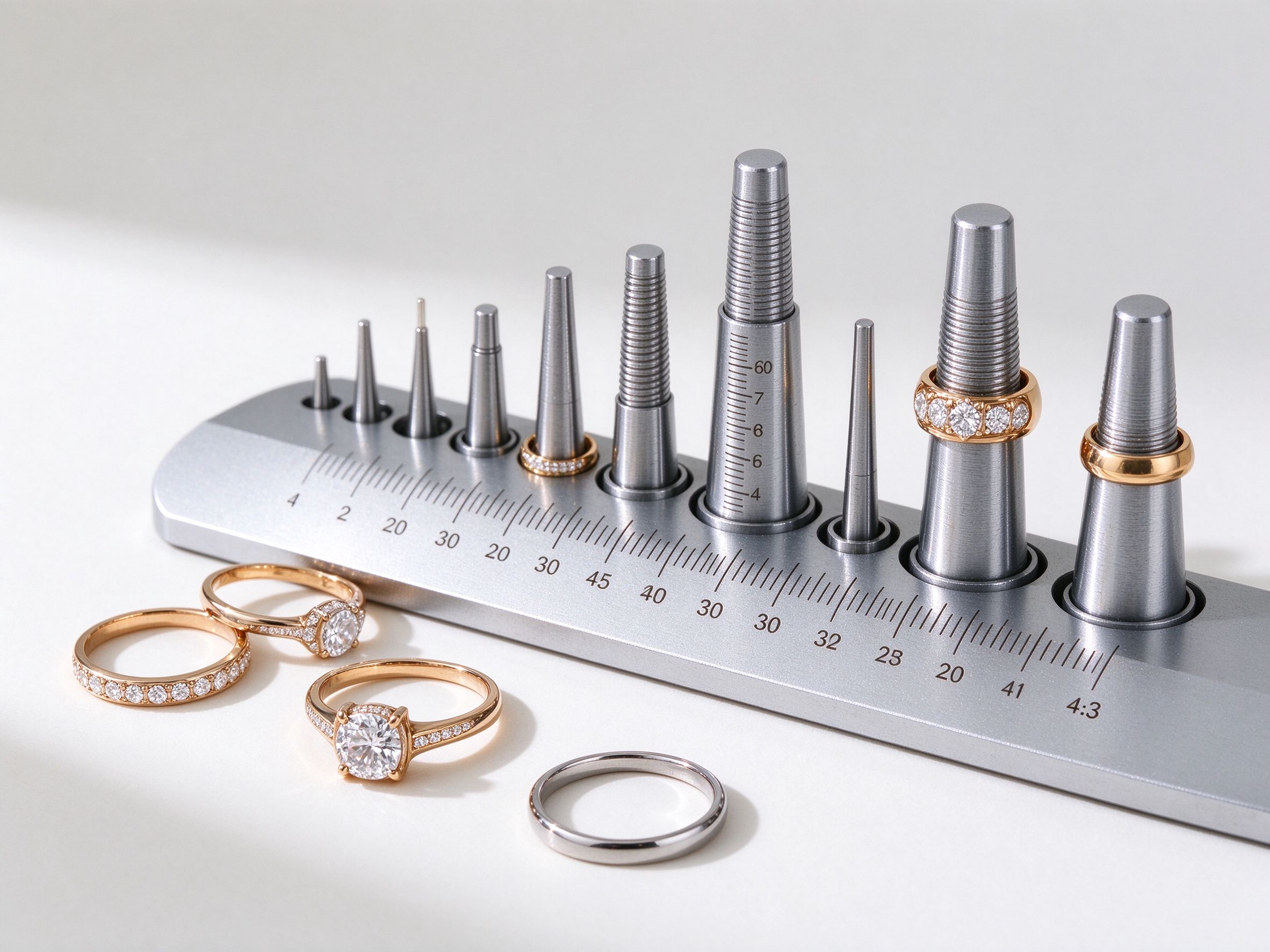
A plain comfort-fit band, sized a half up, worn during the third trimester; the simple shank is easy to resize after pregnancy.
When to Resize Your Engagement Ring
The engagement ring is the ring women worry about most, and the rule is simple: do not resize it while you are pregnant. Resizing a gold band is a cheap and reversible operation, but it has to be done to the correct finger size, and the correct finger size during pregnancy is not your real size. If you resize the ring up a full size during the third trimester, you will have to resize it back down after the baby is born, which is two resizes instead of zero. Resizing twice costs more than resizing once, and each resize weakens the shank slightly, so the best plan is to not resize at all during pregnancy.
Wait until you are done breastfeeding. Hormones change finger size for as long as you are nursing, and fluid retention can persist through the first postpartum year. Many women report that their fingers do not return to their pre-pregnancy size until they stop breastfeeding, because the hormones that support lactation also affect water retention and soft tissue. So the timeline is: wear a temporary band during pregnancy, keep the engagement ring in its box, and get it resized six months to a year postpartum, when the finger has settled to its new normal. That new normal may be a half size different from the pre-pregnancy size, which is normal and permanent, and that is the size you resize to.
From the factory side, resizing a plain gold or silver band is a quick operation. We cut the shank, add or remove a segment, and re-solder, polish, and plate. It costs a fraction of a new ring, and a plain band can be resized up or down about two full sizes before the metal gets too thin. So there is no urgency to get the size perfect during pregnancy, because the ring can be adjusted later. The only rings that cannot be resized easily are eternity bands set all the way around, because resizing breaks the stone setting. For those, the answer is not to wear them during pregnancy at all, because they cannot expand and they cannot be resized. We recommend retiring full-eternity bands for the whole pregnancy, because a swollen finger on a rigid eternity band is a setup for a stuck ring.
The Stuck Ring Emergency
A stuck ring on a swollen finger is the emergency every pregnant woman eventually faces. The finger swells in the evening, the ring goes on in the morning, and by night it will not come off. The first rule is not to panic, and not to yank. Yanking compresses the finger more and makes the swelling worse. The second rule is to elevate the hand above the heart for ten minutes, which lets fluid drain out of the finger and often lets the ring slip off. The third rule is lubrication: dish soap, hand cream, or Windex, worked under the band, lets the ring slide. We cover the emergency side of loose and stuck jewelry in our guide on what to do when a stone goes loose, which is a different emergency but follows the same calm, do-not-force principle.
If the ring truly will not come off, do not cut it yourself with household tools. A jeweller has proper ring-cutting tools that open the shank without scratching the stone or damaging the setting, and a cut band can be soldered back together for a small fee. For a silicone band, this is irrelevant because it is cheap enough to just cut off. This is why we recommend silicone for the third trimester: the cost of a stuck emergency is near zero, because the band is soft and disposable. A stuck gold engagement ring, by contrast, means a trip to the jeweller and a cut-and-resolder, which is avoidable if you just retire it early.
We have seen women wear a tight ring all through the third trimester, convinced it will stretch or that the swelling will go down, and end up with a bruised finger and a bent setting. The damage is not just to the skin; a tight ring on a swollen finger can press on the circulation, and it can bend the shank out of round if the finger swells beyond its capacity. If a ring is tight, stop wearing it. There is no prize for toughing it out, and the ring will still be there after pregnancy. This is the single most common piece of advice we give expecting mothers, and it is the one that prevents the emergencies.
Buying a Pregnancy Ring: What to Look For
If you want a ring to wear during pregnancy, buy one designed for the temporary size. A plain, comfort-fit band in silver or soft gold is ideal, because it is easy to resize later and it has no raised stones to catch or bend. Avoid rings with tall settings, pavé shoulders, or full-eternity stone work, because those either catch on swollen skin or cannot be resized. A plain band is the pregnancy ring, and it is the one we produce most for this purpose. It is cheap, it is comfortable, and it can be resized or retired without regret.
Size it a half to a full size up, as we discussed, and choose a comfort-fit inner edge, which slides on and off a swollen finger more easily than a flat inner edge. We produce comfort-fit bands for exactly this reason: the rounded inside reduces the friction on swollen skin, so the ring goes over the knuckle without binding. A flat-inner band on a swollen finger is a fight every morning; a comfort-fit band slips on with soap and slides off at night. This is a small design detail that makes a big difference during pregnancy.
We also recommend a ring in a metal that is kind to sensitive skin. Pregnancy hormones make skin more reactive, and a cheap plated ring can cause the green-finger reaction we explain in our guide on why some rings discolor the skin green. Sterling silver or solid gold, with no nickel plating, is the safe choice during pregnancy, because the skin under the swollen ring is already moist and sensitive. A pregnancy ring that causes a rash is a ring you will stop wearing, defeating the purpose. Spend a little more on the metal, and the band will stay comfortable through the whole trimester.
Weight Gain and Finger Size Beyond Pregnancy
Pregnancy is not the only reason fingers change size. Long-term weight gain after pregnancy can permanently shift finger size up, just as it does for anyone. We cover this in our guide on how weight changes move ring size, and the pregnancy overlap is obvious: a woman who keeps on weight after the baby will find her pre-pregnancy ring tight forever, not just during pregnancy. This is a permanent change, and the right answer is a resizing, not a spacer. Distinguishing temporary pregnancy swelling from permanent post-pregnancy size change is the whole point of waiting to resize: you wait until the hormones and fluid are gone, then measure the real new size, and resize to that.
Some women lose the baby weight within months and return to their pre-pregnancy size, and their pre-pregnancy ring fits again with no resizing. Others keep a half size up permanently, because the hand structure changed or the weight settled. Both are normal. The only way to know which one you are is to wait, measure again after breastfeeding, and compare. Resizing during pregnancy is a guess, and resizing too early means resizing twice. The patience approach costs nothing and saves a resizing. This is why we are so firm about waiting: the finger you measure at six months postpartum is the real finger, and that is the size the ring should be.
For wholesale brands, this translates to a product line. A plain, comfort-fit, silver or soft-gold band in half sizes, marketed as a pregnancy band or a temporary band, sells well to expecting mothers. It is a low-cost, easy-to-stock SKU, and it pairs naturally with the permanent engagement ring. We produce these bands in the peak sizes, sized a half up from the standard curve, because a pregnant woman buying a temporary band is shopping for a slightly larger finger. It is a small product line, but it is a steady one, and it is the kind of practical piece that builds customer loyalty.
Factory Notes: Resizing a Band We Made
Because we produce the bands, we also resize them, and we can tell you what that actually involves. A plain gold or silver band is cut at the bottom of the shank, a small segment is removed to size down or added to size up, and the joint is soldered, filed, and polished. The whole operation takes twenty minutes on the bench, and the ring comes back to you looking new. We do not charge much for this, because it is a standard operation and the material cost is a tiny sliver of gold. This is why we are relaxed about pregnancy resizing: it is cheap, fast, and reversible, and there is no reason to panic about getting the size exact now.
The one thing we cannot resize is a full-eternity band, because the stones go all the way around the shank, and any cutting breaks the stone setting. For eternity bands, the only options are a stretcher bar, which is a temporary fix, or re-setting the stones onto a new shank, which is expensive. This is why we tell women not to wear eternity bands during pregnancy: the ring cannot expand, the finger will, and the result is a stuck, expensive band. A plain band, by contrast, can be resized up or down two full sizes without breaking a sweat. The choice of ring style during pregnancy is therefore also a choice about how much resizing flexibility you have.
For wholesale customers, we offer resizing as a service, and we size bands to order. If a brand sells a pregnancy band and the customer needs it resized postpartum, we can turn that around in a week. This after-sales service is part of why brands work with a factory rather than a middleman: the resizing goes back to the place that made the ring, where the metal and the setting are known, rather than to a local jeweller who has to guess at the alloy. We stand behind the bands we produce, and that includes resizing them for the next twenty years.
Frequently Asked Questions
Should I size up my engagement ring during pregnancy?
No. The swelling is temporary, and resizing the ring to a swollen finger means resizing it back later. Instead, wear a cheap temporary band or a silicone ring during the third trimester, keep the engagement ring in its box, and resize it after you have finished breastfeeding, when your finger has settled to its real new size.
How much larger is a pregnant finger?
Typically a half to a full size larger than the pre-pregnancy measurement, especially in the third trimester. On a hot day or after a salty meal, it can be a size and a half larger. Size a temporary pregnancy band a half to a full size up, and measure mid-morning on a warm, active hand rather than first thing in the morning.
Can I wear my eternity band during pregnancy?
We recommend against it. A full-eternity band is rigid and cannot expand, and it cannot be resized easily. A swollen finger on a rigid eternity band risks the ring getting stuck and damaging the setting. Retire it for the pregnancy, and wear a plain comfort-fit band instead, which can be resized later.
When should I get my ring resized after the baby?
Wait until you have finished breastfeeding, typically six months to a year postpartum. Hormones during lactation keep water retention high, and fingers can stay swollen or shifted until they stop. Measure your finger again at that point, and resize the ring to the settled size. It may be a half size different from your pre-pregnancy size, which is normal and permanent.
Let Us Help You Size Through Pregnancy
We produce plain comfort-fit bands and resize them for a living, so we know exactly what works for expecting mothers. If you are buying a pregnancy band, we can recommend the right width, the right comfort fit, and the right size to order. If you have a ring that needs resizing after pregnancy, we can handle that too, quickly and cleanly. Contact us at service@holycome.com with your size and your timeline, and we will set you up with a band that fits through the swelling and beyond. We have sized rings for thousands of pregnant customers, and we will size yours too.