
01Oval Moissanite Rings: Elongated Sparkle That Looks Larger Than Round
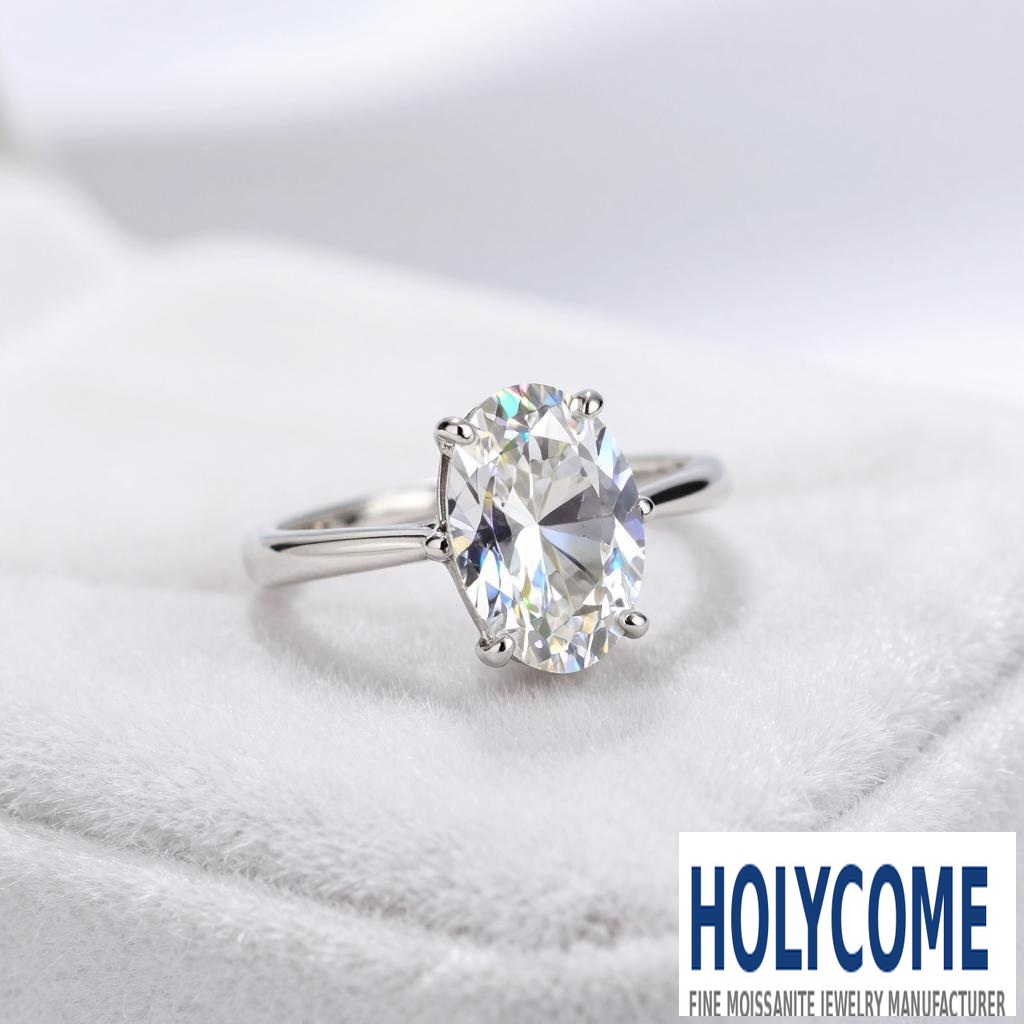
If round brilliant moissanite is the default and cushion moissanite is the classic fancy cut, oval moissanite rings are the fastest-growing shape in moissanite bridal jewelry, and oval moissanite engagement rings now compete with round brilliants for bestseller status. Ovals look bigger face-up than rounds of the same carat weight (the elongated shape stretches the apparent size), they flatter most finger shapes by lengthening the finger visually, and they carry a modern-meets-classic aesthetic that photographs exceptionally well on Instagram and TikTok. Celebrities choosing oval engagement rings over the last five years have driven massive consumer awareness, and oval moissanite now represents roughly 22% of our center stone shape volume for engagement rings — second only to round brilliant. This guide covers the cut parameters that matter for ovals (length-to-width ratio, the bow-tie effect, symmetry), setting styles, pricing, MOQ, and the OEM considerations for brands building an oval moissanite line.
02Why Oval Moissanite Looks Bigger
The oval's visual size advantage is real, not a marketing claim. A well-cut oval moissanite faces up approximately 10-15% larger than a round moissanite of equivalent carat weight because the shape is elongated along one axis. A 1.5ct equivalent oval (8.0x6.0mm) faces up with roughly the same footprint as a 1.7ct round, creating meaningful perceived value for consumers.
The effect is more pronounced at longer length-to-width ratios. Moissanite (silicon carbide) has a refractive index of 2.65, which is why oval moissanite delivers more visible fire than an equivalent oval diamond, especially at the elongated tips (moissanite optical property reference). Length-to-width ratio (L/W) is the single most important shape parameter for ovals, and the right ratio is the difference between an elegant elongated oval and a fat, almost-round oval that reads as misshapen.
| Length-to-Width Ratio | Appearance | Market Demand | Notes |
|---|---|---|---|
| 1.25-1.30 | Chubby, almost round oval | Niche | Looks close to a round; minimal elongating effect; often chosen by buyers who want a slightly softer round. |
| 1.30-1.40 | Classic balanced oval | Best-selling (50% of oval volume) | Elegant, universally flattering; the "safe" ratio for production stock. |
| 1.40-1.50 | Slender, elongated oval | 30% of volume; growing | Fashion-forward; makes the finger look longest; popular in influencer-led DTC brands. |
| 1.50-1.60 | Long, slender oval (cigar shape) | Niche (12%) | Bold, statement look; can show more bow-tie if cut poorly. |
| 1.60+ | Extremely elongated | Very niche (3%) | Rarely stocked; special order only. |
Our default stock ratio is 1.35-1.40 for wholesale oval moissanite, which has the broadest consumer appeal. OEM clients designing for fashion-forward audiences often specify 1.45-1.50.
The oval's visual size advantage is real, not a marketing claim. A well-cut oval moissanite faces up approximately 10-15% larger than a round moissanite of equivalent carat weight because the shape is elongated along one axis. A 1.5ct equivalent oval (8.0x6.0mm) faces up with roughly the same footprint as a 1.7ct round, creating meaningful perceived value for consumers.
03The Bow-Tie Effect
Ovals (and other elongated fancy cuts including marquise and pear) can show a dark "bow-tie" pattern across the center of the stone — a butterfly-wing-shaped shadow caused by light leakage when the pavilion angles are oriented for face-up brightness but leave a dead zone visible at certain angles. Bow-tie is a characteristic of the shape; it cannot be eliminated entirely in ovals, but it can be minimized by skilled cutting.
Our oval cut targets a "very slight" to "slight" bow-tie grade — a faint bow-tie visible only when the stone is tilted at specific angles, not visible in face-up viewing. Stones with strong or prominent bow-tie are downgraded or re-cut. Bow-tie grade is checked manually by our cut graders under a fiber-optic light; this manual check is one reason specialty oval cutting commands a small premium over rounds.
Bow-tie is a cut-quality issue distinct from color or clarity. Two ovals with identical color, clarity, and length-to-width ratio can look completely different depending on how the cutter managed the bow-tie — which is why buying oval moissanite by spec sheet alone (without visual grading) leads to disappointing results.
04Oval Cut Quality Parameters
Beyond length-to-width ratio and bow-tie, several cut parameters determine how much fire and brightness an oval delivers:
- Symmetry: The two halves of the oval should be mirror images. Asymmetrical ovals (one shoulder fatter than the other) read as lopsided to the eye. We hold symmetry to Excellent grade on our premium oval cut.
- Table percentage: 56-62% is ideal for ovals (slightly larger than round's 53-58%, to balance the elongated facet pattern).
- Total depth: 60-65% for ovals. Shallow ovals show more windowing (see-through effect); deep ovals look dark and heavy from the side.
- Girdle thickness: Thin to slightly thick, even around the entire perimeter. Thin girdles at the pointed tips of ovals are a chipping risk.
- Culet: None to very small. Large culets create a visible dark center spot.
GIA provides general cut grading guidance for oval and other fancy-shape diamonds; we apply analogous proportion standards when cutting oval moissanite, adjusted for moissanite's higher refractive index (2.65 vs diamond's 2.42) (GIA fancy-shape cut standards).
05Popular Oval Moissanite Ring Settings
Ovals work beautifully in multiple settings, but a few configurations dominate oval moissanite ring sales:
| Setting | Share of Oval Ring Volume | Why It Works for Oval |
|---|---|---|
| Four-prong solitaire (classic) | 32% | Two prongs at each pointed tip plus two at the sides showcases the elongated shape with minimal metal; clean, modern, and leaves maximum light entry. |
| Six-prong solitaire | 14% | More secure for stones over 2ct; slightly more metal visible but still a solitaire look. |
| Halo (oval halo) | 28% | Halo amplifies the already-large face-up of oval, producing a statement look. Oval halo is our second-best-selling halo style behind round halo. |
| Three-stone oval | 12% | Oval center with half-moon or tapered bullet side stones; strong royal-association look. |
| East-west oval | 8% | Oval set horizontally across the shank rather than vertically; modern, unconventional, strong in designer-led lines. |
| Pavé band oval solitaire | 6% | Oval center with melee down the shank; bridal classic. |
Four-prong setting is the default recommendation for stock oval SKUs because it best shows off the shape. Two important setting notes: prongs on oval tips must seat firmly on the points (the thinnest, most chip-prone parts of the stone), and the head must be proportioned to the specific L/W ratio — a head sized for a 1.35 ratio oval will not properly hold a 1.50 ratio oval of the same carat weight.
06Oval vs Other Fancy Shapes: Buyer's Decision Framework
Brands choosing between oval, cushion, pear, and emerald cut for a fancy-shape line often ask how the shapes compare on key dimensions:
- Apparent size per carat: Oval > Marquise > Pear > Emerald > Cushion > Round. Ovals win on size-per-carat.
- Brilliance and fire: Ovals show more fire than emerald or Asscher (step cuts), similar brilliance to cushions. Round brilliant still leads on total light return.
- Finger-flattering effect: Elongated shapes (oval, marquise, pear) all lengthen the appearance of the finger; oval is the most wearable version of this effect.
- Setting versatility: Oval works in solitaire, halo, three-stone, vintage, and east-west settings without requiring custom head redesign — the most versatile fancy shape.
- Consumer recognizability: Oval has gone from niche to mainstream in the last five years; it no longer requires consumer education the way marquise or Asscher still do.
For brands building a second fancy shape after round, oval is the most commercially safe choice. The shape's visual strengths are immediately obvious to consumers (bigger look, flattering) without requiring jewelry expertise to appreciate.
07Pricing: 14K White Gold Oval Moissanite Rings (EXW Factory, DEF VVS1 Excellent Cut)
Oval moissanite centers carry a small price premium over round moissanite because of lower yield and higher cutting time — approximately 5-10% per stone. Current 2026 wholesale pricing for four-prong solitaire ovals:
| Center Stone | Dimensions (L x W) | 50-199 pcs | 200+ pcs | Typical DTC Retail |
|---|---|---|---|---|
| 0.50 ct equiv. | 6.0 x 4.3mm (1.4 ratio) | $42 | $35 | $249-$399 |
| 1.00 ct equiv. | 8.0 x 6.0mm (1.33 ratio) | $62 | $52 | $399-$799 |
| 1.50 ct equiv. | 9.0 x 6.5mm (1.38 ratio) | $85 | $72 | $599-$1,099 |
| 2.00 ct equiv. | 10.0 x 7.0mm (1.43 ratio) | $108 | $92 | $849-$1,599 |
| 3.00 ct equiv. | 11.5 x 8.0mm (1.44 ratio) | $162 | $138 | $1,299-$2,499 |
Oval halo pieces run approximately $15-25 more per piece than the solitaire pricing above, consistent with halo premiums across shapes. Proper metal stamping and weight disclosure for all rings, including oval moissanite rings, follow FTC Jewelry Guides standards for precious metal representation (FTC Jewelry Guides).
08Quality Control Specific to Oval Settings
Oval rings have specific QC checks beyond standard ring inspection:
- Tip seating: Both end prongs must contact the oval's pointed tips firmly with no gap; exposed tip edges are a chipping risk if knocked.
- Orientation alignment: The oval must be perfectly aligned along the shank axis (for north-south settings) or perfectly perpendicular (for east-west). A 2-degree misalignment is visible to the eye and must be corrected.
- Symmetry check: The head must be centered on the shank and the stone level with no tilting; asymmetrical setting is more visible on ovals than on rounds because the long axis provides a reference line.
- Bow-tie spot check: Every oval center is viewed face-up under D65 lighting at final inspection to confirm no excessive bow-tie is visible in normal viewing position.
Our outgoing defect rate on oval moissanite rings is 2.1% for all oval moissanite settings (slightly above solitaire's 1.9% due to the additional symmetry and bow-tie checks), and client-reported defect rates run 0.4% after delivery. The most common outgoing reject is tip seating (0.5% of pieces), followed by alignment (0.3%).
09MOQ and Lead Times
Oval rings have similar lead times to round solitaire/halo, with one exception: specialty ratio ovals (1.5+ or custom ratios) require dedicated cutting runs.
- Stock oval solitaire (1.35-1.40 ratio): MOQ 50 per size/metal; 12-18 days for gold; 7-10 days for silver.
- Stock oval halo: MOQ 50 per size/metal; 18-24 days for gold.
- Custom ratio ovals (1.45+): MOQ 100 per size/ratio; add +7 days for specialty cutting.
- OEM custom setting (new CAD): MOQ 200; 25-35 days total.
- East-west settings: MOQ 50 for stock heads; lead time +3 days due to orientation alignment.
10FAQ
What length-to-width ratio should I stock for my first oval SKU?
Start with 1.35-1.40. That ratio has the broadest appeal and matches the look of the celebrity oval rings that have driven category demand. Offer a 1.45-1.50 as a secondary fashion-forward SKU after the classic oval has traction; do not open with a 1.5+ niche ratio as your primary oval offering.
Is bow-tie a defect?
A slight bow-tie is inherent to the oval shape and is not a defect — every oval shows a faint bow-tie at certain angles. A strong or prominent bow-tie that is visible face-up in normal lighting is a cutting failure and should be rejected or re-cut. Our graders reject stones with prominent bow-tie before they enter settings.
Are oval rings more likely to chip than round rings?
Ovals have two pointed tips that concentrate leverage if knocked, so tip chipping is a slightly higher risk than on a round (which has no point). Properly seated prongs covering the tips mitigate this risk effectively — our data shows tip-related chipping in consumer wear at less than 0.2% of oval rings, compared to 0.1% for rounds. We recommend six-prong settings for ovals over 2ct for extra tip security.
Can I pair an oval center with a round halo?
No — the halo must follow the shape of the center stone. Oval centers require oval halos; a round halo around an oval center leaves awkward gaps at the tips. Our CAD designs include shape-matched halos for every center shape (oval, cushion, pear, marquise, emerald).
Do east-west ovals sell?
East-west is a niche (8% of our oval volume) but converts well with the right audience — typically modern, design-forward, socially native DTC brands targeting millennial and Gen Z buyers. It photographs very differently from traditional vertical ovals and stands out in feeds. We recommend it as a secondary SKU rather than a primary oval offering.
Do you offer oval samples?
Yes — oval solitaire samples in 1.0ct and 1.5ct (1.35-1.40 ratio, four-prong, 14K white gold) are available at sample pricing ($15 surcharge per piece, 10-14 day lead time). We recommend ordering both ratios (1.35 and 1.50) to decide which fits your brand aesthetic before committing to production.
11Adding Ovals to Your Moissanite Ring Line
Oval moissanite is the easiest fancy shape to add to a moissanite ring program because it requires no consumer education — customers immediately see the larger appearance and flattering finger effect. We recommend starting with two stock SKUs: a 1.0ct four-prong oval solitaire in 14K white gold at 1.35-1.40 ratio, and a 1.5ct oval halo in the same ratio and metal. That gives you a classic solitaire price point and a halo statement price point, and covers the majority of oval consumer demand.
For context on related shapes and settings, see our cuts and shapes catalog, solitaire rings guide, and halo ring guide. Browse coordinating oval moissanite earrings to complete bridal sets, and review our QC process for the grading behind every oval we ship. Stock oval solitaire orders of 50+ pieces ship within 18 business days; contact our B2B desk for samples or a formal OEM quote.