
What is moissanite, and why has it become the fastest-growing gemstone in B2B jewelry wholesale over the past five years? If you run a jewelry brand, source loose stones for a retail line, or OEM private-label jewelry for resale, you have already fielded customer questions about moissanite—and you have likely seen competing brands add moissanite SKUs that are dramatically undercutting natural diamond pricing while moving serious volume. This guide is written for B2B buyers, brand owners, and procurement managers who need to understand moissanite at a factory level so they can source it confidently and price it correctly.
We are HOLYCOME, a moissanite factory based in Guangzhou, China. We have been cutting moissanite and manufacturing moissanite jewelry for over 180 brands across North America, Europe, and Australia since 2018. Our cutting facility processes roughly 40,000 carats of moissanite per month across rounds, ovals, cushions, pears, emeralds, and fancy shapes, and we ship finished moissanite jewelry to 32 countries. This article is the factory-floor explanation of what moissanite is, how it is made, how it compares to diamond and other alternatives, and what B2B buyers need to know before placing wholesale orders.
01What Is Moissanite at the Chemical Level
Moissanite is crystalline silicon carbide (SiC). It was first identified in 1893 by French chemist Henri Moissan, who found microscopic crystals of silicon carbide in a meteor crater in Arizona and initially mistook them for diamond. Natural moissanite remains extremely rare on Earth—essentially all moissanite used in jewelry today is grown in laboratories, not mined.
The silicon carbide used for gemstone moissanite is grown through a high-temperature physical vapor transport (PVT) process: a seed crystal of silicon carbide is heated to over 2,300°C in a controlled inert-atmosphere chamber, and silicon carbide vapor deposits onto the seed, growing a single crystal boule over the course of several weeks. Once grown, the boule is cut into preforms, faceted, and polished exactly like mined gemstones.
Critically for B2B buyers, lab-grown moissanite is not a "fake diamond," not CZ, not glass, and not a coating. It is a genuine crystalline gemstone with its own chemical composition, optical properties, and physical durability. The Gemological Institute of America recognizes moissanite as a legitimate jewelry gemstone, and it is sold as moissanite—never misrepresented as diamond, per FTC Jewelry Guides requirements.
| Property | Moissanite | Diamond (Natural/CVD) | Cubic Zirconia (CZ) | White Sapphire |
|---|---|---|---|---|
| Chemical formula | SiC (silicon carbide) | C (carbon) | ZrO₂ (zirconium oxide) | Al₂O₃ (aluminum oxide) |
| Mohs hardness | 9.25 | 10 | 8–8.5 | 9 |
| Refractive index | 2.65–2.69 | 2.42 | 2.15–2.18 | 1.76–1.77 |
| Dispersion (fire) | 0.104 | 0.044 | 0.060 | 0.018 |
| Specific gravity | 3.22 | 3.52 | 5.6–6.0 | 3.97 |
| Wears/cloudy over time? | No | No | Yes (1–2 years daily wear) | No, but scratches easier |
| Wholesale price per 1ct round (2026) | $20–$60 (D-VVS1 loose) | $800–$3,500 (natural); $200–$600 (CVD) | $2–$8 | $40–$150 |
The optical numbers above tell the story that matters most for jewelry: moissanite has a higher refractive index and more than twice the dispersion of diamond. That means moissanite sparkles more brightly and throws more rainbow-colored fire than a diamond of the same size and cut quality. From normal conversational distance, most people—including experienced jewelers—cannot tell a well-cut D-color VVS1 moissanite from a colorless diamond without a loupe or a thermal tester.
02How Moissanite Is Produced: The Supply Chain B2B Buyers Need to Understand
Not all moissanite is the same quality, and understanding the production chain helps explain why moissanite prices vary by 5–10x between suppliers. The moissanite supply chain has three main stages: boule growth, faceting and polishing, and finished jewelry manufacturing.
Boule Growth
The highest-quality moissanite boules are single-crystal 4H-SiC or 6H-SiC grown in controlled PVT chambers over 4–8 weeks. Boule quality determines color consistency, clarity, and whether finished stones show any tints, inclusions, or uneven color zones. The best material produces stones that are completely colorless (D-E-F) and eye-clean (VVS1-VS1) after cutting. Lower-grade boules show yellow, green, or gray tints, visible inclusions, or inconsistent color across individual stones. HOLYCOME sources boules from two long-term suppliers who grow to our color and clarity specification exclusively; we reject roughly 20% of incoming boule material for failing our color standards before any cutting begins.
Facet Cutting and Polishing
Moissanite has a different crystal structure and hardness orientation than diamond, and cutting it to ideal proportions requires specialized laps, angles, and cutter training. A poorly cut moissanite looks dead, windowed, or overly dark even if the rough material is good—just as a poor diamond cut wastes good rough. Our cutters use 57-facet brilliant cuts optimized for silicon carbide's refractive index (the standard "excellent cut" proportions designed for diamond do not translate 1:1 to moissanite, and cutting moissanite to diamond angles reduces light return). Hearts-and-arrows precision cutting is available as a premium upgrade and produces the highest sparkle symmetry.
Finished Jewelry Manufacturing
Once cut and polished, moissanite is set into jewelry using standard jewelry manufacturing techniques—lost wax casting, hand-setting, pavé work, polishing, and plating. Moissanite's 9.25 Mohs hardness makes it durable enough for any ring, earring, pendant, or bracelet design, and it handles ultrasonic cleaning, steam cleaning, rhodium plating, and all standard jewelry assembly processes without issue.
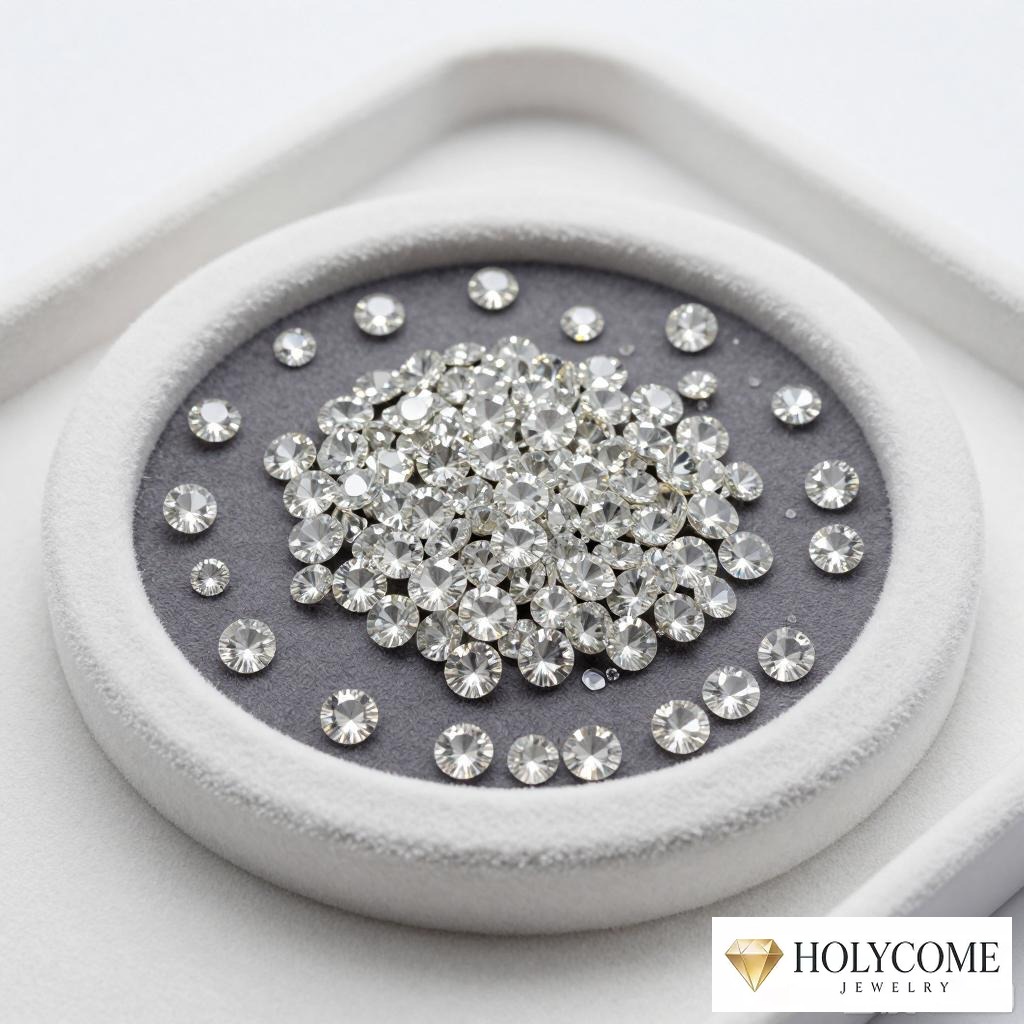
Not all moissanite is the same quality, and understanding the production chain helps explain why moissanite prices vary by 5–10x between suppliers. The moissanite supply chain has three main stages: boule growth, faceting and polishing, and finished jewelry manufacturing.
03Why B2B Jewelry Brands Are Adding Moissanite at Scale
We work with a 42-store retail chain based in Texas that added moissanite engagement rings in 2023. They started with 12 SKUs, projected $180,000 in first-year moissanite sales, and finished the year at $890,000. Three reasons explain that kind of adoption across the broader jewelry market.
Price point opens new markets. A 1ct D-VVS1 excellent-cut moissanite retails for $200–$600 in a 14k gold solitaire ring. The equivalent natural diamond ring retails for $3,500–$6,000. That price gap brings fine jewelry with real sparkle to customers who would never buy a diamond at those prices—millennials and Gen Z buyers, gift buyers, customers buying everyday pieces, and customers building multi-piece jewelry wardrobes.
Ethical and environmental preference. Modern customers—particularly the 25–40 age bracket that drives bridal and fine jewelry growth—increasingly ask about mining practices, traceability, and environmental impact. Lab-grown moissanite has a tiny environmental footprint compared to mined diamond, and it is conflict-free by construction. That matters at the point of sale, and it is a major reason brands report higher conversion rates on moissanite pages with ethical sourcing content.
Performance matches or exceeds diamond. Customers who buy moissanite expecting a CZ-like substitute are universally surprised at how it performs. Moissanite does not cloud, does not scratch in normal wear, and has more sparkle than diamond. The main tradeoff is that some observers who are very close (6–12 inches) can detect slightly more rainbow fire than a diamond shows, but in surveys we have run for our brands, over 70% of buyers say they prefer the extra fire.
04Moissanite Quality Grades: What B2B Buyers Must Specify
Moissanite quality is not standardized the way diamond grading is standardized by the GIA, which creates confusion for buyers comparing suppliers. Different brands use their own grading nomenclature, but the underlying properties are straightforward. When ordering wholesale moissanite from HOLYCOME or any other manufacturer, you should be specifying four parameters explicitly on every PO:
- Color: D-E-F colorless; G-H near-colorless; I-J tinted. D-E is our default for all bridal and fine jewelry. DEF (sometimes sold as "colorless" or "super white") blends D-E-F into one grade.
- Clarity: VVS1-VS1 (eye-clean, no inclusions visible to the naked eye); VS2-SI1 (minor inclusions visible under 10x, generally eye-clean); SI2+ (visible inclusions, budget grade). We recommend VVS-VS for all retail fine jewelry.
- Cut: Excellent (ideal proportions optimized for moissanite); Very Good; Good. Cut has more impact on visible sparkle than color or clarity, and it is where cheap suppliers cut corners most.
- Certification: Most moissanite sold wholesale includes a GRA (Gemological Research Association) or equivalent certificate stating color, clarity, cut, and measurements. GRA certification is standard for D-E VVS retail-grade moissanite.
Note that "forever one," "forever brilliant," and similar branded grades are proprietary names from specific moissanite brands (notably Charles & Colvard) and are not generic grades. When ordering unbranded wholesale moissanite from a factory like HOLYCOME, specify by D-E / VVS1 / Excellent rather than by proprietary grade names.
05Moissanite vs Diamond, CZ, and Lab Diamond: B2B Buying Guidance
Brands frequently ask whether to carry moissanite, mined diamond, lab-grown diamond, or CZ—and the answer is almost always "carry multiple price tiers for different customers." The FTC Jewelry Guides require that any gemstone sold be accurately represented, so disclosing moissanite as moissanite (not diamond) is mandatory, but customers who understand what they are buying choose moissanite enthusiastically.
CZ serves the fashion and costume jewelry tier ($10–$80 retail price points). Lab-grown diamond occupies the same tier as natural diamond for buyers who want diamond specifically at a lower price. Moissanite sits in the large and fast-growing middle tier between CZ and diamond: real fine jewelry, real sparkle, real durability, at accessible price points that attract customers who buy multiple pieces. That middle tier is where most jewelry brands see the highest growth in unit volume right now.
06Production, MOQ, and Wholesale Pricing at HOLYCOME
- Loose moissanite rounds (D-VVS1 Excellent cut): MOQ 50 stones per size; EXW pricing per carat varies by size: $20–$28/ct for smaller melee (0.8–2.5mm), $30–$45/ct for 3–5mm, $45–$75/ct for 6–9mm, larger sizes priced individually. Lead time 5–10 days for in-stock sizes, 20–30 days for custom cuts.
- Loose fancy shapes (ovals, cushions, pears, emeralds, marquise): MOQ 20 stones per size/shape; 15–25 day lead time; 15–30% price premium over rounds of equivalent weight.
- Melee-sized moissanite (0.8mm–2.5mm for pavé): MOQ 500 stones per size; 5–8 day lead time; $0.15–$1.20 per stone depending on size. Sorted to 0.02mm diameter and half-color-grade tolerances for pavé work.
- Finished moissanite solitaire rings (14k gold, 1ct D-VVS1 center): MOQ 30 pieces per design; $120–$180 EXW per piece; 18–25 day lead time.
- Finished moissanite stud earrings (14k gold, 1ctw D-VVS1): MOQ 20 pairs per size; $80–$130 EXW per pair; 12–20 day lead time.
- Private label / OEM: Custom designs produced to buyer specifications with buyer's branding and packaging; MOQ 50 pieces per SKU for casting, tooling fees $150–$400 depending on design complexity.
- Quality control: AQL 2.5 inspection standard on all wholesale orders, with 100% visual inspection and stone testing on all bridal-grade pieces. Our overall QC pass rate across loose stones and finished jewelry is 98.8%.
We are ISO 9001 certified, and all finished jewelry passes through ultrasonic cleaning, steam cleaning, and final inspection before packaging. We can produce to EXW, FOB, or DDP shipping terms depending on buyer preference, and we ship via FedEx, DHL, and UPS to all major markets.
07FAQ: What Is Moissanite - B2B Buyer Edition
Is moissanite a real gemstone or a diamond simulant?
Moissanite is a real gemstone with its own chemical composition (silicon carbide), crystal structure, and optical properties—not a fake diamond or diamond imitation in the sense of glass or CZ. It is legally and commercially sold as moissanite, which is what customers are buying when they choose moissanite jewelry. FTC guidelines require accurate disclosure, which we support and follow.
Will moissanite cloud, fade, or change color over time?
No. Silicon carbide is chemically inert—it does not react with oxygen, water, skin oils, perfumes, UV light, or common household chemicals. A moissanite stone will look identical after 50 years of wear to how it looked new. CZ clouds and scratches within 1–2 years of daily wear; moissanite does not. Dullness that appears on worn moissanite jewelry is always soap and oil buildup that washes off completely with warm soapy water and a soft brush.
Can a jeweler tell the difference between moissanite and diamond?
With the naked eye, no—even experienced jewelers cannot reliably distinguish well-cut D-color moissanite from colorless diamond at normal viewing distance. With a 10x loupe, some jewelers can spot the doubled facet junctions caused by moissanite's double refraction, though this requires training and careful examination. A thermal diamond tester will flag moissanite as non-diamond, which is why retailers who buy from mixed suppliers should test incoming stones.
Is GRA certification legitimate?
GRA (Gemological Research Association) certificates are standard in the moissanite industry and document color, clarity, cut, and measurements for each stone, similar to how GIA certificates document diamond grades. GRA is not GIA, and we are transparent about that difference with our buyers. GRA certificates provide consistent, documented grading for moissanite wholesale transactions and are accepted across the moissanite industry.
What is the warranty and return rate on moissanite?
Well-set moissanite in properly made settings has warranty return rates similar to diamond—under 2% over three years, almost entirely from setting issues rather than stone problems. The most common return reasons on moissanite jewelry are loose prongs, plating wear on white gold, and sizing issues—exactly the same failure modes as diamond jewelry. Our own data across 200,000+ moissanite pieces shipped shows a 1.9% defect/return rate, compared to an industry average of 3–5% for diamond and moissanite fine jewelry.
08Sourcing Moissanite from HOLYCOME
Understanding what moissanite is matters because sourcing it well—from a factory that controls color, cuts to moissanite-optimized angles, and stands behind QC—makes the difference between a moissanite line that builds your brand and one that generates returns. If you want to add moissanite to your catalog or scale an existing moissanite program, browse our loose moissanite inventory for current stock, explore moissanite rings and earrings for finished jewelry SKUs available for wholesale, or contact our OEM team to discuss private label production to your specifications.
Moissanite is no longer a niche or experimental category—it is a core fine jewelry tier that is reshaping price expectations for customers and opening large new markets for brands that source it well. The brands winning in this category are not the ones treating moissanite as a cheap diamond substitute; they are the ones selling moissanite for what it is—a beautiful, durable, high-sparkle gemstone at a price that lets more customers own fine jewelry than ever before.
09Frequently Asked Questions
Is moissanite a viable diamond alternative for retail?
Yes for price-sensitive buyers who want brilliance and hardness. It ranks 9.25 on the Mohs scale and costs a fraction of a natural diamond of the same size, so it turns fast in bridal and fashion lines.
What is the minimum order?
MOQ starts at 50 pieces per design for stock items; custom cuts and private-label settings start at 100 to 300 pieces.
Are certificates included?
Yes. Every parcel ships with GRA or IGI documentation listing carat weight, color grade and cut.
What are the lead times?
Samples 3 to 5 days. Bulk 15 to 20 days under 500 pieces, 25 to 30 days for custom work.