
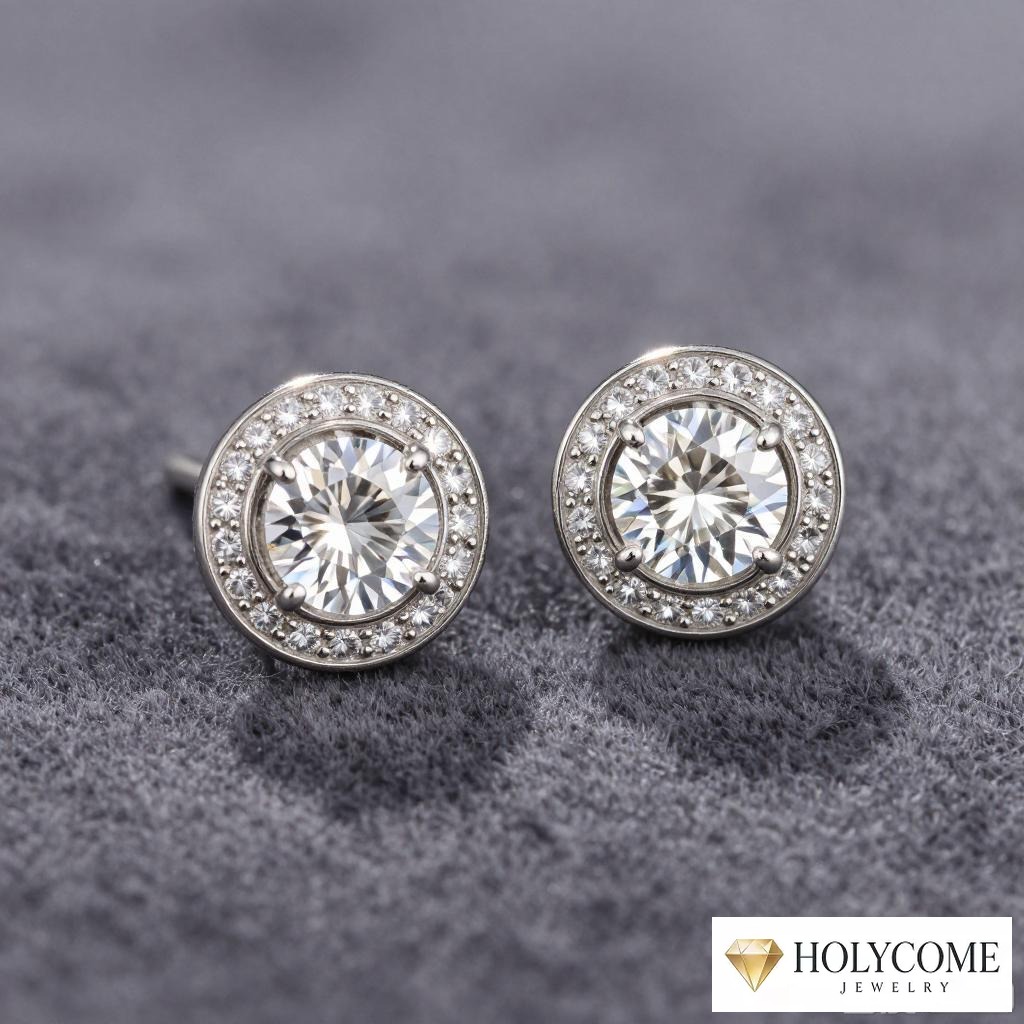
Halo moissanite stud earrings take the classic stud formula and amplify it: a center stone surrounded by a ring of smaller melee stones creates a frame that makes the center look larger, adds another layer of sparkle, and gives the earring a softer, more luminous look than a simple solitaire stud. Halo studs are the best-selling "upgrade" stud style—customers moving up from basic studs almost always consider halos, and halo studs are one of the top bridal earring choices across moissanite and diamond alike.
HOLYCOME produces halo moissanite studs in sizes from 4mm centers up to 9mm centers, in white, yellow, and rose gold, with multiple halo variations (single halo, double halo, cushion halo, oval halo, fancy shape halos). Halo studs represent about 11% of our earring unit volume but carry a higher average price point than plain studs because of the additional melee and labor. This guide covers halo stud design, size mathematics, halo variations, setting construction, production standards, and ordering specifications for brands building a halo stud line.
01Why Customers Choose Halo Studs
The central appeal of halo studs is size magnification. A ring of melee around the center stone adds approximately 2mm to the overall diameter of the earring face. A 5mm center (0.5ct single stone) with a single halo looks like a 7mm stone (≈1.2ct per ear, 2.4ct total for the pair) from normal viewing distance. That visual magnification means customers get the look of much larger stones for the cost of a smaller center plus a fraction of a carat of small melee.
That magnification is not just a trick of perception—it changes the character of the earring. Halo studs read softer, more luminous, and more ornate than solitaire studs. The halo adds a second layer of sparkle around the center, creating a cushion of light rather than a single sharp point of sparkle. That softer look works beautifully for bridal, for everyday wear where customers want noticeable sparkle without the boldness of a large single stone, and for customers who prefer a more traditional, romantic look than modern solitaire studs.
| Center Stone Size | Single Halo Outer Diameter | Visual Equivalent Solitaire | Total Stone Weight (pair) | Best For |
|---|---|---|---|---|
| 3.5mm | ~5.5mm | 5.5mm solitaire (0.65ct/ear) | ~0.6ctw | Second holes, small earlobes, conservative everyday |
| 4mm | ~6mm | 6mm solitaire (0.8ct/ear) | ~0.8ctw | Everyday wear, subtle sparkle, gifting |
| 5mm | ~7mm | 7mm solitaire (1.25ct/ear) | ~1.5ctw | Bridal sweet spot—best-selling halo size; looks substantial without being large |
| 6mm | ~8mm | 8mm solitaire (1.8ct/ear) | ~2.5ctw | Bridal, customers who want visible sparkle |
| 7mm | ~9mm | 9mm solitaire (2.5ct/ear) | ~4.0ctw | Statement bridal, evening wear, bold look |
| 8mm | ~10mm | 10mm solitaire (3.5ct/ear) | ~5.5ctw | Statement and red carpet; very noticeable |
The halo setting is not a new invention—it has roots in Victorian and Edwardian jewelry, where clusters of smaller stones were arranged around a central gem to maximize sparkle in candlelight eras before electric lighting. The modern halo as a bridal staple rose to massive popularity in engagement rings in the 2000s and 2010s, and the same visual logic migrated to earrings. As jewelry design references note, the halo setting's enduring appeal is that it maximizes perceived size and sparkle while maintaining a classic, elegant look that never goes out of style.
02Halo Design Variations
Single Halo
The classic halo: one continuous ring of melee around the center stone. Single halos add about 1mm of radius around the center, creating the classic magnification effect without looking overdone. This is the best-selling halo style for both earrings and rings, and it is the default recommendation for bridal and everyday halo studs. The standard single halo uses 1.0–1.3mm melee in a shared-prong or micro-pavé setting.
Double Halo
Two concentric rings of melee around the center, adding approximately 1.5–2mm of radius and substantially more total sparkle. Double halos make the center look dramatically larger—a 5mm center with a double halo can read as 8mm or more across the face. The look is bolder and more ornate than a single halo; it reads as more formal and more sparkly, and it is particularly popular with customers who want maximum size impact for their budget. Double halos are a stronger bridal and evening look than a single halo.
Cushion, Oval, and Fancy-Shape Halos
Halos do not have to be round. A round center can be surrounded by a cushion-shaped halo (soft square with rounded corners), creating a cushion-shaped face on the earring even though the center is round. Oval halos elongate the face of the stud slightly, creating a subtle vertical line. Fancy-shape centers (pear, cushion, oval, emerald, marquise) typically use halos that match the shape of the center, magnifying the fancy shape without changing its silhouette. Shape-matched halos are a premium category, popular with customers who want their studs to echo the shape of their engagement ring.
Floral and Decorative Halos
Decorative halos arrange the melee in a flower, scallop, or geometric pattern rather than a simple ring, creating a more decorative and vintage-inspired look. Floral halos are popular for romantic and vintage-themed bridal collections; geometric Art Deco halos appeal to customers who prefer less traditional designs. Decorative halos are lower volume than single round halos but carry strong design differentiation and are effective collection-expansion pieces.
Hidden Halo / Under-Halo
A "hidden halo" is a ring of melee set on the side of the center stone (between the girdle and the setting, visible from the side and angle views but not from straight-on), popular in engagement rings. For studs, hidden halos add a subtle extra sparkle that shows when the wearer turns their head, without changing the front-facing silhouette to the same degree as a full front halo. Hidden halos are a niche product for customers who want a surprise detail rather than an obvious halo look.
The classic halo: one continuous ring of melee around the center stone. Single halos add about 1mm of radius around the center, creating the classic magnification effect without looking overdone. This is the best-selling halo style for both earrings and rings, and it is the default recommendation for bridal and everyday halo studs. The standard single halo uses 1.0–1.3mm melee in a shared-prong or micro-pavé setting.
03Halo Setting Construction
Halo studs look simple from the front, but the setting is significantly more complex than a solitaire basket. The halo is a separate metal ring holding melee stones, soldered around the center stone head. Construction quality determines both durability and how clean and bright the halo looks.
Micro-Pavé Halo Technique
Our halos use micro-pavé setting, in which tiny melee stones are set into individually drilled seats in the halo ring, held by tiny beads of metal (prongs) pushed over each stone's edge. Micro-pavé creates a seamless, almost invisible-metal look where the halo appears to be a continuous ring of sparkle rather than a metal ring with stones on it. The alternative—cast-in or glued melee—looks cheap, stones fall out easily, and we never use it.
Melee Quality and Matching
Halo melee quality is critical because every stone in the halo is right next to every other stone; any color mismatch, size inconsistency, or cut difference is immediately visible. We use F-G color, VVS2-VS1 melee sorted to within half a color grade and 0.02mm diameter for all halo work, and we sort melee by fluorescence as well to ensure even sparkle in all lighting. Center stones are D-E color VVS1 to provide a bright center that matches (or slightly outperforms) the surrounding halo.
Halo-to-Center Gap
There should be no visible metal gap between the center stone and the halo melee—both should sit close enough that the sparkle appears continuous. Cheap halo settings leave a visible metal ring between the center and the halo, which breaks the sparkle continuity and looks like a design defect. Our halo settings are positioned so the halo melee sits within 0.2mm of the center stone's girdle, creating a continuous surface of sparkle from center to outer edge.
Backing and Post Construction
Halo studs are slightly heavier than solitaire studs because of the additional metal and stones, so we use larger jumbo friction backs for halo studs 7mm outer diameter and above, to distribute weight across the earlobe and prevent forward droop. Posts are lasered to the back of the halo head (not the center basket) for maximum strength, and we use 0.8mm posts as standard, with screw-back upgrades available for larger sizes.
04Halo Studs vs. Solitaire Studs: Sizing Guidance
A useful sizing rule for advising customers: if a customer wants a halo stud for everyday wear but doesn't want it to read as "big," go with a 4–4.5mm center with single halo (≈6mm outer diameter)—the same visual size as a 6mm solitaire, but with softer, more layered sparkle. If the customer wants a traditional "diamond stud" look with maximum sparkle for bridal, the 5mm center single halo (≈7mm outer) is the sweet spot. If the customer wants big, bold sparkle that competes with large diamond studs, 6–7mm centers with single or double halos deliver.
A common mistake customers make is ordering the same center size they would order in a solitaire stud and adding a halo, which results in a much larger-looking earring than expected. Always advise customers to subtract about 1.5–2mm from their target solitaire size when choosing a halo center to end up with the same visual size.
05Production Standards and Quality Control
Halo Symmetry
A halo must be perfectly concentric around the center stone, with melee spaced evenly around the full circle. A halo that is slightly off-center or has unevenly spaced melee looks lopsided from the front, even to non-expert viewers. Every halo stud is inspected from front viewing angle under 10x magnification to confirm concentricity and even stone spacing.
Stone Security
Each melee stone in the halo is individually set and push-tested with a fine probe to confirm tight seating before polishing. Halo settings hold up as well as pavé ring settings under normal wear, with stone loss rates under 0.7% over three years. Center stones are set in four or six prongs with the same standards as solitaire studs.
Finishing and Polish
Halo studs receive full three-stage polish with particular attention to the area between the center stone and the halo (which can trap polishing compound if not fully cleaned) and the back of the halo head (which contacts the earlobe). All studs are ultrasonically cleaned, steam cleaned, and rhodium plated (white gold) before pairing.
06Coordinating with Engagement Rings
Halo studs are the most popular earring choice for customers who own halo engagement rings, because the matching halo design creates visual coordination between ring and earrings without needing identical stones. Customers with solitaire engagement rings also choose halo studs to add sparkle at the ears without competing with a simple ring. For bridal collections, offering halo studs that match popular halo ring designs (same stone shape, same halo style) drives strong add-on sales.
07MOQ, Lead Times, and Wholesale Pricing
- In-stock single round halo studs: 5 pairs per size/metal MOQ; 12–18 days for silver, 15–25 days for 14k gold
- Double halo studs: 5 pairs per size/metal MOQ; 18–28 days for 14k gold
- Fancy-shape and cushion halo studs: 5 pairs per size/shape/metal MOQ; 20–30 days for gold
- Custom halo designs (brand signature): 20 pairs per size/metal MOQ; 30–45 days; tooling $250–$500
- Stone default: D-E VVS1 Excellent cut centers; F-G VVS2-VS1 melee
- Wholesale pricing (14k white gold single round halo, 5mm center / ~7mm outer): $130–$190 per pair in quantity
- Wholesale pricing (14k white gold double halo, 5mm center / ~8mm outer): $170–$250 per pair in quantity
- Wholesale pricing (14k white gold cushion halo, 5mm cushion center): $150–$220 per pair in quantity
- Wholesale pricing (sterling silver rhodium single halo, 5mm center): $32–$50 per pair in quantity
- QC pass rate: 98.0%—halo concentricity and even melee spacing drive the slightly higher reject rate compared to simple solitaire studs
08Building a Halo Stud Collection
Start with single round halos in 4mm, 5mm, and 6mm centers in white gold—that covers everyday, bridal, and statement sizes. Add a cushion halo option and a double halo option at the 5mm bridal size, and you have a strong core halo line. Merchandise halos prominently alongside solitaire studs so customers can see the visual size difference in person or in product images.
09FAQ: Halo Moissanite Studs
Do halo studs look bigger than solitaire studs of the same center size?
Yes, significantly. A 5mm center with a single halo reads visually as approximately a 7mm solitaire—about 1.5 sizes larger. A double halo makes a 5mm center read as closer to 8mm. That size magnification is the primary reason customers choose halos.
Do stones fall out of halos easily?
Properly micro-pavé-set halo studs hold stones as securely as pavé rings—stone loss rates are under 0.7% over three years of normal wear, comparable to any well-made pavé jewelry. Cheaply made halos with glue-set or poorly seated stones lose stones quickly, but our micro-pavé process seats each stone individually under magnification.
Are halo studs too fancy for everyday wear?
Not at all. Single halo studs in 4–5mm center sizes read as classic fine jewelry, appropriate for office, errands, school, and casual wear. They look like nice diamond studs, not "evening only" jewelry. Double halos and larger sizes (6mm+ centers) start reading as dressier and more formal, but a single 5mm halo is perfectly everyday-appropriate.
Can I get halo studs in yellow or rose gold?
Absolutely. White gold remains the most popular for bridal, but yellow and rose gold halos are growing fast, particularly in vintage-inspired and mixed-metal collections. Yellow gold halos have a warm, vintage look; rose gold halos are romantic and particularly popular for bridal and gifting.
Should I get screw backs or push backs for halo studs?
For 5mm+ centers in gold (retail $200+), we recommend screw backs for maximum security. Halo studs have more monetary and sentimental value than basic studs, and screw backs eliminate the risk of losing an earring to a loose push back. Smaller silver halos can use jumbo push backs comfortably.
10Sourcing Halo Moissanite Studs
Halo quality is all in the micro-pavé and concentricity: a slightly off-center halo or unevenly spaced melee undermines the sparkle continuity that makes halos beautiful. HOLYCOME halo studs are produced with precision-cut micro-pavé, color-matched melee, and strict concentricity inspection to ensure every halo sits perfectly around its center. Browse halo stud designs in our earrings catalog and pair them with halo engagement rings and halo pendants for coordinated halo collections.
Halo studs take the most timeless earring silhouette and make it bigger, softer, and more sparkly without adding dramatic cost—exactly the kind of value proposition moissanite excels at delivering. For customers who want diamond-stud presence at accessible prices, and for brides building coordinated sets with halo engagement rings, halo studs are an essential SKU.
11Frequently Asked Questions
Is moissanite a viable diamond alternative for retail?
Yes for price-sensitive buyers who want brilliance and hardness. It ranks 9.25 on the Mohs scale and costs a fraction of a natural diamond of the same size, so it turns fast in bridal and fashion lines.
What is the minimum order?
MOQ starts at 50 pieces per design for stock items; custom cuts and private-label settings start at 100 to 300 pieces.
Are certificates included?
Yes. Every parcel ships with GRA or IGI documentation listing carat weight, color grade and cut.
What are the lead times?
Samples 3 to 5 days. Bulk 15 to 20 days under 500 pieces, 25 to 30 days for custom work.