
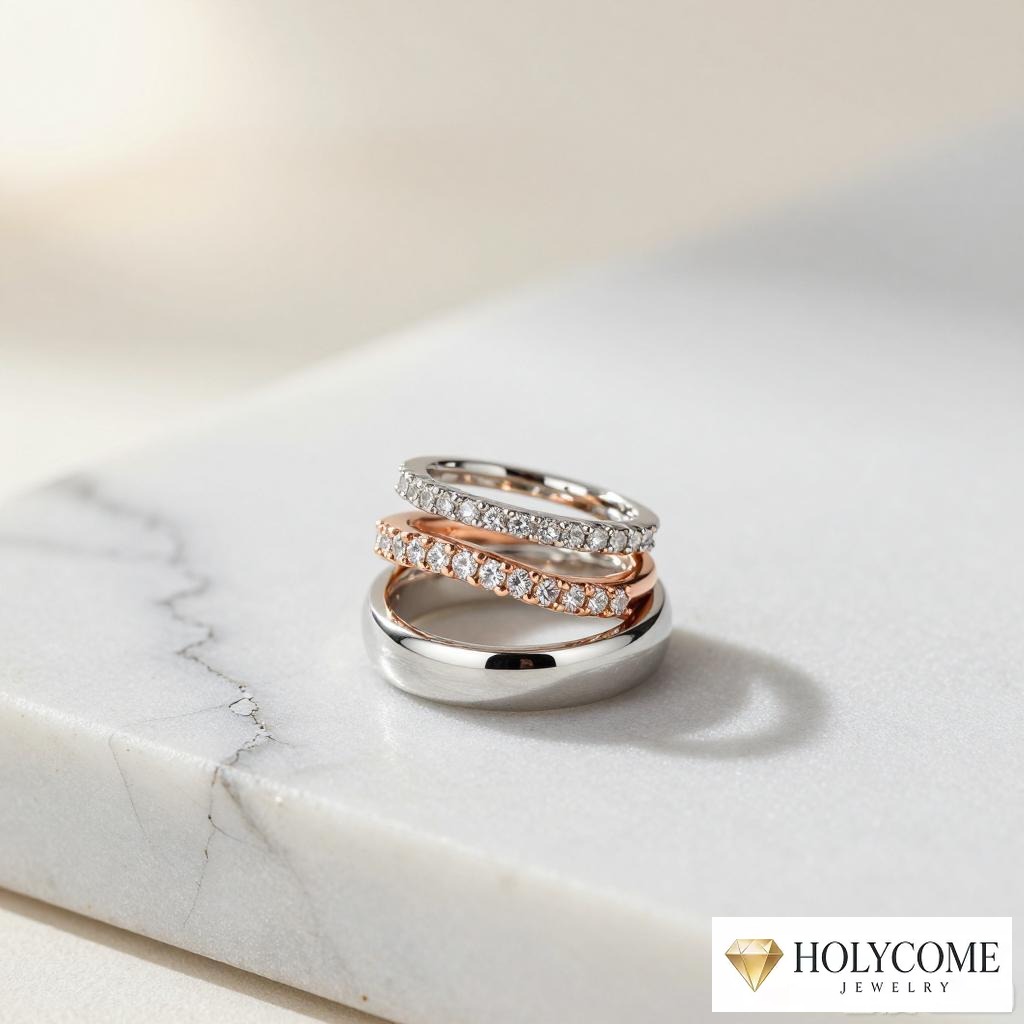
Stackable moissanite wedding bands have transformed bridal jewelry from a single ring purchase into a personal, evolving collection. The core idea is simple: thin, complementary bands designed to be worn together on the same finger, stacked with the engagement ring or worn alone, so customers can build their own combination over time to mark anniversaries, children, career milestones, or personal style changes. Moissanite's affordability makes stacking practical in a way diamond rarely is—customers can add one or two bands a year without the price tag of diamond stacking bands, and moissanite's consistent sparkle across melee and larger stones ensures every band in a stack matches in fire and brilliance.
HOLYCOME produces stackable moissanite bands for over 90 jewelry brands, and stackables are now our best-selling wedding band category, accounting for 65% of all band units shipped. This guide covers stackable band design principles, profile types, how to ensure bands sit flush together, stone layout options, production standards, and strategies for building a stackable band collection that drives repeat purchases.
01The Stackable Band Opportunity
Stackable bands change the economics of bridal jewelry. A traditional engagement ring plus one wedding band is a single purchase at the time of the wedding. Stackable bands invite ongoing purchasing: a first band for the wedding, a second band for the first anniversary, a third band for the birth of a first child, an eternity band for a tenth anniversary, and so on. Customers who buy into stacking become repeat buyers for years, often purchasing three to five bands over a decade. That repeat business is why every major bridal brand has invested heavily in stackable collections.
Moissanite is a uniquely strong fit for the stacking category for three reasons. First, low unit cost means customers can realistically buy multiple bands. A thin moissanite stacking band in sterling silver wholesales for under $30; in 14k gold, most are under $200 wholesale. Diamond stacking bands in equivalent designs wholesale for three to ten times more. Second, moissanite's sparkle consistency means a band bought today will match one bought three years from now in brilliance—something diamond cannot guarantee due to natural variation in cut and color. Third, moissanite's hardness (9.25 Mohs) stands up well to the constant metal-on-metal and stone-on-stone friction that occurs when bands are worn stacked next to each other every day.
| Band Type | Width | Stones | Stacking Role |
|---|---|---|---|
| Plain metal band | 1.5mm – 2.5mm | None; various finishes | Spacer, simple pairing with engagement ring; metal color accent |
| Half pavé band | 1.8mm – 2.5mm | Melee across the top 50–70% of shank | Everyday sparkly band that sits flush against most engagement rings |
| Full pavé / eternity | 1.8mm – 2.5mm | Melee all the way around the band | Maximum sparkle anniversary band; cannot be resized |
| Baguette / emerald band | 2.0mm – 3.0mm | Baguette or emerald cut stones channel or prong set | Art Deco and modern geometric look; contrasts with round melee |
| Contour / shadow band | 1.8mm – 2.5mm | Melee across curved top that wraps engagement ring head | Sits flush with engagement ring head that prevents straight bands |
| Notched band | 2.0mm – 2.5mm | Melee with a custom notch cut for engagement ring head | Perfect flush fit for high-head or cathedral engagement rings |
| Gemstone accent band | 2.0mm – 3.0mm | Alternating moissanite with colored gemstones (sapphire, ruby, emerald) | Birthstone and anniversary bands; adds color to white stacks |
The stackable band trend emerged in the early 2000s and grew to dominance in the 2010s, driven by celebrity bridal looks that featured multiple thin bands worn with engagement rings, and by brands that made stacking an explicit merchandising strategy rather than an afterthought. Contemporary bridal jewelry analyses consistently identify stackability as a core purchasing driver for millennial and Gen Z brides, who view their ring finger as a personal expression that evolves over time rather than a static symbol set at the wedding.
02Design Principles for Stackable Bands
Good stackable bands are designed from the beginning to stack well. A thin band that is simply a narrow version of a wide wedding band will not necessarily sit well, match other bands, or hold up to the friction of daily stacking.
Width and Profile
Stackable bands are thin by design—typically 1.5mm to 2.5mm wide. Anything wider than 2.5mm starts to look bulky when stacked with other bands, and it covers more finger real estate than customers want for a stack that will eventually include three to five bands. The most popular stackable widths are 1.8mm and 2.0mm—thin enough to stack comfortably, thick enough to maintain structural integrity and set melee securely.
Profile (the cross-sectional shape of the band) matters for how bands sit next to each other. Flat-bottom, straight-side profiles (called "knife edge" or "flat court" depending on top shape) stack tightly together with no gaps between bands. Rounded "half round" profiles sit nicely but can leave small visible gaps between bands with different profiles. For a cohesive stack collection, design all bands in a core stackable line to the same profile so they sit flush together.
Flush Fit and Contour Design
The biggest technical challenge in stackable bridal is getting bands to sit flush against the engagement ring. Most engagement ring heads extend below the shank, preventing a straight band from sliding all the way up to the ring—leaving an unsightly gap. There are two solutions:
- Contour bands (curved bands or "chevron" bands): The band has a gentle curve or V-shape at the top that wraps around the engagement ring head, allowing it to sit flush. Curved contours work with most standard heads; V-shaped chevron contours work with larger heads and cathedral settings.
- Notched bands: A precisely cut notch in the band accommodates the specific profile of the engagement ring head. Notched bands must be custom-matched to a specific engagement ring design for perfect fit—they are not universal like contour bands.
We recommend offering a universal curved contour band as a core SKU alongside straight bands, because it solves the fit issue for the majority of engagement ring designs without requiring custom work. For brands that sell engagement rings alongside bands, we produce perfectly matched notched bands that fit each engagement ring SKU exactly.
Stone Layout Patterns
Stackable bands use a variety of stone layouts that create different visual effects when stacked:
- Shared-prong melee: Small 1.0–1.5mm round melee, each stone sharing a prong with the next, creating a continuous line of sparkle. The classic, most popular stackable look.
- U-prong / bar-set: Stones separated by thin metal bars, creating a slightly more structured, modern look than shared-prong.
- Channel-set: Stones set into a groove in the band with no visible prongs; smooth, comfortable, and less prone to stone loss than shared-prong in thin bands.
- Bezel-set: Each stone surrounded by a thin metal rim; sleek, modern, and the most durable setting for thin bands—recommended for customers who wear their stacks during heavy activity.
- Alternating shapes: Alternating rounds and baguettes, or rounds and marquise accents, create visual interest and texture variation in a stack.
- Graduated sizes: Larger stones at the center (2.5–3.0mm) graduating to smaller stones (1.3–1.5mm) at the sides create a subtle focal point at the top of the finger.
Offering three to four different setting styles (shared-prong, channel, bezel, and one accent style like baguette or alternating) gives customers enough variety to build stacks with visual texture, without overcomplicating production.
Metal Color Mixing
Mixed-metal stacks are a major trend. Customers combine white gold, yellow gold, and rose gold bands in a single stack for a layered, personal look. Offering every stackable band design in all three metal colors allows customers to mix and match, and it increases the total SKU count of a collection without new design work. For an entry-level collection, start with the two most popular combinations (all-white, and mixed white-and-rose or white-and-yellow) and expand from there based on demand.
Good stackable bands are designed from the beginning to stack well. A thin band that is simply a narrow version of a wide wedding band will not necessarily sit well, match other bands, or hold up to the friction of daily stacking.
03Production Standards for Thin Stackable Bands
Thin bands are the hardest category to manufacture to high quality standards, because there is very little metal to work with and structural margins are tight. Defects common in cheaply made stackables include bent shanks, stones falling out from minimal prong material, and bands warping during soldering. HOLYCOME produces stackable bands to specific construction standards designed for long-term wear despite the thin profile.
Shank Construction
- Minimum thickness: All 1.8mm and 2.0mm stackable bands maintain 1.0mm minimum wall thickness on the sides and bottom, with 1.2mm thickness in pavé sections where stone seats remove material
- Hardening: Gold bands are age-hardened after casting and setting to increase tensile strength and reduce bending; silver bands are work-hardened through tumbling
- Eternity band construction: Full-eternity bands use precision-drilled seats with shared prongs or channel walls sized for thin-wall durability; they are manufactured to exact finger size (because they cannot be resized)
- Soldering points: Heads, prongs, and sizing joints are laser-welded in addition to soldering for maximum joint strength in thin sections
Melee Setting Standards
Setting melee in a 1.8mm thin band leaves minimal metal for prongs, and this is where cut corners show up most clearly. Our standard for thin-band melee setting:
- Stones are seated in drilled seats to at least 40% of the girdle depth—never surface-set with glue or shallow prongs
- Shared prongs are 0.3mm minimum thickness at the tip (thicker than the 0.2mm used in wider bands) to compensate for the reduced metal mass
- Every stone is burnished after setting and individually tested with a soft probe to confirm no movement
- Melee is matched to within half a color grade across each band, just like in halo settings
Melee loss rates on our stackable bands run under 0.5% per band over five years of wear, comparable to wider band construction despite the thinner profile.
Comfort and Wearability
Because stackable bands sit tightly next to other rings, interior comfort is critical. All our stackable bands use comfort-fit interiors (rounded inside edges) that slide easily over the knuckle and do not pinch against neighboring bands. Exterior edges are softened and polished to avoid sharp edges that cut into adjacent rings over time—this is important because sharp edges on cheap bands wear grooves into neighboring rings after months of constant friction.
04MOQ, Lead Times, and Wholesale Pricing
- In-stock stackable band designs: 10 pieces per size/style/metal MOQ (lower per-SKU MOQ because bands are simpler than rings with centers); 10–15 days for silver, 12–20 days for 14k gold
- Contour and custom-matched bands: 10 pieces per size MOQ; 15–22 days for gold; matched contour bands for specific engagement ring SKUs produced alongside engagement ring orders
- Custom band designs: 30 pieces per size/design MOQ; 25–40 days from CAD approval; tooling fees $150–$400
- Stone default: F–G color, VVS2–VS1 clarity melee (matching center stone color when sold as a matched set); 1.1–1.5mm melee sizes depending on band width
- Wholesale pricing (14k white gold 1.8mm shared-prong half-pavé stackable band): $80–$130 per piece in quantity depending on melee count
- Full eternity bands: $150–$240 wholesale for 14k gold; specify exact size at order (no resizing possible after production)
- Ring sizing: Offer US 3–10 in half sizes for women's stackables; wide 3–4 band stacks on one finger fit tighter than a single ring, so some customers size up half a size for stacks of three or more bands
- QC pass rate: 98.3%—the thin profile and small prongs create slightly higher reject rates than heavy rings; rejected pieces are reset or reworked before shipment
05Merchandising Stackables for Repeat Purchases
Stackable bands are a merchandising category as much as a product category. The brands that do best with stackables treat them as an ongoing purchase journey, not just a single product page.
- Sell stacks as complete looks: Show 3-band and 5-band stacks in product photography so customers can visualize the end result and understand how individual bands look together.
- Offer "start your stack" bundles: Engagement ring + one straight wedding band at a bundle price, with insert cards encouraging adding additional bands for anniversaries.
- Anniversary band marketing: Promote specific bands as "first anniversary," "five year," "push present," or "mother's ring" options with birthstone accents to drive gift purchases.
- Size consistency: Maintain consistent width and profile across all stackable SKUs in a collection, so customers know a new band purchased years later will stack cleanly with their existing set.
- Free virtual stacking: Offer online visualizers where customers can drag and drop bands to preview stack combinations.
06FAQ: Stackable Moissanite Wedding Bands
How many bands should go in a stack?
There is no fixed rule. Most customers start with two (engagement ring + one wedding band), add a third for a first anniversary or the birth of a child, and often build up to four or five bands over time. More than five bands on one finger starts to look crowded and can be uncomfortable for daily wear. Many customers also wear a single stackable band alone on days they leave their engagement ring at home.
Can you wear stackable bands every day without damaging them?
Yes. HOLYCOME stackable bands are built to handle daily wear, including the constant friction of stacked rings rubbing against each other. We recommend taking rings off for heavy lifting, weight training, and aggressive cleaning work, but normal daily wear—office work, washing hands, showering—does not damage well-made thin bands. Moissanite itself handles the friction easily at 9.25 Mohs.
Do I need a contour band if I have a high-head engagement ring?
For most engagement rings with a raised head, a straight band sits with a small gap that some customers do not mind and others dislike. Contour bands eliminate the gap by curving around the head. We offer both options and let customers choose based on their aesthetic preference—some customers prefer the look of a slight gap because it clearly separates the engagement ring from the band, others want a perfectly flush fit.
Can full eternity bands be resized?
No. Because stones are set all the way around the band, cutting and resizing an eternity band removes stones and breaks the setting pattern. Full eternity bands must be ordered in the exact correct finger size. Half-eternity and pavé bands (stones only across the top 50–70%) can usually be resized up or down by about one size without disturbing stones.
Will moissanite melee in stackable bands scratch or wear out from rubbing against other rings?
No. Moissanite is one of the hardest materials used in jewelry, and two moissanite stones rubbing against each other will not scratch each other in any meaningful timeframe—both are 9.25 Mohs, and neither can abrade the other under normal wear. Metal will wear minimally over decades (a few microns per year where bands rub), but the stones are unaffected. This is one of moissanite's biggest advantages over softer gemstones in stackable applications.
07Building Your Stackable Collection
A core stackable line that covers most customer preferences can be built with just five to seven SKUs: a plain polished band, a plain brushed band, a shared-prong half-pavé, a full eternity pavé, a bezel-set band, a channel-set baguette band, and a curved contour band. Offer each in white, yellow, and rose gold (or plated silver), in sizes 3–9 half sizes. That gives you a 21-SKU collection that covers the vast majority of stacking combinations customers want, without spreading inventory across dozens of niche designs.
Browse available stackable band designs in our moissanite rings catalog, including matched contour bands for all our in-stock engagement ring designs. For brands developing proprietary engagement ring designs, we produce perfectly matched notched bands alongside the rings—contact our custom manufacturing team for details. Stackable bands also pair beautifully with moissanite tennis bracelets and stud earrings for complete coordinated looks.
Stackable moissanite bands have turned bridal jewelry from a one-time purchase into an ongoing relationship between brand and customer, and moissanite's affordability, durability, and consistent sparkle make it the ideal material for building a stack over time. The difference between a throwaway thin band and one that holds up through years of stacking lies in the small construction details—wall thickness, hardening, prong strength, and edge finishing. Sourced from a manufacturer that treats thin-band durability as a non-negotiable quality standard, stackable moissanite bands become the product category that keeps customers coming back for years.
08Frequently Asked Questions
Is moissanite a viable diamond alternative for retail?
Yes for price-sensitive buyers who want brilliance and hardness. It ranks 9.25 on the Mohs scale and costs a fraction of a natural diamond of the same size, so it turns fast in bridal and fashion lines.
What is the minimum order?
MOQ starts at 50 pieces per design for stock items; custom cuts and private-label settings start at 100 to 300 pieces.
Are certificates included?
Yes. Every parcel ships with GRA or IGI documentation listing carat weight, color grade and cut.
What are the lead times?
Samples 3 to 5 days. Bulk 15 to 20 days under 500 pieces, 25 to 30 days for custom work.