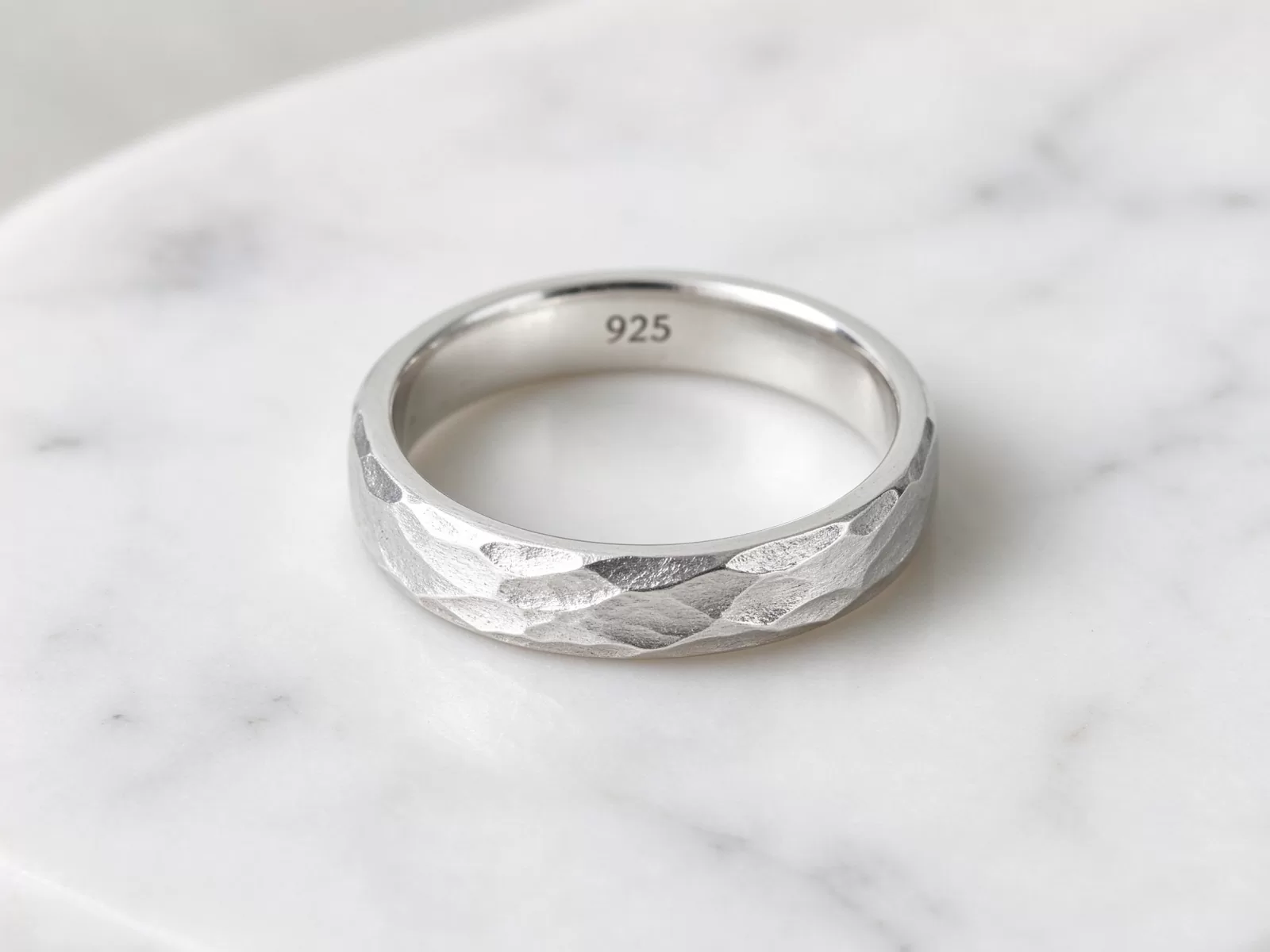
A customer picks up a silver ring, turns it in the light, and decides in about two seconds whether it feels cheap or premium. The judgment is almost never about the stone - it is about the finish. Scratched flat spots, leftover compound, half-matte bands, and a shoulder that catches on a cotton T-shirt all read as "cheap" even when the metal and stone are correct. This guide defines the finish standards we hold on a wholesale silver order so you can specify them too.
01The three finishes buyers order
Mirror polish (bright). The standard for solitaire and dress rings. Achieved by progressing from 220-grit sanding, through tripoli cutting compound, to rouge on a muslin buff. A true mirror finish reflects a clean, undistorted image; "orange peel" texture under light means the grit skipped a step. This is the default for most moissanite solitaires, and it pairs with the seat work described in post-cast stone setting.
Satin (matte). A soft, non-reflective finish made with a fiber brush or a glass-bead blast. Satin hides fine surface scratches and reads modern and minimal. The pitfall is inconsistency: satin must be applied in a single direction and uniform pressure, or the band shows swirls. We use satin on bands and men's pieces.
Brushed. A directional linear texture, coarser than satin. It is used on signet rings, cuff-style bracelets and contemporary bands. Brushing direction must match a reference sample; we lock the brush direction at sign-off.
02How the finish line works
Polishing starts after casting cleanup and stone setting. The bench uses progressively finer abrasives, never skipping a grit, because a coarse scratch hidden under a bright buff still shows after plating. After polishing, the piece goes to ultrasonic and steam cleaning to remove compound residue - leftover rouge in crevices is the number one reason a "polished" ring arrives looking dull. If rhodium plating is ordered, plating happens after polish; the rhodium coat is thin (a fraction of a micron) and will not hide a rough under-finish.
Polishing starts after casting cleanup and stone setting. The bench uses progressively finer abrasives, never skipping a grit, because a coarse scratch hidden under a bright buff still shows after plating. After polishing, the piece goes to ultrasonic and steam cleaning to remove compound residue - leftover rouge in crevices is the number one reason a "polished" ring arrives looking dull. If rhodium plating is ordered, plating happens after polish; the rhodium coat is thin (a fraction of a micron) and will not hide a rough under-finish.
03QC on finish
We QC every order against three checks: (1) lightbox inspection at 45 degrees for scratches and orange peel; (2) finger-run over prongs and shoulders for sharp edges; (3) a white-glove wipe for compound residue. Buyer sign-off samples are kept on file for the run. The fineness mark and stamping should be clean and legible - we follow FTC Jewelry Guides (16 CFR Part 23) labeling expectations and the alloy norm on sterling silver.
04What to specify on the PO
Write the finish name (mirror/satin/brushed), the direction of brush where relevant, and "no compound residue, no sharp edges" as a QC line. Attach a reference sample if you have one. These three lines eliminate the most common finish disputes. For how finish connects to anti-tarnish packaging, see factory packaging and anti-tarnish.
05Common finish defects we catch at QC
Three defects recur on silver orders. First, swirl marks on satin where the brush was held at an angle; we catch these at the lightbox. Second, prong tips left sharp, which we fix by burnishing to a round. Third, a "flat spot" on a band where the polisher pressed too hard, which shows as a dull oval on the shank. Each is a rework rather than a discard, but they slow the run. Writing the finish spec up front means the bench polishes it right the first time instead of reworking after QC. On a well-specified order, our rework rate sits under 2%.
We also separate pieces by finish at packing: a mirror ring and a satin ring tumbling together will scratch each other. Your order ships with pieces individually wrapped so the finish survives transit, and we recheck a random 10% after packing before the carton closes. For how that wrapping ties into anti-tarnish, read our packaging guide.
FAQ
What is the most durable silver finish?
Satin or brushed hides wear better than mirror. Mirror shows scratches fastest but reads the most premium for dress pieces.
Why does my silver arrive looking dull despite polish?
Usually leftover polishing compound in crevices after a rushed cleaning step. Ultrasonic and steam cleaning after buffing prevent this.
Does rhodium plating fix a poor polish?
No. Rhodium is thin; it mirrors the under-finish. A rough polish stays rough under rhodium.
Can you match my existing finish sample?
Yes. Send a reference piece; we match and lock the finish for the run and keep a sign-off sample on file.
Ordering polished silver jewelry at wholesale? Specify mirror, satin or brushed finish, attach a reference if you have one, and we will QC every unit against the sample. We also send a swatch pack with mirror, satin and brushed samples on the same band so you can see the difference in person. Check MOQs or request a finish-sample pack today.
06Frequently Asked Questions
How do I prevent sterling silver from tarnishing in storage?
Use anti-tarnish bags with a sulfur absorber, keep humidity under 60% and avoid paper wrapping. Rhodium plating adds a further barrier on high-turn SKUs.
Is rhodium plating worth the added cost?
Yes for display and gift lines. It resists tarnish for 12–18 months and keeps shelf pieces bright, which reduces markdowns.
What purity do you supply?
925 sterling silver, stamped and hallmarked. Fine silver (.999) is available for beads and bullion-style pieces.
What is the MOQ and lead time?
50 pieces per design, samples 3–5 days, bulk 15–20 days.