Pre-Shipment Jewelry Care: How a Moissanite Factory Readies Your Wholesale Order
When a wholesale buyer opens a carton of moissanite jewelry, the pieces should look as though they left the polishing room that morning. That level of presentation is not accidental. It is the result of a controlled pre-shipment care protocol that a responsible moissanite factory runs on every unit before packing. In this guide we walk through the exact finishing, cleaning, inspection and protective treatment steps our production floor performs, and explain why factory-level pre-shipment care matters more than the cleaning a retailer does after delivery.
Why Pre-Shipment Care Is a Manufacturing Stage, Not an Afterthought
In a small workshop, the owner might polish a ring, snap a photo and drop it in a padded bag. In an industrial moissanite facility, pre-shipment care is a documented station on the production line, with its own tools, checklists and sign-off. The reason is simple: once a carton leaves the factory floor, defects can no longer be corrected cheaply. A missed fingerprint on a rhodium-plated band becomes a customer return; a loose prong discovered after ocean freight becomes a warranty claim; residual polishing compound trapped under a pavé setting becomes a tarnish hotspot weeks later. By treating care as a production stage rather than a finishing gesture, the factory pushes defect rates down and protects the retailer's first-sale experience. Every piece that reaches export QC has already passed a final visual inspection under 10x magnification, a prong-tension check, and a dedicated cleaning cycle. This is the difference between a supplier that ships inventory and a manufacturer that ships confidence.
For humid or coastal markets we upgrade the entire finishing stack, not just the bag. Plating is built slightly heavier, desiccant is doubled, and the outer carton gets an additional vapour inhibitor. A supplier that quotes one finish for every destination is optimising for cost, not for the reality of the voyage your inventory will actually make.
Cleaning chemistry is matched to the metal, not to the gem. Moissanite tolerates almost anything, but rhodium over sterling silver is finicky, so every detergent we use on the line is neutral and residue-free. We never use household bleach, ammonia or abrasive powders, even in aggressive pre-plating strips, because residues are impossible to fully rinse from pav gaps.
Presentation is part of the product in wholesale. A piece that arrives in a crushed pouch with a tarnished spot does not get the price it deserves, no matter how good the stone is. Our finishing and packing team is measured partly on the condition pieces reach the retailer, which keeps the same care ethos alive from casting bench to carton seal.
We train the people who pack cartons the same way we train the people who set stones, because a packing error is just as costly as a setting error in the customer's eyes. Each piece is wrapped, checked against the packing list, and placed so it cannot move. The last person to touch a ring before it ships is as much a quality gate as the first. That discipline shows up in cartons that arrive complete, bright and undamaged, order after order.
Retail staff turnover means care habits drift, which is why we provide printed, posted guidance rather than relying on verbal handover. A laminated care poster behind the counter, refreshed with each order, keeps the wiping and storage habits consistent even when staff change. Good systems outlive individual people, and that is the principle behind every care procedure we hand to our partners.
We test new packaging materials the same way we test new plating: on accelerated samples. Before a new pouch or box goes into production, samples sit in controlled humidity and heat to confirm they protect the finish. Retailers never see a packaging trial, because the trials happen on our bench. This is why our shipping materials keep working as intended, season after season.
The Multi-Stage Cleaning Process Before Plating and Before Packing
Cleaning actually happens twice on our floor. The first wash is performed immediately after stone setting and before electroplating, because plating will seal any grease, polishing compound or fingerprint into the surface permanently. Parts go through a heated alkaline ultrasonic bath, a rinse, an electro-cleaning cycle that electrically strips surface films, and a deionized-water rinse. Only then do they enter the plating barrel or rack. The second clean happens after plating and final inspection, and it is gentler: a cool ultrasonic bath with a neutral jewelry detergent, followed by a steam blow-off and a wipe with a lint-free microfiber cloth. Moissanite itself is chemically stable and harder than almost any setting metal, so it tolerates these cycles well, but the plated silver and the glue used on tiny pavé stones cannot. That is why the post-plating wash uses lower heat and milder chemistry than the pre-plating wash. Retailers rarely see this two-stage process, but they feel it in the way their inventory stays bright for months on display.
The goal of all this care is simple: a customer who keeps the ring for ten years and still recommends the shop. Every wiping cloth, every anti-tarnish strip and every inspection station exists to support that long relationship. A factory cares about your customers because your repeat orders are built on their satisfaction. Care is not overhead; it is the machinery of loyalty.
When a retailer reports a finish problem, we treat it as data, not an annoyance. We trace the batch, review the photos, and adjust the process so the same issue does not recur. This closed loop means our care guidance gets more accurate over time, and our partners benefit from lessons learned on other accounts. A problem solved once improves every future shipment.
A production line never cleans jewellery once and walks away. Every workstation hands a semi-finished piece to the next with a clean cloth and a final wipe, because oil from one stage would be baked into the next by heat, plating or inspection lighting. This handoff discipline is invisible to buyers but it is why our pieces leave the floor free of the invisible smudges that appear under a magnifying glass two weeks later.
We also log every treatment lot. When a customer reports a finish issue months after delivery, we can trace which plating bath, which ultrasonic cycle and which packaging batch the unit ran through, rather than guessing. That traceability is what turns a one-off complaint into a permanent process improvement and keeps our defect rate falling quarter over quarter.
Bulk handling changes the risk equation. A single ring on a velvet pad gets individual attention; a thousand rings moving through trays and tumblers can scuff each other. Our trays are divided and lined, and we stage pieces so that sharp moissanite girdles never ride directly against a polished shank of the next unit. Small packaging choices remove most transit damage before it ever reaches a shipping carton.
Moissanite hardness is a gift and a hazard. At roughly 9.25 on the Mohs scale it resists scratches from daily wear, but that same hardness means its girdle will scratch the softer silver next to it in a shared tray. Our packing and display guidance always treats the stone as a sharp edge, not as a delicate gem, and this single principle prevents most cosmetic damage we see returns for.
How We Inspect Moissanite Brilliance and Stone Security Under Magnification
A finger rub and a glance are not enough. Our final inspectors work under illuminated 10x magnifiers with a cool white daylight-balanced lamp that reveals fire and inclusions the same way a store spotlight will. Each stone is checked for seat contact: the girdle must sit fully on its seat, with no rocking, and every prong must be burnished over the crown without a gap. We run a gentle prong-tension test with a wooden stick on loose stones because a stone that shifts by a tenth of a millimetre will snag in transit and back as a customer complaint. We also verify that no polishing compound has been forced into the culet or trapped between pavé stones, which would dull the spread of light. For paired items such as earring studs, we compare color and brilliance side by side so a customer never notices one stone looking noticeably cooler or greyer than its partner. This inspection is the reason factory-direct moissanite pieces reach the shelf without an immediate 'this looks off' return rate.
The retail counter is where factory care either holds or collapses. Skin acid, hand cream and perfume transfer within seconds of a try-on, and if staff return a ring straight to the pad without wiping it, that film sits under spotlight for weeks. A thirty-second wipe after every try-on is the cheapest longevity program a shop can run, and we train partner staff in exactly this habit.
We test finishes with accelerated ageing on every new plating recipe. Before we approve a bath for production, samples sit in a controlled humidity cabinet under UV to simulate months of display, and we measure when dulling first appears. Only a finish that passes this accelerated test goes into a customer order, which is why our plating outlasts samples chosen purely for a day-one photo.
Warranty data drives our care guidance. Every returned piece is examined to find whether the cause was manufacturing, transit or customer handling, and the findings feed the care cards we print for the next batch. Over time this loop means our instructions address the exact failures retailers actually see, rather than generic jewellery advice copied from the internet.
For humid or coastal markets we upgrade the entire finishing stack, not just the bag. Plating is built slightly heavier, desiccant is doubled, and the outer carton gets an additional vapour inhibitor. A supplier that quotes one finish for every destination is optimising for cost, not for the reality of the voyage your inventory will actually make.
Cleaning chemistry is matched to the metal, not to the gem. Moissanite tolerates almost anything, but rhodium over sterling silver is finicky, so every detergent we use on the line is neutral and residue-free. We never use household bleach, ammonia or abrasive powders, even in aggressive pre-plating strips, because residues are impossible to fully rinse from pav gaps.
Presentation is part of the product in wholesale. A piece that arrives in a crushed pouch with a tarnished spot does not get the price it deserves, no matter how good the stone is. Our finishing and packing team is measured partly on the condition pieces reach the retailer, which keeps the same care ethos alive from casting bench to carton seal.
Tarnish Prevention and Anti-Tarnish Treatment for Export Storage
Sterling silver tarnishes when exposed to sulphur in the air, and ocean freight accelerates it because cardboard, wool and even some packaging glues contain sulphur compounds. To protect pieces during the four to eight weeks a carton spends on the water, our factory applies a final anti-tarnish step. Each unit receives a microfiber pouch treated with an anti-tarnish shield, and we include silica gel plus a slow-release anti-tarnish strip inside the carton. We avoid sealing pieces in airtight plastic bags for long voyages because trapped moisture creates spotting; instead we use breathable treated paper that lets the piece breathe while neutralizing sulphur. The rhodium plating itself is the first line of defence, but plating is porous at a microscopic level, so the chemical shield matters. Retailers who receive our cartons often comment that the silver looks as bright on day 45 as it did on day one. That is not luck; it is packaging chemistry chosen by the production team.
We train the people who pack cartons the same way we train the people who set stones, because a packing error is just as costly as a setting error in the customer's eyes. Each piece is wrapped, checked against the packing list, and placed so it cannot move. The last person to touch a ring before it ships is as much a quality gate as the first. That discipline shows up in cartons that arrive complete, bright and undamaged, order after order.
Retail staff turnover means care habits drift, which is why we provide printed, posted guidance rather than relying on verbal handover. A laminated care poster behind the counter, refreshed with each order, keeps the wiping and storage habits consistent even when staff change. Good systems outlive individual people, and that is the principle behind every care procedure we hand to our partners.
We test new packaging materials the same way we test new plating: on accelerated samples. Before a new pouch or box goes into production, samples sit in controlled humidity and heat to confirm they protect the finish. Retailers never see a packaging trial, because the trials happen on our bench. This is why our shipping materials keep working as intended, season after season.
The goal of all this care is simple: a customer who keeps the ring for ten years and still recommends the shop. Every wiping cloth, every anti-tarnish strip and every inspection station exists to support that long relationship. A factory cares about your customers because your repeat orders are built on their satisfaction. Care is not overhead; it is the machinery of loyalty.
When a retailer reports a finish problem, we treat it as data, not an annoyance. We trace the batch, review the photos, and adjust the process so the same issue does not recur. This closed loop means our care guidance gets more accurate over time, and our partners benefit from lessons learned on other accounts. A problem solved once improves every future shipment.
A production line never cleans jewellery once and walks away. Every workstation hands a semi-finished piece to the next with a clean cloth and a final wipe, because oil from one stage would be baked into the next by heat, plating or inspection lighting. This handoff discipline is invisible to buyers but it is why our pieces leave the floor free of the invisible smudges that appear under a magnifying glass two weeks later.
What Retailers Should Do When the Carton Arrives: First Unboxing Care
Even the best factory packing cannot eliminate condensation after a long sea journey. The first thing a receiving retailer should do is open the outer carton in a dry room, not in a humid storeroom, and let the pieces acclimate for a few hours before display. Do not dump all the pouches into a shared tray immediately; moisture trapped between pieces can transfer. Unwrap each unit, inspect it under store lighting, and wipe any faint transit film with a dry or lightly dampened microfiber cloth before pricing. If a stone feels loose on arrival, photograph it and hold it aside rather than trying to bend the prong yourself, because the factory will replace or reset it under warranty. We provide a short care insert with each bulk order that mirrors this unboxing guidance, and we recommend retailers keep one on hand so their own staff handle deliveries the same way every time. Consistent receiving care extends the factory finish for months.
We also log every treatment lot. When a customer reports a finish issue months after delivery, we can trace which plating bath, which ultrasonic cycle and which packaging batch the unit ran through, rather than guessing. That traceability is what turns a one-off complaint into a permanent process improvement and keeps our defect rate falling quarter over quarter.
Bulk handling changes the risk equation. A single ring on a velvet pad gets individual attention; a thousand rings moving through trays and tumblers can scuff each other. Our trays are divided and lined, and we stage pieces so that sharp moissanite girdles never ride directly against a polished shank of the next unit. Small packaging choices remove most transit damage before it ever reaches a shipping carton.
Moissanite hardness is a gift and a hazard. At roughly 9.25 on the Mohs scale it resists scratches from daily wear, but that same hardness means its girdle will scratch the softer silver next to it in a shared tray. Our packing and display guidance always treats the stone as a sharp edge, not as a delicate gem, and this single principle prevents most cosmetic damage we see returns for.
The retail counter is where factory care either holds or collapses. Skin acid, hand cream and perfume transfer within seconds of a try-on, and if staff return a ring straight to the pad without wiping it, that film sits under spotlight for weeks. A thirty-second wipe after every try-on is the cheapest longevity program a shop can run, and we train partner staff in exactly this habit.
We test finishes with accelerated ageing on every new plating recipe. Before we approve a bath for production, samples sit in a controlled humidity cabinet under UV to simulate months of display, and we measure when dulling first appears. Only a finish that passes this accelerated test goes into a customer order, which is why our plating outlasts samples chosen purely for a day-one photo.
Warranty data drives our care guidance. Every returned piece is examined to find whether the cause was manufacturing, transit or customer handling, and the findings feed the care cards we print for the next batch. Over time this loop means our instructions address the exact failures retailers actually see, rather than generic jewellery advice copied from the internet.
Care Instructions We Bake Into OEM Packaging for Your Brand
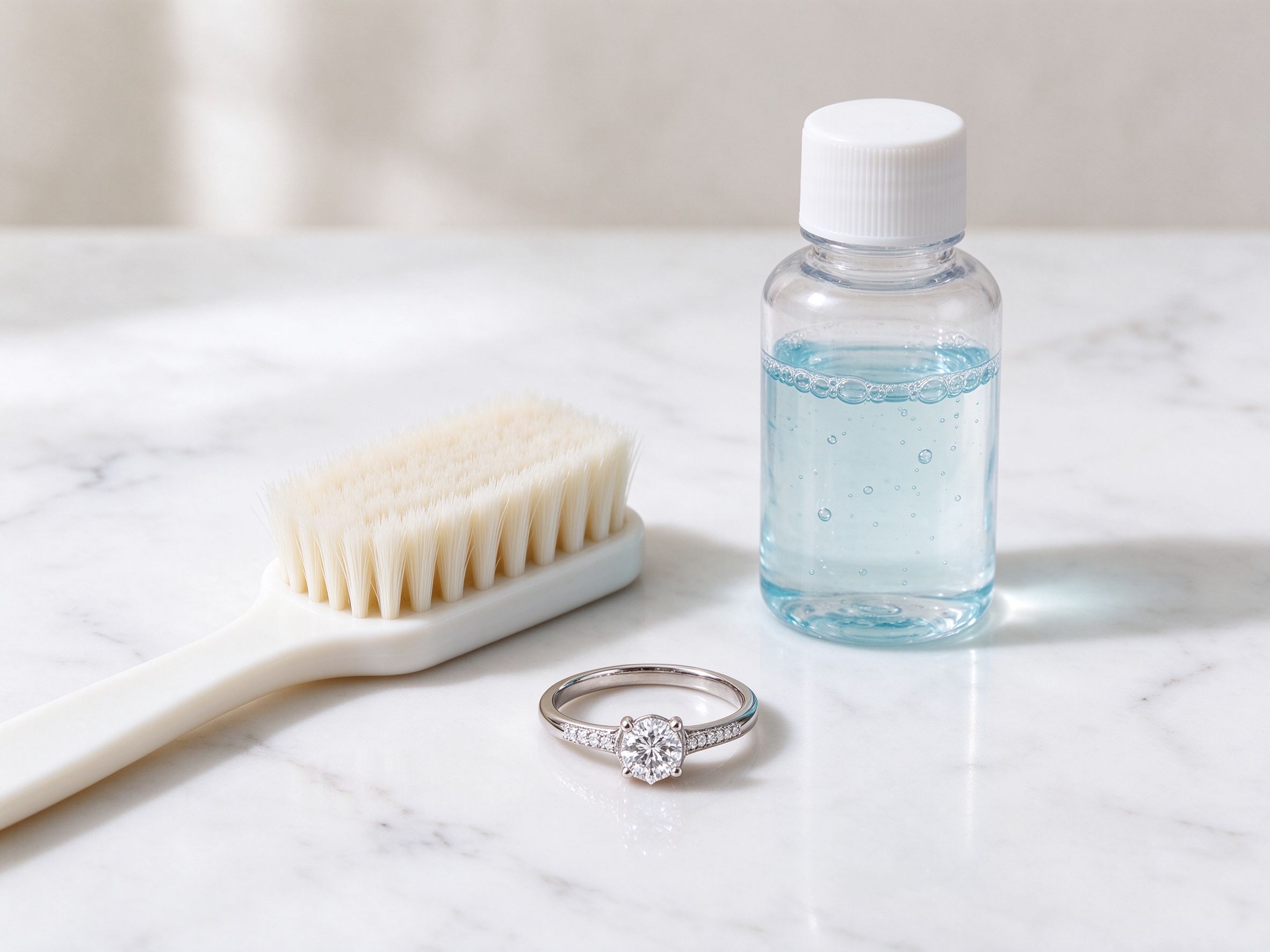
For private-label and OEM buyers, pre-shipment care is also a branding opportunity. We can print your care cards, stamp your pouches, and insert a folded guide that tells your customer how to look after the piece at home. The content is standardized around moissanite's strengths: it is hard, stable and unlikely to scratch, but the 925 silver and the rhodium finish need thoughtful handling. We advise customers to remove moissanite jewelry before swimming, hot-tubbing and heavy cleaning, to store pieces separately so diamonds or other harder items do not scratch the silver, and to avoid spraying perfume or hairspray directly onto plated surfaces. We do not recommend toothpaste, baking soda or chemical dips, because those can strip plating. Instead, a soft brush with warm soapy water is enough. Providing this card reduces warranty contacts by setting realistic expectations, and it turns a transaction into a branded moment.
For humid or coastal markets we upgrade the entire finishing stack, not just the bag. Plating is built slightly heavier, desiccant is doubled, and the outer carton gets an additional vapour inhibitor. A supplier that quotes one finish for every destination is optimising for cost, not for the reality of the voyage your inventory will actually make.
Cleaning chemistry is matched to the metal, not to the gem. Moissanite tolerates almost anything, but rhodium over sterling silver is finicky, so every detergent we use on the line is neutral and residue-free. We never use household bleach, ammonia or abrasive powders, even in aggressive pre-plating strips, because residues are impossible to fully rinse from pav gaps.
Presentation is part of the product in wholesale. A piece that arrives in a crushed pouch with a tarnished spot does not get the price it deserves, no matter how good the stone is. Our finishing and packing team is measured partly on the condition pieces reach the retailer, which keeps the same care ethos alive from casting bench to carton seal.
We train the people who pack cartons the same way we train the people who set stones, because a packing error is just as costly as a setting error in the customer's eyes. Each piece is wrapped, checked against the packing list, and placed so it cannot move. The last person to touch a ring before it ships is as much a quality gate as the first. That discipline shows up in cartons that arrive complete, bright and undamaged, order after order.
Retail staff turnover means care habits drift, which is why we provide printed, posted guidance rather than relying on verbal handover. A laminated care poster behind the counter, refreshed with each order, keeps the wiping and storage habits consistent even when staff change. Good systems outlive individual people, and that is the principle behind every care procedure we hand to our partners.
We test new packaging materials the same way we test new plating: on accelerated samples. Before a new pouch or box goes into production, samples sit in controlled humidity and heat to confirm they protect the finish. Retailers never see a packaging trial, because the trials happen on our bench. This is why our shipping materials keep working as intended, season after season.
Building a Care-Driven Quality System: SOPs, Checklists and Sign-Off
The reason a factory can promise consistent pre-shipment care at scale is that it runs on written standard operating procedures rather than on individual craftsmanship. Every station has a checklist: ultrasonic time and temperature, plating thickness measured by X-ray fluorescence, prong-tension pass rate, anti-tarnish strip count per carton, and final signature. Units that fail any check are routed back to the responsible workstation, not simply repacked. Over thousands of units a month, this disciplined loop is what keeps our defect rate low enough to offer the warranty terms wholesale buyers expect. For a retailer evaluating a supplier, asking to see the pre-shipment checklist is one of the fastest ways to tell a serious manufacturer from a reseller. The factory that can show you its care SOPs is the one whose inventory will arrive ready to sell.
The goal of all this care is simple: a customer who keeps the ring for ten years and still recommends the shop. Every wiping cloth, every anti-tarnish strip and every inspection station exists to support that long relationship. A factory cares about your customers because your repeat orders are built on their satisfaction. Care is not overhead; it is the machinery of loyalty.
When a retailer reports a finish problem, we treat it as data, not an annoyance. We trace the batch, review the photos, and adjust the process so the same issue does not recur. This closed loop means our care guidance gets more accurate over time, and our partners benefit from lessons learned on other accounts. A problem solved once improves every future shipment.
A production line never cleans jewellery once and walks away. Every workstation hands a semi-finished piece to the next with a clean cloth and a final wipe, because oil from one stage would be baked into the next by heat, plating or inspection lighting. This handoff discipline is invisible to buyers but it is why our pieces leave the floor free of the invisible smudges that appear under a magnifying glass two weeks later.
We also log every treatment lot. When a customer reports a finish issue months after delivery, we can trace which plating bath, which ultrasonic cycle and which packaging batch the unit ran through, rather than guessing. That traceability is what turns a one-off complaint into a permanent process improvement and keeps our defect rate falling quarter over quarter.
Bulk handling changes the risk equation. A single ring on a velvet pad gets individual attention; a thousand rings moving through trays and tumblers can scuff each other. Our trays are divided and lined, and we stage pieces so that sharp moissanite girdles never ride directly against a polished shank of the next unit. Small packaging choices remove most transit damage before it ever reaches a shipping carton.
Moissanite hardness is a gift and a hazard. At roughly 9.25 on the Mohs scale it resists scratches from daily wear, but that same hardness means its girdle will scratch the softer silver next to it in a shared tray. Our packing and display guidance always treats the stone as a sharp edge, not as a delicate gem, and this single principle prevents most cosmetic damage we see returns for.
Frequently Asked Questions
How should I clean moissanite jewelry when it arrives?
Use warm water, a drop of mild dish soap and a soft brush, then rinse and pat dry with a lint-free cloth. Avoid toothpaste, baking soda and ultrasonic cleaners at home, since these can dull the rhodium plating on the 925 silver setting even though the moissanite itself is unaffected.
Will my moissanite order tarnish during shipping?
Rarely, when a factory applies anti-tarnish packaging. Breathable treated paper, silica gel and a slow-release anti-tarnish strip protect silver during ocean freight. If a piece does look dull on arrival, it is usually light transit film rather than tarnish, and it wipes off easily.
Can I send pieces back if a stone is loose when they arrive?
Yes. Photograph the piece and keep it aside; do not bend prongs yourself. A responsible factory resets or replaces stones under warranty because loose prongs should have been caught at final inspection.
Is moissanite damaged by ultrasonic cleaning?
The moissanite gemstone itself is stable and safe in ultrasonics, but factory post-plating washes use milder cycles because plated silver and pavé adhesives can be affected. For retail aftercare, hand washing is the safest default.
Can you include our branded care cards and pouches?
Absolutely. OEM buyers can supply their own artwork or use our template. We print care cards, brand pouches and insert guides in the same run as the production order so packaging arrives coordinated with the jewelry.
Conclusion
Pre-shipment care is where factory quality becomes customer loyalty. The cleaning, magnified inspection, anti-tarnish packaging and written SOPs that happen before a carton leaves our floor are the reason wholesale moissanite inventory stays bright, secure and saleable from the first unboxing through months of display. When you choose a manufacturer rather than a reseller, you are choosing that disciplined care system for your own brand.