
Oval cut moissanite rings have become the breakout bridal style of the 2020s, and demand shows no sign of slowing. The elongated silhouette creates the most flattering finger-lengthening effect of any popular shape, delivers larger face-up spread than an equivalent carat weight round, and pairs beautifully with every major setting style from simple solitaires to elaborate halos. Combined with moissanite's signature fire and affordable price point, oval moissanite rings have claimed a 22% share of our bridal ring production—second only to round—and they are the fastest-growing shape across every market we supply.
At HOLYCOME, we cut oval moissanite to multiple length-to-width ratios, calibrate to tight tolerances for consistent setting, and produce finished oval rings in every major setting style across silver, gold, and platinum. This guide covers what makes oval moissanite special, how length-to-width ratio changes the look, setting recommendations, quality factors, and production specifications for brands building an oval moissanite ring line.
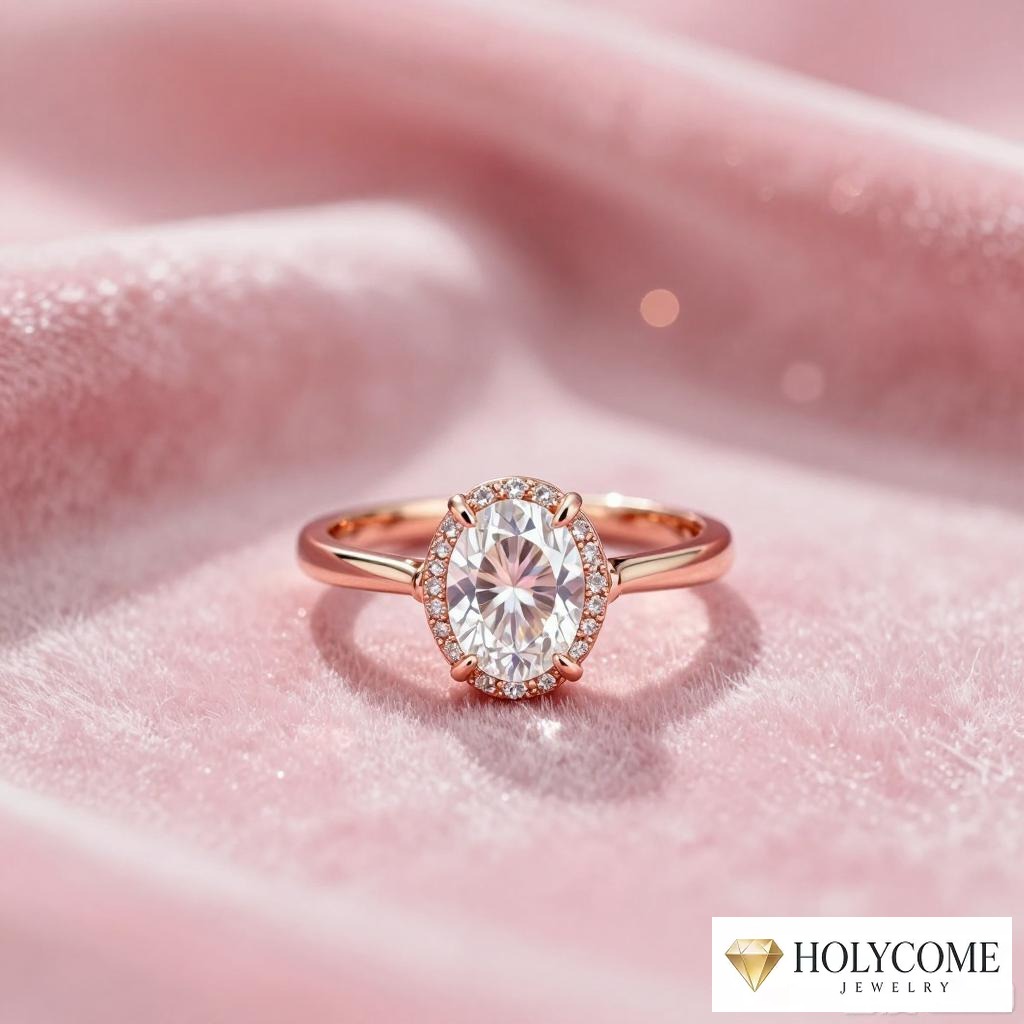
01Why Oval Moissanite Has Become So Popular
Oval cuts offer three concrete advantages that explain their rapid rise. First, the elongated shape makes the wearer's finger look longer and slimmer—a universally flattering effect that explains why oval has been the top celebrity engagement ring shape for over a decade. Round stones sit on the finger as a circle; ovals draw the eye vertically and create a visual line that flatters every hand size and finger length. Second, ovals face up larger than rounds of the same carat weight: an 8×6mm oval (1.5ct equivalent) covers roughly the same finger surface as a 7mm round, and a 10×7mm oval (2.5ct) covers more finger than an 8mm round while weighing less material. Customers get more visible stone per dollar. Third, ovals offer something visually different from the classic round solitaire without feeling like a dramatic departure—they read as timeless and elegant, not trendy or niche.
For moissanite specifically, the oval cut also showcases the material's fire exceptionally well. The elongated facet pattern along the stone's belly produces long, sweeping flashes of colored light that are distinct from the more scattered sparkle of rounds. Many customers describe oval moissanite as having more "personality" than round, with sparkle that moves and changes as the hand rotates.
| Length-Width Ratio | Visual Character | Best For | Market Share |
|---|---|---|---|
| 1.30 – 1.35 | Soft oval closer to round; classic, balanced | Traditional customers, halo settings | ~15% |
| 1.35 – 1.45 | The classic oval ratio—most popular; well-balanced elongation | All setting styles, core bridal collections | ~55% |
| 1.45 – 1.55 | Noticeably elongated; modern, slender look | Solitaires, east-west settings, thin bands | ~22% |
| 1.55 – 1.70 | Very elongated; bold fashion-forward look | Statement pieces, contemporary designs | ~8% |
The oval brilliant cut was invented by diamond cutter Lazare Kaplan in the late 1950s as a modification of the round brilliant that retained sparkle in an elongated shape. GIA's research on oval cuts notes that well-cut ovals approach rounds in light performance while adding the elongated shape advantage—principles that apply directly to moissanite, where our precision-cut ovals are faceted with modified pavilion angles optimized for moissanite's higher refractive index.
02The Bowtie Effect and Cut Quality
The most discussed cut quality issue with ovals is the bowtie—a dark, bowtie-shaped area across the center of the stone caused by light leakage through the pavilion when the oval's facet angles are not optimized. Every oval has some bowtie; the question is how pronounced it is. A faint, barely visible bowtie that appears only at certain angles is normal and acceptable even in high-quality stones. A dark, obvious bowtie visible from most angles is a cut quality defect that makes the stone look dead in the center and should be rejected.
Bowtie severity depends primarily on the pavilion angle pattern and the length-to-width ratio. Very elongated ovals (ratios above 1.55) are harder to cut without a pronounced bowtie, which is why premium-cut ovals above 1.5 ratio command a price premium. HOLYCOME grades oval moissanite on a bowtie scale of 1–5 (1 = no visible bowtie, 5 = severe dark bowtie) and rejects all stones graded 4 and 5; our standard production stock is grade 2–3 (faint to slight bowtie visible only at extreme angles), with grade 1 "no bowtie" premium cuts available for high-end collections.
Facet Patterns for Oval Moissanite
Oval moissanite is cut in two primary facet patterns:
- Standard brilliant oval (4/4 pavilion): The most common pattern, with four main pavilion facets on each side and kite-shaped crown facets. Delivers excellent sparkle with a classic oval look; the backbone of our oval production.
- Crushed ice oval: Uses a higher number of smaller facets arranged in a pattern that breaks light into more, smaller flashes—creating the "crushed ice" sparkle look popular in modern moissanite. Hides bowtie better than standard brilliants, but some customers find the smaller flashes less fiery. We offer crushed ice ovals as an alternative cut for brands serving that aesthetic.
We do not recommend offering both cuts without clearly distinguishing them in product descriptions, because customers who expect classic big-flash sparkle can be disappointed by the different look of crushed ice, and vice versa.
The most discussed cut quality issue with ovals is the bowtie—a dark, bowtie-shaped area across the center of the stone caused by light leakage through the pavilion when the oval's facet angles are not optimized. Every oval has some bowtie; the question is how pronounced it is. A faint, barely visible bowtie that appears only at certain angles is normal and acceptable even in high-quality stones. A dark, obvious bowtie visible from most angles is a cut quality defect that makes the stone look dead in the center and should be rejected.
03Setting Styles for Oval Moissanite Rings
Ovals work beautifully in almost every setting style, but each option creates a different look and has practical considerations.
Prong Count and Orientation
Ovals are typically set with 4 prongs (two at the ends of the long axis, two on the sides) or 6 prongs (two on each end, two on each side). Four prongs show more of the stone's outline and are the standard for most solitaire settings. Six prongs add security for large ovals (9×7mm / 2.5ct and above) and create a more traditional look. The prongs at the pointed ends must be carefully positioned to cover the tips without crushing them—ovals have slightly vulnerable tips that can chip if prongs are pressed too hard during setting, which is why experienced setters use rounded-tip prongs with adequate seat depth.
Most ovals are set north-south (long axis running up and down the finger). East-west setting (long axis running across the finger) is a growing contemporary trend that makes the ring look wider and more modern, and it pairs particularly well with solitaires and bezel settings. We recommend offering one east-west oval SKU in modern collections—it stands out in photography and attracts customers looking for something different from the standard vertical orientation.
Halo Settings with Oval Centers
Oval halos are our second-best-selling halo style after round halos. The elongated halo shape mirrors the oval center and creates a dramatic spread that makes a 1.5ct oval look closer to 3ct on the finger. The key design detail with oval halos is using an oval halo frame (not a round halo around an oval center, which looks mismatched and amateurish). Melee in an oval halo must be carefully spaced around the elongated curve, with slightly smaller stones at the curved ends to maintain even visual weight. A poorly designed oval halo looks lopsided or pinched at the ends; we CAD-model every halo to match the center dimensions before production.
Three-Stone and Side Stone Settings
Ovals pair beautifully with half-moon, tapered baguette, or smaller oval side stones. A classic three-stone design with an oval center and two half-moon sides is one of our top-selling oval designs—it reads as substantial and elegant without the melee density of a full halo. For brides who want symbolism, the three stones represent past, present, and future, making three-stone ovals a popular anniversary ring option as well as engagement rings.
Bezel and Semi-Bezel Settings
Bezel settings (where a thin metal rim surrounds the entire stone edge) create a clean modern look with ovals and provide maximum protection to the stone tips—making them a great choice for customers with active lifestyles who worry about knocking prongs. Full bezel ovals have a sleek, contemporary feel; half bezels (metal rims only on the long sides or tips) leave more stone exposed while still protecting the vulnerable ends. Bezel settings reduce light entry from the sides slightly, but with moissanite's high refractive index the effect on sparkle is minimal.
04Production Specifications and Quality Standards
Calibration and Tolerances
Ovals require tighter calibration than rounds for proper setting, because an oval that is 0.1mm off in length or width will not seat correctly in a precision head. HOLYCOME calibrates oval moissanite to ±0.03mm on both length and width for production orders, tighter than our ±0.05mm tolerance for rounds. Length-width ratio is held to within ±0.02 of the specified ratio to ensure consistent visual proportion across every stone in a production batch.
Color Recommendations
Ovals show body color slightly more visibly than rounds of the same grade because of their longer light path through the stone. For white gold and platinum settings, we recommend D-E color ovals to ensure the stone looks completely colorless across its entire length. For yellow and rose gold, F-G color is sufficient, as the warm metal reflects through the stone and masks faint body color just as it does with rounds. Very elongated ovals (ratio 1.5+) show slightly more color than shorter ovals; stick to D-E for those in white metal regardless of brand positioning.
MOQ, Lead Times, and Wholesale Pricing
- Loose oval moissanite (in-stock ratios): 10 pieces per size/ratio MOQ; 7–10 day lead time for sizes 5×3mm through 12×8mm
- In-stock finished oval ring designs: 5 pieces per SKU MOQ; 15–20 days for silver, 18–25 days for 14k/18k gold
- Custom oval ring designs: 30 pieces per SKU MOQ; 35–50 days from CAD approval; tooling fees $300–$700
- Stone default: D color, VVS1 clarity, Excellent cut, 1.40 ratio (classic oval), slight bowtie only
- No-bowtie premium cut upgrade: +15–25% stone cost, available in 1.35–1.50 ratios
- Wholesale pricing (14k white gold oval solitaire, 8×6mm / 1.5ct D-VVS1): $210–$280 per piece in quantity depending on band width and head style
- QC pass rate: 98.9% for finished oval rings; primary reject reasons are off-ratio stones, visible bowtie beyond specification, and prong coverage issues
05FAQ: Oval Moissanite Rings
What length-to-width ratio is best for an oval moissanite?
The 1.35–1.45 ratio range is the classic, best-selling oval look—long enough to create the flattering elongated effect, but not so long that the stone looks like a marquise. That is our default ratio for in-stock pieces. Customers who prefer a more slender, modern look tend to prefer 1.45–1.55; anything above 1.5 is a pronounced elongated oval that reads as a fashion choice rather than a classic oval.
Does an oval moissanite look bigger than a round of the same carat weight?
Yes. Because of the elongated shape, an oval faces up roughly 10% larger in surface area than a round of the same millimeter width, and because customers size ovals by length (8×6mm, 9×7mm, etc.), the spread advantage becomes even more pronounced. A 9×7mm (approx 2ct equivalent) oval covers noticeably more finger than a 7mm (1ct) round, and approaches an 8mm (2ct) round in visual coverage.
Are oval moissanite more prone to chipping than rounds?
The pointed ends of an oval are slightly more vulnerable than a round's continuous curve, but in a well-made prong setting where the tips are fully covered and protected, chipping is extremely rare. Moissanite's 9.25 Mohs hardness is more than sufficient for daily wear, and our setting quality data shows chip rates for ovals are less than 0.1% over five years—no different from rounds in practice. Bezel settings provide even more tip protection.
Can oval moissanite be resized easily?
Simple solitaire oval rings resize exactly the same as round solitaire rings—about one size up or down with no issues. Oval halos and pavé band ovals have the same resizing limitations as any pavé ring: resizing over 1.5 sizes risks disturbing melee stones. We recommend made-to-size production for oval halo pieces to avoid post-sale resizing complications.
Do oval moissanite have more or less sparkle than rounds?
Well-cut oval moissanite delivers total light return very close to round brilliants—the difference is in the character of the sparkle. Rounds produce smaller, more uniformly distributed flashes; ovals produce longer, broader flashes that sweep across the stone as it moves. Customers who prefer bold, dynamic sparkle often prefer ovals; customers who want the most consistent, evenly distributed brilliance tend to choose rounds. Both styles are brilliant cuts with strong sparkle.
06Sourcing Oval Moissanite Rings
Ovals are a shape where cut quality separates premium pieces from commodity product. The bowtie effect, ratio consistency, and tip protection during setting all require tight production standards that budget suppliers often cut corners on. HOLYCOME cuts and calibrates our own oval moissanite in our facility, holding ratio to tight tolerances and grading every stone for bowtie severity before it enters the setting queue. Browse available oval designs in our rings catalog, or contact us for custom oval design development. Coordinate oval engagement rings with matching oval pendants and oval stud earrings for complete collections.
Oval moissanite rings give customers the flattering, elongated look that has made ovals a bridal favorite, with the fiery sparkle and exceptional value that only moissanite provides. The shape works across every setting style, flatters every hand, and offers visual size that outperforms rounds on a per-carat basis. For brands building a moissanite bridal line, ovals are not an optional add-on—they are a core SKU that belongs in every collection alongside rounds and cushions, sourced from a manufacturer that understands ratio consistency, bowtie control, and the specialized setting techniques that oval stones require.
07Frequently Asked Questions
Is moissanite a viable diamond alternative for retail?
Yes for price-sensitive buyers who want brilliance and hardness. It ranks 9.25 on the Mohs scale and costs a fraction of a natural diamond of the same size, so it turns fast in bridal and fashion lines.
What is the minimum order?
MOQ starts at 50 pieces per design for stock items; custom cuts and private-label settings start at 100 to 300 pieces.
Are certificates included?
Yes. Every parcel ships with GRA or IGI documentation listing carat weight, color grade and cut.
What are the lead times?
Samples 3 to 5 days. Bulk 15 to 20 days under 500 pieces, 25 to 30 days for custom work.