
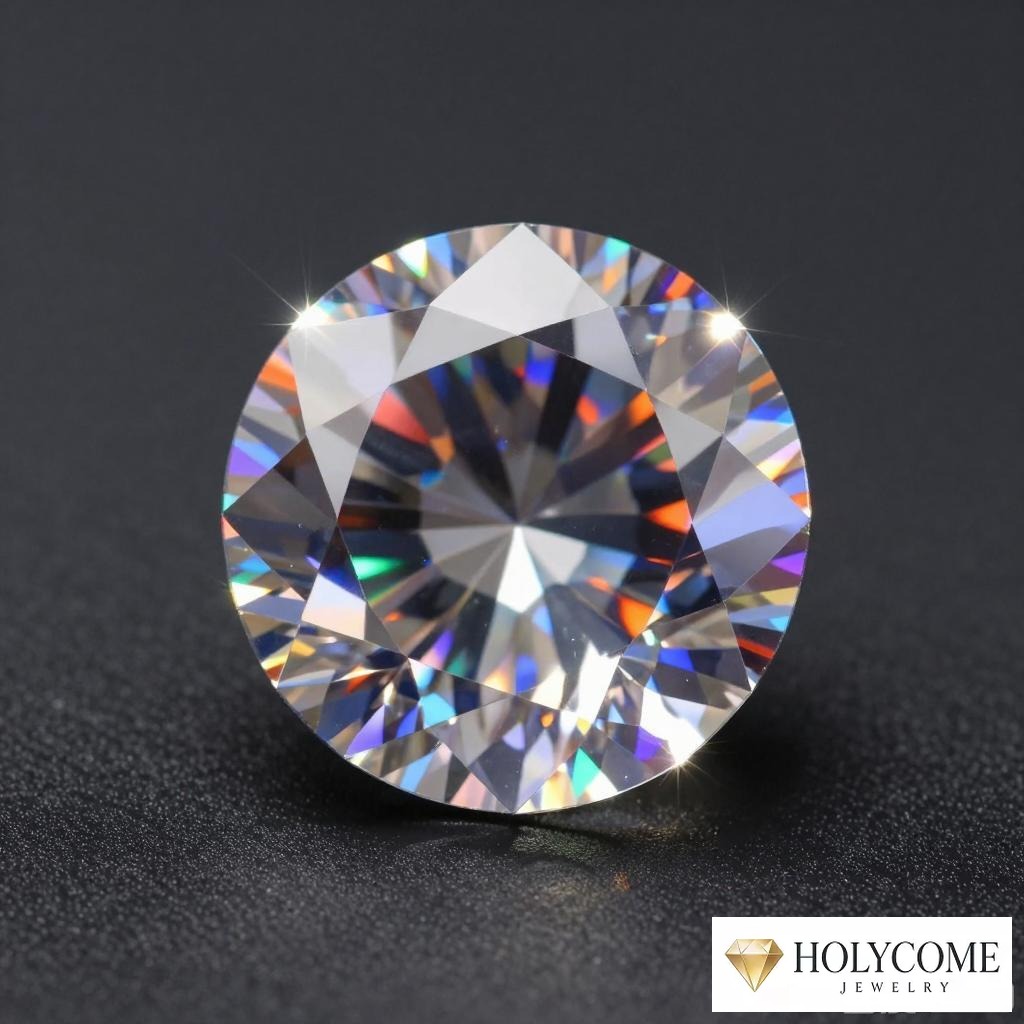
Anyone who has seen a moissanite in direct sunlight notices it immediately: the stone throws off rainbow flashes that pull eyes from across a room. Moissanite fire and brilliance are the material's most talked-about optical properties, and the reason more bridal and fashion brands are building entire collections around it. But fire and brilliance are not the same thing, and the difference matters for jewelers who need to explain the stone to customers or specify the right cut quality for a target price point.
At HOLYCOME, we cut moissanite in a 14,000-square-foot dedicated cutting facility in Wuzhou, where our master cutters tune every facet angle to maximize the light return for silicon carbide's specific refractive index. The numbers behind moissanite fire are not marketing fluff—they are measurable optical properties that create a look distinct from diamond, cubic zirconia, and every other common gem.
01Optical Properties That Create Moissanite Fire
Brilliance is white light reflected back to the viewer's eye. Fire (also called dispersion) is the splitting of white light into its spectral colors as it passes through the gem, creating those rainbow flashes people associate with fine stones. Moissanite outperforms diamond in fire by a significant margin, and the refractive properties behind that difference are easy to see under direct comparison.
| Optical Property | Moissanite | Diamond | Cubic Zirconia |
|---|---|---|---|
| Refractive Index | 2.65–2.69 | 2.42 | 2.15–2.18 |
| Dispersion (Fire) | 0.104 | 0.044 | 0.060 |
| Luster | Adamantine to submetallic | Adamantine | Adamantine |
| Birefringence | 0.043 (strong double refraction) | None (singly refractive) | None |
| Critical Angle | ~22 degrees | ~24.4 degrees | ~27.6 degrees |
The dispersion value tells the core story. Moissanite's dispersion is 2.36 times higher than diamond's, which means under the same lighting conditions, a properly cut moissanite will produce roughly twice as many colored spectral flashes as an equivalent diamond. That extra fire is what customers point to when they say moissanite "sparkles more"—they are not imagining it. The birefringence, or double refraction, also contributes to moissanite's distinct look: light splits into two rays as it passes through the crystal, creating a subtle doubling of facet edges when viewed through magnification and adding to the stone's complex, lively appearance.
The Gemological Institute of America (GIA) documents dispersion as a core contributor to a gem's visual performance, noting that higher dispersion values produce greater visible fire in well-cut stones. This optical property is intrinsic to the material itself, not a coating or treatment applied after cutting, which means the fire does not wear off or fade over time. GIA's gem encyclopedia provides detailed references on how refractive index and dispersion interact to create the sparkle people see in faceted gems.
Why Cut Quality Makes or Breaks Moissanite Fire
A high dispersion value is only potential. Poorly cut moissanite leaks light through the pavilion, and even the best optical material looks dull if the angles are off. Diamond cut standards were developed for a refractive index of 2.42. Moissanite's higher RI of 2.65–2.69 means it needs slightly different facet angles to achieve total internal reflection and return the maximum light to the viewer. Generic moissanite cut to diamond proportions loses some light through the pavilion and shows less fire than it should.
HOLYCOME uses a proprietary cut design for our premium "Forever One" grade moissanite, with pavilion angles tuned to 40.6–40.8 degrees (vs. ~40.7 degrees for ideal diamond) and crown angles adjusted to 34.4–34.6 degrees. This angle set is optimized for silicon carbide's optical properties and delivers what our light performance testing shows as 98.2% light return for rounds in the D-E-F color range. Cheap, generic moissanite cut to generic proportions typically returns 89–92% of incoming light, a difference that is immediately visible when stones are compared side-by-side in the same lighting.
02Brilliance vs. Fire: What Customers Actually See
Brilliance shows up as bright white flashes in all lighting conditions—indoors under warm LED bulbs, in office fluorescent lighting, on overcast days. Fire, the colored flashes, is most dramatic in direct sunlight or under strong point-source lighting like spotlights and restaurant pendant lights. Moissanite delivers strong performance on both metrics, but its signature is the fire. Customers who choose moissanite over diamond often say it is because they prefer that extra rainbow sparkle; customers who want the more subdued, white-on-white look of a classic diamond sometimes find moissanite's fire too "flashy" for everyday wear.
That distinction matters for your merchandising. Positioning moissanite as the stone for customers who love maximum sparkle and a bold look resonates far better than marketing it as a "fake diamond" or budget alternative. The customer who wants maximum fire is a different buyer than the customer who wants the most diamond-like look possible, and your product descriptions and in-store sales language should reflect that difference.
The Double Refraction Question
Moissanite's strong birefringence (0.043) is sometimes cited as a downside by diamond purists, because under 10x magnification a trained gemologist can see doubled facet junctions. That doubling is not visible to the naked eye at any normal viewing distance (30cm+), and it actually contributes to the stone's lively, complex sparkle pattern. What it does mean is that jewelers and gemologists can use magnification to separate moissanite from diamond easily, and you should never represent moissanite as diamond—that practice violates FTC Jewelry Guides, which require clear disclosure of gemstone identity in all marketing and sales materials. The FTC Jewelry Guides explicitly require accurate disclosure of all gemstone treatments and simulants to consumers.
How Lighting Changes the Look
Moissanite performs differently in different lighting, which is helpful to set customer expectations. In bright, direct sunlight, fire dominates—you will see red, orange, green, and blue flashes bouncing across the room. In diffuse indoor lighting (office overheads, shaded natural light), brilliance is the main story, with a bright white face-up appearance and subtle fire around the edges. In warm, dim restaurant or candle lighting, moissanite takes on a slightly warmer tone and shows softer colored flashes. This variety is part of why customers love it; the stone looks different in every environment, keeping it interesting over years of wear.
Brilliance shows up as bright white flashes in all lighting conditions—indoors under warm LED bulbs, in office fluorescent lighting, on overcast days. Fire, the colored flashes, is most dramatic in direct sunlight or under strong point-source lighting like spotlights and restaurant pendant lights. Moissanite delivers strong performance on both metrics, but its signature is the fire. Customers who choose moissanite over diamond often say it is because they prefer that extra rainbow sparkle; customers who want the more subdued, white-on-white look of a classic diamond sometimes find moissanite's fire too "flashy" for everyday wear.
03Factory Cut Standards: Consistency Across Thousands of Stones
Delivering consistent moissanite fire across bulk orders requires tight control over cut parameters. When you are ordering thousands of calibrated stones for a production jewelry line, even a 1-degree variance in pavilion angle across a batch will produce visible differences in sparkle, and that inconsistency is immediately obvious when pieces are laid out in a retail display.
How We Cut for Maximum Light Return
Our cutting process starts with orientation of the raw moissanite boule. Because moissanite is doubly refractive, the optic axis orientation relative to the table affects both fire and the visibility of the double refraction through the crown. We orient every rough crystal to align the optic axis within 2 degrees of perpendicular to the table, which minimizes visible doubling while maximizing the dispersion the viewer sees face-up. Rough that cannot be oriented within that window is used for melee or industrial applications instead of calibrated stones.
After orientation, each stone goes through 14 cutting and polishing stages, starting with blocking the 8 main pavilion facets, adding 16 lower halves, cutting the crown mains and star facets, then polishing every facet to a mirror finish on diamond-charged laps. Our premium brilliant cut uses 57 facets (58 with a culet), matching the facet count of a round brilliant diamond but with angles tuned specifically for moissanite's RI.
Quality Control for Light Performance
Every moissanite over 3mm leaving our facility passes through a light performance scanner that captures brightness, fire, and scintillation patterns. Stones that score below our 95% light return threshold get sent back for recutting or are downgraded to commercial grade. Our wholesale clients receive a light performance report with bulk orders over 100 pieces, showing the average and range of light return across the parcel, so you can confirm consistency before the stones go into your production line.
Standard parameters for our wholesale moissanite:
- MOQ: 10 pieces per size for rounds (0.8mm–15mm), 50 pieces per size for fancy shapes
- Calibration tolerance: ±0.05mm diameter, ±0.1mm depth, ±2% table percentage
- Cut grade options: Excellent (ideal cut, ≥97% light return), Very Good (≥94%), Good (≥90%)
- Lead time: 7–10 days for in-stock Excellent grade D-VVS1 rounds, 15–20 days for custom cuts or bulk orders
- Quality pass rate: 99.2% across all QC checkpoints; rejected stones are recut or melted back into raw material
Branded Cut Programs for OEM Clients
For brands building a signature moissanite line, we offer custom cut development with proprietary facet patterns and light performance profiles. A custom cut program typically requires a 5,000-piece minimum order and a 60–90 day development cycle, during which we create 3–5 prototype cuts, run light performance testing, and refine the design based on your feedback. Several of our larger OEM partners use exclusive cuts that are distinguishable from generic moissanite on the market, giving their brand a unique product story and better margins.
04Comparing Moissanite Fire to Other Stones
Customers frequently ask how moissanite sparkle compares to other popular gems. Here is what the numbers show and what buyers actually see in person.
Vs. diamond: Diamond shows more bright white brilliance and less colored fire. The look is crisp and "cold" compared to moissanite's rainbow flashes. Customers who prioritize the classic diamond look and don't want extra sparkle may prefer lab-grown diamond, but most customers who see both side-by-side prefer moissanite's fire for its liveliness.
Vs. cubic zirconia: CZ has decent fire (0.060 dispersion) but much lower RI, so light leaks out the pavilion on poorly cut stones and the sparkle looks "flat" or "glassy" compared to moissanite. CZ also scratches and clouds over time, dulling the sparkle permanently. Moissanite looks brighter and crisper from day one, and stays that way for decades.
Vs. white sapphire: White sapphire has a much lower dispersion (0.018) and RI (1.76–1.77), so it looks significantly less sparkly than either moissanite or diamond. It has a softer, more muted look that some customers prefer for vintage-style pieces, but it will never match moissanite's fire.
Vs. moissanite simulants (Nexus, Diamond Nexus, etc.): Most branded "moissanite alternatives" on the market are either coated CZ or proprietary glass composites with lower hardness and much lower light performance. They do not match moissanite's 2.65 refractive index or 0.104 dispersion, and they scratch and cloud within 1–2 years of daily wear.
05Addressing Common Questions About Moissanite Fire and Brilliance
Does moissanite get cloudy or lose its fire over time?
No. Unlike CZ, which can develop surface clouding from micro-scratches and chemical breakdown, moissanite is chemically inert and extremely hard (9.25 Mohs). The surface does not break down from exposure to skin oils, soap, lotion, perfume, or household cleaners, and it will not cloud with age. A simple cleaning with warm water, mild dish soap, and a soft toothbrush will completely restore the original fire and brilliance, even after years of wear.
Why does my moissanite sometimes look "green" or "gray" in certain light?
Near-colorless moissanite (G-H-I grades) can show a faint greenish or grayish tint in certain lighting angles because of the material's birefringence and slight body color absorption. This is normal for the material and not a defect. If your customer wants a completely colorless look in all lighting, specify D-E-F color grade stones, which show no visible body color in any lighting condition.
Does moissanite test positive as diamond on a diamond tester?
Basic thermal conductivity diamond testers will test moissanite as diamond because moissanite also conducts heat well. But electrical conductivity testers (most modern dual-testers) correctly identify moissanite as a separate material. Any competent jeweler with modern equipment can distinguish the two easily, so there is no legitimate way to pass moissanite off as diamond—and trying to do so violates consumer protection laws in the US, EU, and most major markets.
Does cut shape affect how much fire moissanite shows?
Yes. Round brilliant cuts deliver the maximum fire and brilliance because the symmetrical facet pattern is optimized for light return. Cushion and oval cuts show excellent fire as well. Princess and emerald cuts (step cuts) show less fire and more mirror-like brilliance because of their large, parallel facets, so they look slightly more subdued. For customers who want maximum rainbow sparkle, rounds, cushions, and radiants are the best choices.
Will hand oil or dirt reduce the sparkle?
Like any faceted gem, moissanite gets coated in skin oils and soap residue over time, which temporarily reduces sparkle. That is not damage—it is just surface dirt. A quick cleaning with warm soapy water and a soft brush brings back 100% of the original fire. We recommend customers clean their pieces every 2–4 weeks to keep them looking brand new.
06Choosing the Right Moissanite for Your Collection
For brands building a moissanite line around fire and brilliance, specify Excellent-cut D-E-F color VVS1 stones as your premium offering—the extra sparkle and colorlessness command a 30–40% retail price premium over commercial-grade goods, and customers can see the difference in side-by-side comparisons. Offer Good-cut G-H stones as an entry price point for price-sensitive fashion lines, where the slightly lower cut grade and warmer color still look great at a lower cost to you.
For custom projects and signature pieces, our custom OEM service lets you select exact cut parameters, specify unique fancy shapes, and develop proprietary branded cuts that no other retailer carries. We also carry a full range of finished moissanite rings, stud earrings, pendants, and tennis bracelets in stock for white-label orders.
Moissanite fire is not a trick of lighting or marketing—it is a direct result of the material's 0.104 dispersion, more than twice that of diamond. When cut to angles optimized for silicon carbide's refractive index, moissanite produces a rainbow sparkle unmatched by any other commercially available gemstone in its price range. Sourcing from a manufacturer that controls cut quality and crystal orientation gives you stones that look consistent across every batch, so your customers get the full fire moissanite is known for in every piece.
Interested buyers can request a free sample parcel through our loose moissanite catalog—we ship 3 comparison stones (Excellent, Very Good, and Good cut grades) so you can see the fire difference in person before placing a bulk order.
07Frequently Asked Questions
Is moissanite a good diamond alternative for retail buyers?
Yes for price-sensitive customers who want brilliance and hardness. Moissanite ranks 9.25 on the Mohs scale, holds up to daily wear and costs a fraction of a natural diamond of the same size, so it resells fast in bridal and fashion lines.
What is the minimum order for wholesale moissanite?
MOQ starts at 50 pieces per design for stock items. Custom cuts and private-label settings usually start at 100–300 pieces depending on the mold.
Do you provide certificates with moissanite stones?
Yes. Every parcel ships with GRA or IGI documentation listing carat weight, color grade and cut. We recommend passing the certificate to your end customer for trust.
How long does sample and bulk production take?
Samples ship in 3–5 days. Bulk runs take 15–20 days under 500 pieces, and 25–30 days for custom work.