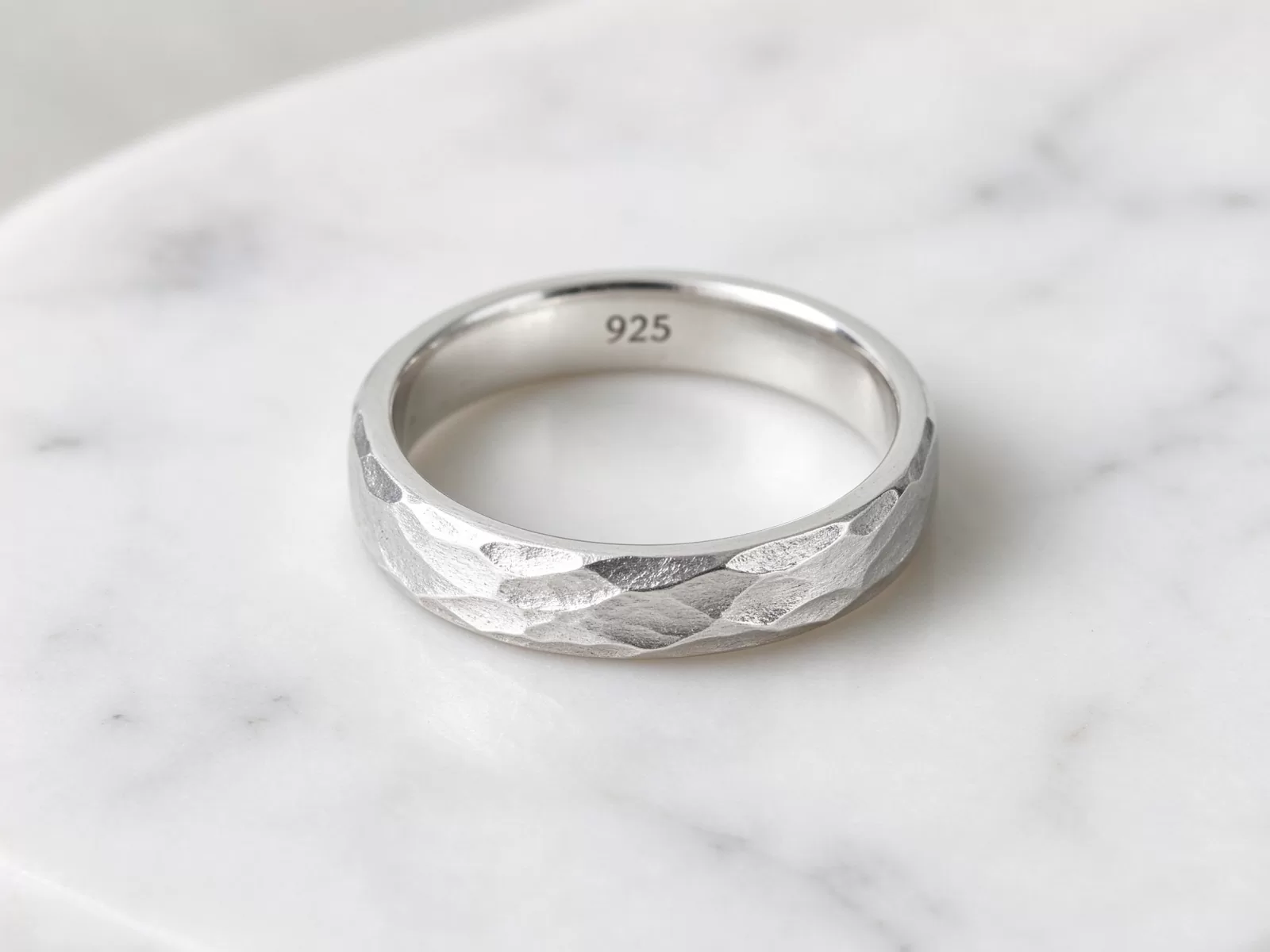
An earring buyer in Manchester returned a parcel last year: 200 pairs of sterling silver studs, after two months on her shelf. The rhodium layer had worn through on the post backs, the silver had yellowed, and three customers came back with green ear reactions. She assumed the alloy was bad. It was not. The factory she had bought from was plating at 0.05 micron instead of 0.2 micron, skipping the copper strike, and using a nickel barrier layer that REACH would not have allowed anyway.
Earrings fail on plating more often than on anything else. Posts, backs and wire bend, twist and rub against skin every day, and the finish is what the customer actually sees. Here are the plating choices we offer and where each one belongs.
01Why sterling silver itself is not enough
Bright 925 sterling silver (92.5% Ag, 7.5% Cu) tarnishes on contact with sulfur in air and skin. Left unplated, a pair of studs will dull in 4 to 6 weeks of wear. the Wikipedia sterling silver reference notes this explicitly; the copper content is what gives the alloy its hardness and also what drives tarnish. Plating is not decorative; it is the barrier that keeps the silver looking new.
02The four plating options we actually run
| Plating | Thickness | Look | Best for | Expected wear |
|---|---|---|---|---|
| Rhodium, standard | 0.2 micron | Bright white, mirror | EU/UK studs, daily wear | 12 to 18 months |
| Rhodium, heavy | 0.5 micron | Bright white, durable | bridal, gifting | 24+ months |
| 14K gold flash | 0.5 micron over nickel-free strike | Warm yellow | Gold-toned everyday line | 8 to 12 months |
| Rose gold flash | 0.5 micron | Pink-gold | Fashion seasonal line | 6 to 9 months |
Every plating starts with a copper strike, then a nickel-free palladium barrier for EU-bound orders. The barrier is what stops silver copper from migrating into the plating and causing the yellow-back problem the Manchester buyer saw.
Every plating starts with a copper strike, then a nickel-free palladium barrier for EU-bound orders. The barrier is what stops silver copper from migrating into the plating and causing the yellow-back problem the Manchester buyer saw.
03Rhodium thickness is where cheap lots hide
The trade minimum for retail-grade rhodium is 0.1 micron. We run 0.2 micron standard and 0.5 micron heavy. At 0.05 micron, rhodium wears off in weeks on post backs, exactly the failure mode above. If a supplier quotes you a price 20% below market on silver studs, ask for the plating thickness before you ask anything else. Rhodium also hardens the surface. A 0.2 micron rhodium plate on a post raises the Vickers hardness enough to resist the bending that happens when customers force posts through tight piercings.
04Nickel: do not skip this for the EU
The EU Nickel Directive, now folded into REACH Annex XVII, limits nickel release from posts and ear wires to 0.5 microgram per square centimeter per week. Read the consolidated REACH regulation on EUR-Lex for the current limit. We run all EU-bound ear orders on nickel-free posts with a palladium barrier, and we test 1 in 50 finished pairs with a nickel-release swab before shipment. If your supplier cannot show you a nickel-free certificate for posts, the order is not EU-safe.
05Stone setting on earrings
Studs are usually four-prong or bezel-set moissanite between 3mm and 6.5mm. Huggies and hoops use channel-set melee. We match stone color across a pair to within one color grade; a mismatch between left and right is the number one earring return reason we see. For pendant-scale stone matching on the same line, our necklace pendant and chain gauge guide covers the matching logic at pendant size.
06Frequently Asked Questions
Is rhodium plating the same as white gold?
No. Rhodium is a platinum-group metal plated over silver; white gold is a gold alloy that itself is usually rhodium-plated. Rhodium over 925 silver gives the white look at a silver price, but it will eventually wear through and show silver underneath.
How often should a customer re-rhodium plated earrings?
Every 12 to 18 months for standard 0.2 micron plating under daily wear. Heavy 0.5 micron plating stretches this to 24 months. Most high-street jewelers re-plate for $15 to $25.
Are your earrings safe for sensitive ears?
EU-bound orders are nickel-free, lead-free and cadmium-tested. We also offer titanium posts as a 5% upcharge for customers with known nickel allergy. Posts are the contact point that triggers reaction, not the dangle.
Do you plate in yellow gold or just silver tone?
We run 14K gold flash and rose gold flash as standard options. These are plating, not solid gold; for solid gold settings see our K-gold setting durability for retail.
What MOQ do you require on earring styles?
12 pairs per style per plating option. Mixed-color stone packs (D-E and F-G) are allowed within the MOQ. Sample pairs ship at cost before bulk.
07Order nickel-free plated earrings direct
We ship DDP to EU, UK and US with nickel-free certificates on request. MOQ 12 pairs per style; lead time 15 to 20 days. See our REACH nickel compliance for EU wholesale, compare plating options with our factory production flow, and request a plating sample kit showing 0.2 versus 0.5 micron rhodium side by side.