Wholesale Ring Sizes Which Half Sizes to Stock - HOLYCOME
When a jewelry brand places a first wholesale order with a factory, one of the most expensive mistakes it can make is ordering the wrong size distribution. A thousand rings sounds like a lot, but if four hundred of them land in sizes nobody buys, the other six hundred cannot cover the demand, and the brand ends up with dead stock on one end and stockouts on the other. We see this happen in almost every new collection we produce. The design is right, the stones are right, the pricing is right, but the size mix is wrong, and the whole collection underperforms. This guide is the inventory curve we have learned over years of cutting and setting rings for wholesale brands, and it tells you exactly which half sizes to stock, how many of each, and where the slow sizes live.
The short answer is that ring sizes are not a flat demand curve. They cluster heavily in the middle, around a single US size 6 and a half size 6.5 for women, and around US size 9 and 9.5 for men. Roughly half of all rings sold sit in just three adjacent sizes, and the long tail of half sizes on either side moves slowly. Stock the middle deep, the shoulders shallow, and the edges barely at all. Get that curve right, and your inventory turnover doubles. Get it wrong, and you are discounting slow sizes a year later to clear them.
This is not a retail guess. It is a production-planning problem, and we solve it the same way every factory does: by looking at what actually ships. Every order we fill has a size breakdown attached to it, and after years of summing those breakdowns, the curve is remarkably consistent across brands, across regions, and across price points. The shape of demand for ring sizes does not change much. What changes is the size of your first order and how much risk you can carry. This guide gives you the curve, the reasoning behind it, and the rules for stocking it without tying up cash in dead inventory.
The Bell Curve of Ring Size Demand
Ring size demand follows a bell curve, and it is a fairly steep one. For a women's collection, the peak sits at US size 6, with 6.5 and 5.5 as the two shoulders. Together, those three sizes typically account for forty to fifty percent of every order. Size 7 and size 5 are the next tier, moving moderately. Size 4.5 and size 7.5 move slowly. Sizes below 4.5 and above 7.5 are the long tail, and they should be stocked very lightly, if at all. For men, the peak shifts to size 9 and 9.5, with 8.5 and 10 as shoulders, and the curve looks identical, just shifted two or three sizes to the right.
This is the same distribution you would expect for any human measurement. Finger circumference is normally distributed, like height or shoe size. Most people cluster around the average, and fewer people are at the extremes. The difference with rings is that the extremes are expensive to stock, because each half size is a separate SKU. In shoes, a size 13 sits next to a size 12 on the shelf, and both sell eventually. In rings, a size 4 and a size 8 are different inventory units that cost you real money to produce and hold. You cannot just order one of every size; you have to weight the order toward the middle.
We build this weighting into every wholesale quote we send. When a brand asks for a thousand units, we do not quote a flat ten units per size. We quote a distribution: size 6 and 6.5 get eighty units each, size 5.5 and 7 get fifty, and the rest taper down. This is the curve, and it is the single highest-leverage decision in a ring collection. A brand that orders flat will be out of size 6 by month two, sitting on size 4.5 for two years. A brand that orders to the curve will turn stock twice as fast and never have a customer walk away empty handed.
Why Half Sizes Matter More in Wholesale Than You Think
Half sizes are not a luxury in the ring business; they are the unit of demand. A customer whose finger measures 6.25 will not buy a size 6 and live with a pinch, and she will not buy a size 7 and watch it spin. She will leave and buy from the competitor who stocks 6.5. This is why missing a half size is not a small gap; it is a lost sale. In a retail store, the customer who cannot find her size does not wait for your restock, she buys elsewhere. So the half sizes around the peak are non-negotiable, and the long-tail half sizes are where you cut.
The mistake new brands make is treating half sizes as optional extras. They order whole sizes only, telling themselves they will add half sizes once they see which ones move. But the half sizes around the peak are exactly the sizes that move fastest, and by the time the brand discovers that, it has lost the customers who wanted them. We always recommend stocking half sizes across the peak and shoulders from the first order, because that is where the demand actually is. Whole-size-only stocking leaves half the market unserved, and those are your best customers, because they know their size and will not compromise.
From a production standpoint, half sizes cost us almost nothing extra. Cutting a size 6.5 ring uses the same stone, the same band, the same setting labor as a size 6. The only difference is the mandrel diameter during sizing. So the factory cost of a half size is negligible, which means there is no cost reason to avoid stocking them. The reason to avoid the long-tail half sizes is not production cost, it is inventory carrying cost: you tie up cash in a SKU that sells once a year. Stock the peak half sizes deep, and the economics work in your favor.
The Women's Size Curve: Stocking by Percentage
Here is the women's size distribution we recommend, expressed as a percentage of a total ring order. Treat this as a starting point, and adjust it after your first sales season, because your specific customer may skew slightly larger or smaller. But for a first order, this is the curve that works.
Size 6 gets about sixteen percent of the order. Size 6.5 gets about fourteen percent. Size 5.5 gets about twelve percent. Size 7 gets about ten percent. Size 5 gets about eight percent. Those five sizes together are sixty percent of your entire order, and they are the core of your collection. This is where you cannot afford to be out of stock. If a customer comes in and her size is 6.5, you must have it.
After the core five, the shoulders thin out. Size 7.5 gets about six percent. Size 4.5 gets about five percent. Size 8 gets about four percent. Size 4 gets about three percent. Those four sizes cover the moderate tail, and they move, just slower. Beyond that, the long tail begins: size 8.5 and above, and size 3.5 and below, get about one to two percent each, or are stocked on a made-to-order basis. These are the sizes that sit on the shelf, and you should carry just enough to look complete in the display, not enough to tie up cash.
For a five-hundred-piece women's order, this works out to roughly eighty size 6, seventy size 6.5, sixty size 5.5, fifty size 7, forty size 5, and then smaller lots of the shoulders. This is the curve we build into our production schedule, and it is the reason our wholesale partners rarely have a stockout in the peak sizes. We overproduce the middle slightly, because a stockout at size 6 costs more than a few extra units sitting around, and we underproduce the edges, because dead stock there costs real money.
The Men's Size Curve: Shifted Right
The men's curve is the same shape, shifted right. The peak for men's rings sits at size 9, with 9.5 and 8.5 as shoulders. Size 10 and size 8 are the next tier. Roughly half of men's rings sold fall in sizes 8.5 through 10.5, which is a narrower band than women's, because men's fingers cluster more tightly around the average. Stock size 9 and 9.5 deepest, 8.5 and 10 next, and taper outward.
Men also have a smaller size range overall. A men's ring below size 7.5 is unusual, and one above size 12 is rare. So the men's long tail is shorter, which makes stocking easier. You can cover the whole men's range in about ten active sizes, with the peak carrying the bulk. This is why men's bands are often easier to stock than women's: the curve is steeper and the range is narrower, so less SKU complexity covers most demand.
One men's-specific note: men who wear wider bands need a size up, as we explain in our guide on sizing for knuckle and band width. A ten-millimeter men's band fits tighter than a four-millimeter band on the same finger, so the men's effective demand shifts slightly up when the collection uses wide bands. If your men's line is all eight-millimeter comfort-fit bands, shift the peak to 9.5 and 10, because customers wearing wide bands size up a half. This is a production decision that moves the curve, and we factor it in when we plan the order.
Half Sizes vs. Whole Sizes: The Deep vs. Wide Tradeoff
Every wholesale buyer faces the same tradeoff: do I stock more half sizes across the range, or fewer whole sizes deeper? The answer is to stock half sizes deep in the peak, and whole sizes only at the edges. At the peak, the difference between a 6 and a 6.5 is a lost sale, so you must carry both. At the edge, the difference between a 4 and a 4.5 is a small sale anyway, and you can fill it on demand. So you concentrate half-size inventory where demand is thick, and you simplify to whole sizes where demand is thin.
This is the economic logic of the curve. In the middle, each half size moves enough units to justify the SKU. At the edges, each half size moves too few, so combining them into whole sizes reduces SKU count without losing meaningful sales. A brand that stocks every half size from 4 to 9 will have twice as many SKUs as one that stocks half sizes only from 5.5 to 7, and the extra SKUs will move slowly. The second brand turns inventory faster, has less dead stock, and serves the vast majority of customers. That is the goal.
We help brands make this call when they plan a collection. If the brand is small and cannot carry many SKUs, we recommend a core of sizes 5 through 7.5 in half sizes, which covers roughly seventy percent of demand with just six SKUs. If the brand is larger and wants to look complete, we add the shoulders and the long tail. Either way, the principle is the same: depth at the peak, width at the edges only when you can afford it. Do not spread the order thin across twenty sizes; concentrate it where the sales are.
Comfort Fit vs. Standard Fit: The Curve Shifts
Not all rings size the same way. A comfort-fit band, with a rounded inner edge, slides onto the finger more easily and feels looser than a standard flat-inner band of the same marked size. This shifts the effective demand. Comfort-fit rings run about a half size large, meaning a customer who measures a 6.5 on a standard mandrel may take a 6 in comfort fit. So if your collection is comfort fit, the peak shifts down half a size, to size 6 rather than 6.5. We have seen brands order a comfort-fit line on the standard curve, then wonder why size 6.5 sits on the shelf and size 6 sells out. The fit style moved the demand, and the order did not follow.
This is a manufacturing detail, but it has a direct inventory consequence. We produce both standard and comfort fit bands, and we flag the fit style on every size chart we send. A comfort-fit collection should be stocked on a shifted curve, half a size down. A standard-fit collection stays on the standard curve. A mixed collection needs its own blend. Get this wrong, and even a perfectly shaped curve will underperform, because the marked sizes do not match the customers' actual fingers.
The width of the band shifts the curve too, as we noted for men. Wide bands run tight, so a wide-band collection shifts half a size up. Narrow midi bands run small on the finger they sit on, which is a separate math. Each design decision—fit style, band width, stone setting height—nudges the effective size curve. We build these adjustments into the size plan before production, because adjusting them after the rings are made means remaking stock, which is expensive. Plan the curve to the actual product, not to a generic chart.
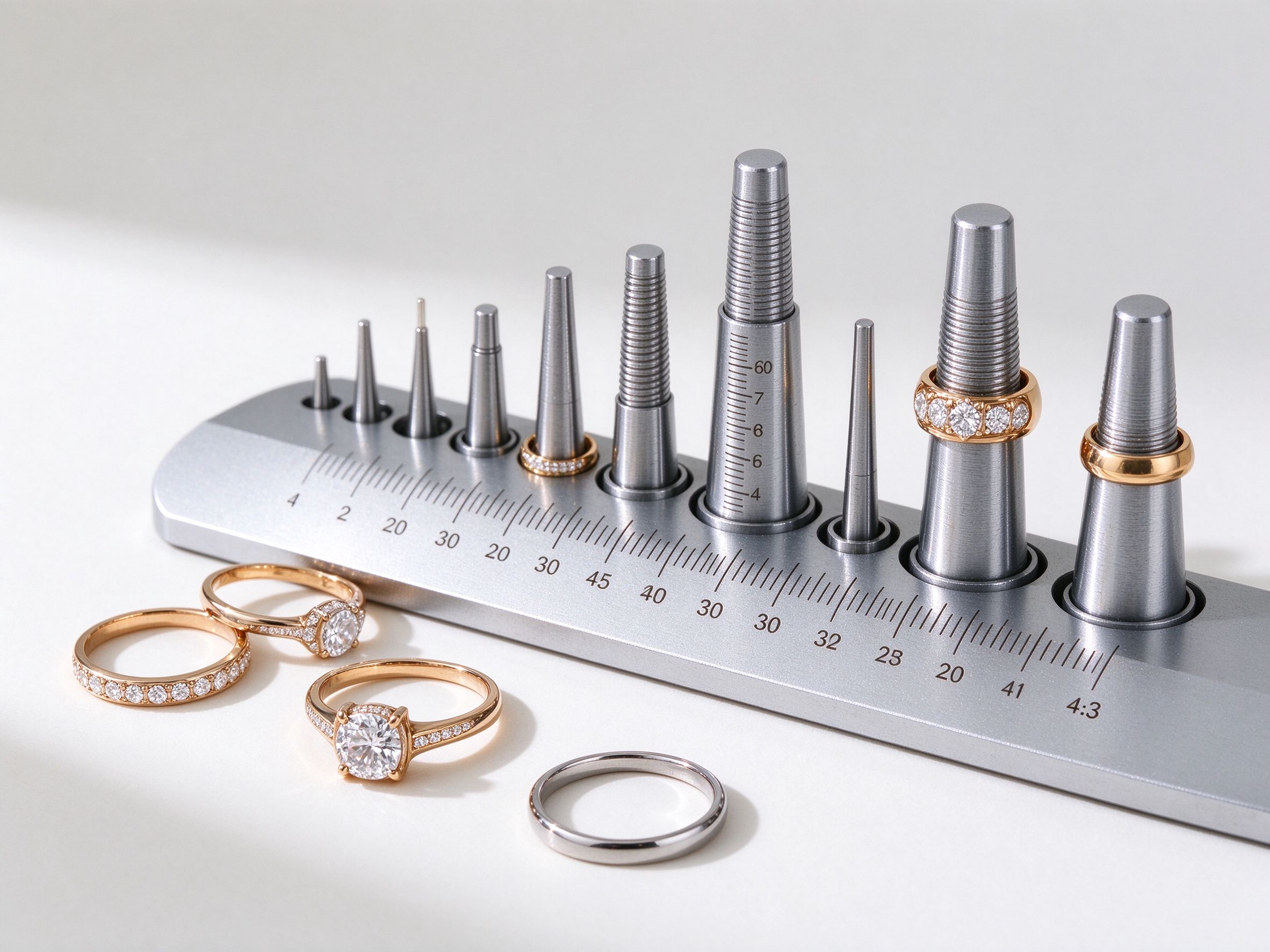
A production mandrel with half-size marks; every ring is sized to this gauge before QC, so the size curve in your order is accurate to the millimeter.
Regional and Demographic Skew
The bell curve is universal, but its center moves slightly with demographics. A brand selling to Northern European customers will see the peak shift up by a quarter to a half size, because hands there are on average larger. A brand selling to East Asian markets will see the peak shift down. A brand selling to a younger, slimmer customer base will skew smaller; a brand selling to an older customer base will skew larger, because fingers widen with age. These are small effects, but they move tens of units in a thousand-piece order, and they matter when you are trying to avoid stockouts.
We track these skews for our wholesale partners by region. A brand ordering for the US market gets the standard curve, peaked at 6. A brand ordering for the German market gets the curve shifted up half a size. A brand ordering for the Japanese market gets it shifted down. We do this from the sales data the brand sends us, because the factory cannot know the local customer without the retail numbers. After the first season, the brand shares which sizes moved, and we adjust the next production run to match. This is how the curve gets sharpened over time: first order is the generic curve, second order is tuned to real sales.
Seasonality also moves the curve slightly. Rings sell larger in the winter, when fingers are cold and customers size up to be comfortable indoors, and smaller in the summer, when swollen fingers push demand up by a half size in hot months. We cover this daily and seasonal swing in our guide on why fingers change size through the day and season. For wholesale, this means a summer collection should be stocked a half size larger than a winter collection, because the customer buying in July is measuring a swollen finger. It is a small effect, but it shows up in returns when you ignore it.
Made-to-Order: How to Handle the Long Tail
The long tail—sizes below 4.5 and above 7.5 for women, below 7.5 and above 12 for men—should almost never be stocked deep. These sizes move once or twice a year, and carrying ten units of each ties up cash that earns nothing. The right answer for the long tail is made-to-order. Display the size in the catalog, let the customer order it, and produce it in five to seven days. You serve the customer without carrying the inventory.
As a factory, we support this directly. We keep the core stones and band widths in stock, and we can size a made-to-order ring to any size within a week. This means our wholesale partners can offer the full size range on their website while only stocking the peak. The long tail becomes a service, not a stock obligation. This is how modern jewelry brands carry forty sizes without tying up forty times the cash: stock the middle, produce the tail on demand.
The tradeoff is lead time. A made-to-order size takes longer than a stocked one, and some customers will not wait. But those customers are rare, and they are already accustomed to special ordering a size 8.5 ring. The vast majority of demand sits in the stocked core, where immediate availability matters. By making the tail on demand, you keep the customer who wants the rare size without funding it on the shelf. We build this hybrid model into every wholesale size plan we design, and it is the single biggest cash-flow improvement we offer brands.
First-Order Quantities: How Many to Start With
For a first wholesale order, we recommend sizing the core deep enough to last a full sales season, and the shoulders shallow enough to reorder. A five-hundred-piece first order, on the women's curve, gives you about eighty units of size 6, which is usually enough for three to four months of a new brand's sales. If the brand sells faster, it reorders; if slower, it learns the curve is lighter than expected. The mistake is ordering two thousand pieces flat and finding out later that the design only moves in size 6. Start smaller, learn the curve, then scale.
We usually recommend a first order of three to five hundred pieces, not a thousand, because the first order is a learning order. It tells you which sizes actually move in your market, with your customer, in your price range. After that first season, your second order can be larger and sharper, because it is built on real data. Brands that lead with a thousand-piece order on a guessed curve often come back with dead stock and a smaller reorder. Brands that start with five hundred and reorder grow faster, because their second order is tuned. This is the inventory lesson factories learn the hard way, and we pass it on.
The reorder logic follows the same curve but sharper. After the first season, you know exactly which sizes moved. The reorder doubles down on the winners and cuts the losers. If size 4.5 barely moved in season one, you do not reorder it; you make it made-to-order. If size 7 moved faster than expected, you stock it deeper. The curve starts as our generic distribution and becomes your specific one, shaped by your own sales. That is how inventory turns from a guess into a system.
The Cost of Getting the Curve Wrong
The cost of a bad size mix is not obvious until it is too late. On one end, you are out of stock in size 6, and every customer who wants that size buys from a competitor. You do not see those lost sales, because they never happen; you only see that your conversion rate is low. On the other end, you have fifty size 4.5 rings sitting in a warehouse, and six months later you are discounting them at cost to clear space. Both ends hurt, and they add up. A well-shaped curve avoids both, by putting stock where it sells and producing the rest on demand.
We have seen brands tie up forty percent of their first-order cash in slow sizes. That is cash that could have been spent on marketing, on a second design, or on reorders of the sizes that actually move. The size curve is not a detail; it is a capital allocation decision. Every ring you stock in a slow size is a ring you cannot stock in a fast one. Get the weighting right, and the same cash produces twice the revenue. Get it wrong, and half your inventory sits dead while you miss sales in the middle.
This is why we spend so much time on the size plan before we cut a single ring. The cutting is the easy part; the stone, the setting, the polish, all of that is repeatable. The size mix is the one decision that cannot be fixed after production. You can recut a stone, reset a prong, refinish a band, but you cannot turn a size 4.5 ring into a size 6. The size is in the metal. So we plan the curve carefully, because it is the one irreversible decision in the whole order.
How We Size Rings on the Bench: Accuracy Matters
A size curve only works if the sizes are actually accurate. A size 6 that measures 6.25 on the mandrel is not a size 6, and it will feel loose, which means the customer's true size is lower, which means your demand curve is off. This is why factory sizing accuracy matters so much for wholesale inventory. We size every ring on a calibrated stainless mandrel, checked against a gauge every morning, and we reject rings that are off by more than a quarter size. A half-size of error across a thousand rings shifts the effective demand by a full size, which is enough to create the exact stockout-and-dead-stock problem we are trying to avoid.
We cover the inaccuracy of paper sizers in our guide on why paper sizers are inaccurate and why mandrels matter, and the same accuracy discipline applies to the factory side. A ring measured on a hand-held plastic sizer at the bench will drift, because the plastic flexes. We use hardened steel mandrels and a hammer-fitting gauge, so the size is consistent from the first ring to the thousandth. Consistency is what makes the inventory curve reliable: if every size 6 is truly 6, then the demand you see for size 6 is real demand, and your reorders are accurate.
For wholesale brands, this consistency is worth more than it sounds. A brand that receives a shipment where size 6 rings vary by a half size will get returns from customers whose ring fits wrong, and the brand will misread those returns as a sizing problem rather than a production problem. By sizing consistently on calibrated mandrels, we eliminate that noise, so the brand's sales data is clean. Clean data means the curve gets sharper each season, which means inventory gets tighter, which means less cash tied up and fewer stockouts. It all starts with accurate sizing on the bench.
Internal Link: Connecting Sizing to Care
Once the right size mix is in stock, the next thing that affects repeat orders is how the rings hold up. A ring that tarnishes or loosens quickly creates returns and warranty claims, which distort the inventory picture and eat into margin. We cover the maintenance side in our guide on the 90-day jewelry care calendar, which explains what customers should do to keep a ring looking new. A brand that educates its customers on care sees fewer returns and fewer warranty replacements, which means the inventory it stocked actually stays on customer fingers, not coming back through the door.
This matters for the size curve because returned rings distort it. If twenty size 6 rings come back in a quarter because of tarnish, the brand thinks demand for size 6 is soft, and it underorders the next run—when in reality the rings are coming back for a care problem, not a size problem. Clean sizing and clean care data go together. We produce rings that size accurately and hold their finish, and we give brands the care content to pass on, so their inventory data reflects real demand, not avoidable returns.
Frequently Asked Questions
How many sizes should a new brand stock for a first order?
Start with the core: for women, sizes 5 through 7.5 in half sizes, which is six SKUs covering about seventy percent of demand. For men, sizes 8 through 10.5 in half sizes, six SKUs covering most men's demand. Add one or two shoulder sizes if you can, and make everything else made-to-order. This keeps the first order lean enough to learn from, while serving most customers immediately.
Should I stock half sizes or whole sizes only?
Stock half sizes in the peak and shoulders, where demand is thick and a missing half size is a lost sale. At the long-tail edges, whole sizes are fine, because the customers there will special order anyway. Concentrate your half-size inventory on sizes 5.5 to 7 for women and 8.5 to 10 for men, and simplify the rest.
How often should I reorder?
Reorder the peak sizes when they drop below a two-week supply, because a stockout at size 6 costs more than holding a few extra units. The shoulders can wait for a monthly review, and the long tail never needs a reorder because it is made to order. We provide reorder schedules with every wholesale plan, tuned to your sales velocity.
Does comfort fit change which sizes I stock?
Yes. Comfort-fit bands run about a half size large, so shift the whole curve down half a size. A comfort-fit collection peaks at size 6 rather than 6.5. Wide bands shift the curve up half a size. Always stock to the actual fit style and band width of your product, not to a generic chart.
Partner With Us on Your Size Plan
We have spent years building the size curve that works for wholesale jewelry brands, and we refine it with every production run. When you work with moissafactory, you do not have to guess which sizes to stock. We build the size plan into your quote, size every ring on a calibrated mandrel, and support your long-tail sizes with fast made-to-order turnaround. Whether you are launching your first collection or scaling an established one, we help you put inventory where it sells and keep your cash working. Contact us at service@holycome.com with your collection idea, and we will send you a size curve and a production quote built for your market. The right design plus the right size mix is how a ring collection turns, and we build both into every order.