01Why the return rate, not the unit price, decides your moissanite wholesale margin
Most buyers open a moissanite wholesale negotiation on price per carat. I get it. But after twelve years on the floor, I can tell you the number that quietly eats a trading company's margin is the return rate. A 3% return on 500 pieces costs you more in freight, restocking and customer trust than a 4% price difference ever will.
Moissanite is hard. At 9.25 on the Mohs scale it shrugs off most daily wear. That hardness is exactly why buyers assume returns will be near zero. They are not, because returns rarely come from the stone. They come from settings that loosen, prongs that snag, plating that dulls and rings that arrive with a fingerprint on the table because nobody wiped them before packing.
So we run a care loop, not a care page. Cleaning, inspection and repair are folded into production and pre-ship, and the same loop is handed to your customer in plain language. That is the piece most suppliers skip.
02The three places returns actually start
Before I describe the loop, here is where the problems originate on our line. It is almost never the rough.
- Stone seating: a prong that was not pushed and polished correctly lets the moissanite shift, and the customer feels a rattle.
- Surface film: oils from handling dull the brilliance, and the buyer thinks the stone is cloudy or low grade.
- Plating and sizing: rhodium over 925 silver wears at the shank, and a ring that was sized in a hurry comes back a half size off.
Each of these is cheap to prevent at the bench and expensive to fix after DDP delivery. That is the whole logic of the loop.
Each of these is cheap to prevent at the bench and expensive to fix after DDP delivery. That is the whole logic of the loop.
03Stage one: incoming stone check before anything is set
Every parcel of moissanite is opened under a loupe before it reaches a setter. We check for internal inclusions visible at 10x, bow-tie darkness on fancy shapes, and color consistency across the lot. A batch that drifts two grades from the reference stone gets quarantined, not blended into your order.
This matters more in moissanite wholesale than in finished-goods trading because you are buying a promise of repeatability. If the second shipment does not match the first, your customer returns the ring and blames you, not us.
Stock items ship from one piece. Custom cuts and custom settings start at 30 pieces, and the stone check is documented so the custom run has a reference to match.
04Stage two: in-process checks at the bench
Setters work with a loupe and a torch, and every tenth piece is pulled for a full inspection. We test prong tension by hand, check that the girdle is not pinched, and confirm the seat is level so the table faces true. A stone that sits high on one side will catch on knitwear, and a snag is a return.
This is also where we catch plating issues early. Rhodium over 925 silver is applied thin and even, and any piece with a dull patch goes back to the bath before it reaches polishing.
Our line runs about 20% faster and yields about 20% better than a typical trading company on the same order size. The reason is simple: the QC lead sits at the bench, not in an office, and problems are fixed in minutes instead of being logged and shipped.
05Stage three: pre-ship AQL and the cleaning routine
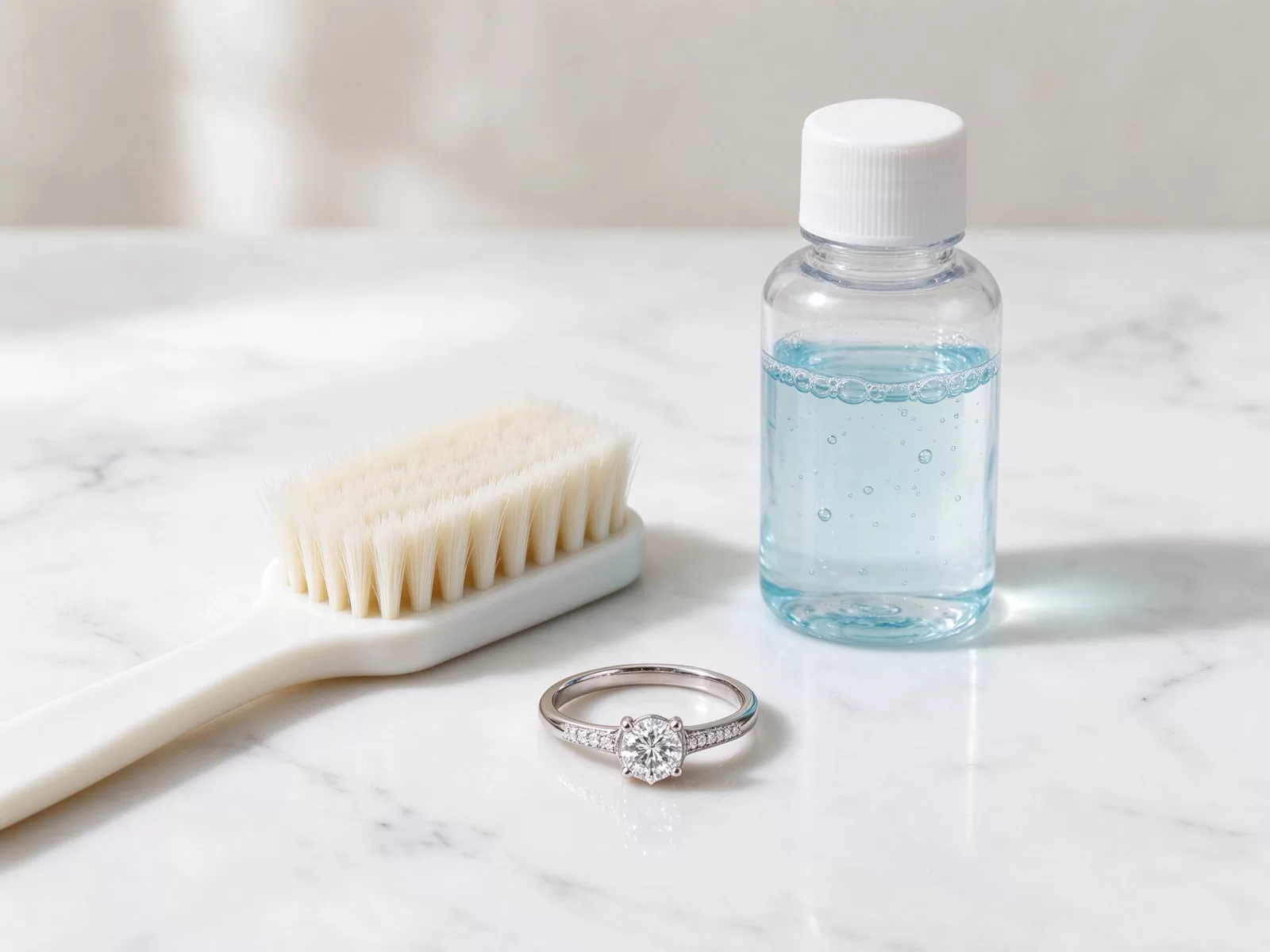
Before packing we run an AQL sample against the order. Stones are checked for chips and looseness, settings for symmetry, and clasps for snap. Then every piece is cleaned: warm water, mild soap, soft brush, rinse, and a lint-free wipe. No ultrasonic on pieces with glued or thin settings, because cavitation can loosen a seat.
The clean step sounds trivial. It is the single cheapest return-reduction move we make. A brilliant stone sells; a smudged one generates a support ticket.
| Loop stage | What we check | What it prevents | Where it happens |
|---|---|---|---|
| Incoming stone | Clarity at 10x, color match, bow-tie | Grade drift between lots | Stone room |
| In-process | Prong tension, seat level, plating | Rattles, snags, dull patches | Setter bench |
| Pre-ship AQL | Symmetry, clasp, surface film | Arrival complaints | Packing line |
| Customer care card | Cleaning and storage steps | User-caused dullness | Insert |
06The repair loop: what happens after a return reaches you
Returns will happen. What matters is how fast you can turn one around. We keep a repair bench for wholesale accounts, and the common fixes are prong retipping, re-seating a shifted stone, re-polishing a scratched shank and re-plating rhodium.
Send us the piece with the order reference and we quote the fix. Small repairs on stock items usually turn in 12 to 18 days alongside the next production run, so you are not paying a separate freight cycle for one ring.
Certificates travel with the piece: GRA for the stone and IGI where the order calls for it. Keep that paperwork with the return so the repair bench knows the exact grade it is matching.
07What you hand the end customer
The loop only closes if the wearer knows three things. Clean with warm water and mild soap, not abrasive cleaners or toothpaste. Store moissanite separately from softer stones so nothing scratches. Take the ring off before gym work, swimming and gardening, because chlorine and grit are harder on settings than on the stone.
Put that on a small card in the box. Buyers who do report fewer cloudy-stone complaints, because the customer stops assuming the stone failed and starts cleaning it.
We would rather spend two minutes cleaning a ring before it ships than two weeks arguing about a return after it lands.
08Payment, delivery and what to ask for
Terms are straightforward. T/T with 30% deposit for production orders, PayPal for samples. DDP delivery runs 5 to 8 days to US and EU addresses. MOQ is one piece on stock and 30 pieces on custom. Production is 12 to 18 days after deposit and stone approval.
When you request a quote, ask for the AQL report and the cleaning checklist with it. A supplier who cannot produce those is not running a loop; they are running a hope.
09Frequently Asked Questions
What is the MOQ for moissanite wholesale orders?
Stock moissanite pieces start at one piece, so you can sample before committing. Custom cuts and custom settings start at 30 pieces, and the stone check is documented against your reference.
How long does production and delivery take?
Production runs 12 to 18 days after deposit and stone approval, with a three-stage QC pass before packing. DDP delivery to US and EU addresses takes 5 to 8 days after dispatch.
How is the price quoted?
Quotes are per piece and depend on stone size and grade, metal weight and setting complexity. Certificates are GRA as standard, with IGI where the order requires it, and the quote states which applies.
Send your spec, target quantity and destination to service@holycome.com or WhatsApp +86 133 7744 7107, and ask for a quote plus a sample so you can run the care loop on your own bench before you commit to a season.