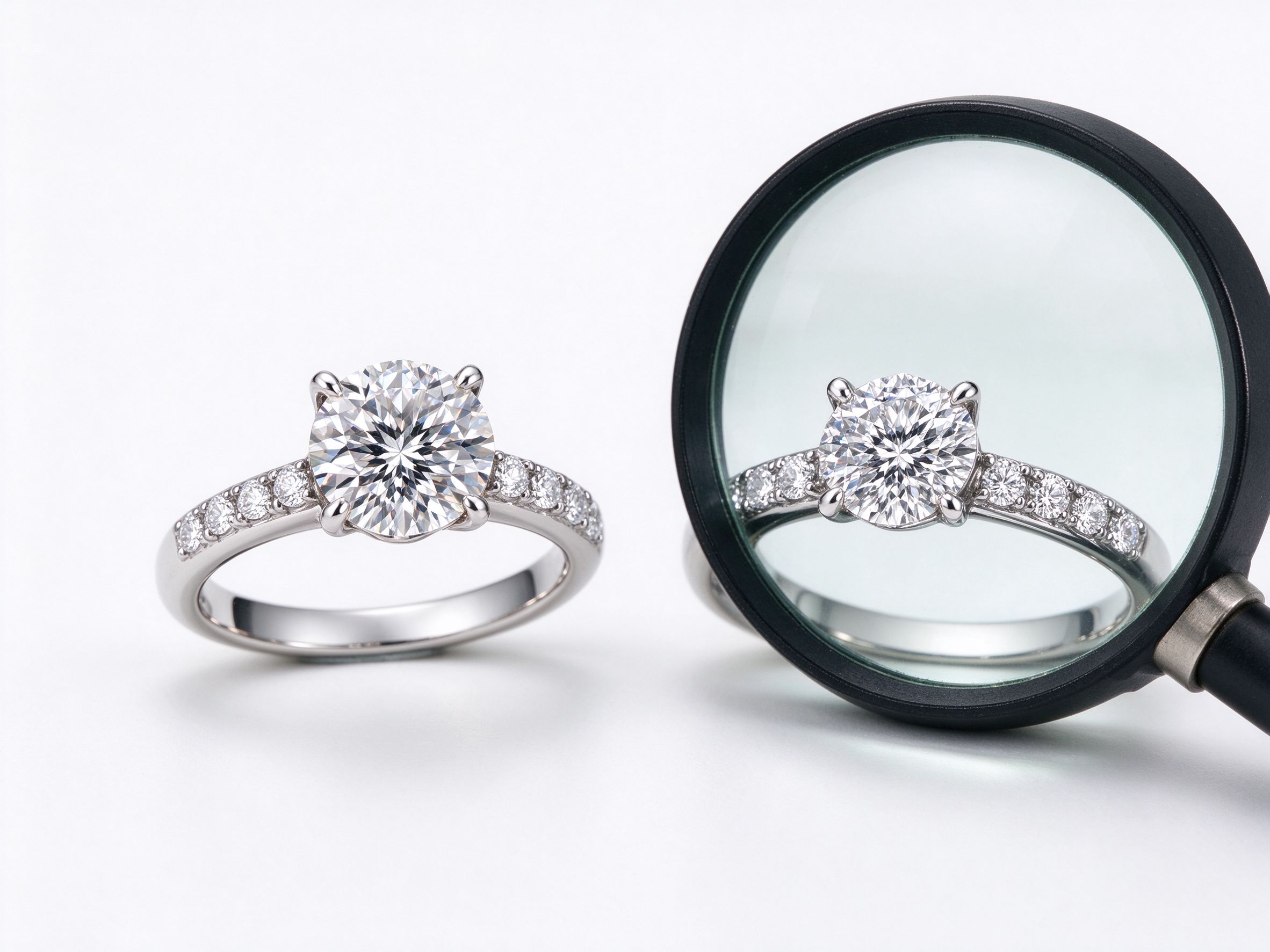
Lab Grown vs Moissanite Wholesale Margin - HOLYCOME
One of the most common questions we hear from wholesale buyers is not which stone looks better, but which one makes more money. Lab grown diamonds and moissanite both fill the affordable-bridal and fashion-jewelry space, but they sit on very different cost bases, carry different retail price points, and attract different customers. If you stock both, the margin math decides how much of each you should carry. If you are choosing one, the comparison decides which one deserves the shelf space. This guide breaks the two categories down by wholesale cost, retail markup, returns, and repeat purchase, so you can make the call on numbers rather than on which sales pitch you last heard.
The short answer is that moissanite has a lower wholesale cost and a higher percentage markup, but a lower absolute ticket and a more price-sensitive customer. Lab grown diamonds cost more at wholesale but carry a higher absolute gross profit per sale and a more confident buyer. The right mix depends on your price point, your customer, and how much floor space you want to dedicate. Read on for the actual economics.
The wholesale cost base of each category
Moissanite is a lab-created silicon carbide, grown in its own specialized process and then cut and polished. Because the material is engineered to be very hard and nearly flawless, the yield from rough to finished is high, and the per-stone cost is low. A moissanite one-carat equivalent can be bought at wholesale for a small fraction of what a comparable lab grown diamond costs. The material itself is abundant and the supply chain is mature, which keeps wholesale prices steady and low.
Lab grown diamonds, by contrast, are carbon crystals grown in CVD or HPHT reactors. They carry the energy cost of growth, the yield loss from cutting rough to polished, and the cost of third-party certification. Even though lab grown diamond prices have fallen sharply over the last few years, a certified one-carat lab grown diamond still costs many times what a one-carat moissanite costs at wholesale. The reason is not that diamonds are intrinsically rare anymore; it is that the growth and cutting process carries real per-carat cost, and the certificate carries a fee. You can read the full build-up in our guide to lab grown diamond price per carat.
For the buyer, the practical difference is this: moissanite lets you stock a wide range of sizes and shapes with very little capital tied up. Lab grown diamonds tie up more capital per stone, but each stone carries a higher price. A store with limited cash flow can carry a deep moissanite inventory and a narrow lab grown inventory; a store with capital and a bridal customer can lean into lab grown and use moissanite as the entry tier.
Retail price positioning and markup
Because moissanite is cheap at wholesale, retailers can apply a large percentage markup and still land at an accessible price. A moissanite engagement ring that cost you a small amount at wholesale can retail for a price that feels like a deal to the customer. The percentage margin is attractive. The dollar margin per ring, however, is modest, because the ticket itself is low. Moissanite sells on value: the customer comes for the price and the sparkle, not for the certification story.
Lab grown diamonds carry a higher wholesale cost, but they also retail at a higher ticket, and the dollar gross profit per sale is larger. A certified one-carat lab grown engagement ring retails at a price where even a standard markup produces a healthy absolute margin. The customer buys it because it is a real, certified diamond at a fraction of a natural diamond's price, and they are willing to pay for that certification. The percentage markup may be lower than moissanite's, but the dollars on the bottom line are often higher.
| Factor | Moissanite | Lab grown diamond |
|---|---|---|
| Wholesale cost | Low | Moderate to high |
| Retail ticket | Entry to mid | Mid to high |
| Percentage markup | High | Moderate |
| Dollar margin per sale | Lower | Higher |
| Customer buys on | Price, sparkle | Certification, diamond status |
Customer expectations and returns
Returns are where the two categories diverge in a way that margin math misses. Moissanite is sold with clear expectations: it is a simulated, affordable stone, and customers who buy it generally understand what they are getting. The risk is when a salesperson lets a customer believe a moissanite is a diamond, which leads to a return or a complaint later. Sold honestly, moissanite has a low return rate, because the customer got exactly the affordable sparkle they paid for.
Lab grown diamonds are sold with the expectation of being "a real diamond." Customers who buy them expect diamond-like durability, resale expectations, and certification. The return risk is lower on product quality, but higher on expectation management: if a customer thought a lab grown diamond would hold value like a natural one, they may be disappointed later. Honest selling about what lab grown is, and what it costs, prevents this. Because the ticket is higher, a single return costs more in restocking and shipping, so expectation-setting matters more.
Wholesale buyers should also consider the customer's post-sale questions. Lab grown diamond customers ask about certificates, resale, and care, which requires staff who can explain the category. Moissanite customers mostly ask about hardness and care. A store that cannot explain lab grown certification will have a harder time selling it at the higher ticket, which quietly lowers the effective margin because fewer of the higher-ticket stones convert.
Inventory risk and reordering
Moissanite inventory risk is low because the wholesale cost per stone is low and the supply chain is stable. You can stock a wide range of shapes and sizes without tying up much capital, and reorders are quick and cheap. If a shape does not sell, the loss is small. This makes moissanite an easy category to experiment with: you can test oval, pear, and cushion stock and keep what moves.
Lab grown diamond inventory risk is higher because each stone costs more. Stocking a deep range of sizes and grades ties up working capital, and lab grown prices continue to trend downward, which means unsold inventory gently depreciates. The smart approach is to stock the popular hero sizes and grades, and order the rest to demand. You can see how cost has moved in our 2026 cost per carat guide. The stores that get into trouble are the ones who overstocked lab grown at a high price and now watch the market undercut them.
Which customers buy which stone
Moissanite buyers tend to be price-led: they want a large, bright stone at an accessible price, often for an engagement ring on a budget, or for fashion pieces they wear daily. They are not usually shopping on certification; they are shopping on size and sparkle. This customer is price-sensitive and will compare you to online sellers. Your margin on them comes from service, setting design, and trust, not from the stone alone.
Lab grown diamond buyers tend to be value-led but not purely price-led: they want a certified diamond at a natural-diamond discount, often for an engagement ring that reads as "real." They will compare certificates, grades, and prices, and they are willing to pay more for a stone that comes with a lab report. This customer has a higher ticket, a higher absolute margin, and a lower tolerance for being pushed toward a cheaper alternative. If your store serves this customer, lab grown is the category to lean on.
Many stores serve both. The common pattern is to use moissanite as the entry ring that gets a bride in the door, then upgrade her to a lab grown center stone once she understands the difference. That conversation is profitable because the upgrade sale carries a higher margin, and the customer feels guided rather than upsold. For context on how the categories overlap on one production floor, see our note on mixed production lines.
The repeat-buyer and referral effect
Margin is not just the first sale; it is the lifetime value of the customer. A moissanite buyer who loves her affordable ring may come back for earrings, a pendant, or a wedding band, and those follow-on sales repeat the same low-cost, high-percentage-margin economics. Because moissanite is affordable, the customer is willing to buy more pieces, which compounds the margin over time. The low ticket is offset by frequency.
A lab grown diamond buyer may buy fewer pieces, but each is a higher-ticket event, and a satisfied lab grown customer often returns for an anniversary band, a push present, or a wedding band that matches her ring. The certificate and the brand experience she had on the first sale drive the second. A store that builds trust on a high-ticket first sale earns a higher-value repeat customer, even if the purchase frequency is lower.
Either way, the category that wins is the one you sell honestly and service well. A store that pushes moissanite as a diamond will lose the repeat buyer; a store that overstates lab grown resale value will too. The margin you keep depends on the margin you set expectations for.
Combining both categories in one store
The strongest wholesale jewelry operations do not choose one category; they position both. Moissanite becomes the accessible, fashion-forward entry that broadens the funnel. Lab grown becomes the certified, bridal center that carries the higher ticket. The two are displayed side by side, with clear signage explaining the difference, so the customer self-selects into the tier that fits her budget and expectations. This approach captures the price-led customer who would otherwise leave without buying, and the value-led customer who would otherwise buy online.
The inventory split is usually weighted by your customer base. A fashion-led boutique may carry more moissanite and a narrow lab grown bridal selection. A bridal-led store may carry a deep lab grown selection and a small moissanite entry tier. The mistake to avoid is carrying both shallowly: a couple of moissanite shapes and a couple of lab grown sizes serves neither customer well. Pick your mix, and stock each category deeply enough that the customer has a real choice.
Durability, care, and the customer experience
The two stones behave differently over time, and that difference affects returns and reviews. Moissanite is extremely hard, second only to diamond on the hardness scale, so it resists scratching well in daily wear. But it has a different optical character: more fire, more rainbow sparkle, and a slightly different look under certain lighting. Customers who expect a quiet, white diamond sparkle can find moissanite's fire too much, and that expectation gap drives returns when the salesperson overstates the similarity. Sold honestly as its own stone, moissanite wears beautifully for years and requires only normal care.
Lab grown diamonds are chemically and optically identical to natural diamonds, so they wear, look, and feel exactly like the diamonds customers already know. There is no "adjustment" period: a lab grown diamond ring looks and behaves like any diamond ring. The care instructions are the same as for natural diamonds. This familiarity is part of why lab grown sells at a higher ticket: the customer is not taking a chance on a new material, she is buying a known product at a new price. For a store, that familiarity lowers the support burden and the return rate on the higher-ticket item.
Customer reviews also diverge. Moissanite reviews tend to focus on "great value for the price" and "so much sparkle." Lab grown diamond reviews tend to focus on "looks like a real diamond" and "certified, so I trusted it." When you read your own reviews, pay attention to which language appears. If your customers rave about value, your moissanite positioning is working. If they rave about authenticity, your lab grown positioning is working. Pushing the wrong claim, such as calling moissanite a diamond, erodes both.
The sales conversation and how it affects margin
Margin is not just set by wholesale cost; it is set by how the sales conversation goes. A store that can clearly explain the difference between the two stones, and match the customer to the right one, closes more sales at the right price. A store that confuses the customer, or pushes the higher-ticket stone onto someone who wanted the value option, loses the sale or earns a return. The best retail teams train staff on a simple script: understand the budget, show both options, explain the certification difference, and let the customer choose.
This matters to wholesale buyers because it determines which category will actually sell through for them. If your staff cannot explain why a certified lab grown diamond costs more than a moissanite, the higher-margin lab grown stones will sit in the case. If they can explain it confidently, the lab grown category converts. Invest a little in staff training on the category you want to push; it returns more than any discount from a supplier. The stores that earn the highest effective margins are not the ones with the cheapest wholesale price; they are the ones who sell through inventory fast and at full price.
Marketing each category
The two categories need different marketing. Moissanite sells on aspiration and value: "the ring you want, at a price you can say yes to." It pairs well with large center stones, halo settings, and fashion styling. Lab grown diamonds sell on transparency and credibility: "a certified diamond, engineered, at a fraction of natural." It pairs well with certificate displays, origin stories, and honest price messaging. Advertising one category with the other's message confuses the customer.
For wholesale buyers, this means the supplier's marketing support matters. A factory that provides good product photos, certificate verification links, and honest comparison copy makes it easier to sell through. A supplier that overclaims or blurs the line between the two stones creates liability. When you choose a wholesale partner, look at the materials they provide. The partner who equips you to sell honestly is the partner who protects your margin over the long run.
Resale value and the secondhand question
A question customers ask, and that affects your repeat business, is what the stone is worth later. Neither moissanite nor lab grown diamonds hold the resale value that natural diamonds once did, and you should be honest about that. Moissanite has almost no secondhand market; it is worn for enjoyment, not as a stored asset. Lab grown diamonds also resell well below their original retail, because the wholesale cost continues to fall and there is no scarcity premium. The honest message to your customer is that both stones are bought to wear, not to invest. Setting that expectation up front prevents disappointment and protects your reputation.
For the store, resale value matters less than sell-through. A stone that you can sell at a healthy margin and turn over is a better inventory than a stone that holds value but sits unsold. In a deflating lab grown market, the goal is to buy close to demand and turn stock quickly, not to hold and hope. Moissanite's low cost makes it easy to turn; lab grown's higher cost rewards disciplined, just-in-time buying. Either way, the margin you earn is the sell-through margin, not a resale margin. We cover this honestly in our guide on whether lab grown diamonds hold resale value.
Edge cases: who should stock only one
Although most stores benefit from carrying both, there are clear cases for stocking only one. A store positioned purely as a value, fashion, or bridal-on-a-budget brand may do better leaning entirely on moissanite, because that is the customer it attracts. Adding lab grown would split the message and tie up capital. Conversely, a bridal-focused store that competes on certification and service may be better off stocking only lab grown, because moissanite dilutes the "real diamond" positioning its customers expect. The decision depends on the brand you have built, not on the category's generic margin.
A small online seller with limited capital often starts with moissanite alone, because the low wholesale cost lets them offer a wide range of sizes and shapes with little inventory risk. They add lab grown later, once they have a bridal customer asking for certified stones. A service-led local jeweler often starts with lab grown alone, because its customers come for trust and certification, and adds moissanite as an entry tier once it has the foot traffic. There is no universal correct mix; there is only the mix that matches your customer and your capital. Test, measure sell-through, and adjust.
How to decide what to stock
Start with your customer. If they walk in asking "what is your cheapest engagement ring," moissanite is your volume play. If they walk in asking "do you have certified lab diamonds," lab grown is your margin play. If you are online and compete on price, moissanite's low cost and high markup gives you room to promote. If you are a service-led local jeweler, lab grown's higher ticket and trust-based sale plays to your strengths. Test both with a small opening buy, track which sells, and lean into the winner. The numbers will tell you faster than any general rule.
A practical way to start the test is to stock a matched pair of similar-looking rings, one moissanite and one lab grown, at the price points each category naturally occupies. Let customers compare them in the case, and track which one sells. The sales data from that small test is worth more than any generic advice about which category is more profitable. Run it for a quarter, then adjust your buy. Because moissanite is cheap to stock, the test costs little; because lab grown carries the higher margin, even a few conversions justify the test. Treat the first buy as market research, not as a permanent decision.
One more factor to weigh is the staff time required to support each category. Lab grown customers ask more questions, want certificates explained, and compare prices online before they arrive. That takes knowledgeable staff time, but it also means the customer who reaches the counter is already partly sold. Moissanite customers ask fewer questions and decide faster, but they are more price-sensitive and more likely to walk if the price is not right. Factor your own team's time into the margin, not just the wholesale cost. A high-ticket sale that takes a skilled staff member an hour is still more profitable than a low-ticket sale that takes five minutes, as long as the conversion holds.
At HOLYCOME, we supply lab grown diamonds wholesale to stores that want the certified-bridal margin, and we work with buyers who also carry moissanite as their entry tier. We can help you size the lab grown half of your mix so you are not overstocked on a deflating asset. Reach us at service@holycome.com to talk through the margin that fits your store. For the other side of the comparison, see our guide on which category you should sell.