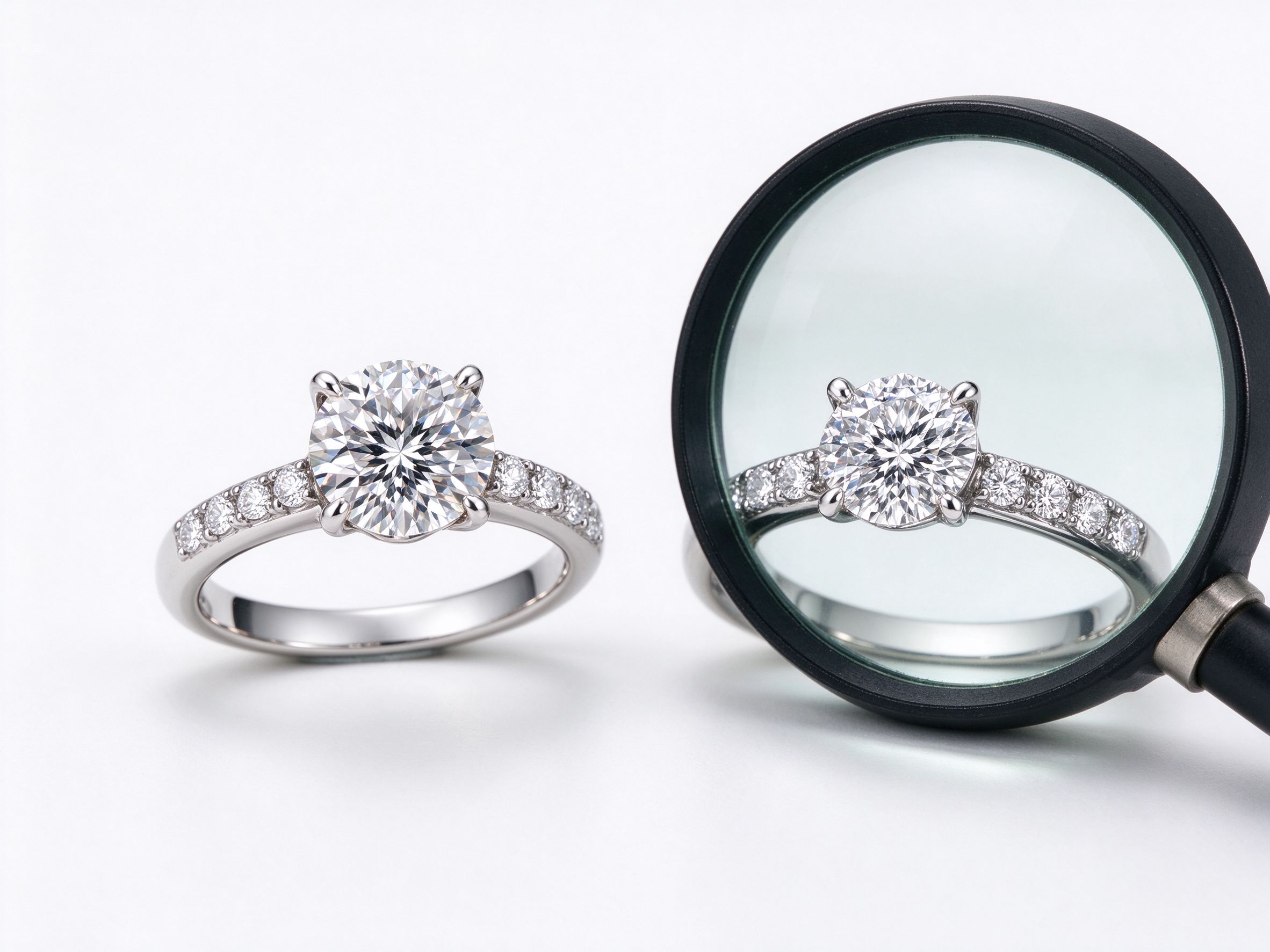
Why Moissanite Stud Setting Is Harder Than It Looks: Factory Insight
A pair of four-millimeter moissanite studs looks like the simplest product in a jewelry catalog. Yet on a factory line, stud earrings generate a disproportionately high reject rate relative to their price, because the setting work happens on a platform so small that the setter has almost no room to maneuver. This article explains why stud setting is genuinely harder than it appears, how our setter bench is tooled for it, and what that means for OEM pricing.
The Geometry Problem: Setting a Stone on a Platform the Size of a Pinhead
A stud setting is a shallow cup with prongs spaced around a tiny circular rim. The stone sits almost on top of the metal, with very little depth to seat it. On a ring, the setter can push the prong in from the side with room to spare; on a stud, the prongs are millimeters from the stone crown, and any slip of the pliers marks the facet.
The platform itself is often a closed-back disc, which means the setter cannot see the pavilion seat from below to confirm the stone is fully seated. The work is done by feel and by top-down observation under magnification. This is why experienced stud setters are paid differently than general bench hands, and why studios that hire casually show high chipping rates.
Our stud bench uses binocular loupes with a ring light so the setter sees the girdle seat before closing prongs. Without that magnification, even a skilled operator is working blind, and blind work on a brittle stone ends in chipped edges.
Moissanite Brittle Behavior: Why the Prong Must Close in Small Taps
Moissanite is very hard, but hardness is not the same as toughness. Along the pavilion facets, a moissanite stone can chip if a prong is forced against it with a single hard squeeze. The correct technique is to seat the stone dry, confirm it does not rock, and then close each prong in several small, controlled taps, alternating around the stone so the pressure stays balanced.
A rushed setter closes one prong fully and then moves to the next, which cants the stone and forces the later prongs to bend a misaligned seat. We train against this by requiring the setter to bring all prongs to light contact first, then finish each one in sequence. The cycle is slower per stone, but the chip rate is far lower.
When a chip does occur, it almost always shows at the girdle edge where the prong meets the stone. We inspect that contact point under magnification on every stud, because a hairline chip there will catch light as a dead spot and be the first thing a customer sees in a bright room.
Seat Matching: Cutting the Metal Cup to the Stone That Actually Arrives
Stones are never perfectly uniform, even within a matched parcel. The seat in a stud cup is pre-machined to a nominal size, but the setter must test-fit each stone and adjust the seat with a small burr before setting. Skipping this step means the stone either sits too high and rocks, or is forced into a seat that pinches it.
For stud pairs, we sort stones so the two seats receive stones that match in both size and table height. A pair where one stone sits a fraction higher reads as lopsided when worn, even though each earring alone looks fine. This matching step is invisible but it is the difference between a premium pair and a wholesale one.
We keep a small selection of burrs at each bench so seat adjustment takes seconds rather than a trip to a separate station. That time saving is why our stud throughput remains competitive despite the attention to detail.
Throughput vs Quality: How Many Studs a Good Setter Actually Completes
A trained stud setter on our line completes a measured number of units per day, and that number is the basis of our pricing. New operators take longer and chip more stones; experienced ones move faster with lower defect rates. When a quote seems suspiciously cheap, it usually means the factory is using untrained labor and absorbing chipped stones into the cost of goods.
We track units per setter per shift alongside reject rate, because a setter who goes fast but chips five percent of stones is actually more expensive than a slower one who errors at half a percent. The economics favor patience on this bench, and we price accordingly.
For an OEM brand, this means asking how the factory staffs its stud line. A studio that assigns general bench hands to studs because the product looks simple will produce a stud reject problem that shows up as returns three months later.
Post-Setting Inspection: The Magnification Check That Prevents Returns
After setting, every stud pair goes through a magnification inspection focused on three things: prong tips smooth, stone not rocking, girdle free of chips. Prong tips that are sharp or pointy catch hair and read as cheap under bright retail light, so we finish them smooth as a matter of course.
We also check that the stone is centered in the cup. A stone that sits even slightly off-center looks fine at arm length but obvious when the customer compares the pair. This is the kind of defect that studio product photos hide but that real customers notice.
Only after passing this bench does the pair move to plating, because correcting a sharp prong or a loose stone after plating damages the finish. The inspection gate is placed where correction is cheap, not after the piece is already finished.
Earring Line Workflow at Our Facility
Earring pair matching is a distinct QC step. Two stones that look identical as singles can read as mismatched once worn side by side, because the eye compares them directly. We pair earrings under balanced lighting, rotate them, and check that both stones fire equally before the pair is bagged. A mismatched pair is the most common stud complaint we see from competitors.
Weight balance matters for earrings more than most factories admit. A heavy stone on a thin post will droop forward on the lobe, looking tilted within an hour of wear. We tune the post angle and add a small rear weight so the earring sits upright, and we test the hang on a realistic earring display before approval.
Huggie and hoop earrings carry their own QC burden because the hinge and post must align perfectly after repeated opening. A hoop that gaps at the joint reads as cheap within seconds. We assemble each hinge with a deliberate break-in, test the snap, and inspect the seam under magnification so the join line is invisible.
Every price we quote as a factory is really three numbers stacked on top of each other: the cost of the rough moissanite, the cost of the metal and findings, and the cost of the labor that turns both into a finished setting. Buyers who compare only the final unit price rarely realize how much of that number is process rather than material. A shop that undercuts by ten percent is usually skipping one of those three layers, and the layer it skips is almost always the labor that controls fit, polish, and stone security.
Tooling amortization is the quiet number behind any custom order. When we cut a new wax mold or machine a custom die, that cost has to be spread across the first production run. This is why the minimum order quantity exists at all: it is not a hurdle we invented, it is the break-even point on engineering time. Reorders after the first run are dramatically cheaper because the tooling is already paid for and the line is already tuned.
Our quality control bench is where ninety percent of defective units would actually have been caught if the upstream process were perfect, but perfection upstream is expensive. The practical factory model is to inspect at three gates: after casting, after stone setting, and after plating. Each gate catches a different failure mode, and routing a unit backward when a gate fails is far cheaper than catching it after packaging.
Moissanite is harder to set than cubic zirconia, and that difference shows up in the reject rate. The stone is more brittle along its pavilion facets, so a prong pushed too hard will chip the girdle instead of bending. Our setters are trained to seat the stone dry first, check that it rocks evenly, and only then close the prongs with small repeated taps rather than one aggressive squeeze. This discipline is invisible in the final product but it is why our breakage rate stays below one percent.
Pair Matching and Post QC
Capacity planning is the difference between a two-week lead time and a six-week one. A factory that quotes you four weeks when its floor is already full is guessing. When we accept an OEM order, we reserve actual bench slots and plating-bath time against it before we confirm the date. If a slot slips, the customer knows before the shipment date, not after.
Plating thickness is where factories either save you money or cost you a sale later. A one-micron rhodium flash looks perfect on day one and wears through in weeks of retail handling. Our standard retail-grade finish is a measured three to five microns, verified by X-ray fluorescence on sampled pieces from every batch. The cost delta is small per piece; the cost of a return is not.
When a brand asks for private labeling, the work starts long before the first stone is set. We map their packaging, their insert card, their logo placement, and their target retail price against our production cost structure. A price point that looks comfortable at sample stage can become unprofitable at volume once packaging and inspection are added, so we price the full landed kit, not just the loose jewelry.
Grading loose moissanite into the settings we have produced is a matching exercise, not a grab bag. We sort every parcel by color, cut, and light performance before it reaches the setter, and we pair stones so that a matched pair of earrings or a full tennis bracelet reads as one continuous sparkle rather than a set of unrelated stones. This sorting step is labor that discount factories usually skip, which is why their matched sets show obvious stone-to-stone variation.
Lead times for repeat orders are always shorter than for first samples, and this is a signal you should use when evaluating a supplier. The first run includes sampling, mold approval, and line tuning. Once those are done, reorders flow through a stable process. A factory that cannot quote a meaningfully shorter reorder lead time has not actually industrialized your product, it is still hand-making each unit as a fresh project.
Welding and soldering are where a bracelet or chain either becomes durable or becomes a return. A cold joint that looks fine at inspection will flex open after a month of wear. Our welders use controlled heat, flux, and a post-weld pickle bath, and every structural joint is stress-tested by hand before polishing. We do not rely on the polish step to hide a weak solder seam.
The gap between a sample and mass production is where many OEM projects fail. A beautiful handmade sample that cannot be repeated at fifty or five hundred units is a marketing photo, not a product. We design every sample with the production line in mind: standard prong sizes, available stone dimensions, and findings we already stock. If a design cannot scale, we tell the brand before tooling is paid.
Custom Earring Tooling Economics
Surface preparation decides plating adhesion more than the plating chemistry itself. A piece that is not properly pickled, ultrasonic cleaned, and copper-flashed before rhodium will shed its finish regardless of how thick you plate it. Our pre-plating process is a fixed sequence because it is the single most common cause of jewelry that looks dull within its first retail season.
Consignment versus firm purchase is a commercial decision as much as a production one. For established brands we can split a larger order into staged shipments, which reduces their inventory risk and our working-capital strain. For new brands, the first run is usually firm because we have no sales history to underwrite the risk. This is normal factory economics, not a negotiation tactic.
Stone weight and metal weight are two different profit levers. We can hit a target retail price by under-sizing the stones or by under-using metal, and buyers should know which lever a factory pulled. Our quotes break out carat weight and gram weight separately so a brand can see exactly where the cost sits. A price that looks too good usually corresponds to a thinner shank or smaller-than-advertised stones.
Certification paperwork is part of manufacturing, not an afterthought. For lab-grown diamond orders routed through IGI, the stone serial numbers are recorded at intake, matched to the setting before assembly, and re-verified at final QC so the certificate number traveling with the finished piece is the one actually in the jewelry. Mixing stones between batches during production is the leading cause of certificate mismatch.
Polishing is the step most likely to be cut when a factory is behind schedule. A rushed polish leaves prong tips rounded, internal corners dull, and a surface that rhodium will not fully brighten. Our polishing schedule is a fixed labor budget per piece type because we learned the hard way that skimping here destroys the perceived value of even perfect stones.
The most profitable OEM relationships are the ones where the brand shares its sell-through data. When we know which sizes, metals, and stone grades reorder fastest, we pre-stage findings and rough stones, which shortens lead times and reduces defect rates. Treating the factory as a black box costs you money even if the unit price is nominally lower.
Tolerance creep is the slow enemy of consistent jewelry. First-piece inspection compares every critical dimension to the approved sample: post gauge, prong count, bail inner diameter, clasp tension. When a dimension drifts by a fraction of a millimeter across a production run, the factory corrects the bench before more units are made rather than at the end of the run. Catching drift late means scrapping a whole batch.
Lead Times, Capacity and Reorder Cadence
We price in the metal market, not against a competitor's poster price. Sterling silver and brass substrate costs move with commodity markets, so a quote held for ninety days is a promise we can only honor if the metal is locked at order confirmation. Brands that want price stability ask us to lock metal at PO; brands that chase a low number months later usually get a re-quote.
Accessibility of design changes matters at volume. A small redesign that takes ten minutes on one sample becomes a significant per-unit cost at two thousand units. When we evaluate a custom request, we estimate the change in cycle time, not just the change in material. A design that looks slightly different can quietly double the setter's time per piece.
Our reject rate is a number we track weekly, not per order. A factory that only hears about quality problems from customer returns has already lost control. Internal rejection at each gate gives us leading indicators: if stone-set rejects rise, the setter's fixture needs adjustment; if plating rejects rise, the pre-clean sequence is drifting. Catching the trend beats reacting to the complaint.
Packaging is integrated into the production schedule on purpose. The jewelry and the box, the pouch, and the thank-you card are assembled together at the end so a delayed box never holds up a finished shipment. Brands that source packaging separately often discover this mismatch at the worst possible time, when the goods are already in transit.
Minimum order quantities are flexible on mix but not on total labor. We can usually combine several related SKUs into one run to reach the MOQ threshold, because shared tooling and shared setup make small batches of similar pieces economical. What we cannot do is run ten completely unrelated designs at tiny quantities, because each design carries its own setup cost.
The finish on the inside of a setting tells you how a factory treats its junior operators. Rough interiors catch skin and hair and feel cheap the moment the customer puts the piece on. We require every piece to be deburred and polished internally before it moves to plating, even though the customer will rarely inspect that surface consciously. They will feel it.
Reverse logistics are priced into honest quotes. When a factory has never planned for returns, the brand absorbs them invisibly. Our production QC targets a defect rate low enough that returns are exceptions, and we track the return reason codes so that the next batch is improved by the last batch's failures rather than repeated.
Frequently Asked Questions
Why are my moissanite studs arriving with chipped stone edges?
Chips almost always come from forcing prongs in one hard squeeze on a brittle stone. A trained setter seats dry, checks for rock, and closes prongs in small alternating taps. Ask your factory about their setter training.
Can I reduce stud cost by ordering simpler settings?
The setting geometry matters more than ornamentation. A tiny closed-back stud on a narrow platform is actually harder to set than a larger open setting. Cost drivers are setter time and stone breakage, not decoration.
Why do one stone in each pair sit higher than the other?
This is seat and stone mismatch. A matching factory sorts stones by table height and adjusts each seat to the stone, rather than forcing every stone into an identical pre-cut cup.
What reject rate should I expect on stud earrings?
Internal stone-set rejects below two percent are healthy for small studs. A factory that cannot quote a reject rate is likely absorbing breakage invisibly into your unit price.
Do prong tips need to be finished smooth?
Yes. Sharp prong tips catch hair and read as cheap under bright light. Smooth prong tips are a post-setting inspection standard, not an optional polish step.
Conclusion
Stud setting is a specialized bench, not the entry-level work it appears to be. The small platform, closed back, and brittle behavior of moissanite demand trained hands, magnification, and a disciplined close-prong technique. Brands that understand this budget for setter labor and inspect for it, rather than discovering the cost in a wave of returned pairs.