
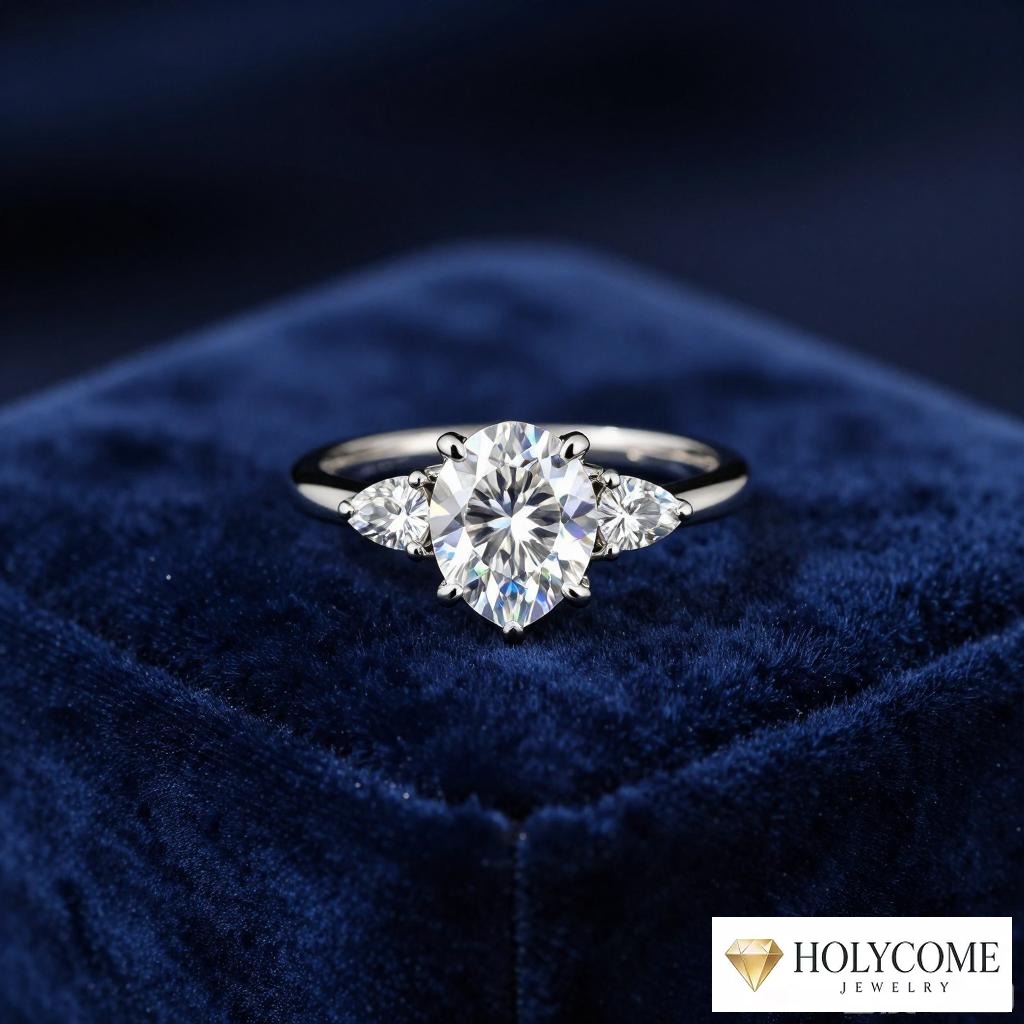
Three-stone moissanite rings carry meaning that resonates deeply with couples choosing moissanite for their engagement jewelry: three stones representing a couple's past, present, and future together. The design itself is older than its modern symbolic reading—three-stone rings date back centuries and were popularized in modern bridal by diamond campaigns that attached the past-present-future meaning in the 1990s—but the silhouette remains one of the top-selling engagement ring styles across all gemstone types. With moissanite, the three-stone design delivers exceptional visual presence, balanced sparkle, and rich symbolic weight at a price that puts the style within reach for far more couples than diamond three-stone rings.
At HOLYCOME, three-stone designs make up 12% of our moissanite engagement ring production, and they are especially popular for anniversary rings and upgrade pieces where customers want more symbolism and visual weight than a solitaire. This guide covers three-stone design configurations, stone size ratios, side stone shape options, production considerations, and ordering details for brands building a three-stone moissanite ring line.
01Why Three-Stone Works
Three-stone rings deliver a balance of size, symbolism, and wearability that no other silhouette quite matches. The center stone remains the focal point, but the two side stones add total sparkle surface area, create a wider spread across the finger, and create the visual impression of a larger overall piece without the price of a single large center stone. A 7mm center with two 4.5mm sides creates a ring with a total spread over 16mm across the finger—bolder than a solitaire, without the melee density of a full halo.
The symbolic weight of three stones adds emotional value to the design that simple solitaires cannot match. For many couples, the side stones represent their life before meeting, their current life together, and their future; for others, the stones represent friendship, love, and fidelity, or the couple plus their family. This built-in narrative makes three-stone rings particularly popular for anniversary gifts, renewal of vows, and "upgrade" rings purchased years after a simpler engagement ring.
| Center : Side Ratio | Typical Sizes (center : sides) | Visual Character | Best For |
|---|---|---|---|
| 1 : 0.50 (0.33ct each side) | 7mm (1.25ct) : 4.5mm (0.33ct) | Classic balance; center clearly dominates; sides accent without competing | Core bridal, most popular ratio |
| 1 : 0.65 (0.50ct each side) | 7mm (1.25ct) : 5mm (0.5ct) | Bold, substantial look; sides are prominent; more total sparkle | Statement pieces, customers wanting presence |
| 1 : 0.75 (0.75ct each side) | 7mm (1.25ct) : 5.5mm (0.75ct) | Nearly equal stones; reads as trilogy; very dramatic | Trilogy/anniversary pieces; less common for engagement |
| Graduated taper | Multiple tapering stones beyond three sides | Long, slender look; vintage feel | Vintage and Art Deco inspired designs |
The three-stone silhouette has a long history in jewelry, with three-stone and five-stone rings documented as far back as the 18th century. The specific "past, present, future" framing emerged in diamond marketing in the late 20th century but has since become a standard symbolic reading across gemstone types. Engagement ring style histories consistently rank three-stone designs among the top five enduring bridal silhouettes across price points.
02Side Stone Shape Options
The choice of side stone shape dramatically changes the look and feel of a three-stone ring, and this is where three-stone designs offer more variety than almost any other bridal silhouette.
Same-Shape Sides
Using the same shape for the center and sides creates the most cohesive, classic look. Round centers with round sides are the traditional three-stone style and remain the top-selling configuration. Oval centers with smaller oval sides create an elegant, elongated look that is particularly flattering on slender fingers. Cushion centers with cushion sides deliver a soft, romantic three-stone that reads as modern vintage. Same-shape sides are the safest choice for core collection SKUs because they appeal to the broadest range of customers.
Half-Moon and Crescent Sides
Half-moon (D-shaped) side stones are the most popular fancy-shape side stone for three-stone rings. They curve naturally against the center stone (especially cushions and ovals), creating a smooth, unbroken line from side to side without visible gaps, and their straight outer edge creates a clean end to the head. Half-moon sides with a cushion or oval center produce one of the most elegant three-stone configurations and account for roughly a third of our custom three-stone production.
Tapered Baguette Sides
Baguette-cut side stones (long rectangular step cuts, tapered to be narrower on the outside) create the classic Art Deco and Mid-Century three-stone look. Their straight lines and step-cut facets contrast with a brilliant-cut center, adding geometric elegance. Baguette sides work best with round, emerald, and asscher centers, and they read as more traditional and formal than round sides. Baguette three-stone rings are particularly popular with customers who want something that reads as "classic with an edge" rather than strictly traditional.
Trapezoid and Bullet Sides
Trapezoid (tapered four-sided) and bullet (pointed outer edge) side stones create bold, geometric three-stone designs with modern architectural character. They pair best with square and rectangular centers (princess, radiant, emerald, asscher) where their angular lines complement the center's geometry. These are not mass-appeal shapes, but they are popular with customers seeking something distinctive and modern.
Pear and Marquise Sides
Pear-shaped (pointed toward or away from center) and marquise side stones create distinctive, dramatic three-stone rings with a strong vintage feel. They are most commonly seen in Victorian and Edwardian reproduction pieces, and they work best with round, oval, or cushion centers. These shape combinations are less common in mainstream collections but are consistent sellers for brands specializing in vintage-inspired designs.
The choice of side stone shape dramatically changes the look and feel of a three-stone ring, and this is where three-stone designs offer more variety than almost any other bridal silhouette.
03Design and Proportion Details
Three-stone rings live or die by their proportions. Get the ratios and spacing wrong and the ring looks awkward; get them right and it feels perfectly balanced and substantial.
Center-to-Side Ratio
The golden ratio for three-stone engagement rings is side stones approximately 0.45–0.55 carat equivalent for a 1ct center, which translates to a diameter ratio of about 0.65–0.70 (i.e., a 7mm center with 4.5–5.0mm sides). This ratio makes the center clearly the star while giving the side stones enough presence to read as intentional elements rather than afterthoughts. Sides smaller than 0.3ct equivalent look like tiny accents; sides larger than 0.75ct per side compete with the center and read as a three-stone "trilogy" rather than an engagement ring.
Spacing and Gaps
Well-designed three-stone rings have minimal visible gaps between the center and side stones. The side stones sit very close to the center (0.2–0.5mm girdle-to-girdle clearance) to create a unified sparkle field across the head. Large gaps make the ring look like three stones set on a band rather than a cohesive design. CAD modeling is essential for getting spacing right across every size combination—pre-made settings that are designed for one specific center size leave awkward gaps when stones are swapped.
Head and Shank Design
Three-stone heads are wider than solitaire heads because they must accommodate three stones across. The head typically tapers from the wide stone platform down to the shank, which can be as thin as 2.0mm (dainty look) or as wide as 3.0mm (substantial traditional look). Three-stone rings with large side stones (over 0.5ct each) benefit from slightly thicker shanks to balance the visual weight of the wide head. Cathedral shanks (where the band rises to meet the head with arching shoulders) complement three-stone designs beautifully and add a traditional, architectural feel.
Prong Configuration
Each stone in a three-stone ring is held with its own prongs. Round centers typically use 4 prongs (or 6 for stones over 8mm); side stones use 2 prongs each (one on the outside, one shared on the inside next to the center) or 3 prongs. Shared prongs between center and sides create a tighter, more seamless look with less visible metal. Independent prongs create more separation between stones and make each stone more individually prominent.
04Production and Quality Standards
Three-stone rings demand more precise manufacturing than solitaires because they require aligning three stones to create a single balanced composition.
Stone Matching
Side stones must be closely matched to each other and to the center stone. The two side stones in a pair should be within 0.02mm of each other in diameter, within half a color grade of each other, and of identical clarity grade. Mismatched sides (one larger, one yellower, one more included) create an obviously lopsided look that even non-expert customers notice. Sides should also be matched to the center in color—at minimum F-G for white gold/platinum with a D-E center, or G-H for yellow/rose gold. Mismatched color between center and sides shows clearly under natural light.
Alignment and Setting
- All three stones are set at the same table height and angle, so their tops sit on a single horizontal plane; one stone set higher or tilted breaks the balanced look
- The two side stones are mirror images of each other—same distance from center, same angle, same prong coverage
- Prongs are sized proportionally for each stone: heavier prongs for the center, smaller prongs for the sides
- Girdle clearance between center and sides is consistent on both sides and sufficient to prevent the stones from touching (contact can cause chipping over time as the ring flexes)
Durability Considerations
The side stones in a three-stone ring sit at the outer edges of the head, where they are more exposed to knocks and impacts than a center stone in a solitaire. For this reason, side stone prongs are made slightly heavier relative to stone size than center prongs, and we use rounded-tip prongs that fully cover the girdle edge rather than sharp V-tips. Bezels are not commonly used for three-stone engagement rings (they look too heavy), but half-bezels on the outer edges of the side stones add protection for customers with active lifestyles.
05MOQ, Lead Times, and Wholesale Pricing
- In-stock three-stone designs: 5 pieces per SKU MOQ; 18–25 days for silver, 20–30 days for 14k/18k gold
- Custom three-stone (customer-specified stone sizes/shapes): 1 piece available for bespoke; 30 pieces per SKU MOQ for production runs; 35–50 day lead time; tooling/CAD fees $200–$500
- Stone default for three-stone: D-E color, VVS1 clarity Excellent cut center; F-VVS2 Excellent cut matched sides; H&A cut available as premium upgrade
- Side stone pairs: All side stones are sold as matched pairs cut from the same rough batch to ensure color/clarity matching
- Wholesale pricing (14k white gold classic three-stone, 7mm/1.25ct round center with 5mm/0.5ct round sides): $320–$430 per piece in quantity
- Ring sizing: Three-stone rings with plain shanks can be resized up to one size up or down without disturbing the head; three-stone pavé bands are best made-to-size
- QC pass rate: 98.5%—alignment and side-stone matching create slightly higher reject rates than solitaires; misaligned stones or mismatched sides are reset before shipment
06Merchandising Three-Stone Rings
Three-stone rings sell best when their symbolic meaning is presented clearly in product descriptions and photography. Product photos should show the ring head-on to emphasize the three-stone balance, plus side profile shots that show the stone proportions. Many brands offer three-stone rings as both engagement rings and anniversary bands, with slight modifications (smaller center, engraving) differentiating the two categories.
For your core three-stone SKU, start with the classic configuration: round center with round sides in the 1:0.5 ratio, offered in white, yellow, and rose gold with 1ct, 1.5ct, and 2ct center options. Add one baguette-side three-stone and one half-moon-side cushion three-stone as secondary options, and you cover the vast majority of three-stone demand without overstocking niche designs.
07FAQ: Three-Stone Moissanite Rings
What do the three stones in a three-stone ring represent?
The most common reading is past, present, and future—the center stone represents the present moment and current love, while the side stones represent the couple's lives before they met and their future together. Other common interpretations include friendship, love, and fidelity; the couple and their children; or the Holy Trinity in religious contexts. Many customers also choose side stone sizes that match their children's birth months or other personal meanings.
How large should side stones be relative to the center?
For engagement rings, side stones should be roughly one-third to one-half the carat weight of the center, or about 0.65–0.70 times the diameter. For a 1ct (6.5mm) center, 0.33ct (4.5mm) sides are the classic proportion. For anniversary bands and trilogy rings where no single stone dominates, sides can be closer to 0.75ct each for a more balanced three-stone look.
Are three-stone rings more likely to lose stones than solitaires?
No. A well-made three-stone ring with properly constructed prongs is just as secure as a solitaire. The outer side stones are slightly more exposed to side impacts than a center stone in a solitaire, but with heavy enough prongs and regular prong inspections (recommended once a year for any ring with prongs), stone loss is extremely rare. Our warranty data shows three-stone rings have stone loss rates comparable to solitaire rings over five years of wear.
Can three-stone rings be worn with a wedding band?
Yes, but the wide three-stone head requires a contour or notched wedding band to sit flush, just like halo rings. Straight bands will leave a gap. We produce matching curved wedding bands specifically for each three-stone design, and most customers who purchase a three-stone engagement ring buy the matching band at the same time.
Is a three-stone ring appropriate as an engagement ring or is it mainly for anniversaries?
Three-stone rings work beautifully as engagement rings. The past-present-future symbolism is perfectly suited to engagement, and the style has been used as an engagement ring for decades. That said, three-stone rings are also the most popular style for 10-year, 20-year, and 25-year anniversary rings—especially when the original engagement ring was a simple solitaire. The same design works for both purposes, with sizing and engraving adjusted to fit the occasion.
08Building Your Three-Stone Collection
Three-stone moissanite rings give customers symbolism, visual presence, and balanced sparkle that neither solitaires nor halos quite match. The design is versatile enough to work as both engagement and anniversary jewelry, and moissanite's affordability makes a design that was historically exclusive to larger budgets accessible to mainstream bridal customers. Explore three-stone options in our rings catalog, or work with our custom design team to develop exclusive three-stone designs for your brand, including matched three-stone pendants and earrings for coordinated collections.
A well-proportioned three-stone moissanite ring is a bridal piece with heart—it carries meaning, shows substantial sparkle, and looks equally appropriate as an engagement ring and an anniversary piece. The key to quality three-stone production lies in matched side stones, precise alignment, and proper proportions that balance the three elements without letting any one stone dominate awkwardly. Working with a manufacturer that cuts and matches its own moissanite and sets three-stone rings to tight alignment tolerances gives you pieces that feel balanced, intentional, and built for decades of wear.
09Frequently Asked Questions
Is moissanite a viable diamond alternative for retail?
Yes for price-sensitive buyers who want brilliance and hardness. It ranks 9.25 on the Mohs scale and costs a fraction of a natural diamond of the same size, so it turns fast in bridal and fashion lines.
What is the minimum order?
MOQ starts at 50 pieces per design for stock items; custom cuts and private-label settings start at 100 to 300 pieces.
Are certificates included?
Yes. Every parcel ships with GRA or IGI documentation listing carat weight, color grade and cut.
What are the lead times?
Samples 3 to 5 days. Bulk 15 to 20 days under 500 pieces, 25 to 30 days for custom work.