
The shape of a moissanite is the first thing a customer notices when a piece comes out of the box. Round brilliants dominate bridal sales, but fancy shapes—cushion, oval, princess, emerald, pear, marquise, radiant, Asscher, heart, and old mine cuts—drive fashion and alternative bridal lines, and demand for non-round moissanite has grown steadily as the material moves mainstream. Each moissanite cut performs differently in terms of light return, rough yield, setting considerations, and customer appeal, and bulk buyers need to match the shape to the collection, price point, and target customer.
HOLYCOME cuts more than 30 different moissanite shapes in our Wuzhou cutting facility, from calibrated 0.8mm rounds for pavé melee to 15mm custom fancy cuts for signature pieces. Our production data across 14 years gives us a clear view of which shapes drive the lowest defect rates, highest customer satisfaction, and best margins for jewelry brands.
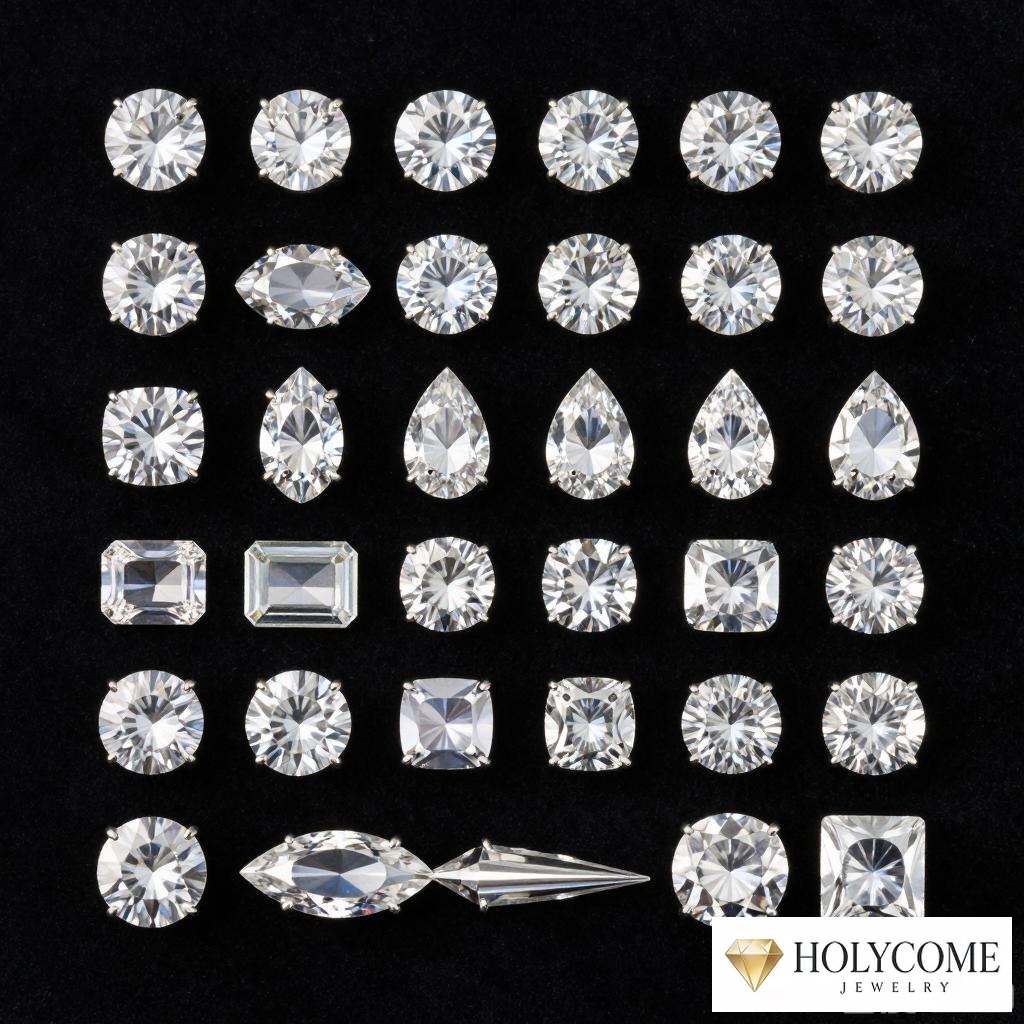
01Popular Moissanite Cuts and Their Characteristics
Every cut shape has its own facet structure, light performance, and setting requirements. The table below compares the most commonly ordered wholesale moissanite shapes across key metrics B2B buyers care about.
| Cut Shape | Facet Count | Fire / Brilliance | Rough Yield | Best For | Popularity (Wholesale) |
|---|---|---|---|---|---|
| Round Brilliant | 57–58 | Maximum fire and brilliance (98% light return) | ~40% | Engagement rings, studs, solitaire pendants | #1 (65% of orders) |
| Cushion Cut | 64–74 (modified brilliant) | Excellent fire, softer "pillowy" sparkle | ~50% | Vintage-inspired bridal, halo rings | #2 (10%) |
| Oval Cut | 57–58 (elongated brilliant) | Excellent brilliance, elongated finger-lengthening look | ~45% | East-west settings, modern bridal | #3 (8%) |
| Princess Cut | 57–76 (square brilliant) | Bright, sharp corner sparkle; strong fire | ~65% | Modern geometric bridal, solitaire rings | #4 (5%) |
| Emerald Cut | 50 (step cut) | Mirror-like hall-of-mirrors effect, understated elegance | ~55% | Art Deco, vintage, minimalist pieces | #5 (4%) |
| Pear Cut | 58–71 (teardrop brilliant) | Excellent fire, unique asymmetric shape | ~40% | Pendant necklaces, statement rings | #6 (3%) |
| Marquise Cut | 58 (navette brilliant) | Maximum size appearance per carat, bold sparkle | ~35% | Elongated statement rings, accent stones | #7 (2%) |
| Radiant Cut | 70 (cropped corner brilliant) | Combines emerald outline with brilliant sparkle | ~55% | Modern bridal, high-fire pieces | #8 (2%) |
| Asscher Cut | 50–58 (square step cut) | Symmetrical hall-of-mirrors, vintage feel | ~55% | Art Deco, vintage-inspired rings | #9 (1%) |
Rough yield matters for pricing because shapes that waste less raw crystal cost less per finished carat to produce. Princess cuts have the highest yield of any popular shape (~65%) because their square outline closely matches the cross-section of a moissanite boule, which translates to a lower per-carat price for buyers. Marquise and pear cuts have the lowest yield because their pointed ends require cutting away much more of the rough, which is reflected in their slightly higher per-carat cost.
The American Gem Society (AGS) and GIA both provide detailed cut grading standards for diamonds that serve as a reference framework for moissanite cuts as well, though the optimal angles differ because of moissanite's higher refractive index. Wikipedia's diamond cut reference documents the history and geometry of the major cut shapes used across the gem industry, many of which have been adapted for moissanite.
02Performance Differences Between Cut Shapes
Not all shapes deliver the same sparkle profile. Round brilliants remain the most popular because the symmetrical, mathematically optimized facet pattern returns the maximum possible amount of light to the viewer's eye, delivering both strong white brilliance and the rainbow fire moissanite is known for. Fancy shapes make intentional trade-offs between light return and visual character.
Brilliant Cuts vs. Step Cuts
Brilliant cuts (round, cushion, oval, princess, pear, marquise, radiant) use triangular and kite-shaped facets arranged to maximize light return through total internal reflection. These cuts show moissanite's signature fire at its strongest, with rainbow flashes in all lighting. Step cuts (emerald, Asscher, baguette) use long, parallel rectangular facets that create a "hall of mirrors" effect instead of sharp colored flashes. Step-cut moissanite looks more subdued and elegant, with less fire but a sophisticated, architectural look that appeals to customers who prefer a less flashy stone.
Brilliant cuts are the safe choice for bridal lines, where customers expect sparkle. Step cuts work well for fashion jewelry, menswear pieces, and customers seeking a vintage or alternative look.
Bow-Tie Effect in Fancy Shapes
Elongated fancy shapes—oval, pear, marquise, and some radiant cuts—can exhibit a dark "bow-tie" shaped shadow across the center of the stone when the pavilion angles are not precisely cut. The bow-tie happens because light leaks out through the pavilion in that central zone rather than reflecting back to the viewer. A small amount of bow-tie is normal and adds contrast, but a large, dark bow-tie is a cut defect that makes the stone look dull in the center. HOLYCOME uses computer-optimized angle sets for all fancy shapes that minimize bow-tie visibility while maintaining strong light return across the rest of the stone. Any fancy cut showing a pronounced dark bow-tie under normal lighting is rejected during QC and recut.
Moissanite-Specific Cut Considerations
Because moissanite is doubly refractive (birefringent), the orientation of the crystal's optic axis relative to the table affects the appearance of fancy shapes differently than rounds. In step cuts like emerald and Asscher, poor crystal orientation can create visible double vision of the facet lines, which is distracting to the naked eye. Our cutters orient every fancy-shape rough to align the optic axis perpendicular to the table within 2 degrees, just as we do for rounds, which minimizes visible double refraction and keeps the look clean.
Not all shapes deliver the same sparkle profile. Round brilliants remain the most popular because the symmetrical, mathematically optimized facet pattern returns the maximum possible amount of light to the viewer's eye, delivering both strong white brilliance and the rainbow fire moissanite is known for. Fancy shapes make intentional trade-offs between light return and visual character.
03Setting and Calibration Considerations by Shape
Different shapes require different setting approaches, and calibration tolerance matters more for some shapes than others. Understanding these differences helps you avoid production issues when setting thousands of stones in a mass production line.
Calibration Tolerance Requirements
Round stones are forgiving in prong settings because the curved edge distributes pressure evenly and small size variations can be absorbed by adjusting prong tightness. Fancy shapes with sharp corners (princess, marquise, pear, radiant) are much less forgiving. A 0.1mm size error on a princess cut means the corners don't seat correctly in V-tip prongs, leading to chips during setting or stones that sit crooked in the mount. We hold tighter calibration tolerance (±0.03mm) for fancy shapes with corners, vs. ±0.05mm for rounds.
Shape-Specific Setting Risks
- Princess cuts: Sharp corners are chipping points. Always use V-tip prongs that fully cover the corner points; avoid exposed corners in tension settings.
- Marquise and pear cuts: The pointed ends are the most vulnerable to chipping and require V-tip prongs. These shapes also show uneven girdle thickness more visibly than rounds, so inspect girdles before setting.
- Emerald and Asscher cuts: Large open tables make inclusions and polish marks more visible than in brilliant cuts. Specify VS1 or better clarity for step cuts over 5mm.
- Oval cuts: Check for even outline symmetry; lopsided ovals are immediately visible when set. We sort for outline symmetry ratios within ±0.02 on length-to-width.
- Cushion cuts: Come in "modified brilliant" (more fire) and "classic" (softer, chunkier facets). Confirm which style your supplier is shipping, as they look very different.
04Factory Production Capabilities and Lead Times by Shape
Production capacity and lead times vary by shape because of differences in cutting complexity, rough yield, and demand. Our standard wholesale offerings cover the following parameters:
In-Stock Shapes and Sizes (7–10 Day Lead Time)
- Round brilliant: 0.8mm–15mm, D-J color, VVS1-SI1 clarity
- Cushion modified brilliant: 3mm–12mm, D-H color, VVS1-VS1
- Oval brilliant: 3x2mm – 12x8mm, D-H color, VVS1-VS1
- Princess cut: 2mm–10mm, D-H color, VVS1-VS1
- Emerald cut: 3x2mm – 11x9mm, D-H color, VVS1-VS1
- Pear cut: 4x3mm – 12x8mm, D-H color, VVS1-VS1
Made-to-Order Shapes (15–20 Day Lead Time)
- Marquise, radiant, Asscher, heart, old mine, old European, hexagon, trillion, rose cut, and custom proprietary cuts
- Custom length-to-width ratios (e.g., elongated cushions at 1.2:1 ratio, slim ovals at 1.7:1)
- Fancy colored moissanite in any cut shape (blue, green, yellow, champagne, gray, black)
- Sizes over 12mm (all shapes) and special orders for high-volume production runs over 5,000 pieces
MOQ Structure
Minimum order quantities reflect production setup costs for each shape and size:
- Standard rounds: 10 pieces per size (under 3mm melee: 100 pieces per size)
- Stock fancy shapes (cushion, oval, princess, emerald, pear): 20 pieces per size
- Made-to-order shapes: 50 pieces per size; custom cuts require 500–5,000 piece MOQ depending on complexity
- Finished jewelry (settings with stones): 5 pieces per SKU for white-label in-stock items; 30 pieces per SKU for custom OEM designs
Our quality pass rate across all shapes averages 99.2% after final QC. Fancy shapes have a slightly higher reject rate (1.2% vs. 0.6% for rounds) because of the tighter calibration and symmetry requirements, but rejected stones are always recut rather than shipped, so parcels consistently meet the stated grade.
05Custom and Proprietary Cut Development
Brands looking to differentiate their moissanite line from generic market offerings often develop a proprietary cut exclusive to their brand. We work with OEM clients through the full cut development process:
- Concept phase (week 1–2): Share reference images, light performance goals, and brand aesthetic direction. Our design team produces 2–3 CAD renderings of proposed facet patterns.
- Prototype cutting (week 3–5): We cut 10–20 prototype stones in the chosen design and run light performance analysis, side-by-side comparisons against standard rounds, and durability testing.
- Refinement (week 6–8): Based on prototype feedback, we adjust facet angles and proportions, cut a new batch of refined prototypes, and have you approve the final design in person.
- Production setup (week 9–12): We create custom cutting laps and fixtures for the new design, train our cutting team on the new cut, and produce the first bulk order.
Proprietary cut development requires a 5,000-piece minimum order commitment over 12 months and a one-time tooling/development fee of $2,000–$5,000 depending on design complexity. Several of our largest OEM partners use exclusive cuts that cannot be found anywhere else in the market, and they consistently report 20–30% higher margins on those proprietary lines compared to their generic moissanite SKUs.
06FAQ: Moissanite Cuts and Shapes
Which moissanite cut looks most like diamond?
Round brilliant cut moissanite, when cut to proportions optimized for silicon carbide's refractive index (not diamond proportions), looks most like a well-cut diamond in overall appearance—though it will show more colored fire. For customers who want the most diamond-subtle look, specify an H&A (hearts and arrows) cut with slightly tighter angles to reduce excess fire while maintaining brilliance.
What is hearts and arrows (H&A) moissanite?
Hearts and arrows is a precision-cut variant of the round brilliant that uses extremely tight symmetry (within 0.2% on all facets) to produce a visible "hearts" pattern through the pavilion and "arrows" pattern through the crown when viewed with a special H&A viewer. H&A moissanite commands a 15–20% price premium over standard excellent cut rounds and appeals to customers who value cut precision. We offer H&A cutting for rounds 3mm and up.
Which cut looks the largest for its carat weight?
Elongated shapes look larger per carat weight because they spread more across the finger. Marquise cuts have the largest face-up surface area per carat, followed by oval, pear, and emerald cuts. Round brilliants have the smallest face-up diameter per carat because they carry more weight in the pavilion depth. If your customers want a "big" look at a given price point, elongated fancy shapes deliver that.
Do certain cuts chip more easily than others?
Shapes with sharp points (marquise, pear, princess) are more vulnerable to chipping at those points during setting and wear if not properly protected by prongs. Round brilliants are the most chip-resistant overall shape because they have no sharp corners and the even girdle distributes impact evenly across the circumference. For customers with active lifestyles who worry about damage, rounds or cushion cuts (with their rounded corners) are the safest recommendation.
Can you cut moissanite to match a specific diamond cut I use?
Yes. We can calibrate our moissanite cuts to match the exact proportions, facet pattern, and outline of any branded or proprietary diamond cut you currently use, so the moissanite pieces in your collection have the same visual character as your diamond pieces. Send a sample stone or CAD specifications and we will match it.
07Building a Balanced Moissanite Shape Inventory
For brands building a new moissanite collection from scratch, we recommend starting with a shape mix that mirrors market demand while leaving room for unique pieces:
- 60% rounds (the staple; covers solitaires, studs, pendants, and most basic settings)
- 12% cushions (vintage and halo bridal demand continues to grow)
- 10% ovals (strong growth in modern bridal and east-west settings)
- 8% emerald/Asscher (art deco and minimalist niche; loyal, high-margin customer base)
- 5% princess (traditional square bridal market)
- 5% specialty shapes (pear, marquise, radiant, heart for statement pieces and seasonal drops)
You can browse available shapes and sizes in our loose moissanite catalog, or explore pre-set pieces in our ring, earring, and pendant collections. For custom cut development or proprietary shape requests, contact our OEM team through the custom jewelry page to discuss your project.
The moissanite cut you specify shapes everything from production yield to customer satisfaction to the retail price your brand can command. Round brilliants remain the low-risk, high-volume workhorse for a reason, but expanding into well-cut fancy shapes opens up new customer segments and higher-margin SKUs that set your brand apart from generic moissanite resellers. Working with a manufacturer that cuts to tight tolerances, controls crystal orientation to minimize double refraction, and sorts for bow-tie and symmetry on every fancy shape ensures your stones look consistent across every batch.
08Frequently Asked Questions
Is moissanite a viable diamond alternative for retail?
Yes for price-sensitive buyers who want brilliance and hardness. It ranks 9.25 on the Mohs scale and costs a fraction of a natural diamond of the same size, so it turns fast in bridal and fashion lines.
What is the minimum order?
MOQ starts at 50 pieces per design for stock items; custom cuts and private-label settings start at 100 to 300 pieces.
Are certificates included?
Yes. Every parcel ships with GRA or IGI documentation listing carat weight, color grade and cut.
What are the lead times?
Samples 3 to 5 days. Bulk 15 to 20 days under 500 pieces, 25 to 30 days for custom work.