
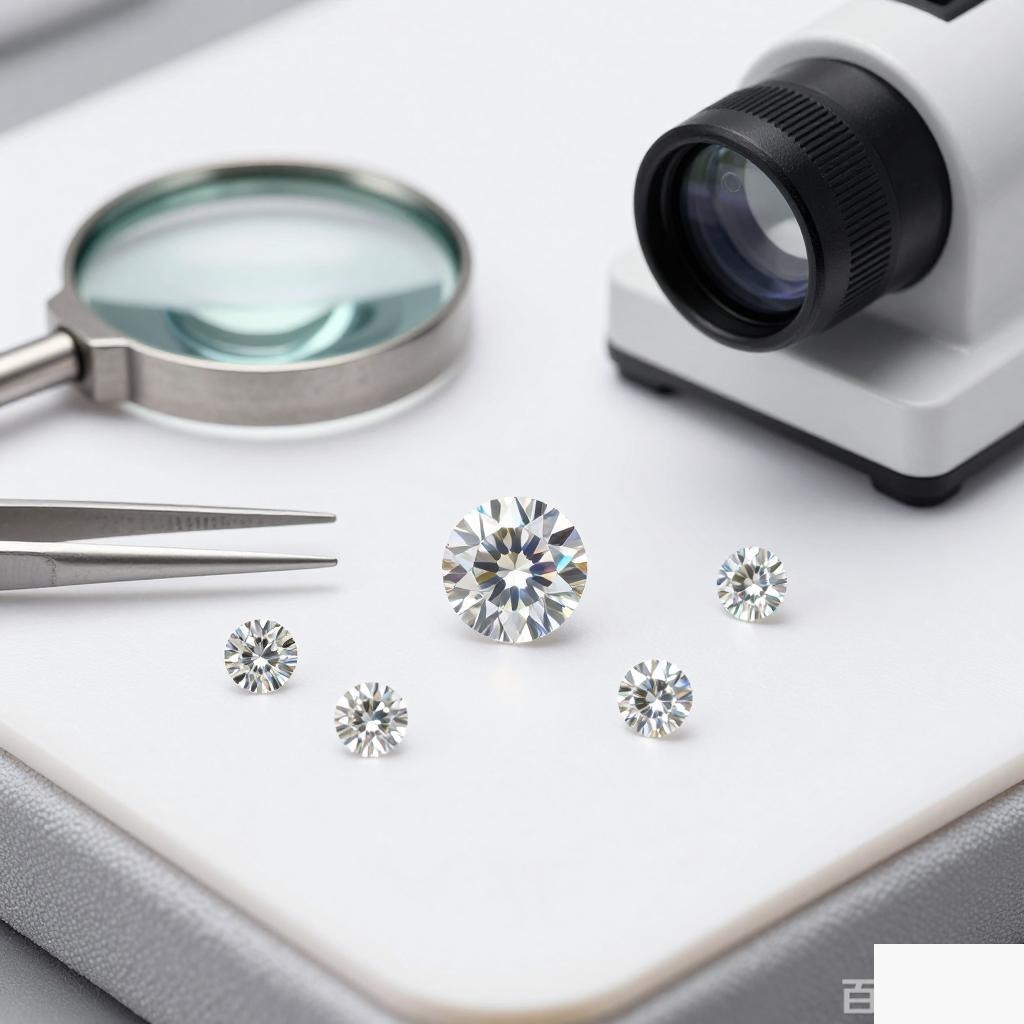
Two 6.5mm round moissanite stones can look dramatically different on the finger even when they have identical carat weight, color grade, and clarity grade. The difference is moissanite cut quality. Cut is the one factor entirely controlled by human hands, and it is the single biggest driver of how much sparkle, fire, and brilliance a stone produces. Yet many buyers sourcing loose moissanite for their jewelry lines treat cut as an afterthought—choosing stones by size and price alone and wondering later why some pieces pop in the showcase and others look flat or washed out. This guide breaks down how we grade moissanite cut quality at our HOLYCOME factory, what ideal/excellent/good actually mean on the production floor, and how to spec cut when placing wholesale orders.
01Why Cut Quality Drives Visual Performance
Moissanite is already a high-dispersion, high-refraction material—its refractive index (2.65) is higher than diamond (2.42), and its dispersion (0.104) is more than double diamond's (0.044). Those numbers mean a perfectly cut moissanite has the raw material to out-sparkle a diamond of the same size. But a poorly cut moissanite leaks light through the pavilion, looks dark in the center, shows a weak bow-tie on fancy shapes, or throws a washed-out fisheye effect that makes the stone look glassy rather than brilliant.
Light performance in a faceted stone is a geometry problem. Light enters through the crown (top), bounces off the pavilion facets (bottom), and reflects back out through the table to your eye. If the pavilion angles are too shallow, light exits through the back of the stone instead of returning to the viewer, and the stone looks dead. If the pavilion is too deep, light leaks out the side and the center looks dark. If the table is oversized or the crown is too flat, fire (the colored flashes) is sacrificed for spread (visible size). Every facet has to be placed within a narrow range of angles for maximum light return.
What makes this hard with moissanite specifically is that silicon carbide is a doubly refractive material and grows in hexagonal crystals, which means cutters cannot always just copy a diamond's proportions blindly. Optimizing moissanite requires cutting ratios tuned specifically to SiC's refractive index—something many low-cost cutters skip in favor of maximum material yield.
02How We Grade Moissanite Cut on the Factory Floor
We grade every loose moissanite we cut or source into three production tiers: Ideal Cut, Excellent Cut, and Commercial (Good) Cut. These are not marketing labels; they correspond to measurable proportion ranges that we verify with a Helium Light Performance scanner and idealscope imaging before the stone leaves our quality control room.
| Grade | Table % | Crown Angle | Pavilion Angle | Girdle Thickness | Depth % | Symmetry | Light Return |
|---|---|---|---|---|---|---|---|
| Ideal (H&A) | 53–57% | 33.5–35.5° | 40.6–41.2° | Thin–Med (0.7–1.5%) | 60.5–62.5% | Excellent (H&A pattern) | 97%+ |
| Excellent | 52–60% | 32–36° | 40.2–41.6° | Thin–Slightly Thick (0.5–2.0%) | 59–63.5% | Very Good | 93–97% |
| Commercial (Good) | 50–65% | 30–38° | 39–43° | Varies (0.3–3.0%) | 57–66% | Good | 85–93% |
Notice the Ideal ranges are tight—we hold crown and pavilion angles within roughly one degree of target. That tight tolerance is what produces the crisp hearts-and-arrows pattern visible through an idealscope and the bright, balanced light return buyers associate with premium moissanite.
We grade every loose moissanite we cut or source into three production tiers: Ideal Cut, Excellent Cut, and Commercial (Good) Cut. These are not marketing labels; they correspond to measurable proportion ranges that we verify with a Helium Light Performance scanner and idealscope imaging before the stone leaves our quality control room.
03Ideal Cut with Hearts and Arrows
Our Ideal tier (sometimes called Super Ideal or Premium by other vendors) is cut to hearts-and-arrows (H&A) proportions. Under a dedicated H&A viewer, the stone displays eight symmetrical arrows through the table and eight symmetrical hearts through the pavilion when viewed from below. The pattern is a quick visual proof that the facets are aligned to very high symmetry—within about 0.5% of perfect on each of the 57 or 58 facets.
H&A cut is not a gimmick. That alignment level directly correlates with light return because misaligned facets leak light at predictable angles. A genuine H&A stone must show the full pattern with no missing hearts, no broken arrows, and even spacing. Many vendors advertise "hearts and arrows" on stones that show a blurry approximation under casual inspection; the real pattern is sharp, high-contrast, and visible on every one of the eight directions.
We use Idealscope and ASET imaging on every Ideal-grade stone we ship. The Idealscope uses a red reflector to show areas of the stone returning light (red, good), leaking light (white/transparent, bad), or blocked by the viewer/observer (black, normal). A well-cut Ideal round shows a clean red ring with sharp black arrow-shaped contrast and minimal white leakage under the table.
Ideal cut stones carry roughly a 25–40 percent price premium over commercial cut in the same size and color, and they are reserved for flagship engagement ring programs, premium private-label lines, and customers who specifically compete on optical performance.
04Excellent Cut
Excellent cut is our production workhorse and the grade we recommend for most wholesale engagement ring programs. It delivers roughly 93–97 percent of the light return of an Ideal cut at 70–80 percent of the price. The proportions are held to a slightly wider tolerance (crown 32–36°, pavilion 40.2–41.6°), and the hearts-and-arrows pattern may be slightly less crisp or partially visible, but the stone still looks bright and fiery to the naked eye.
Most independent jewelry stores and DTC brands we supply build their core engagement ring line around Excellent cut stones and reserve Ideal cut for their top tier or signature pieces. In side-by-side showcases under normal retail lighting, the visual difference between Excellent and Ideal is subtle; it becomes obvious under direct spotlight or idealscope comparison.
05Commercial (Good) Cut
Commercial cut (sometimes just called "factory cut" in the market) is the bulk-produced grade found on most entry-level moissanite from large-volume manufacturers. Proportions are held loosely to maximize yield from the rough crystal, and the stones can have tables as wide as 65 percent or pavilions as deep as 43°, both of which reduce sparkle or create a fisheye/window effect where you see through the stone instead of seeing brilliance.
Commercial cut stones have a place in the market. They are the right choice for fashion jewelry, earrings, pendants, and price-point promotional pieces where the stone is small (under 5mm, 0.5ct equivalent) or where the design uses many stones and per-unit cost matters. They are a poor choice for center stones over 6mm (1ct equivalent) in engagement rings, where cut differences become impossible to miss at arm's length.
06Recognizing Poor Cut Before You Buy
B2B buyers do not always have an idealscope on hand during supplier visits. A few quick visual checks catch most bad stones:
The table test. Place the stone face-down on a printed page or a white piece of paper with black text. If you can clearly read text through the stone, it is windowing—a sign of a shallow pavilion. A well-cut stone acts as a mirror and does not let you see through it.
The face-up white-out test. Hold the stone face up under a single white light bulb (not multiple retail lights). If the center of the stone looks washed out or grayish-white instead of returning bright white light, the pavilion angles are off. This is the "fisheye" effect.
The dark-center test. Look at the stone under diffused daylight (shade outdoors or next to a bright window). If the center looks dark or black while the edges sparkle, the pavilion is too deep.
The bow-tie check (fancy shapes). Oval, pear, marquise, and radiant cuts can show a dark bow-tie-shaped shadow across the center. A small, subtle bow-tie is normal on these shapes. A large, black bow-tie visible under normal lighting is a sign of poor cutting and should be rejected.
Spotlight sparkle. Hold the stone about 12 inches under a single strong point light (like a phone flashlight in a dark room) and rock it slowly. A well-cut stone throws sharp, bright flashes in all directions as it moves; a poorly cut stone looks dull or shows flashes from only a narrow angle range.
07How Cut Affects Apparent Size
A common misconception: larger spread (diameter for a given carat weight) is always better. A shallow cut stone can have a larger diameter because more of its weight is pushed to the edges, but it will look washed out and dead face-up. A properly cut stone can be 0.1–0.2mm smaller in diameter than a shallow stone of the same weight but look dramatically bigger on the finger because it returns light and appears bright.
At our factory, we cut to diameter targets rather than weight targets. A 1.0ct equivalent round is 6.5mm in diameter; a 1.5ct is 7.5mm; a 2.0ct is 8.0mm. We hold diameter within +/-0.05mm and let weight fall where it falls at ideal proportions. Stones cut to weight targets often end up deep and dark to hit the carat number, which is a problem diamond buyers also face.
The GIA's diamond cut grading system pioneered the modern approach to proportion-based cut grading; while moissanite is not graded by GIA, the optical principles transfer directly. The Wikipedia article on gemstone cut summarizes the history of proportion grading. The FTC Jewelry Guides also require that cut claims ("ideal cut," "hearts and arrows") be substantiated, which is why we back those labels with measurable scanners and imaging.
08Cut and Fancy Shapes
Round brilliant cut has the most standardized proportion set. Fancy shapes are more forgiving in some ways and more demanding in others:
Cushion and oval cuts vary enormously between brands. The "crushed ice" cushion (small facets, high dispersion, flashy look) and the "antique cushion" (larger facets, chunkier sparkle) are cut to very different proportions, and the choice is aesthetic rather than a quality question. Ask your supplier for the exact faceting pattern you want.
Pear and marquise cuts require precise head-to-belly ratio and V-tip alignment. A ratio of 1.45:1 to 1.70:1 is the most popular for pears; marquise runs 1.8:1 to 2.2:1. Ratios outside those ranges look unbalanced.
Princess and radiant cuts need well-sized corner facets to avoid chipping risk at the sharp points. Look for a centered X-pattern through the table and no large dark windows.
Emerald and Asscher cuts (step cuts) are the most revealing of poor cutting because every facet line must be perfectly parallel and the table must be perfectly centered. Badly cut emeralds show obvious crooked facets and windowing.
09Factory Production Data
Out of our monthly production of roughly 48,000 loose moissanite stones, the grade split runs approximately: 8 percent Ideal H&A, 42 percent Excellent, 40 percent Commercial, and 10 percent rejected for out-of-spec proportions or polishing defects. The 10 percent reject rate is why our prices are not the lowest in the Yiwu market—but it is also why wholesale buyers who run branded stores consistently come back; consistent cut quality produces consistent showcase performance, which produces consistent sell-through.
Our in-line quality control uses three checks on every stone: (1) Sarin-style proportion scanning after bruting and polishing, (2) Idealscope imaging before grading, and (3) a trained QC grader's visual inspection under 10x loupe and daylight-equivalent lighting. Stones that fall outside the stated tolerance for their grade are either re-cut (if material allows) or downgraded to the matching commercial grade. We do not ship mis-graded stones, and every Ideal and Excellent stone comes with a QC card listing its measured proportions.
10Real Client: DTC Bridal Brand
A direct-to-consumer bridal brand in California came to us in 2023 after working with a different Chinese moissanite supplier for two years. Their complaint: customer reviews consistently mentioned that their 3ct oval halo ring "looked dull" or "looked fake" compared with customer expectations from online photos. They sent us three sample rings from their existing stock, and our QC found the problem immediately: the ovals were cut shallow (pavilion depth 38.8 degrees, below the 40-degree minimum for light return) to hit a target weight at a low cost. The stones windowed badly face-up—you could read text through them.
We re-cut their signature oval to Excellent-grade proportions (pavilion 40.8 degrees, crown 34 degrees, ratio 1.5:1) and supplied 400 pieces in the first production run. Their return rate on the ring dropped from 11 percent to 2.8 percent within six months, and their review average rose from 4.1 to 4.8 stars out of 5. The per-unit cost went up $18; the revenue impact from lower returns and higher conversion was roughly 12x that difference.
11How to Spec Cut When Placing a Wholesale Order
Most suppliers will default to commercial cut unless you specify tighter tolerances on the PO. When you place an order, state the following in writing:
- Grade: Ideal H&A, Excellent, or Commercial. If you are ordering Excellent or above, specify acceptable crown and pavilion angle ranges.
- Diameter tolerance: +/-0.05mm for center stones, +/-0.1mm for melee.
- Girdle specification: thin to medium for rounds, slightly thick at points for fancy shapes to prevent chipping.
- Symmetry and polish: very good to excellent for center stones, good for small melee.
- Certification and inspection: ask for QC reports on center stones over 6mm; require a sample lot approval before the full production run.
Our loose moissanite page lists the available grades with price breaks for volume, and we can supply proportion reports for any order above MOQ (30 pieces for stocked grades, 100 pieces for custom cuts). Cut quality pairs naturally with setting quality in our moissanite engagement rings program, where Excellent-cut centers are the default. For earrings and necklaces, Commercial cut melee is often the economic choice for small accent stones, but our designers still recommend Excellent cut for any center stone larger than 5mm.
12Frequently Asked Questions
Does moissanite get GIA cut grades like diamond?
GIA does not issue full cut grade reports for moissanite the way it does for diamond. Some labs (including GIA and IGI) will issue identification reports for moissanite, but they do not assign an Excellent/Ideal cut grade the way they do for diamonds. Buyers rely on proportion data, Idealscope/ASET images, and trusted suppliers instead.
What's a realistic price difference between Ideal and Commercial cut?
For a 6.5mm (1ct equivalent) round D-color VVS moissanite, expect roughly $18–28 per stone for commercial cut, $35–50 for excellent cut, and $55–80 for ideal H&A cut, depending on volume and whether the stone is branded (Forever One, etc.). The price gap narrows on smaller sizes and widens on large carat sizes.
Is an Ideal cut worth the premium for an engagement ring center stone?
For a center stone over 1.5ct (7.5mm) in a flagship bridal line, yes—the difference is visible to customers in side-by-side comparison and shows up in conversion and return rates. For accent stones, earrings, pendants, or smaller center stones under 1ct, Excellent cut delivers most of the visual value at a meaningfully lower cost.
Can a badly cut moissanite be re-cut?
Sometimes. Re-cutting removes 5–15 percent of the material weight and costs $15–45 per stone depending on size and damage. It is usually worth it for large premium stones (3ct+) and never worth it for small melee or commercial-grade material, where replacement is cheaper.
How do I test cut quality without an idealscope?
Use the four visual tests above: read-through, face-up white-out, dark center under daylight, and spotlight sparkle. Together they catch 90 percent of bad cuts. A $15 handheld idealscope adds the last 10 percent and is worth having if you source more than a few hundred stones a year.
Do all moissanite brands (Charles & Colvard, Holycome, etc.) cut to the same proportions?
No. Each brand cuts to its own proprietary faceting blueprint. Charles & Colvard Forever One uses their own pattern; our HOLYCOME Ideal cut uses a modified brilliant with slightly tighter crown/pavilion angles optimized for moissanite's RI; budget brands cut to whatever yields the most from the rough. Always ask for proportion specs, not just a brand name.
Moissanite cut quality is not a mysterious aesthetic judgment—it is a measurable engineering target. Define the proportion tolerance you need, inspect samples before production, and hold your supplier to a written spec. The reward is stones that sparkle consistently across every piece, lower return rates, and customers who post unboxing photos that actually look like your studio photography. To spec a cut grade for your next wholesale order or request sample stones with Idealscope images, contact the HOLYCOME production team directly.
Related reading: Moissanite Cut Quality Ideal Wholesale Supplier, Moissanite Cut Quality Ideal Moissanite, Moissanite Cut Quality Ideal: Wholesale Buying.