
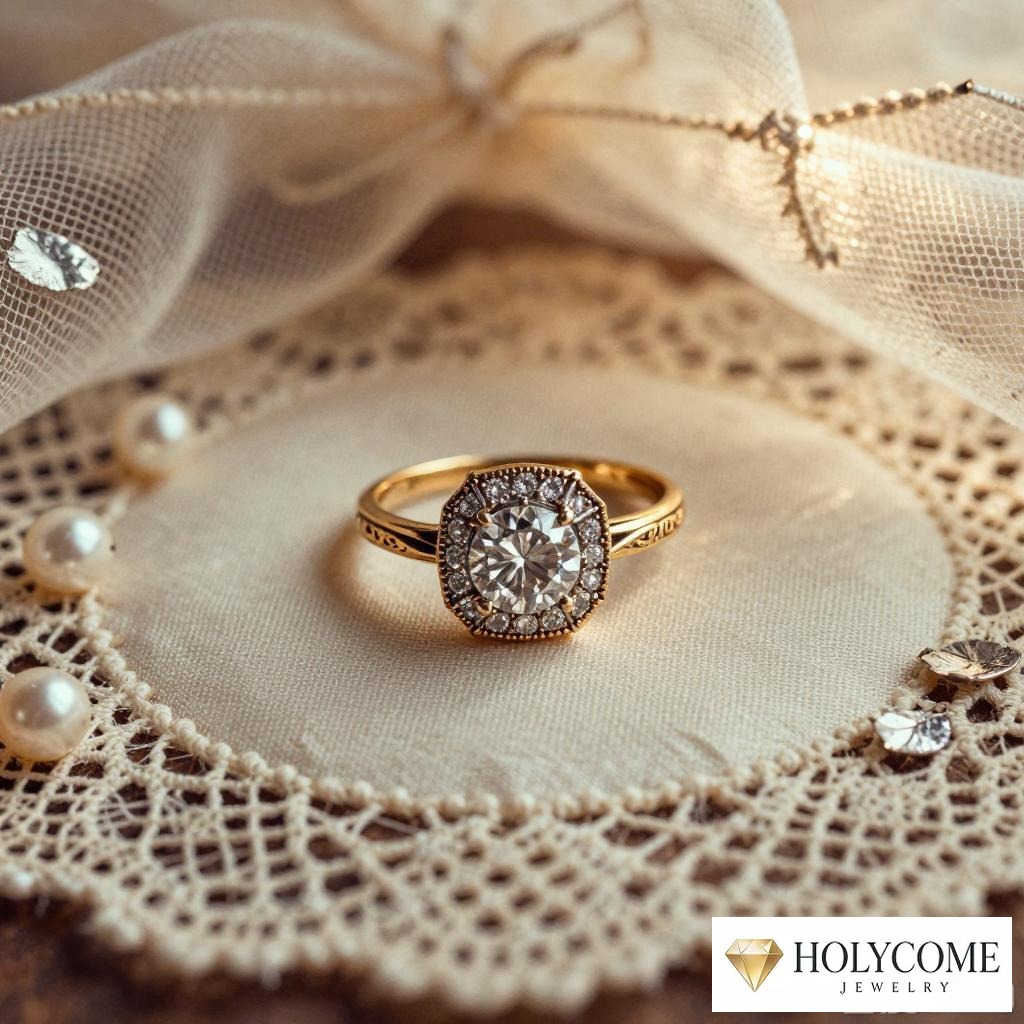
Vintage-inspired moissanite rings capture the romance and craftsmanship of past eras—Edwardian filigree, Art Deco geometry, mid-century elegance, and 1970s organic forms—built with modern gemstone technology and durable construction. The vintage category is one of the fastest-growing segments in moissanite bridal, driven by customers who want a ring with character, history, and distinctive design, without the ethical concerns, price premium, and wear that come with actual antique diamond jewelry. Moissanite's strong fire and wide availability in fancy shapes make it a natural fit for vintage designs that originally used old mine cuts, rose cuts, and other cuts known for dispersion and personality rather than clinical precision.
HOLYCOME produces vintage-inspired moissanite rings for over 60 brands specializing in heirloom-style bridal, and our vintage category production has grown 40% year-over-year since 2023. This guide covers the major vintage style periods, the design details that make a ring feel genuinely vintage, production techniques for vintage-style settings, and ordering specifications for brands building a vintage moissanite line.
01Why Vintage and Moissanite Are a Natural Match
Vintage engagement rings were designed for the cutting technology of their era, and that history shapes the aesthetic. Edwardian and Victorian rings used rose cuts and old mine cuts—stones with large open tables, fewer facets, and higher crowns that show fire and warm reflected light rather than the clinical white brilliance of modern brilliants. Art Deco rings prioritized geometric shapes, milgrain edges, and intricate hand engraving. Mid-century rings featured sculptural, organic forms. These designs were never about maximizing white light return in the way modern diamond cuts are; they were about sparkle character, metalwork detail, and overall design.
Moissanite fits these aesthetics beautifully for three reasons. First, moissanite's higher dispersion delivers the warm, fiery sparkle that old cuts were prized for—many customers find that moissanite in a vintage setting captures the character of antique cuts better than modern brilliant diamonds do. Second, moissanite's affordability allows brands to offer designs with large centers and extensive melee (a vintage hallmark) at accessible prices; an Art Deco design with a 2ct center and 60+ melee stones would cost prohibitively much in diamond, but lands at mid-range bridal prices in moissanite. Third, moissanite is available in every popular vintage shape—cushion old mine, oval, emerald, asscher, marquise, and pear—in calibrated sizes ready for vintage settings.
| Era | Key Design Elements | Best Moissanite Cuts | Popular Metals |
|---|---|---|---|
| Victorian (1837–1901) | Rose cuts, ornate engraving, pearls accents, nature motifs (leaves, flowers, serpents) | Rose cut, old mine cushion, oval | Rose gold, yellow gold, silver-topped gold |
| Edwardian (1901–1915) | Delicate filigree, lace-like metalwork, platinum, milgrain, scroll motifs | Old European cut round, marquise, rose cut | Platinum, white gold |
| Art Deco (1920–1939) | Geometric patterns, step cuts, baguette side stones, geometric halos, black enamel, bold symmetry | Asscher, emerald, cushion old mine, round | Platinum, white gold (yellow gold also used) |
| Retro / Mid-Century (1940–1960) | Sculptural forms, rose gold, large solitaires, two-tone metal, bow and ribbon motifs | Round brilliant, oval, emerald | Rose gold, yellow gold, two-tone |
| 1970s Boho | Organic shapes, bezel settings, textured metal, nature motifs, cluster settings | Pear, marquise, round, freeform | Yellow gold, sterling silver |
The Federal Trade Commission's Jewelry Guides require that vintage-inspired or reproduction pieces be labeled accurately as "vintage-style" or "vintage-inspired" rather than "vintage" or "antique" unless the piece itself is 50–100+ years old. FTC disclosure requirements for vintage jewelry prevent brands from misleading customers about age, and our brand partners label all vintage-design HOLYCOME pieces as "vintage-inspired" to stay compliant.
02Key Vintage Design Details
What makes a ring look genuinely vintage rather than just a modern ring with milgrain applied as an afterthought? It is in the details—and customers who seek out vintage pieces notice those details.
Milgrain and Edge Detailing
Milgrain—the tiny beaded border applied to metal edges—is the single most recognizable vintage detailing, but it must be done right to look authentic. Coarse, uneven milgrain applied quickly with a rotary tool looks cheap and modern. Vintage milgrain was applied by hand with a milgrain wheel, producing small, uniform, slightly irregular beads that follow curves naturally. HOLYCOME applies milgrain to vintage designs by hand using traditional milgrain tools, with bead size matched to the era (finer beads for Art Deco, slightly larger beads for Victorian and Retro). We also add delicate edge engraving—hand-applied bright-cut or chased patterns—to settings where period accuracy calls for it.
Filigree and Open Metalwork
Edwardian and Art Deco rings are famous for filigree—intricate open metalwork created by twisting and soldering fine wire into lacy patterns. Genuine hand filigree is labor-intensive to produce; cast filigree (where the open pattern is cast as part of the piece rather than built from wire) is more affordable and durable for daily wear, but must be designed carefully to match the light, airy look of hand filigree. We offer both cast filigree for core production and hand-fabricated filigree for premium heirloom collections. All filigree elements have a minimum wire thickness of 0.7mm for structural durability—filigree thinner than that bends or breaks with regular wear.
Hand Engraving
Vintage rings featured hand engraving on the shank, around the halo, and even on the prongs. Modern machine engraving has a uniform, mechanical look that feels inconsistent with vintage aesthetics. HOLYCOME's master engravers produce hand-applied bright-cut engraving—scrolls, floral patterns, geometric lines, and period-correct motifs—that matches the depth and variation of genuine antique engraving. Engraving can be added to shanks, gallery rails (the open section of the head visible from the side), and ring interiors for personal messages.
Side Stone Combinations
Art Deco rings famously combined center stones with baguette, trapeze, and bullet-cut side stones, creating bold geometric silhouettes. Victorian and Edwardian rings often used small rose-cut melee or even tiny pearls (we use synthetic sapphire or white moissanite for durability, as real pearls are unsuitable for daily-wear bridal). Offering side stone variations—including tapering baguettes, trapezoids, and half-moon cuts—adds period authenticity to vintage designs that generic halo rings cannot match.
Fancy Shape Centers
Vintage designs favor cushion old mine, asscher, emerald, and oval centers over modern round brilliants. Cushion old mine cut moissanite has the large facet pattern, soft corners, and chunky sparkle that customers associate with Victorian and Art Deco antiques, and it is our top-selling vintage center shape. Asscher cut moissanite—with its step facets and square cut corners—is the classic Art Deco stone and a must-have for any vintage collection.
What makes a ring look genuinely vintage rather than just a modern ring with milgrain applied as an afterthought? It is in the details—and customers who seek out vintage pieces notice those details.
03Production Considerations for Vintage-Inspired Moissanite Rings
Vintage designs are more complex than basic solitaires or simple halos, and production requires different skills at the bench.
Durability Without Sacrificing Aesthetic
Genuine antique rings were not always built for daily wear over decades—many were thinner, more delicate, and used soft solders that fail over time. A reproduction that is too faithful to original thin construction will bend, break, or lose stones. Our vintage designs retain the look and feel of authentic antiques while reinforcing critical structural points: shanks are cast to minimum 1.2mm wall thickness (original antiques are often 0.8mm or thinner), filigree sections are reinforced at stress points, and prongs are slightly more substantial than period originals for long-term stone security. Customers get the vintage aesthetic without the fragility.
Antique-Look Finishes
Modern rings are typically high-polish to a mirror finish, but many vintage rings originally had softer, less reflective finishes. We offer several period-appropriate finishes:
- High polish with antiqued recesses (oxidized or liver-of-sulphur darkening in engraving and milgrain lines to add depth and age)
- Satin or brushed finish on flat surfaces with polished edges (popular for Retro and Mid-Century designs)
- Florentine or textured finish for 1970s-inspired organic designs
- Two-tone finishes (white metal head with yellow or rose gold shank, common in Retro-era rings)
Stone Matching for Vintage Designs
Vintage rings were cut by hand, and stones in a single ring were not precision-matched to the degree modern machine cutting allows. Perfectly matched, identical-looking melee can look too "perfect" and break the vintage illusion. For our vintage collections, we use melee sorted to within one color grade (rather than the half-grade matching we use for modern designs) to preserve slight variation that reads as authentic. For old-mine and rose-cut moissanite, we specifically select stones with the larger, more open facet patterns and slight table size variation that mimic antique cutting. H&A precision cut moissanite looks too clinical for vintage settings and is not recommended.
MOQ, Lead Times, and Wholesale Pricing
- In-stock vintage designs: 5 pieces per SKU MOQ; 20–28 days for sterling silver, 25–35 days for 14k/18k gold (longer than modern designs due to hand finishing and engraving)
- Custom vintage reproductions: 20 pieces per SKU MOQ (lower than fully custom modern designs because vintage customers expect unique pieces); 40–55 days from CAD approval; tooling and engraving setup fees $400–$1,000
- Stone default for vintage: D-F color, VVS1-VS1 clarity, old mine cushion/asscher/emerald cuts with larger facet patterns; rose cut available for Victorian and Edwardian designs
- Wholesale pricing (finished 14k white gold Art Deco halo, 1ct cushion center with milgrain and baguette sides): $380–$520 per piece in quantity, depending on engraving complexity and side stone count
- Ring sizing: Vintage designs with engraving or filigree on the shank are best made-to-size; resizing engraved rings after production damages engraving and requires re-work
- QC pass rate: 97.2% of finished vintage pieces pass final QC on first inspection—slightly lower than modern designs due to the hand-finished elements; pieces with uneven milgrain, engraving flaws, or alignment issues are reworked before shipping
04Building a Vintage Moissanite Collection
A strong vintage collection does not need dozens of SKUs to cover the category. Start with three to four core era-representative designs and expand as demand justifies:
- One Art Deco geometric halo with asscher or cushion center, baguette side stones, milgrain edges, and white gold or platinum finish—the top-selling vintage silhouette
- One Edwardian filigree solitaire with round or marquise center, delicate open metalwork, and a thin band
- One Retro-era two-tone piece with rose gold shank and white gold head, oval or emerald center, and sculptural form
- One Victorian-inspired design with rose cut center, nature motifs (leaves, flowers, or scrollwork), and rose or yellow gold
Each core design can be offered in 2–3 metals and 3–4 center stone sizes to create a collection of 24–36 SKUs without the inventory risk of stocking dozens of unique designs.
05FAQ: Vintage-Inspired Moissanite Rings
Are vintage-inspired moissanite rings actual antiques?
No. HOLYCOME vintage-style rings are newly manufactured pieces designed to reflect the aesthetics of historical eras (Victorian, Edwardian, Art Deco, Retro). They are not old or previously owned. Genuine antique engagement rings are at least 50–100 years old and show wear, patina, and handmade construction evidence from their era. Our reproduction vintage rings deliver the same aesthetic but with modern moissanite and durable construction built for daily wear.
Do vintage-style rings wear differently than modern rings?
Genuine antiques wear differently because they were built to older construction standards, but our vintage reproductions are built to the same structural durability standards as our modern rings: solid shanks, secure prong settings, and reinforced stress points. The hand engraving and milgrain will wear slightly over decades just as they do on antiques—this normal patina adds character rather than representing a defect.
Can you replicate a family heirloom ring in moissanite?
Yes. Our custom jewelry team regularly reproduces family heirloom designs, matching the proportions, engraving patterns, and stone layout of the original while replacing the original stones (often worn old-cut diamonds) with moissanite that matches the original cut character. Custom reproduction requires photos of the original piece from multiple angles, plus measurements if available; lead time 40–60 days depending on design complexity.
Is milgrain durable or does it wear off?
Hand-applied milgrain of proper depth holds up well over decades of wear. Surface-applied milgrain (shallow beads) can wear flat over 10–20 years, especially on the bottom of the shank where the ring rubs against other fingers and surfaces. Our milgrain is cut to sufficient depth that even after 20+ years of wear the beads remain visible; worn milgrain can be re-applied by a jeweler during routine maintenance if desired.
What is the difference between vintage, antique, and estate jewelry?
"Antique" technically means pieces over 100 years old; "vintage" generally refers to pieces 50–100 years old (roughly 1920s–1970s); "estate" means any previously owned piece regardless of age. Our reproduction pieces are none of these—they are new rings made in vintage styles. FTC guidelines require transparent labeling, and we support our brand partners in describing vintage-inspired pieces accurately.
06Partnering for Vintage Moissanite Production
Vintage designs require bench jewelers trained in hand-finishing techniques—milgrain, hand engraving, filigree work—that many mass-market jewelry factories do not staff. HOLYCOME's production team includes master jewelers with decades of experience in period-correct reproduction work, and we supply vintage collections to brands across North America, Europe, and Australia. View our rings catalog to see in-stock vintage designs, or reach out through our custom manufacturing page for proprietary design development. We also produce matching vintage-style earrings and pendants to complete coordinated collections.
Vintage-inspired moissanite rings fill a niche that diamond vintage pieces cannot: they deliver the romance, character, and design heritage of antique jewelry with a durable, ethically produced, brilliantly sparkling gemstone at a price that makes heirloom design accessible to modern couples. The difference between a generic vintage-style ring and a genuinely beautiful reproduction lies in the hand-finished details—milgrain depth, engraving quality, stone matching, and structural integrity. Sourcing from a manufacturer that treats those details as core quality standards gives you vintage pieces your customers will be proud to wear and pass down.
07Frequently Asked Questions
Is moissanite a viable diamond alternative for retail?
Yes for price-sensitive buyers who want brilliance and hardness. It ranks 9.25 on the Mohs scale and costs a fraction of a natural diamond of the same size, so it turns fast in bridal and fashion lines.
What is the minimum order?
MOQ starts at 50 pieces per design for stock items; custom cuts and private-label settings start at 100 to 300 pieces.
Are certificates included?
Yes. Every parcel ships with GRA or IGI documentation listing carat weight, color grade and cut.
What are the lead times?
Samples 3 to 5 days. Bulk 15 to 20 days under 500 pieces, 25 to 30 days for custom work.