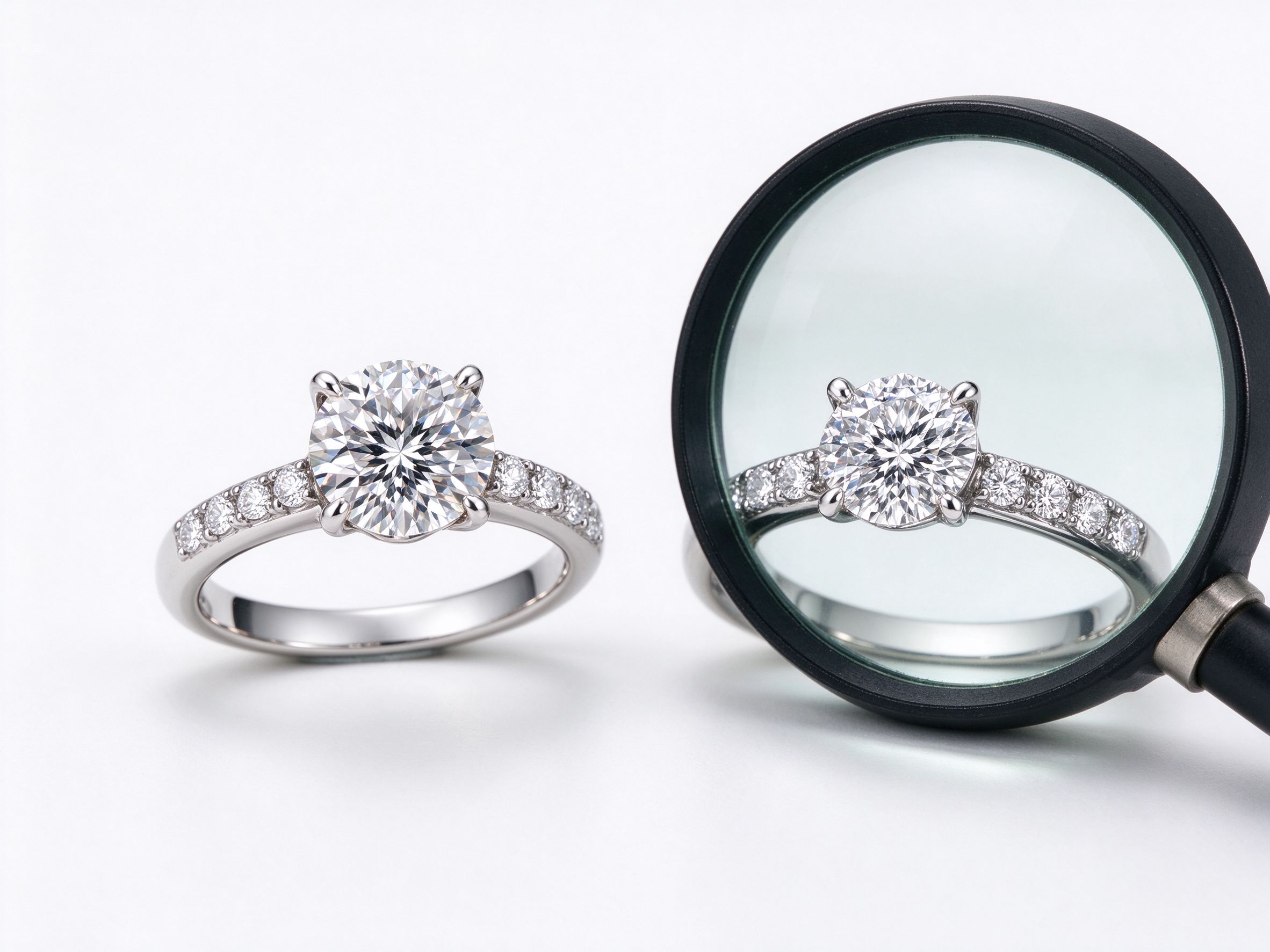
Matching Moissanite Cuts to Pendant Settings: Factory Process
A moissanite stone is cut in a workshop, but it is only finished when it is matched to the setting it will actually live in. A round brilliant that is perfect in a solitaire ring can look dull, dark, or oddly proportioned when dropped into a vertical pendant. This article explains how our cutting and stone-matching bench pairs stones to pendant settings, what viewing angle has to do with it, and why brands should specify stone matching rather than accept whatever loose stones arrive.
The Viewing Angle Problem
A ring stone is viewed straight down at the table; a pendant stone is viewed from above and at an angle, often in diffused indoor light. The cut that maximizes face-up brilliance at ideal viewing does not necessarily maximize oblique brilliance, which is what the pendant actually delivers. Our cutting bench tunes moissanite for the viewing angle of its end product.
For pendants, we weight light return at oblique angles more heavily than ideal-front brilliance. A slightly thicker pavilion angle can trade a little ideal-face-up sparkle for much better life when viewed from a natural standing distance. This is a deliberate cut choice, not a compromise.
When a brand sends us a reference pendant, we test the stone cut against that pendant geometry before approving a parcel. A stone cut optimized for rings is the most common reason pendants look lifeless in photos.
Color Matching Across a Collection
Moissanite parcels vary subtly in tone even when graded the same. A stone that reads warm next to a cool white chain is a visible defect, especially on a pendant that sits against skin and clothing. We sort every parcel by color temperature before it reaches the setter.
For a necklace collection with matching earrings, we match stones across the whole set rather than per piece. The pendant, the earrings, and any bracelet must share the same color family, or the set reads as mismatched under retail lighting.
We buy stone parcels in lots and reserve them per collection, so a reorder six months later uses the same color family. Factories that buy stones order by order cannot promise this continuity, and their reorders show a subtly different stone.
Table Height and Seat Depth
Two stones of the same carat can sit at different heights in the same seat, depending on how deeply they were cut. On a pendant, a stone that sits too high shows its basket and catches clothing; too low and it vanishes into the bezel. We measure table height per stone and machine the seat to match.
For paired sets, we select stones with matching table heights so the pendant and earrings sit at the same relative depth. This is invisible in a studio shot but obvious when the set is worn together.
The setter test-fits each stone dry, checks that it does not rock, and adjusts the seat with a small burr before closing any prongs. Skipping dry fitting forces stones into seats that pinch or rock, which is a leading cause of loose pendants.
Cut Shapes and Pendant Settings
Not every cut shape suits a pendant. Oval and pear shapes read well hanging vertically because their elongation follows the neck; round cuts are versatile but can look small at distance. We advise brands on which cut shape fills their pendant silhouette best, rather than cutting a stone to a generic size.
Fancy shapes like emerald or Asscher cuts show their clarity more than brilliant cuts, which is fine for moissanite but means the setting must bezel or halo them to hide inclusion characteristics. The cut choice drives the setting design.
Halo pendants put a smaller center stone in a ring of accent stones, which lets brands hit a larger visual size at a lower stone cost. We match the center and accent stones so the halo reads as one bright circle rather than a collection of unrelated points.
Why Specify Stone Matching in the PO
A purchase order that says one-carat moissanite pendant does not specify which stone cut, which color family, or which table height. Without that, the factory ships whatever is on the shelf, and results vary batch to batch. We ask brands to approve a physical stone sample before we cut the full parcel.
The approved stone sample becomes the reference for the whole run. We compare representative stones from the production parcel against it under standardized lighting, and we reject parcels that drift in color or cut.
For brands, the practical step is simple: approve the stone before the run, not the piece. Once the stone is right, the setting work is reliable. Once the stone is wrong, no amount of setting fixes it.
Pendant Tooling and Bail Engineering
Capacity planning is the difference between a two-week lead time and a six-week one. A factory that quotes you four weeks when its floor is already full is guessing. When we accept an OEM order, we reserve actual bench slots and plating-bath time against it before we confirm the date. If a slot slips, the customer knows before the shipment date, not after.
Plating thickness is where factories either save you money or cost you a sale later. A one-micron rhodium flash looks perfect on day one and wears through in weeks of retail handling. Our standard retail-grade finish is a measured three to five microns, verified by X-ray fluorescence on sampled pieces from every batch. The cost delta is small per piece; the cost of a return is not.
When a brand asks for private labeling, the work starts long before the first stone is set. We map their packaging, their insert card, their logo placement, and their target retail price against our production cost structure. A price point that looks comfortable at sample stage can become unprofitable at volume once packaging and inspection are added, so we price the full landed kit, not just the loose jewelry.
Grading loose moissanite into the settings we have produced is a matching exercise, not a grab bag. We sort every parcel by color, cut, and light performance before it reaches the setter, and we pair stones so that a matched pair of earrings or a full tennis bracelet reads as one continuous sparkle rather than a set of unrelated stones. This sorting step is labor that discount factories usually skip, which is why their matched sets show obvious stone-to-stone variation.
Lead times for repeat orders are always shorter than for first samples, and this is a signal you should use when evaluating a supplier. The first run includes sampling, mold approval, and line tuning. Once those are done, reorders flow through a stable process. A factory that cannot quote a meaningfully shorter reorder lead time has not actually industrialized your product, it is still hand-making each unit as a fresh project.
Welding and soldering are where a bracelet or chain either becomes durable or becomes a return. A cold joint that looks fine at inspection will flex open after a month of wear. Our welders use controlled heat, flux, and a post-weld pickle bath, and every structural joint is stress-tested by hand before polishing. We do not rely on the polish step to hide a weak solder seam.
The gap between a sample and mass production is where many OEM projects fail. A beautiful handmade sample that cannot be repeated at fifty or five hundred units is a marketing photo, not a product. We design every sample with the production line in mind: standard prong sizes, available stone dimensions, and findings we already stock. If a design cannot scale, we tell the brand before tooling is paid.
Chain Sourcing and Lot Matching
Surface preparation decides plating adhesion more than the plating chemistry itself. A piece that is not properly pickled, ultrasonic cleaned, and copper-flashed before rhodium will shed its finish regardless of how thick you plate it. Our pre-plating process is a fixed sequence because it is the single most common cause of jewelry that looks dull within its first retail season.
Consignment versus firm purchase is a commercial decision as much as a production one. For established brands we can split a larger order into staged shipments, which reduces their inventory risk and our working-capital strain. For new brands, the first run is usually firm because we have no sales history to underwrite the risk. This is normal factory economics, not a negotiation tactic.
Stone weight and metal weight are two different profit levers. We can hit a target retail price by under-sizing the stones or by under-using metal, and buyers should know which lever a factory pulled. Our quotes break out carat weight and gram weight separately so a brand can see exactly where the cost sits. A price that looks too good usually corresponds to a thinner shank or smaller-than-advertised stones.
Certification paperwork is part of manufacturing, not an afterthought. For lab-grown diamond orders routed through IGI, the stone serial numbers are recorded at intake, matched to the setting before assembly, and re-verified at final QC so the certificate number traveling with the finished piece is the one actually in the jewelry. Mixing stones between batches during production is the leading cause of certificate mismatch.
Polishing is the step most likely to be cut when a factory is behind schedule. A rushed polish leaves prong tips rounded, internal corners dull, and a surface that rhodium will not fully brighten. Our polishing schedule is a fixed labor budget per piece type because we learned the hard way that skimping here destroys the perceived value of even perfect stones.
The most profitable OEM relationships are the ones where the brand shares its sell-through data. When we know which sizes, metals, and stone grades reorder fastest, we pre-stage findings and rough stones, which shortens lead times and reduces defect rates. Treating the factory as a black box costs you money even if the unit price is nominally lower.
Tolerance creep is the slow enemy of consistent jewelry. First-piece inspection compares every critical dimension to the approved sample: post gauge, prong count, bail inner diameter, clasp tension. When a dimension drifts by a fraction of a millimeter across a production run, the factory corrects the bench before more units are made rather than at the end of the run. Catching drift late means scrapping a whole batch.
Custom Necklace OEM Workflow
We price in the metal market, not against a competitor's poster price. Sterling silver and brass substrate costs move with commodity markets, so a quote held for ninety days is a promise we can only honor if the metal is locked at order confirmation. Brands that want price stability ask us to lock metal at PO; brands that chase a low number months later usually get a re-quote.
Accessibility of design changes matters at volume. A small redesign that takes ten minutes on one sample becomes a significant per-unit cost at two thousand units. When we evaluate a custom request, we estimate the change in cycle time, not just the change in material. A design that looks slightly different can quietly double the setter's time per piece.
Our reject rate is a number we track weekly, not per order. A factory that only hears about quality problems from customer returns has already lost control. Internal rejection at each gate gives us leading indicators: if stone-set rejects rise, the setter's fixture needs adjustment; if plating rejects rise, the pre-clean sequence is drifting. Catching the trend beats reacting to the complaint.
Packaging is integrated into the production schedule on purpose. The jewelry and the box, the pouch, and the thank-you card are assembled together at the end so a delayed box never holds up a finished shipment. Brands that source packaging separately often discover this mismatch at the worst possible time, when the goods are already in transit.
Minimum order quantities are flexible on mix but not on total labor. We can usually combine several related SKUs into one run to reach the MOQ threshold, because shared tooling and shared setup make small batches of similar pieces economical. What we cannot do is run ten completely unrelated designs at tiny quantities, because each design carries its own setup cost.
The finish on the inside of a setting tells you how a factory treats its junior operators. Rough interiors catch skin and hair and feel cheap the moment the customer puts the piece on. We require every piece to be deburred and polished internally before it moves to plating, even though the customer will rarely inspect that surface consciously. They will feel it.
Reverse logistics are priced into honest quotes. When a factory has never planned for returns, the brand absorbs them invisibly. Our production QC targets a defect rate low enough that returns are exceptions, and we track the return reason codes so that the next batch is improved by the last batch's failures rather than repeated.
Batch Consistency Across Reorders
Tooling files are archived after a custom run, which is why reorders after a year still match the original sample. We keep the wax patterns, the CNC programs, and the measured stone seats on file so that a reorder does not restart the design process. This is the operational difference between a factory that prototypes and one that produces.
Surface finish consistency across a batch is a measurable target, not a vibe. We compare representative pieces under standardized lighting and magnification, and we reject batches where the rhodium tone shifts warm or matte across units. Inconsistent finish reads as a quality problem even when every individual stone and dimension is correct.
When brands ask us to match a competitor's piece, we reverse-engineer it as a drawing before quoting, because measuring a finished object tells us the result but not the process. Two settings that look identical can require very different production routes, and quoting without that analysis is how orders end up losing money for everyone.
We treat compliance documentation as a production output, not a sales promise. Nickel release test reports, material certifications, and plating thickness certificates are generated from the same batches that ship, so the document matches the goods. A certificate produced after the fact to order is worth less than the paper it is printed on.
The value of a long run is not just lower unit cost. Longer runs let the setter, the polisher, and the plater get into a rhythm, and cycle time drops measurably after the first few dozen units. This is why pricing tiers step down at volume: it is not a volume discount, it is a reflection of a more stable, faster process.
Every factory has a sweet spot for order size. Too small and the setup cost dominates; too large and inventory risk and working capital dominate. We advise brands on the sweet spot for their specific design rather than always pushing the biggest run, because a brand that ties up cash in unsold stock will not reorder. Sustainable order sizing is how accounts grow year over year.
Hand-finishing and machine-finishing are chosen per piece, not by default. A contour that can be milled consistently should be milled; a delicate prong tip that would snap on a fixture should be finished by hand. Factories that do everything by hand are slow and inconsistent; factories that automate everything lose detail on delicate pieces. The line between is the craft.
Frequently Asked Questions
Why does my pendant stone look duller than my ring?
Because pendants are viewed from an oblique angle. A stone cut for straight-down ring brilliance can look dark on a pendant. The cut should be tuned to the viewing angle.
Can you match stones across a necklace and earring set?
Yes. We sort by color temperature and table height across the whole collection, so the pendant and earrings read as one set under retail lighting.
Will reorders match the original stone color?
If we reserve the stone lot family, yes. Factories that buy stones order by order cannot promise this. Specify lot continuity in your PO.
Which cut shape is best for a pendant?
Oval and pear read well vertically on the neck; round is versatile; fancy cuts need halos or bezels to hide clarity. We match the cut to the pendant silhouette.
Should I approve the stone or the finished piece?
Approve the stone sample before the run. Once the stone is right, the setting is reliable; a wrong stone cannot be fixed by setting.
Conclusion
Matching moissanite to a pendant is a precision job: tune the cut for the oblique viewing angle, sort by color temperature, match table height across the set, and approve the stone before production. That is what turns a generic one-carat pendant into a necklace that sells on its light, not its spec sheet.