
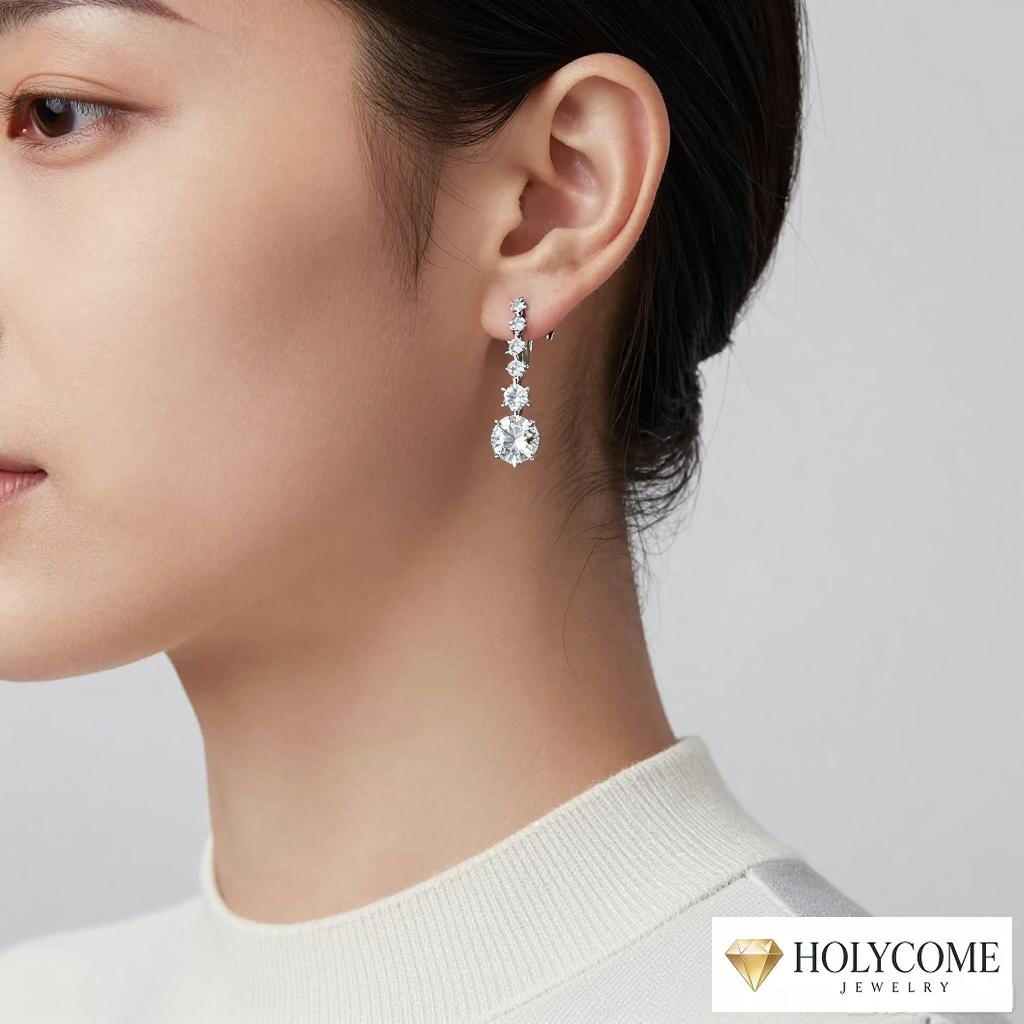
Moissanite ear climbers (also called ear crawlers, ear pins, or ear sweeps) are the most modern silhouette in moissanite earrings—a long, narrow design that starts at the earlobe piercing and curves upward along the ear, following its natural contour instead of hanging down or sitting static on the lobe. Climbers exploded in popularity around 2018–2019 and have become a staple earring style, prized for their unique look, their ability to create the visual effect of multiple piercings with one hole, and their dramatic sparkle profile that reads modern rather than traditional.
HOLYCOME produces moissanite ear climbers in styles ranging from delicate single-row crawlers to bold full-ear designs and vine motifs, in silver and gold. Climbers represent about 8% of our earring unit volume but carry strong fashion appeal and high social media engagement, making them a valuable addition to a moissanite earring line. This guide covers climber design, sizing, how they fit and stay on the ear, construction details, and ordering specifications for moissanite ear climbers.
01What Makes Ear Climbers Unique
Traditional earrings hang down from the piercing; studs sit in one spot. Ear climbers are designed to travel up the ear from a single piercing, typically 15–35mm long and 3–8mm wide, creating a line of stones that follows the ear's curve. They require no additional piercings to achieve a curated, multi-stone look, which is a major part of their appeal—customers with a single first-hole piercing can wear a dramatic earring that looks like they have 5–10 stones lined up their ear.
Climbers appeal to two distinct customer groups: fashion-forward customers who want an alternative to classic studs and hoops, and customers intrigued by the curated ear look who have not gotten multiple piercings. They are also a top bridal earring style for modern brides who want a contemporary alternative to traditional drops, especially brides wearing sleek or minimalist wedding dresses where a clean, modern earring complements the aesthetic.
| Climber Style | Length | Stone Layout | Look | Best For |
|---|---|---|---|---|
| Single-row crawler | 15mm – 25mm | Straight line of graduated small stones tapering toward the top | Clean, minimal, modern; delicate sparkle | Everyday wear, minimalists, office wear |
| Vine / leaf climber | 20mm – 30mm | Organic vine pattern with branch-and-leaf stone arrangement | Romantic, nature-inspired, feminine | Bridal, soft romantic styles, gifting |
| Wide bar climber | 20mm – 30mm | Multiple rows of stones or a wider geometric bar shape | Bold, modern, architectural; substantial sparkle | Evening wear, bold fashion, statement looks |
| Starburst / radiating climber | 25mm – 35mm | Stones radiating outward from the lobe toward the top | Dramatic, editorial, red-carpet look | Bridal statement, black tie, editorial |
| Full-ear contour climber | 30mm – 45mm | Long contour that follows the entire ear curve | Very bold, avant-garde, high-fashion | Editorial, runway, bold brides, editorial content |
Ear climbers as a modern jewelry form rose to mainstream popularity in the mid-to-late 2010s, part of a broader wave of contemporary earring design that explored alternatives to the classic stud/hoop/drop categories. Contemporary jewelry writers note the climber's appeal in an era of social media, where earrings that photograph from the front at interesting angles perform especially well on Instagram and TikTok—platforms where ear content is a massive category.
02How Ear Climbers Stay On
The question every new climber customer asks is "how do these stay on?" Traditional earrings use friction on the post or a latch; ear climbers use a different mechanism: the long post goes through the piercing, and the earring is rotated upward (climbed) until the design sits flush against the front of the ear, following its curve. The post then extends down behind the earlobe, where a butterfly back or clutch slides on and holds the earring at the correct angle. A properly fitted climber does not hang down—it sits pressed against the ear, with the weight distributed along the length of the piece rather than pulling from the single piercing point.
Three design details determine whether a climber stays in place comfortably:
- Post position and angle: The post must be positioned and angled so that when the earring is rotated up the ear, the post passes straight through the piercing without twisting. If the post angle is wrong, the earring will not sit flush against the ear, it will pull at the piercing, or it will slide back down.
- Curve matching: The contour of the climber must approximately match the average ear curve. Designs that are too straight stick off the top of the ear; designs that curve too sharply dig into the ear. Our climbers are shaped to a 20-degree average ear curve from lobe to top, which fits the vast majority of ears well.
- Backing stability: We use extra-large, flat "climber clutches" that distribute pressure across more of the back of the earlobe, preventing the post from rotating and holding the earring at the correct angle. Standard small butterfly backs can rotate in the piercing and let the climber slide back down.
We test every climber on ear models before production and supply matching large clutches with every pair. Customers with very thin or very curved ears occasionally need to bend a climber slightly to fit, which we note in product instructions—the thin metal can be gently adjusted with fingers or pliers by a jeweler.
The question every new climber customer asks is "how do these stay on?" Traditional earrings use friction on the post or a latch; ear climbers use a different mechanism: the long post goes through the piercing, and the earring is rotated upward (climbed) until the design sits flush against the front of the ear, following its curve. The post then extends down behind the earlobe, where a butterfly back or clutch slides on and holds the earring at the correct angle. A properly fitted climber does not hang down—it sits pressed against the ear, with the weight distributed along the length of the piece rather than pulling from the single piercing point.
03Climber Design Variations
Classic Single-Row Graduated Crawlers
The best-selling climber design: a single line of round stones graduated in size from small at the top to slightly larger at the lobe, or uniform size for a clean modern look. Single-row crawlers are minimalist enough for everyday wear and sleek enough for evening, making them the most versatile climber style. They are typically 20–25mm long with 1.3–2.0mm stones.
Vine and Nature Motifs
Vine, leaf, and branch climbers use organic curving lines with small stones positioned like leaves along a branch. These are the most popular bridal climber style because the organic motif complements floral wedding dresses and romantic aesthetics, and they read as less starkly modern than geometric designs. Many vine climbers incorporate tiny marquise stones cut to look like leaves, with small rounds as berries or flower centers.
Geometric and Art Deco Climbers
Angular geometric shapes, baguette stones arranged in Art Deco fan patterns, triangular silhouettes, and architectural bar shapes appeal to customers who want modern, bold design. Geometric climbers photograph particularly well and are strong social media content pieces—they create the kind of strong visual that drives saves and shares.
Cuff and Ear Jacket Combinations
Some climbers include an integrated ear cuff at the top that clips onto the upper cartilage for additional stability, eliminating any need for precise post balancing. Cuff-combination climbers are popular for longer designs (30mm+) where post-only support can allow slight rotation, and they create a bold, fully-curated look from a single piercing.
04Stone Considerations for Climbers
Climbers typically use smaller stones (1.1–2.0mm melee) arranged in patterns, with the exception of statement climbers that may incorporate a larger focal stone at the lobe. Melee quality matters disproportionately on climbers because the stones are arranged in a long line right in front of the viewer—any color or size mismatch is immediately visible. We use F-G color, VVS2-VS1 melee sorted to within 0.02mm diameter and half a color grade for all climbers.
Stone setting on climbers is more complex than on studs or hoops because the metal is curved in two directions (the length curve and the contour to the ear), so seats must be cut at compound angles to face each stone forward at the correct angle. Our stone setters hand-cut seats for each stone to ensure consistent stone alignment across the full length of the climber—poorly set climbers have stones that tilt in different directions, which looks messy from the front.
05Comfort and Wearability
Well-made climbers are very comfortable to wear, even for full days, because the weight is distributed along the length of the earring rather than pulling on a single point. Many customers report finding climbers more comfortable than heavy drops. The key comfort factors are:
- Weight under 3 grams per earring: Any more and the pressure on the piercing becomes noticeable within a few hours
- Rounded edges on the back: The entire back surface must be smooth and rounded—any sharp edge on the post arm or metal backing irritates the skin behind the ear
- Polished interior surface: The side that touches the ear is polished mirror-smooth, not rough-cast
- Post thickness 0.8mm: Thin enough for standard piercings; not so thin that it bends
06Production Standards and Quality
Symmetry in Pairs
Climber pairs must be mirror-symmetrical—left and right earrings should curve in opposite directions to follow each ear correctly. Each pair is produced as a matched left/right set (not two identical pieces), and we inspect them on an ear form to confirm they sit at matching angles on both ears.
Stone Alignment
Every stone on a climber must face forward at the correct angle, not tilted up, down, or sideways. Stones that are set off-angle look like manufacturing defects from the front, even if they are technically secure. We inspect each climber from the front viewing angle to confirm all stones present as bright, evenly aligned points of light.
Post Strength
The post on a climber acts as a lever, so it is subject to more torque than a stud post. We use slightly heavier 0.9mm posts on climbers over 25mm long to resist bending, and posts are lasered to the body of the earring with double welds for extra strength.
07MOQ, Lead Times, and Wholesale Pricing
- In-stock single-row graduated crawlers: 10 pairs per size/metal MOQ; 12–18 days for silver, 15–25 days for 14k gold
- Vine and motif climbers: 5 pairs per style/metal MOQ; 18–28 days for 14k gold
- Geometric and statement climbers: 5 pairs per style/metal MOQ; 20–30 days for gold
- Custom climber designs: 20 pairs per style MOQ; 30–45 days from CAD approval; $200–$450 tooling fee
- Stone default: F-G color, VVS2-VS1 melee; sizes 1.2–2.0mm depending on design
- Wholesale pricing (14k white gold single-row crawler, 22mm): $90–$140 per pair in quantity
- Wholesale pricing (14k white gold vine bridal climber, 25mm): $130–$200 per pair in quantity
- Wholesale pricing (14k white gold statement starburst climber, 35mm): $200–$320 per pair in quantity
- Wholesale pricing (silver rhodium plated single-row crawler): $22–$35 per pair in quantity
- QC pass rate: 97.5%—compound curves and stone alignment create higher rejects than simpler styles; rejected pieces have stones reset or posts re-angled before shipment
08Building a Climber Collection
Climbers work best as a curated selection of 3–5 styles rather than a huge catalog: a classic single-row crawler for everyday modern wear, a vine style for bridal and romantic customers, and a bolder statement climber for evening and fashion covers the core market. Merchandise climbers alongside huggies and studs for the "curated ear" customer who stacks multiple earring types in one ear.
09FAQ: Moissanite Ear Climbers
Do I need multiple piercings to wear ear climbers?
No—that is the primary advantage of ear climbers. They create the visual effect of a long line of stones up the ear using only a single first-hole piercing. The climber's post goes through the piercing, the earring is rotated up along the ear, and the clutch behind the ear holds it in place. Some statement climbers include an optional cuff at the top that rests on the upper ear without requiring a piercing there.
Do ear climbers stay on securely?
Yes, when fitted correctly. The key is using the large flat clutch supplied with the climber and making sure the earring sits flush against the ear after rotating it up. Customers with very thin earlobes sometimes bend the post slightly for a tighter fit, which is easy to do with fingers or small pliers. Well-made climbers stay on through normal daily wear, including office work and social events.
Can I wear ear climbers every day?
Simple single-row crawlers work beautifully for everyday wear—they are comfortable, they stay in place, and they add more visual interest than basic studs without reading as "evening jewelry." Longer, more elaborate statement climbers are better reserved for events and occasions, just like long drop earrings.
Do ear climbers work for all ear shapes?
Most ears are similar enough in curve that standard climbers fit well for the majority of customers. Customers with very small ears or very sharply curved outer ears may find longer climbers (30mm+) don't follow their ear contour perfectly; in those cases, the climber can be gently bent by hand or by a jeweler to match their ear curve. Most customers have no fit issues with 20–25mm climbers.
Are ear climbers comfortable to sleep in?
We don't recommend sleeping in climbers. The long shape presses against the side of the head when side-sleeping, which can bend the post or irritate the piercing over time. They are easy to take in and out, and the simple post/back mechanism makes them straightforward for daily wear.
10Sourcing Moissanite Ear Climbers
Climber quality is determined by three things: the accuracy of the post angle (so the earring sits correctly when rotated up), the contour of the curve (so it follows the ear without gapping), and the alignment of the stones (all facing forward consistently). Cheaply made climbers have posts at wrong angles, stones that point every direction, and sharp backs that irritate the skin. HOLYCOME climbers are engineered to fit and sit correctly, with proper posts, large stability clutches, and hand-set stones aligned for consistent front-facing sparkle. Browse climber designs in our earrings catalog, and pair them with moissanite huggies and studs for curated ear collections.
Ear climbers occupy a unique space in the earring market: they look like a bold, curated, multi-piercing look but require only a single standard piercing, they feel modern and fresh compared to classic silhouettes, and moissanite's sparkle translates beautifully along the long line of stones. They are a category where design engineering matters as much as aesthetics, and working with a manufacturer that gets the post angle, curve, and stone alignment right is the difference between climbers that look beautiful and stay put and climbers that slide, tilt, or irritate.
11Frequently Asked Questions
Is moissanite a viable diamond alternative for retail?
Yes for price-sensitive buyers who want brilliance and hardness. It ranks 9.25 on the Mohs scale and costs a fraction of a natural diamond of the same size, so it turns fast in bridal and fashion lines.
What is the minimum order?
MOQ starts at 50 pieces per design for stock items; custom cuts and private-label settings start at 100 to 300 pieces.
Are certificates included?
Yes. Every parcel ships with GRA or IGI documentation listing carat weight, color grade and cut.
What are the lead times?
Samples 3 to 5 days. Bulk 15 to 20 days under 500 pieces, 25 to 30 days for custom work.