
01Moissanite Color Grades: Mapping DEF, GH, IJ to Real B2B Value
GIA's color grading scale is the universal reference for diamond color in the jewelry trade, and most moissanite manufacturers calibrate against it for customer familiarity (GIA Color Grading). Color is the second biggest price driver in moissanite after cut, and it is the category that causes the most confusion for first-time wholesale buyers. Unlike diamond, where the GIA D-Z scale is universally applied and understood, moissanite color grading is done by each manufacturer against its own master stones. Two "DEF colorless" stones from different factories can look noticeably different face-up under the same lighting. That inconsistency is a real merchandising risk when you are building a catalog — customers return stones they perceive as "tinted" or "yellow," and inconsistent color across a size run looks unprofessional on a retail shelf.
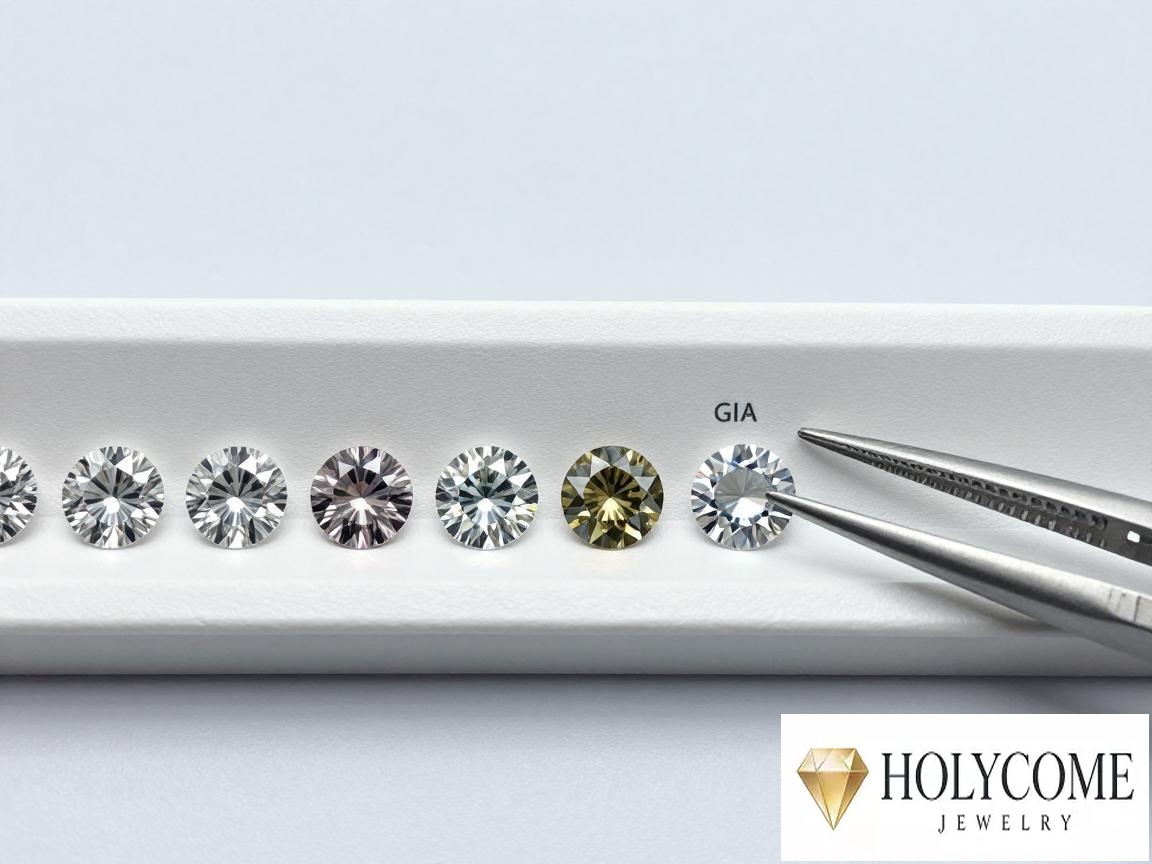
This guide explains how we grade color at HOLYCOME, how our grading maps to the GIA diamond color scale buyers already know, how to choose the right color tier for each price point, and how to inspect incoming parcels so you get what you pay for. Our grading is based on 1.2 million stones we have sorted and QC'd in-house since 2017, benchmarked against a GIA-graded D-to-J master diamond set in a GIA-standard daylight-equivalent light box.
02Why Moissanite Color Is Different from Diamond
Diamond color comes mostly from nitrogen impurities that absorb blue light, producing a yellow-to-brown tint. Silicon carbide's color mechanisms relate to nitrogen, boron and structural defects as documented in materials science references (Wikipedia: Moissanite); Moissanite (silicon carbide) color is controlled by several factors during crystal growth: nitrogen concentration (which produces yellow), boron (which can produce blue or gray), lattice defects, and growth orientation relative to the c-axis. Old-generation moissanite (pre-2015) was infamous for greenish or grayish undertones, particularly in sizes above 8mm (roughly 2ct diamond equivalent). Modern growth technology with controlled doping and post-growth annealing has largely eliminated those issues in premium material — but "largely" is not "completely," which is why every stone still needs grading.
One important optical quirk: because moissanite is birefringent (doubly refractive), apparent color can shift slightly depending on viewing angle, particularly in larger sizes. A stone that looks colorless face-up may show a faint warm tint viewed through the side of the pavilion. This is normal for SiC and is not a grading defect; our grading is always done face-up in the standard 5-10 degree viewing geometry used for diamond grading.
Diamond color comes mostly from nitrogen impurities that absorb blue light, producing a yellow-to-brown tint. Silicon carbide's color mechanisms relate to nitrogen, boron and structural defects as documented in materials science references (Wikipedia: Moissanite); Moissanite (silicon carbide) color is controlled by several factors during crystal growth: nitrogen concentration (which produces yellow), boron (which can produce blue or gray), lattice defects, and growth orientation relative to the c-axis. Old-generation moissanite (pre-2015) was infamous for greenish or grayish undertones, particularly in sizes above 8mm (roughly 2ct diamond equivalent). Modern growth technology with controlled doping and post-growth annealing has largely eliminated those issues in premium material — but "largely" is not "completely," which is why every stone still needs grading.
03The DEF / GH / IJ Tiers: What Each Grade Means
The wholesale moissanite market has converged on three broad letter-grade tiers borrowed from diamond nomenclature. Here is how we define them at HOLYCOME, mapped to their GIA diamond equivalents:
| HOLYCOME Grade | Mapped GIA Equivalent | Face-up Appearance | Typical Wholesale Premium vs IJ | Recommended Price Tier |
|---|---|---|---|---|
| DEF (Colorless) | D / E / F (colorless range) | Colorless to the unaided eye face-up; no visible yellow, gray, or green under standard lighting | +70-100% over IJ | Premium, luxury, top-tier bridal |
| GH (Near-Colorless) | G / H (near-colorless) | Faint warmth detectable by trained grader side-by-side against DEF; appears colorless to most consumers once set | +25-40% over IJ | Mid-range bridal, value-premium fashion |
| IJ (Faint Warmth) | I / J (faint yellow, near-colorless) | Slight warm/yellow tint detectable even by untrained eye when viewed loose face-down; noticeably warmer set in white metal | Baseline | Value tier, yellow gold settings, fashion/statement |
Within the DEF tier, we do not separate D, E, and F grades for moissanite the way diamond grading does. The difference between D and F moissanite is below what even a trained grader can reliably distinguish without a side-by-side master comparison, and splitting the grade creates more SKU complexity than the market rewards. Most premium moissanite manufacturers use the same "DEF" grouping. If you specifically need stones matched to a particular GIA D/E/F master for diamond-adjacent product lines, we can do a custom sort for an additional $3-5 per stone.
Colors beyond IJ (K/L/M and warmer, sometimes sold as "champagne" or "fancy warm") are produced on a limited basis. Warm-toned moissanite works well in yellow gold and rose gold settings where a slight cream tone complements the metal; our experience is that these grades sell best in vintage and bohemian-style lines, not as diamond substitutes.
04Green Tint, Gray Tint, and the "Old Moissanite" Problem
If you have been in the jewelry business long enough to remember early moissanite (2000-2014), you probably associate moissanite with a characteristic greenish-gray flash. That came from two technical issues in early SiC growth: nitrogen doping levels that were not tightly controlled, and cutting that did not consistently orient the rough to minimize off-axis birefringence effects. The result was stones that looked fine in some lights but showed a noticeable greenish or grayish cast in fluorescent office lighting or north-facing daylight — the so-called "disco ball" or "alien" look.
Modern premium moissanite has largely solved this. Our internal QC rejects stones showing visible green or gray undertones at a rate of roughly 1.5-2% of DEF production and 3-4% of GH production. Those rejected stones are either downgraded or recut, never shipped as premium. However, we still see these undertones in 10-15% of low-cost moissanite coming from small cutters who buy mixed-grade boules, so buyers shopping for price alone frequently encounter the problem.
How to screen for green/gray tint in incoming parcels:
- View stones face-down on a white, matte grading tray (not black velvet, which hides tint) under daylight-equivalent light (5000K-6500K, CRI 90+).
- Place a DEF master stone alongside the sample for side-by-side comparison. Green or gray tint becomes much easier to detect with a known-color reference.
- Check under warm incandescent light (2700K) as well. Green tint that is invisible in cool light can reveal itself as a muddy tone in warm light.
- For orders over 500 pieces, inspect a minimum 10% random sample under both lighting conditions.
We provide a graded master stone set (DEF, GH, IJ) to all wholesale clients placing first orders over $3,000 so their incoming QC can calibrate to our grading.
05How Size, Shape, and Metal Affect Apparent Color
Color grading is done on calibrated round stones 1-2ct equivalent (6.5-8mm). Several factors change how color appears in finished jewelry:
Size
Larger stones show color more easily than smaller stones, because light travels through more material before exiting. A 3mm melee stone in IJ will look completely colorless in a pavé setting; the same IJ grade in a 12mm (5.5ct equivalent) center stone will show noticeable warmth face-up. We recommend DEF for all center stones above 8mm (2ct equivalent) in white metals, regardless of the tier. For side stones and melee, GH is usually sufficient because the small stones read colorless in setting.
Shape
Step cuts (emerald, Asscher) act as windows into the stone — their large, open facets make color far more visible than brilliant cuts. For this reason, we only stock emerald and Asscher in DEF VVS1. Fancy shapes with large windows (some cushions, elongated ovals at high ratios) also show color more aggressively than round brilliants.
Metal Color
White gold, platinum, and silver reflect white light back through the stone, making any warm tint more visible. Yellow gold and rose gold reflect warm light and visually warm up the stone, which means a GH or even IJ grade can face up nearly colorless in a yellow gold mounting. This is one of the most underutilized cost savings in B2B purchasing — many of our DTC brand partners run their white-gold bridal in DEF and their yellow-gold bridal in GH, saving 20-30% on stone cost with zero increase in color-related returns.
06Pricing Structure by Color Grade
Our current bulk wholesale pricing (500+ piece orders) for calibrated round brilliant HOLYCOME premium hearts-and-arrows cut, VVS1 clarity, looks like this:
| Size (mm / ct equiv) | DEF (USD/stone) | GH (USD/stone) | IJ (USD/stone) | DEF vs IJ Cost Gap |
|---|---|---|---|---|
| 3.0mm / 0.10ct (melee) | $0.95 | $0.75 | $0.60 | +58% |
| 5.0mm / 0.50ct | $4.50 | $3.40 | $2.60 | +73% |
| 6.5mm / 1.0ct | $24.00 | $16.50 | $12.50 | +92% |
| 8.0mm / 2.0ct | $62.00 | $42.00 | $30.00 | +107% |
| 9.0mm / 2.75ct | $98.00 | $65.00 | $46.00 | +113% |
| 11.0mm / 5.0ct | $245.00 | $172.00 | $118.00 | +108% |
Notice how the DEF premium widens with size. That reflects both the higher material cost of colorless large rough and the greater yield loss when color sorting large stones (large DEF-grade SiC boule sections are rare). The pricing implication for brand buyers: for a $299 retail 1ct solitaire, stepping down from DEF to GH saves $7.50 per stone — a meaningful 2.5% of retail — without a measurable increase in consumer-perceived color difference once set. For a $1,299 3ct center piece, saving $52 per stone on DEF vs GH (about 4% of retail) starts to weigh against the risk of a visible warm tint on a larger stone, so DEF is usually the better call.
07Color Consistency Across Production Lots
Consistency matters as much as absolute grade. A retailer selling 1ct DEF solitaires online will get returns if customers comparing two photos (or two rings in a bridal set) see one stone whiter than another. At HOLYCOME, we maintain color consistency across lots by:
- Calibrating every production lot against the same physical master stones (replaced annually, measured with a spectrophotometer).
- Grading stones in batches by calibrated size, not mixing lots.
- Holding ±0.5 grade tolerance for DEF and ±1 grade tolerance for GH/IJ. A stone on the F/G border is downgraded to GH, never upgraded to DEF.
- Quarantining mixed-color returns from the cutting floor and separating them by measured color before re-sorting.
For OEM clients who need absolutely matched sets (engagement ring + wedding band with side stones, or earring pairs), we offer a "matched set" sorting service where stones are color-matched to a tolerance of ±0.25 grade within each pair/set. This adds $2 per stone but eliminates the visual mismatch that causes bridal-set returns.
08Fancy Colors: Black, Blue, Green, Pink, Champagne
Beyond white/colorless moissanite, we also produce colored varieties on a made-to-order basis:
- Black moissanite: Created by introducing controlled lattice defects via irradiation and annealing. Jet black, opaque, and very popular in men's bands. MOQ 100 pieces per size.
- Blue moissanite: Boron-doped during growth; ranges from faint steel blue to vivid royal blue. Our "royal blue" is the most popular colored SKU for men's jewelry.
- Green moissanite: Produced via controlled doping; ranges from pale mint to deep forest. Sells primarily as accent stones and fashion pieces.
- Pink / champagne / cognac: Nitrogen and defect engineering produces warm pink through brown-cognac tones. Limited production runs; lead time 25-30 days.
Colored moissanite is not coated — the color is structural, produced during growth or post-growth treatment, and will not wear off or fade with wear or cleaning. This distinguishes it from coated "mystic" topaz and other surface-treated gems.
09Compliance and Disclosure Note
When selling colorless or near-colorless moissanite in the US market, be careful not to describe it using diamond color-grade terms in a way that implies it is diamond. "Colorless moissanite" or "DEF-grade moissanite" (referring to the manufacturer's moissanite grading scale) is acceptable; calling it "D-color moissanite" without clarifying it is moissanite is a deceptive practice under the FTC Jewelry Guides (FTC Section 23.25). We recommend language like "colorless (DEF grade) moissanite" for US-facing product pages.
GIA does not grade moissanite, and moissanite is not subject to the same GIA color-report framework that applies to diamond. We provide HOLYCOME color-grade cards with bulk shipments and can issue GRA (Gem Research Association) third-party certificates on request for $2.50 per stone, which many brands use for consumer-facing documentation.
10FAQ
Should my whole bridal line be DEF, or can I mix GH in some sizes?
Our most successful OEM partners use the following tiering: DEF for all center stones 6.5mm (1ct) and up in white metal; GH for side stones and melee (under 4mm); GH or IJ for all yellow-gold mountings regardless of center size, because the metal warmth masks any tint. This setup delivers perceived color quality where customers look hardest (the center stone) while reducing overall stone cost by 15-25%.
How do I know I'm actually getting DEF when I pay for DEF?
Three verification steps: (1) Request a master stone set from your supplier so you have a physical DEF reference. (2) Inspect a 10% random sample of incoming parcels face-down on a white tray under 5500K daylight light, side-by-side with your master. (3) If a parcel looks off, ask for a third-party GRA certificate; we provide these for any disputed lot. Suppliers who refuse to stand behind their grading with certificates or sample returns are generally cutting corners.
Can moissanite change color over time from UV exposure or wear?
Properly grown and annealed modern moissanite is color-stable. UV exposure (sunlight, tanning beds), cleaning chemicals, and normal wear do not change the body color of moissanite. We have 8-year-old wear samples in DEF that still grade DEF on our spectrophotometer. Avoid high-temperature direct torch heating during repair (see our repair guide) because extreme heat can in rare cases cause localized color change at the surface.
Is there a visible difference between HOLYCOME DEF and other brands' DEF?
Grading standards vary slightly between manufacturers. What one supplier calls DEF, another might call GH. The only way to compare is by direct side-by-side observation under standardized lighting. We have done these comparisons with most major brands; our DEF grades tighter than most competitors because we only accept stones that match our DEF master within 0.5 grade, and we downgrade border stones to GH. Buyers consistently tell us our DEF is whiter than the "colorless" grade they were previously buying.
What causes some moissanite to look gray in certain light?
Gray appearance in moissanite usually comes from one of two sources: boron contamination during growth (which produces a permanent gray modifier), or pavilion angles that are cut too steeply, causing light extinction that reads as gray under overhead lighting. Premium cut grading combined with tight growth doping controls eliminates the issue in our production; if you see gray stones in a parcel, it is almost always low-end material cut from poorly sorted rough.
Do you offer certified color-matched bridal sets?
Yes. For OEM clients ordering engagement rings with matching wedding bands, we color-match the center stone and side stones across both pieces to within 0.25 grade. This matching service adds $2 per stone to the standard wholesale price and is included in our premium bridal package. We also offer GRA certificate bundling for matched sets at $2.50 per stone.
11Choose Grade Based on Setting, Not Just Price
The worst buying decision we see is paying DEF prices for IJ stones, or paying DEF premiums for melee stones small enough that no customer will see the difference. The best buying decision matches color grade to metal, stone size, and retail price point — DEF for white-metal centers above 1ct, GH for melee and yellow-gold centers, IJ for value-tier fashion and large yellow-gold statements. That matrix gives you the best perceived quality per dollar of stone cost, which is the whole point of wholesale sourcing.
To order samples or request our current wholesale price list by grade and size, reach out to our B2B team. We ship sample parcels with three stones per grade (DEF/GH/IJ) for direct comparison, along with our master color card and grading guide. You can also browse in-stock loose moissanite by grade, explore premium ring settings designed for DEF-grade stones, or read about cut quality and light performance for the full optical picture. All standard orders ship within 5 business days from our rolling stock in 47 calibrated sizes.