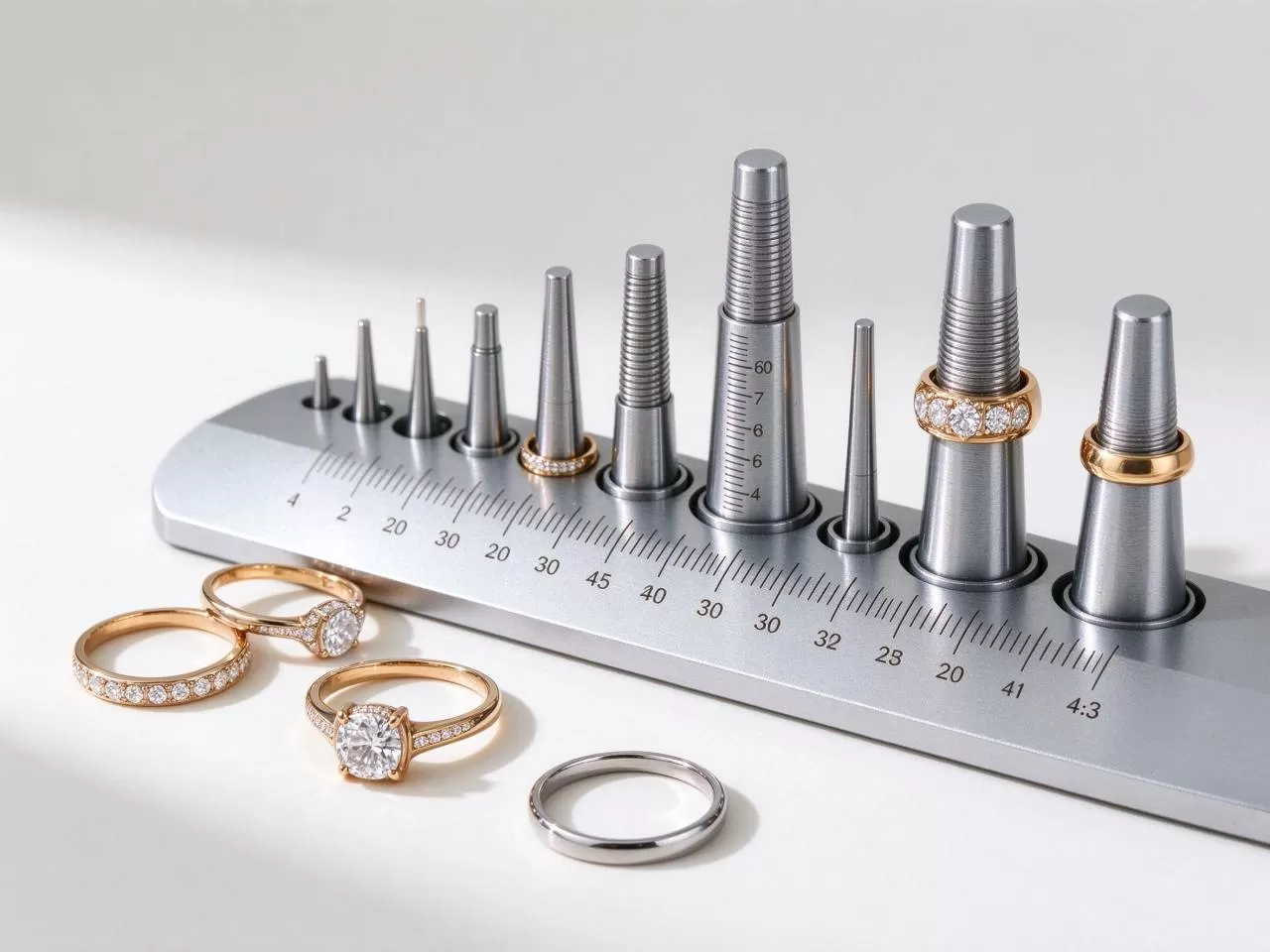
Every January I clear a shelf in our sample room and look at what came back from buyers. Not the returns for defects, the returns for boredom. Nine times out of ten the dead stock is a tool that only works for one size. A ring gauge that covers size 4 to 6. A bezel pusher for a 3mm stone only. A mandrel in a single diameter. Buyers order them because the unit price looks easy, then they sit.
This is article four in our series on jewelry tools wholesale, and I want to talk about coverage. Not which tools are good, but which size and fit ranges turn on a shelf and which ones become warehouse weight. Twelve years of QC and buyer conversations taught me that coverage is a purchasing decision, not a product spec.
01The coverage rule: one tool, many sizes
If a tool only serves one dimension, it needs to be a consumable or a specialty item with a known buyer. If it is durable, it needs to span a range. That is the whole rule, and it explains most of what sells.
Think about the ring sizing gauge on the reference market. A belt-style multisizer covering size 1 to 17 sells steadily because one unit handles the whole counter. A fixed steel mandrel in a single size sells once and never again unless the buyer is a repair bench. Same category, completely different velocity.
When we quote jewelry tools wholesale, I ask buyers one question first: what range does this tool cover? If the answer is a single point, I flag it as a specialty line and price it accordingly. If it covers a spread, it goes in the core assortment.
02Where size coverage actually pays
Four tool families reward broad coverage more than the rest. This is where I would spend the sample budget first.
- Ring sizing and measuring: gauges, mandrels and taper sticks that span at least size 1 to 15, ideally 1 to 17. Repair benches and retail counters both need the full spread, and a narrow gauge forces them to buy two.
- Pliers and cutters: a set that covers flat nose, chain nose, round nose, side cutter and end cutter outsells any single pair. Buyers want the tray, not the piece.
- Loupes and magnifiers: dual-power units around 5x and 10x or 5x and 12x cover inspection and setting work with one SKU. Single-power loupes are a harder sell outside gemology.
- Screwdriver and bur sets: blade diameters from roughly 0.50mm to 3.00mm, bur assortments in mixed head shapes. A set with a real range replaces six individual orders.
Notice these are all bench tools a buyer keeps for years. That durability is exactly why coverage matters. A disposable item can be narrow. A tool that lives on the bench for a decade has to earn its drawer space.
Notice these are all bench tools a buyer keeps for years. That durability is exactly why coverage matters. A disposable item can be narrow. A tool that lives on the bench for a decade has to earn its drawer space.
03What sits: single-fit and near-fit items
The slow movers are predictable. Anything sized to one watch caliber, one clasp width, one stone diameter or one chain gauge is a specialty order. That is fine if your customer base is narrow, but it is a bad default for a general wholesale catalog.
The trickier category is the near-fit item, the tool that almost covers a range but stops short. A spring bar tool with tips that only reach openings above 1.5mm will frustrate anyone working on slim lugs. A bezel roller sized for one stone diameter leaves the setter reaching for a second tool. These sell once and then generate support tickets, which costs more than the margin.
If a tool cannot handle the smallest and largest job on the same bench, the buyer will eventually buy the tool that can. Coverage is retention.
My rule on near-fit items: only stock them if the narrow range is the point, like a fine-tip tweezer for hairspring work. Otherwise push the supplier toward a wider version or skip it.
04Fit coverage beyond size numbers
Size is only half of fit. The other half is compatibility, meaning whether the tool mates with the hardware your buyers actually handle.
- Spring bar tips that reach into narrow lug openings, not just standard ones.
- Ring mandrels marked in both US and EU sizing so one stick serves two markets.
- Bur shanks at the standard 2.35mm so they fit the rotary handpieces buyers already own.
- Replacement blades and tips sold individually, so a worn set can be refreshed without rebuying.
- Gauge markings that stay legible after polishing, because a worn scale is a returned tool.
This is where factory QC earns its keep. A gauge that reads correctly on day one but loses its etch after two months is a fit failure, not a cosmetic one. Our three-stage QC catches marking depth at the in-process check, before the tool is packed.
05A coverage matrix you can copy
Here is how I would split a first jewelry tools wholesale order by coverage type. It is a starting frame, not a formula, and it assumes a mixed trade customer base of retail counters, repair benches and small studios.
| Coverage type | Example tool | Suggested share of tool budget | Reorder signal |
|---|---|---|---|
| Full-range core | Ring gauge size 1 to 17 | 40 percent | Steady monthly repeats |
| Set-based | Five-piece plier tray | 25 percent | Buyers ask for refills or single replacements |
| Dual-power | 5x and 12x loupe | 15 percent | Repeat orders from the same accounts |
| Refill and replacement | Screwdriver blades, bur singles | 15 percent | Frequency rises as installed base grows |
| Specialty narrow fit | Caliber-specific holder | 5 percent | Order only against a named customer |
The last row is the one buyers get wrong. Specialty items belong in the catalog to prove depth, but they should not eat inventory budget. Order them against a real request, not a hope.
06How we handle coverage on the factory side
Stock tools ship from one piece at MOQ 1 pc, so a buyer can test a range before committing. Custom coverage, meaning your own marking, packaging or a size range we do not currently hold, starts at 30 pcs per SKU with 12 to 18 days of production time.
Every order runs the same three-stage QC: incoming check on steel and marking, in-process check on fit and function, and pre-ship AQL sampling against the agreed spec. Ring gauges and mandrels get a physical fit test against a master set, because a printed scale means nothing if the taper is wrong.
Cost, speed and yield run about 20 percent better than typical trading companies on comparable tool lines. The reason is boring: we cut and finish in-house instead of brokering through a second factory, so there is no duplicate handling margin and no waiting on someone else's queue. Payment is T/T with 30 percent deposit, PayPal for samples, and DDP delivery lands in 5 to 8 days.
07Reading reorder data for fit gaps
Once a tool line is live, the reorder pattern tells you where coverage is thin. If buyers keep ordering two gauges instead of one, your single SKU does not span enough. If replacement tips outsell the tool body, the tip durability is the real product.
I ask buyers to send me the two-item orders specifically. Those are the clearest signal of a gap, because the customer had to buy twice to finish one job. That feedback shapes the next production run faster than any survey.
08Frequently Asked Questions
What is the MOQ for jewelry tools wholesale?
Stock tools ship from 1 pc, so you can test coverage before scaling. Custom marking, packaging or non-standard size ranges run at 30 pcs per SKU. Price is quoted per piece and drops at volume tiers.
How long does production take on custom tool orders?
Custom runs take 12 to 18 days after deposit and spec sign-off, plus 5 to 8 days DDP transit. Stock items ship faster. Certificate paperwork, where applicable, is issued per batch.
How is pricing calculated on gauges and measuring tools?
Pricing is per unit based on material, marking method and size range, with tiered breaks at higher quantities. Samples are paid by PayPal so you can confirm fit before a bulk order.
If you want to test coverage on your own counter, send me your current tool list and the two-item orders you keep placing. I will tell you which ranges to widen, quote stock pieces from 1 pc or custom from 30 pcs, and ship samples so you can feel the fit before you commit. Reach the team at service@holycome.com or WhatsApp +86 133 7744 7107.