Why Paper Ring Sizers Are Inaccurate (and What a Mandrel Proves)
You have done it a hundred times: cut a strip of paper, wrap it around your finger, mark the overlap, measure it against a ruler, convert the millimeters to a ring size, and order a ring that arrives a half size off. It is the default home method, and it is the source of a huge share of sizing errors. As a factory that sizes rings on steel mandrels every day, we want to explain exactly why the paper strip lies, by how much, and what the correct tools actually measure. Once you understand the physics, you will never trust a paper strip again, and you will get the right size on the first order.
The core problem is that a paper strip measures the outside of your finger, but a ring sits on the inside of a band. Those two numbers are not the same. The strip flexes, compresses the skin, and sits at an angle, while a real ring is a rigid circle of metal that has to slide over the knuckle and then rest at the base. The paper method ignores knuckle clearance, band width, and the way a rigid circle behaves differently from a flexible strip. The result is usually a ring that is a half size too small, because people pull the strip tight to be precise, and tight is the enemy of a ring that has to pass a knuckle.
What the Paper Strip Actually Measures
When you wrap paper around your finger, you are measuring the circumference of the soft tissue at the point where the strip happens to sit. But the strip has no thickness of its own to speak of, and it bends to whatever shape your finger has. A real ring band has a width, a wall thickness, and a rigid circular shape, and those properties change how the same circumference translates into a ring size. A paper strip that reads a 54 millimeter circumference does not correspond exactly to a size 7 ring, because the ring's inner diameter is a circle, and the way that circle interfaces with an uneven, knuckled finger is more complex than a flat strip can capture.
Worse, people pull the strip to different tensions. One person wraps it snug, another pulls it tight, a third leaves it loose. Each of those readings is a different number, and the difference between snug and tight on a finger is easily half a ring size. There is no standardized tension in a home paper method, which means there is no reproducibility. You can measure your own finger three times in five minutes and get three different numbers, depending on how hard you pulled.
The strip also sits at a slight angle on the finger, because it is hard to hold a flat strip perfectly perpendicular to the finger. An angled strip measures a longer path around the finger than a perpendicular one, which overstates the circumference and pushes you toward a size that is too large. People who notice the strip sliding tilt it to hold it, and that tilt quietly inflates the measurement. The paper method is a cascade of small errors, and they usually add up to a ring that does not fit.
What a Steel Mandrel Actually Measures
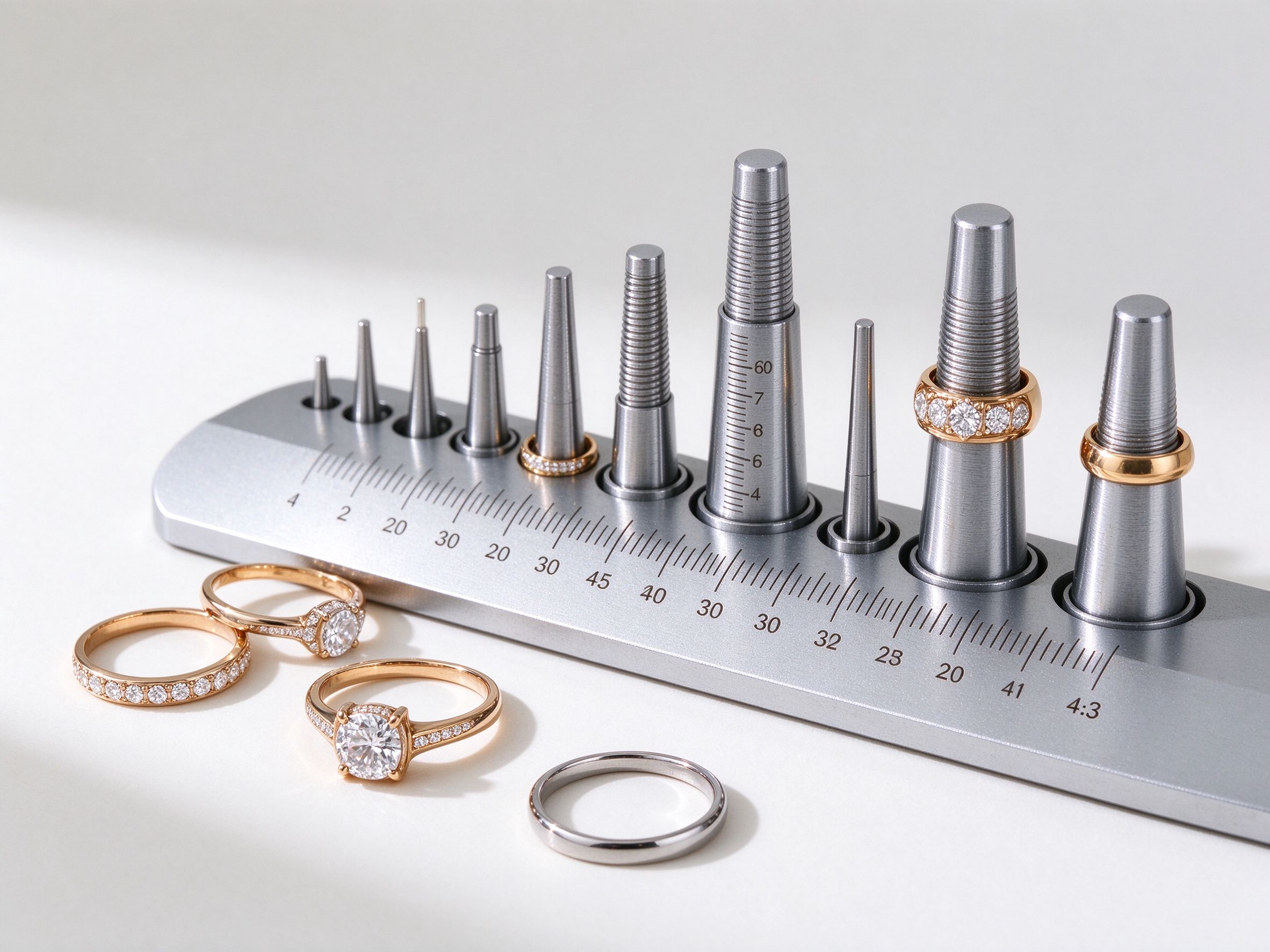
A mandrel is a tapered steel rod, marked in ring sizes, that we slide a real ring onto. The ring settles at the point where it fits the rod, and that point reads the true size. Crucially, the mandrel is used with an actual ring band, not a strip. The band has the same width, thickness, and rigidity as the ring you will eventually wear, so the fit you feel on the mandrel is the fit you will feel on your finger. The mandrel does not lie, because it is measuring the same rigid object that will be on your hand.
We also use ring sizing sticks, which are a set of solid metal rings in half-size increments that you try on directly. These are the gold standard for home measurement, because they are rigid, they have real band width, and you can feel how each one passes the knuckle and rests at the base. A set of plastic or metal sizer rings costs a few dollars and is far more accurate than any paper strip. If you are ordering online, this is the tool we recommend, because it removes the tension and angle errors entirely.
On the factory floor, we verify every finished ring on a calibrated mandrel before it ships. The mandrels themselves are checked against a gauge block periodically, because a worn or bent mandrel would propagate errors into every ring. This is the kind of quality control that home measurement cannot replicate, and it is why a ring that comes off our bench reads true to the size we promised. The number on the order is the number on the mandrel, and the number on the mandrel is the number on your finger.
The Knuckle Problem the Paper Strip Ignores
The biggest single failure of the paper strip is that it measures the base of the finger, not the knuckle. A ring has to slide over the knuckle to get onto the finger, and the knuckle is often the widest part. If you size the ring to the base of the finger, measured by a strip, the band will not pass the knuckle, and you will be stuck with a ring that will not go on. This is the exact problem we cover in our guide on how to size for large knuckles, and it is why a strip that reads a perfect size at the base can produce a ring that will not go on at all.
A real sizer ring, tried on, forces you to feel the knuckle clearance directly. You slide it on, feel it pass the knuckle, and then feel how it rests at the base. If it passes the knuckle but spins at the base, you need a sizing bead, not a larger ring. The paper strip cannot teach you any of this, because it never has to pass a knuckle. It just sits on the soft part and gives you a number that ignores the hardest part of the fit.
For people with average knuckles, the strip error is small enough to live with. For people with prominent knuckles, arthritis, or bony fingers, the strip error is the difference between a ring that fits and one that will not go on. We see these customers come back again and again, because they trusted a strip, ordered a band, and then could not get it over the knuckle. The fix is always the same: try on a real sizer, feel the knuckle, and size to the knuckle with a bead for the base.
Band Width Changes Everything the Strip Misses
A narrow band and a wide band of the same inner diameter fit very differently on the same finger. A wide band presses on more skin, creates more friction, and feels tighter, which is why wide bands are sized a half size looser than narrow bands. The paper strip knows nothing about band width. It gives you one number regardless of whether the ring you are ordering is a 2 millimeter thin band or an 8 millimeter wide band, and that one number is wrong for at least one of those designs.
On the mandrel, we account for width explicitly. A comfort-fit wide band is sized slightly larger than a flat narrow band, even though both are described as the same nominal size. This is why two rings that both read a size 7 can feel different on the finger: one is narrow and flat, the other is wide and rounded, and the mandrel sizing has already compensated. The paper strip has no way to make this compensation, because it never touches a band at all.
When you order a wide band, like a men's wedding band, the paper strip method is at its worst, because the width correction is largest. Men's bands are wide, and they need to be sized up a half or even a full size from a strip reading, just to clear the knuckle and feel comfortable. We tell every wholesale customer ordering men's bands to size up from any home strip measurement, and to confirm with a real sizer. It is the single most common error in men's band orders.
Temperature, Time of Day, and the Strip
A paper strip measures your finger at one moment, but your finger changes size through the day. We explain this fully in our article on why fingers change size from morning to evening. Measure with a strip on a cold morning, and you will get a smaller number than the same finger on a warm afternoon. The strip does not know this; it just gives you a snapshot, and that snapshot may be on the small or large end of your natural range.
The right approach is to measure at mid-morning, after you have been active and your hands are warm, but not after exercise or a hot shower. Measure twice, a few hours apart, and average the readings. A real sizer ring tried on at those two moments is more forgiving, because you can feel the range. A strip, by contrast, demands that you trust a single number taken at a moment when your finger may be unusually small.
Water retention from salt, alcohol, or a long flight also swells fingers, and a strip taken the morning after a salty dinner will read large. People then order a ring to that swollen number, and when the swelling goes down, the ring is loose. The strip amplifies these transient changes into a permanent order, because there is no felt feedback to tell you the finger is temporarily puffy. A sizer ring, tried on again in a few days, would reveal the change.

A calibrated steel mandrel; we slide each finished band on it to confirm the true inner diameter before shipping.
Why the Dominant Hand Breaks the Strip Method
The paper strip also does not account for handedness. Your dominant hand is usually half a size larger than your non-dominant one, as we explain in our guide on dominant hand ring size differences. If you measure the wrong hand with a strip, you get a number for the hand you measured, not the hand you wear the ring on, and the band arrives half a size off. The strip cannot tell you which hand to measure; it just gives you a number for whichever finger you wrapped it around.
This is a particular problem for surprise engagement rings, where a partner sneaks a strip around the wrong finger while the intended wearer sleeps. The strip number is real for that finger, but it is the wrong finger, and the ring will not fit the ring finger. The fix is to measure the exact finger that will wear the ring, on the exact hand, at mid-day, and to cross-check with a real sizer if at all possible. The strip is only as good as the finger you point it at.
What We Tell Wholesale Brands to Do
For the brands we manufacture for, we recommend shipping a free reusable plastic sizer ring with every engagement ring order, or including one in a pre-order sizing kit. The cost is negligible, and it cuts the resize return rate dramatically. A customer who tries on a real sizer orders the right size the first time, and a ring that fits on arrival is a ring that does not come back. The economics of this are obvious: one cheap sizer ring prevents a resize round trip, which costs far more in shipping and labor than the sizer ever did.
We also recommend that brand sizing guides explicitly warn against paper strips. Tell customers, in plain language, that the strip method is approximate and that a real sizer is the reliable way. Brands that do this sound more informed, and their customers come away feeling that the brand understands the product. It is a small piece of education that builds trust and reduces returns. We provide the copy for these guides to our wholesale partners, because we would rather prevent a wrong order than resize it.
How to Measure Well Even Without a Sizer
If you truly cannot get a sizer ring and must use a strip, do it as well as the strip allows. Use a narrow strip of paper or, better, a length of dental floss, which conforms more consistently. Wrap it snugly around the base of the finger, not tight, with no gaps and no slack. Mark the point where the strip overlaps, then measure that length against a ruler in millimeters. Look up the millimeter-to-size conversion chart we provide, and then add half a size to that number, because the strip almost always under-measures relative to a rigid band that must clear a knuckle.
Measure at the right time: mid-morning, hands warm, not after exercise or a salty meal. Measure the exact finger and hand that will wear the ring. Measure twice, a few hours apart, and take the middle of the two readings. If the two readings differ by more than half a size, your finger is fluctuating a lot, and you should wait a few days and measure again before ordering. These steps do not make a strip as accurate as a real sizer, but they remove the worst errors.

A half-size sizer set: rigid metal rings you try on directly, the most accurate home measurement tool available.
The Hidden Error of Measurement Conversion Charts
Even when the strip reading is taken perfectly, the conversion from millimeters to ring size introduces another error. Ring size charts are not perfectly consistent across countries. US sizes, UK sizes, and European sizes are mapped to different inner diameter ranges, and the conversion charts found online often round the millimeter readings to the nearest whole size, which discards the half-size information that matters most. A strip that measures 54.2 millimeters might be charted as a 7, when the true conversion is closer to a 6.5. The chart rounds away the precision you needed, and the band lands wrong.
At the factory, we do not rely on online charts. We have our own calibrated mandrels that are traceable to a gauge block, and every finished ring is checked against that physical standard, not a web page. The number we ship to is the number the mandrel reads, and the mandrel is itself checked every quarter. This is the difference between a measurement and a guess. A strip plus a chart is a guess, because both the strip and the chart are approximations layered on each other. A mandrel is a measurement, because it is the same physical object that will be on your finger.
A mandrel is a measurement, because it is the same physical object that will be on your finger. Treat your home measurement with the same respect: borrow a ring you already own and wear daily, slip it onto a mandrel at a local jeweler for ten seconds, and read the true size. That ten-second reading is worth more than a hundred strips of paper, because it uses a real band on a calibrated rod. Do that once, and you will never have to guess again. The ring that arrives will fit, because you measured with the tool that actually behaves like the ring. That is the difference between a ring you wear for years and one that sits in a drawer after one uncomfortable week. Measure true, and the ring disappears onto your hand, fitting so well you forget it is there, which is exactly how a ring should feel.
Frequently Asked Questions
How far off is a paper strip, typically?
Usually about half a size, and almost always on the small side, because people pull the strip tight. Wide bands and large knuckles widen the error to a full size.
Is a string better than paper?
Slightly, because it conforms, but it stretches under tension, which introduces its own error. A rigid sizer ring is better than both.
Can I trust a ring sizing app?
Phone apps that measure a screen or a credit card are approximate. They are a starting point, not a final measurement, and should be confirmed with a real sizer.
What is the most accurate way to size at home?
A set of half-size metal sizer rings, tried on at mid-day on the exact finger that will wear the ring, accounting for knuckle clearance and band width.
Measure with the Tool That Fits Like the Ring
The paper strip is a quick approximation, and it is fine for a rough guess, but it is not how you order a ring you will wear every day for decades. The strip measures a soft, flexible circumference at one moment, while a ring is a rigid circle that has to clear a knuckle, press against a finger of a given width, and sit comfortably at the base. Those are different problems, and only a real sizer ring or a mandrel measures the right thing. Spend a few dollars on a sizer set, measure the right finger at the right time, and the ring will fit on the first order, every time. That is the whole secret, and it costs almost nothing.
If you are a brand or wholesaler, we can supply sizer rings and mandrels alongside your production orders, so your customers measure right the first time. A well-sized ring ships once, and a ring that ships once never comes back. Contact our team to build a sizing kit into your customer experience. Measure once, on the right finger, with the right tool, and the ring fits forever, beautifully and comfortably on your hand today now soon thank you very much.