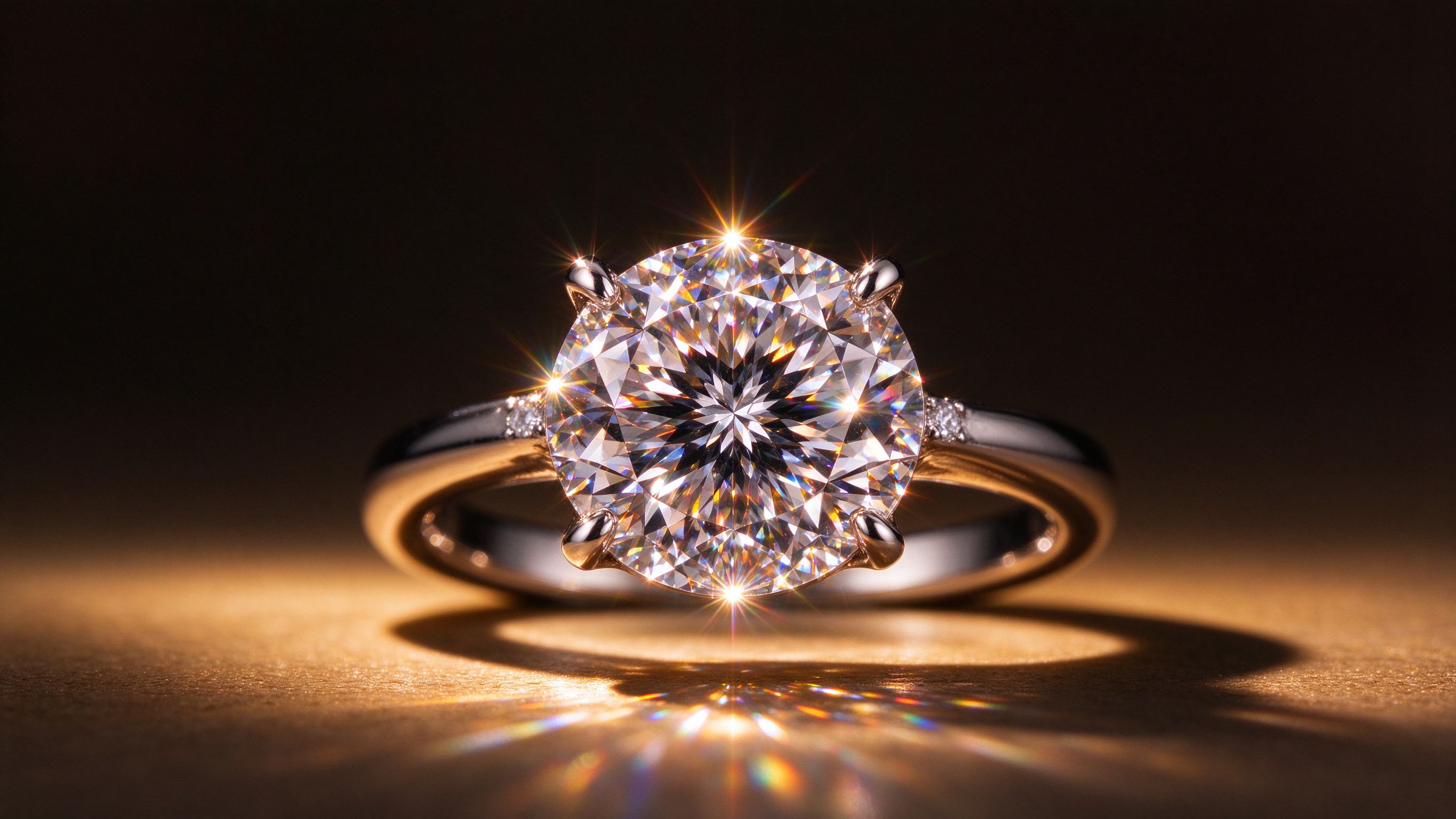
Lab Diamond Color Clarity Grade Margin - HOLYCOME
Not every diamond grade makes the same margin. A D-flawless stone is glamorous but slow-moving and expensive to carry in inventory; a G VS2 stone is less dramatic, faster-selling and often more profitable per carat. Wholesale buyers who stock only the grades they would personally want end up with a warehouse of beautiful stones that do not turn. This guide maps the color and clarity price ladder, shows which grades carry the best margin for the effort, and explains how to build an assortment that balances glamour with turnover.
The color ladder and how prices move
Diamond color is graded from D (colorless) through Z (light yellow or brown). For lab grown near-colorless white goods, the commercially relevant range runs from D down to about J, after which stones enter a yellowish or brownish tint that changes their product category. The price drop across the ladder is not linear. D to F is a small premium band because the color difference between them is nearly impossible to see face-up. G to J is the "near colorless" band where most retail sales happen, and prices step down more sharply as you move toward J. K onwards becomes a tinted category priced differently.
The economic insight is that retail customers cannot reliably tell D from G in a mounted stone, especially in yellow or rose gold settings. A G color stone in a solitaire looks white on the hand, and the customer is paying for a perceived colorlessness that the setting already delivers. This is why G to near-H is the volume band: it delivers the look of colorlessness at a lower wholesale cost, leaving more margin for the retailer. More on how color is graded is in the guide to color and clarity for buyers.
The clarity ladder and how prices move
Clarity is graded from FL (flawless) down to I2/I3 (included). The commercially relevant range for lab grown white goods runs from VVS1 through SI2. VVS stones are eye-clean and command a premium; VS stones are eye-clean at 10x and are the mainstream choice; SI1 stones are usually eye-clean and offer the best value; SI2 stones may have visible inclusions and are priced accordingly. The price drop from VVS to VS is moderate; from VS to SI1 is the steepest step, because SI1 is the first grade where the factory had to cut around visible inclusions.
The retail reality is that most customers cannot see inclusions in a mounted stone without a loupe, and even with a loupe they struggle to tell VVS from VS. The margin opportunity is in the eye-clean grades: VS and SI1 stones that look identical to the customer but cost materially less than VVS. A retailer who sells a G VS2 stone at a price close to what a G VVS1 would command is capturing the grade difference as margin, because the customer perceives the stone the same way.
The margin matrix: which grade combinations pay best
The table below shows a qualitative margin assessment for common color and clarity combinations, based on wholesale price versus retail demand. These are not price quotes; they are relative margin positions for a typical 1.5-carat round.
| Grade combination | Wholesale cost relative | Retail demand | Margin assessment |
|---|---|---|---|
| D FL | Very high | Low volume | Glory margin but slow; order on demand |
| D-VVS1 | High | Low to medium | Good for top-tier marketing |
| E-VVS2 | High | Medium | Solid but carries inventory cost |
| G-VS1 | Medium-high | High | Strong margin, fast mover |
| G-VS2 | Medium | Very high | The classic margin band |
| H-VS2 | Medium-low | Very high | Best value margin for solitaire sales |
| H-SI1 (eye-clean) | Low | High | Excellent margin; verify eye-clean |
| I-SI1 | Low | Medium | Good for yellow-gold settings |
| J-SI2 | Very low | Low | Discount bucket; avoid unless priced right |
The sweet spot for most retailers is G-H, VS2 to SI1. These stones look white and eye-clean to the customer, cost materially less than VVS or D stones, and sell at volumes that turn inventory quickly. The D-flawless stones have their place as marketing centerpieces, but they should be ordered on demand rather than stocked.
Why eye-clean SI1 is the hidden margin winner
Of all the grade combinations, eye-clean SI1 is the most underrated. An SI1 stone has inclusions visible under 10x magnification, but if the inclusions are placed in the pavilion or girdle, they are invisible to the naked eye at normal viewing distance. The customer sees a stone that looks VS-clean, but the wholesale cost is closer to SI1 pricing. The margin gap between a VS2 and an eye-clean SI1 can be 10 to 20 percent per carat, and the customer experience is nearly identical.
The catch is that not every SI1 is eye-clean. Some SI1 stones have inclusions that are visible to the naked eye, and selling those as "eye-clean" creates returns and complaints. Wholesale buyers should either see the stone in person or trust a factory that grades honestly and provides inclusion plots. A factory that sells only eye-clean SI1s as a separate SKU is a partner worth working with; a factory that mixes eye-clean and visible SI1s is a source of warranty problems.
Color tint by setting metal
Color margin also depends on the setting metal. White gold and platinum settings emphasize body color, because the white metal reflects into the stone and makes any yellow tint more noticeable. Yellow and rose gold settings mask body color, because the warm metal reflects into the stone and makes a J or K color look whiter than it is. A retailer selling yellow-gold settings can safely stock I or J color stones at lower cost, capturing margin that a white-metal retailer cannot.
This is a practical assortment decision. If your program is mostly white-gold or platinum solitaire settings, stock G-H colors. If your program includes yellow or rose gold, you can move into I-J colors without losing perceived whiteness, and the wholesale cost drops accordingly. The combination of metal and color is a margin lever that most buyers overlook because they think about color in isolation.
Cut grade as a margin lever
Cut grade interacts with color and clarity margin. A stone cut to "very good" or "excellent" proportions returns more light and looks whiter and cleaner than a "good" cut stone of the same color and clarity. Customers pay more for excellent cut because the stone sparkles, and the perceived value supports a higher retail price. A factory that cuts for weight rather than proportion may deliver a larger-looking stone, but it will face up duller and sell for less.
For margin, the rule is to prioritize cut grade over the top two color or clarity grades. A G VS2 excellent-cut stone usually outsells an E VVS1 good-cut stone, because the customer responds to sparkle first. When you are choosing between paying up for a higher color grade or paying for a better cut, the better cut almost always wins on retail shelf. More on this trade-off is in the guide to polishing tolerance and cut precision.
Where D-flawless stones fit
D-flawless stones are not useless; they have a specific role. They are marketing centerpieces for high-end programs, and they sell to customers who specifically want the top grade regardless of whether they can see the difference. The mistake is stocking them in depth. A D-flawless stone may sit in inventory for six months before it sells, and during that time wholesale prices drift down, so the stone may lose value while you wait. The right move is to order D-flawless stones on demand, or keep one or two as display pieces.
For a smaller retailer, D-flawless inventory is usually a trap. The capital tied up in one D-flawless solitaire could buy five G-VS2 stones that turn in a month. The margin on the five G-VS2 stones, turned over repeatedly, dwarfs the one-time margin on the D-flawless stone. Buyers who understand this build their assortment around the volume band and use top grades only for customer requests.
Fancy colors and their margin profile
Fancy colored lab grown diamonds -- yellows, greens, pinks, blues -- have a very different margin profile than white goods. Production of consistent fancy colors is smaller, and treated fancy colors command premiums that white goods do not. A vivid yellow lab grown stone can sell for 30 to 60 percent more per carat than a near-colorless white stone of the same size, because the supply is thinner and the customer base is more specialized. The trade-off is that demand is also thinner: fancy colors sell in smaller volumes, so inventory risk is higher.
For most retailers, fancy colors are a niche add-on rather than a core category. A small selection of vivid yellows in popular sizes attracts customers looking for something different, and the margin on those stones is strong. But stocking deep across multiple fancy colors ties up capital that would turn faster in white goods. The practical move is to keep a few fancy yellow stones in stock and order other colors on demand. The treatment disclosure on fancy colors is also important; irradiated stones should be clearly labeled, because some customers will only buy untreated fancy colors.
Size and grade interaction
Margin also depends on how grade interacts with size. In melee under 0.5 carats, color and grade differences are barely perceptible, and buyers stock by lot rather than by individual grade. In the 1 to 2 carat range, grade differences become visible and customers start paying for them. Above 3 carats, even small grade differences carry large price premiums, because the customer is spending more money and expects more precision. This means the margin strategy is different at each size band.
For melee, buy in lots at the best per-carat price and do not over-invest in individual grading. For 1 to 2 carat centers, focus on the G-H VS2-SI1 band where the customer perceives quality. For 3 carat-plus stones, be more careful about grade, because the customer will compare certificates and the price gap between grades is large. A factory that can supply all three size bands with consistent grade quality is worth building a program with.
There is also a matching consideration when selling pairs. A pair of studs needs two stones that match in color and clarity, and the factory has to set aside stones that match. This matching process itself costs margin, because some stones never match and end up sold at a discount. The margin on matched pairs is therefore slightly higher than on single stones, which is why buyers should ask for pair pricing rather than doubling single-stone prices.
Grade inflation and buyer vigilance
As the lab grown market has grown, some smaller labs have been accused of grade inflation: grading a stone more generously than IGI or GIA would, so the stone looks better on paper than it looks in person. A stone graded "G VS1" by an unknown lab might actually be an H VS2 in IGI terms. This is not usually fraud, but it means the stone is worth less than the certificate suggests, and a downstream appraiser will eventually grade it honestly.
For buyers, the defense is to stick with recognized labs and to spot-check stones against your own experience. If a supplier consistently delivers stones that grade lower when you send them to IGI, they are either using an inflating lab or misrepresenting the grade. A supplier whose stones consistently grade at or above IGI expectations is a supplier whose grade margin you can trust. The cost of an occasional IGI re-check on a new supplier is trivial compared with the cost of carrying misgraded inventory for a year.
Stocking for different customer segments
Not all customers want the same grade. A customer buying an engagement ring for the first time, on a budget, will usually prioritize size over grade, and an H-SI1 eye-clean stone that looks white and clean on the hand is the right sell. A customer upgrading from a previous ring may want higher color and clarity, and will pay for E-VVS. A customer buying a gift may be influenced by marketing and want the best grade they can afford. A good retailer stocks a range so each customer gets what they actually want, rather than forcing everyone into one grade band.
The margin insight is that the budget customer is where volume margin lives, while the upgrade customer is where high-ticket margin lives. A program that only stocks top grades misses the volume; a program that only stocks budget grades misses the high-ticket sales. The best assortment is weighted toward the volume band with a smaller selection of top grades for the upgrade customer.
The psychology of grade shopping
Customers shop grades the way they shop wine: they want to feel they got a good bottle, but most cannot tell the difference blind. A customer who has not seen a D-flawless stone next to a G-VS2 stone in person will often assume the G-VS2 is colorless, because it looks white on their hand. This is not a trick; it is the reality of how color perception works in mounted jewelry. Retailers who understand this can sell the G-VS2 at a price that feels premium to the customer, while still capturing a larger wholesale margin than if they had bought the D-flawless.
The ethical boundary is that the certificate must state the true grade. You are not deceiving the customer by showing them a G stone in a setting where it looks white; you are explaining that G is near-colorless, which is what it is. What you must not do is call a G stone an F, or an SI1 a VS2. The certificate exists for that reason, and honest retailers use it as a selling tool rather than hiding it.
Testing eye-clean SI1 stones
When you buy eye-clean SI1 stones, you need a reliable way to confirm eye-clean status. The standard test is to view the stone face-up from 15 inches away under normal lighting, without magnification. If you cannot see an inclusion, the stone is eye-clean for retail purposes. Some buyers also look at the stone from the pavilion side, because inclusions hidden under the crown can be visible through the pavilion. A factory that provides inclusion plots on SI1 stones makes this step easy, because you can see where the inclusions are before you mount the stone.
If you are buying in volume, ask the factory to separate eye-clean SI1s from visible SI1s before shipment. A good factory will do this as a matter of course, because it protects both parties. If the factory mixes them, you will end up sorting the stones yourself, which costs time and creates warranty risk. The eye-clean premium is real, and it is worth paying for stones that have been pre-sorted.
Regional differences in grade preference
Grade preference varies by market. In the US, customers have been trained to think of D-F as "colorless" and will often pay the premium for it, even in a mounted stone. In European markets, customers are more comfortable with G-H and see no reason to pay for D-F. In East Asian markets, there is often a preference for higher clarity grades, VVS being more popular than in Western markets. A wholesale buyer who sells across regions should stock grade bands that match the end market, rather than applying one global default.
For private label brands selling online, the grade preference is shaped by how you market. If your brand positions itself as premium, customers will expect D-F and VVS, and you should stock accordingly. If your brand positions itself as value, G-H VS2-SI1 is the right band, and you can price aggressively. The grade you stock is a brand decision, not just a cost decision.
How HOLYCOME builds grade margin programs
We stock the G-H VS2-SI1 band in depth because it is where retail demand and wholesale cost meet. We also separate eye-clean SI1 stones from visible SI1s as distinct SKUs, so buyers know exactly what they are getting. For top-tier programs, we can source D-flawless or VVS stones on demand within a short lead time, and we provide inclusion plots for every SI1 stone so buyers can confirm eye-clean status before mounting. Our Shenzhen facility also sorts stones by face-up appearance, not just by certificate grade, because two stones with the same certificate can face up differently depending on cut and tint.
This face-up sorting is a step many factories skip, but it matters when you are selling to customers who compare stones in person. A stone that grades H on paper but faces up like a G is a bonus for the customer; a stone that grades G but faces up like an H is a disappointment. We flag both, so buyers can price accordingly rather than discovering the gap after the customer has mounted the stone.
If you are reviewing your current assortment, the useful exercise is to pull your sales history for the last 12 months and see which grade combinations actually sold. You will usually find that 80 percent of revenue came from 20 percent of the grade combinations, and that the combination you thought was glamorous was not in that top 20. Our team at service@holycome.com can help you map your sales mix against wholesale pricing to find where margin is hiding. More context on how prices move across the year is in the 2026 cost per carat guide, and the broader wholesale price context is in the wholesale pricing guide.
The bottom line
Color and clarity margin is not about buying the highest grades; it is about buying the grades the customer perceives as equal to higher grades. G-H VS2-SI1 is the volume band where most margin lives, eye-clean SI1 is the hidden winner, and D-flawless stones belong on order rather than in inventory. Cut grade matters more than the top two color or clarity steps, and setting metal lets you safely move into lower color bands without losing perceived whiteness. Build the assortment around what actually turns, and the margin follows.
The practical next step is to pull your last 12 months of sales data and plot which grade combinations produced the most revenue. In most assortments, the top 20 percent of grade combinations will account for 80 percent of revenue, and those are the combinations to stock in depth. The remaining 80 percent of combinations should be ordered on demand. This simple exercise usually reveals that the glamorous top grades were not in the top 20 percent, and that the volume band was quietly doing the work. If you want to benchmark your current grade mix against Shenzhen wholesale pricing, reach out to service@holycome.com with your sales history; we can show you where the margin is hiding.